Maharashtra State Board Class 7 English Solutions Chapter 2.4 How Doth the Little Busy Bee
Class 7 English Chapter 2.4 How Doth the Little Busy Bee Textbook Questions and Answers
1. Write the meaning of:
doth, opening (in the context of the poem), cell.
2. A parody is playful, comic imitation of a writer’s style. A parody is like a verbal cartoon. Compare the original poem and its parody given on page 35 using the following points:
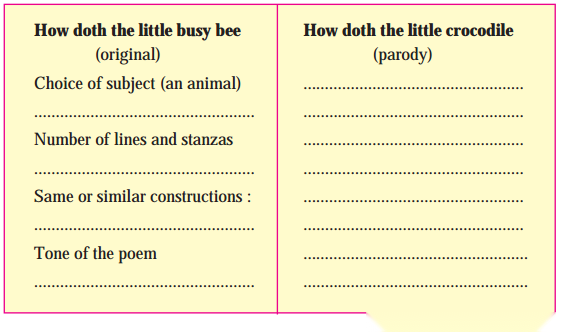
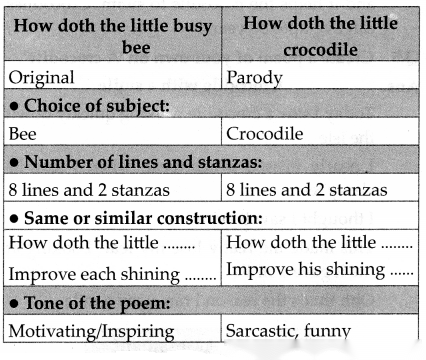
3. Answer the following questions and write in short, why the parody sounds funny.
Question a.
What does the bee stand for?
Answer:
The bee stands for hard-work and positivity
Question b.
What does the crocodile stand for?
Answer:
The crocodile stands for laziness, mischief and negativity.
Question c.
Why does the bee work hour after hour?
Answer:
The bee works hour after hour to store the nectar that it collects from the flowers.
Question d.
Why does the crocodile work?
Answer:
The crocodile works only to fill its stomach.
Question e.
Is the bee a gentle creature? Is the crocodile gentle?
Answer:
The bee is a gentle creature. The crocodile is not gentle.
4. Desciibe a crocodile in your own words. Which of the words and phrases in the poem will you use In a realistic description?
Put a tick mark against the ones you will use.
5. Note that most of the times well-known works are parodied, because people can enjoy the parody better when they know the original. Try to find more examples of parodies in English or other languages.
6. What do you like better – the original poem or the parody? Why?
Question 1
Maharashtra Board Solution
What do you like better – the original poem or the parody? Why?
Solution & Step-by-Step Answer:
block bg-white dark:bg-slate-900/80 border-l-4 border-emerald-500 rounded-r-xl p-5 my-3 shadow-xs border border-slate-200/60 dark:border-slate-800">
Solution & Step-by-Step Answer:
I like the parody. I like the parody because it is funny, interesting and the best part is that it is very easy to memorize.
Class 7 English Chapter 2.4 How Doth the Little Busy Bee Additional Important Questions and Answers Answer the following questions.
Question 1
Maharashtra Board Solution
Why does the parody sound funny?
Solution & Step-by-Step Answer:
The parody sounds funny because it is just in complete contrast with ‘How doth the little busy bee’. The bee is hard working and positive. She is using every minute fruitfully while in contrast the crocodile is wasting its time doing nothing still manages to keep its stomach full.
Question 2
Maharashtra Board Solution
Match the nouns with the adjectives used to describe them: |
Column ’A’ | Column B’ |
1. bee | a. shining |
2. food | b. smiling |
3. tail | c. busy |
4. jaws | d. sweet |
5. scale | e. little |
6. crocodile | f. golden |
Column ’A’ | Column B’ |
1. bee | c. busy |
2. food | d. sweet |
3. tail | a. shining |
4. jaws | b. smiling |
5. scale | f. golden |
6. crocodile | f. golden Read the following extract and do the activities. Answer the questions in one word. Question i. Question ii. Complex Factual Questions:
Question 1
Maharashtra Board Solution
How does the bee build her cell?
Solution & Step-by-Step Answer:
The bee builds her cell skilfully.
Question 2
Maharashtra Board Solution
What food does the bee make?
Solution & Step-by-Step Answer:
The bee makes sweet food.
Poetic Device:
Question 1
Maharashtra Board Solution
Make a list of the rhyming words
Solution & Step-by-Step Answer:
hour – flower; cell – well
Question 2
Maharashtra Board Solution
What is the rhyme scheme of the first stanza?
Solution & Step-by-Step Answer:
The rhyme scheme of the first stanza is abcb
Question 3
Maharashtra Board Solution
What is the rhyme scheme of the second stanza?
Solution & Step-by-Step Answer:
The rhyme scheme of the second stanza is abac
Read the following extract and do the activities. Simple Factual Questions:
Question 1
Maharashtra Board Solution
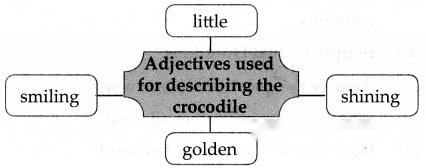
Complete the web.
Solution & Step-by-Step Answer:
Complex Factual Questions:
Question 1
Maharashtra Board Solution
Which river is mentioned in the above poem?
Solution & Step-by-Step Answer:
River Nile is mentioned in the above poem.
Question 2
Maharashtra Board Solution
Whom does the crocodile welcome?
Solution & Step-by-Step Answer:
The crocodile welcomes little fishes.
Question 3
Maharashtra Board Solution
How does the extract portray the crocodile?
Solution & Step-by-Step Answer:
The extract portrays the crocodile as a deceiving, idle reptile.
Question 4
Maharashtra Board Solution
Write the rhyme scheme for the 2nd stanza.
Solution & Step-by-Step Answer:
The rhyme scheme is abab.
Question 5
Maharashtra Board Solution
And welcomes little fishes in, With gently smiling jaws! Identify the figure of speech of the above lines and explain.
Solution & Step-by-Step Answer:
Poetic Device:
Question 1
Maharashtra Board Solution
Pick out the rhyming words from the 1st stanza.
Solution & Step-by-Step Answer:
Crocodile – Nile, tail – scale
Writing Skills:
Question 1
Maharashtra Board Solution
Create a poem of your own on ‘A crocodile’.
Solution & Step-by-Step Answer:
Crocodile with a smile Today I saw a crocodile walking quickly down the isle I nearly missed a heartbeat, when I saw its clawy feet. I thought I saw it cry a tear, This made me really lose my fear. Looking at me it gave a smile Ohh that’s the reason I ran away a mile.
How Doth the Little Busy Bee Summary in English In this poem, the poet Isaac Watts tells us about the busy bee who does not waste time but works day in and day out to collect nectar from the flowers and stores it in the hives built by the bees. The poet appreciates the skills of the bees, used in making the cells and sealing them for future use. The poet is trying to tell us that we should take the example of these small creatures and use our time fruitfully. Isaac Watts The parody “How doth the – a small little crocodile” written be Lewis Caroll tries to poke fun at the poem “How doth the little busy bee”. The parody in a humorous way speaks about the idleness and cunningness of a crocodile in contrast to the hardworking bee. The busy bee works all day for its honey but in contrast the crocodile remains idle yet gets his fill. Introduction: ‘How doth the little busy bee’ written by Isaac Watts is a poem in which the hard work of the bee is appreciated. A parody is playful comic imitation of a writer’s style. A parody deliberately copies someone or something in an amusing way. It may be simply a humorous imitation of a well-known or popular work. Glossary: |