Latest Maharashtra State Board (SSC & HSC) 2026-27 Syllabus Digest & Solutions Updated!
Class 7Geography2026-27 Syllabus

Chapter 2 The Sun, the Moon and the Earth Solutions

Complete Maharashtra State Board Balbharati & Yuvakbharati textbook solutions for Chapter 2 The Sun, the Moon and the Earth. Step-by-step solved exercises, numerical problems, and digest answers.

79 Solved Questions10 Diagrams3411 words

Maharashtra State Board Class 7 Geography Solutions Chapter 2 The Sun, the Moon and the Earth

Class 7 Geography Chapter 2 The Sun, the Moon and the Earth Textbook Questions and Answers

1. Correct the wrong statements. Write down the corrected ones.

Question 1 Maharashtra Board Solution
The moon revolves around the sun.
Solution & Step-by-Step Answer:
Wrong – The moon revolves around the earth.
Question 2 Maharashtra Board Solution
On a full moon day, the moon, the sun and the earth are positioned in this sequence.
Solution & Step-by-Step Answer:
Wrong – On a full moon day, the sun, the earth and the moon are positioned in this sequence.
Question 3 Maharashtra Board Solution
The revolutionary orbits of the earth and the moon are in the same plane.
Solution & Step-by-Step Answer:
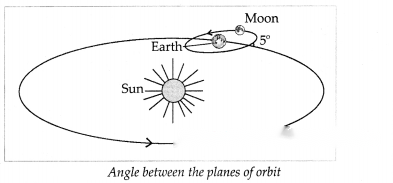
Wrong – The revolutionary orbits of the earth and the moon are not in the same plane. The moon’s revolutionary orbit makes an angle of about 5° with that the earth.
Question 4 Maharashtra Board Solution
In one revolution of the moon, its orbit intersects the earth’s orbit only once.
Solution & Step-by-Step Answer:
Wrong – In one revolution of the moon, its orbit intersects the earth’s orbit twice.
Question 5 Maharashtra Board Solution
It is alright to observe a solar eclipse without protecting the eyes.
Solution & Step-by-Step Answer:
Wrong – It is necessary to view the sun disc through dark glasses or through special goggles made for that purpose, otherwise the intense light of the sun can be harmful to the naked eye.
Question 6 Maharashtra Board Solution
An annular solar eclipse occurs when the moon is in the perigee position.
Solution & Step-by-Step Answer:
Wrong – An annular solar eclipse occurs when the moon is in the apogee position.

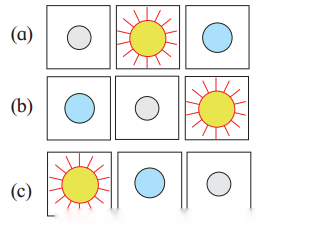
2. Select the correct option.

Question 1 Maharashtra Board Solution
Solar eclipse
Solution & Step-by-Step Answer:
(b)

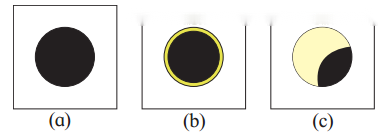
Question 2 Maharashtra Board Solution
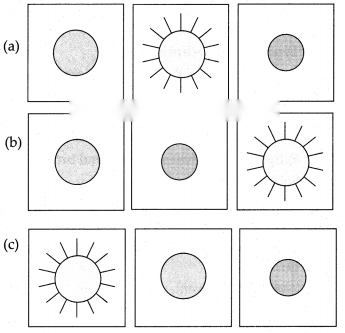
The shape of sun disc at the time of annular solar eclipse.
Solution & Step-by-Step Answer:
(a)

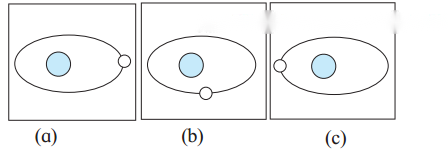
Question 3 Maharashtra Board Solution
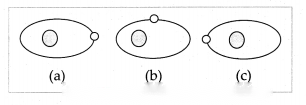
Apogee position of the moon.
Solution & Step-by-Step Answer:
(c)

3. Complete the following table.

Details

Lunar Eclipse

Solar Eclipse

Phase of the moon

…………

…………….

Sequence

Moon-Earth- Sun

………….

Type of Eclipse

………….

…………..

Maximum duration of total eclipse

107 minutes

…………….

Answer:

Details

Lunar Eclipse

Solar Eclipse

Phase of the moon

Full Moon Day

New Moon Day

Sequence

Moon-Earth-Sun

Moon-Earth-Sun

Type of Eclipse

Total and Partial

Total, Partial, Annular

Maximum duration of total eclipse

107 minutes

440 Seconds

4. Draw and label the diagrams.

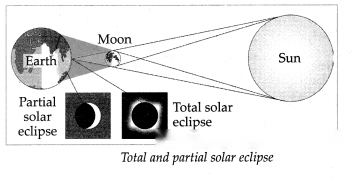
Question 1 Maharashtra Board Solution
Total and partial solar eclipse:
Solution & Step-by-Step Answer:

Question 2 Maharashtra Board Solution
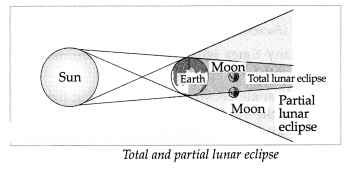
Total and partial lunar eclipse:
Solution & Step-by-Step Answer:

5. Answer the following:

Question 1 Maharashtra Board Solution
Why do the sun, the moon and the earth not lie in one and the same line on every full moon and new moon day?
Solution & Step-by-Step Answer:
(i) The orbital path of the earth and that of moon are not in the same plane. (i) The moon’s revolutionary orbit makes an angle of about 5° with that of the earth. (iii) On each new moon day, the lines joining the earth and the sun and the moon make an angle of 0° whereas on each full moon day, this angle is 180°. (iv) So, the sun, the earth and the moon may not be in one straight line in the same plane on every new moon or full moon day.
Question 2 Maharashtra Board Solution
When a total solar eclipse occurs why is the partial eclipse also seen from the earth?
Solution & Step-by-Step Answer:
(i) On a new moon day if the sun, the moon & the earth fall in one line & are in the same plane, the shadow of the moon falls on the earth (ii) This shadow is of two types – the central portion of the shadow is darker & the periphery is light. (iii) In the area where the dark shadow falls, the sun becomes completely invisible. Such an area experiences a total solar eclipse. (iv) However during the same period, at the places where the shadow is lighter, the sun disc appears partially covered. Such an area experience partial solar eclipse. Thus when a total solar eclipse occurs a partial eclipse is also seen from the earth.
Question 3 Maharashtra Board Solution
Suggest measures that can be taken to eradicate the superstitions related to the eclipses.
Solution & Step-by-Step Answer:
The following measures can be taken to eradicate superstition related to eclipses:
Question 4 Maharashtra Board Solution
What precautions should we take while observing a solar eclipse?
Solution & Step-by-Step Answer:
The precautions to be taken while observing a solar eclipse are:
Question 5 Maharashtra Board Solution
What types of Solar eclipses will occur in perigee conditions?
Solution & Step-by-Step Answer:
Total and Partial solar eclipse will occur in perigee condition. (1) Total solar eclipse :

(2) Partial solar eclipse:

Activities:

Class 7 Geography Chapter 2 The Sun, the Moon and the Earth InText Questions and Answers

Use your brain power:

Question 1 Maharashtra Board Solution
On the day of solar eclipse, in which part of the earth will it not be seen?
Solution & Step-by-Step Answer:
Solar eclipse will not be seen where there is night.
Question 2 Maharashtra Board Solution
Can we see total and annular solar eclipses on the same occasion?
Solution & Step-by-Step Answer:
No, total and annular solar eclipses cannot be seen on the same occasion.
Question 3 Maharashtra Board Solution
Why is an annular lunar eclipse not seen?
Solution & Step-by-Step Answer:
An annular lunar eclipse cannot be seen because:
Question 4 Maharashtra Board Solution
Which eclipses will you see from the moon?
Solution & Step-by-Step Answer:
Solar eclipses can be seen from the moon.
Question 5 Maharashtra Board Solution
Why are solar eclipses caused by the other planets not seen from the earth?
Solution & Step-by-Step Answer:
(i) A Solar eclipse occurs when the moon comes in between the sun & the earth & all of them are in the same plane & fall in one line on a new moon day. (ii) Similarly, when Venus & Mercury come in between the earth & the sun, they make a small speck against the surface of the sun as they are too far away. (iii) The other planets have orbits outside the earth’s & cannot fall in line between the earth & the sun. (iv) Hence, the solar eclipse caused by other planets are not seen from the earth.

Think about it:

Question 1 Maharashtra Board Solution
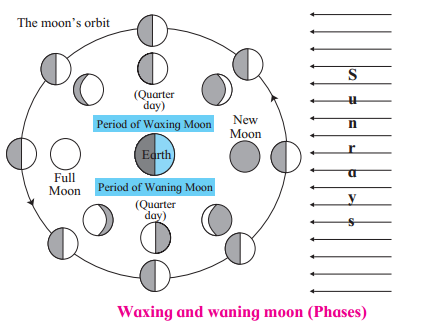
Figure shows positions of the moon as seen from the space and as seen from the earth. How will you identify which are which?
Solution & Step-by-Step Answer:
Half of the moon’s portion is illuminated by the sun, and the other half remains dark. However, only some part of this illuminated portion of the moon can be seen from the earth. The position of the moon from the Earth is as follows:

Question 2 Maharashtra Board Solution
Like sunlight and moonlight, is there anything called the earth light? If yes, where do you think it is found?
Solution & Step-by-Step Answer:
Yes, Earthlight is the partial illumination of the dark portion of the moon’s surface by light reflected from the earth’s airglow.
Question 3 Maharashtra Board Solution
When solar eclipses do not occur on a new moon day, does it mean that the moon does not have any shadow at all?
Solution & Step-by-Step Answer:
The moon casts a shadow on every new moon day, but solar eclipse occurs only when the moon’s shadow falls on the earth.

Class 7 Geography Chapter 2 The Sun, the Moon and the Earth Additional Important Questions and Answers

Fill in the blanks choosing the correct options from the brackets:

Question 1 Maharashtra Board Solution
The shape of the moon’s orbit is _________. (round, elliptical, square)
Solution & Step-by-Step Answer:
elliptical
Question 2 Maharashtra Board Solution
The moon has _____ and ______ motions. (axial, orbital, elliptical)
Solution & Step-by-Step Answer:
axial, orbital
Question 3 Maharashtra Board Solution
When the moon is closest to the earth it is said to be in ________. (apogee, perigee, orbit)
Solution & Step-by-Step Answer:
perigee
Question 4 Maharashtra Board Solution
When the moon is farthest to the earth it is said to be in ______. (apogee, perigee, arial) (round, elliptical, square)
Solution & Step-by-Step Answer:
apogee
Question 5 Maharashtra Board Solution
Solar Eclipse occurs on the _______ day. (full moon, new moon, quarter moon)
Solution & Step-by-Step Answer:
new moon
Question 6 Maharashtra Board Solution
Lunar Eclipse occurs on the ______ day. (full moon, new moon, quarter)
Solution & Step-by-Step Answer:
full moon
Question 7 Maharashtra Board Solution
_______ solar eclipse is a rare phenomenon. (Total, Partial, Annular)
Solution & Step-by-Step Answer:
Annular
Question 8 Maharashtra Board Solution
When the shadow of the moon on the central portion of the earth is darker while the periphery is lighter it is known as a _______ solar eclipse. (partial, total, lunar)
Solution & Step-by-Step Answer:
total
Question 9 Maharashtra Board Solution
When the shadow of the moon on the central portion of the earth is lighter and the sun disc appears to be partially covered, it is known _________ solar eclipse. (total, partial, solar)
Solution & Step-by-Step Answer:
partial
Question 10 Maharashtra Board Solution
The moon is ________ when the earth, the moon and the sun make an angle of 90°. (full, semicircular, crescent)
Solution & Step-by-Step Answer:
semicircular
Question 11 Maharashtra Board Solution
Occultation occurs with reference to the _____. (sun, moon, earth)
Solution & Step-by-Step Answer:
moon
Question 12 Maharashtra Board Solution
Transit is associated with the _______.(sun, moon, earth)
Solution & Step-by-Step Answer:
sun
Question 13 Maharashtra Board Solution
During the period of _______ eclipse, a large number of birds and animals get confused. (solar, lunar, annular)
Solution & Step-by-Step Answer:
solar

Correct the wrong statements. Write down the correct ones:

Question 1 Maharashtra Board Solution
When the moon is closest to the earth it is said to be in apogee and when it is the farthest, the position is called perigee.
Solution & Step-by-Step Answer:
Wrong – When the moon is closest to the earth it is said to be in perigee and when it is the farthest, the position is called apogee.
Question 2 Maharashtra Board Solution
The moon wanes from the new moon day to the full moon day and waxes from the full moon to the new moon day.
Solution & Step-by-Step Answer:
Wrong – The moon waxes from the new moon day to the full moon day and wanes from the full moon to the new moon day.

Select the correct options:

Question 1 Maharashtra Board Solution
Solution & Step-by-Step Answer:
(c)

Question 2 Maharashtra Board Solution
Solution & Step-by-Step Answer:
(c)

Complete the following table:

Question 1 Maharashtra Board Solution

Details

Numerical facts

1. Perigee distance

……….

2. Apogee distance

……….

3. Angular distance between the moon’s and the earth’s orbit

………..

4. Maximum duration of a total solar eclipse

……….

5. Maximum duration of a total lunar eclipse

…………

6. Number of solar eclipse (types)

………….

7. Number of lunar eclipse (types)

……………

Solution & Step-by-Step Answer:

Details

Numerical facts

1. Perigee distance

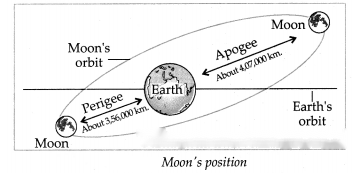
3,56,000 km

2. Apogee distance

4,07,000 km

3. Angular distance between the moon’s and the earth’s orbit

4. Maximum duration of a total solar eclipse

7 minutes 20 seconds

5. Maximum duration of a total lunar eclipse

107 minutes

6. Number of solar eclipse (types)

3

7. Number of lunar eclipse (types)

2

Name the following:
Question 1.
Motions of the moon.
Answer:
Axial and orbital motion.

Question 2 Maharashtra Board Solution
Types of solar eclipse.
Solution & Step-by-Step Answer:
Total solar eclipse, Partial solar eclipse, Annular solar eclipse.
Question 3 Maharashtra Board Solution
Types of lunar eclipse.
Solution & Step-by-Step Answer:
Total lunar eclipse and Partial lunar eclipse.
Question 4 Maharashtra Board Solution
Eclipse that confuses animals and birds.
Solution & Step-by-Step Answer:
Solar eclipse.
Question 5 Maharashtra Board Solution
An example of occultation.
Solution & Step-by-Step Answer:
Total solar eclipse.
Question 6 Maharashtra Board Solution
The event of the occurrence of solar eclipse or lunar eclipse.
Solution & Step-by-Step Answer:
Astronomical event.

Define the following:

Question 1 Maharashtra Board Solution
Perigee:
Solution & Step-by-Step Answer:
When the moon is the closest to the earth in its orbit, it is perigee.
Question 2 Maharashtra Board Solution
Apogee:
Solution & Step-by-Step Answer:
When the moon is at the farthest from the earth in its orbit, it is apogee.
Question 3 Maharashtra Board Solution
Occultation:
Solution & Step-by-Step Answer:
The moon revolves around the earth. While doing so, it obscures1 a star or a planet and that celestial2 body appears to hide behind the moon. This is called occultation.
Question 4 Maharashtra Board Solution
Transit:
Solution & Step-by-Step Answer:
If an inner planet like Mercury or Venus comes in between the line of the earth and the sun, a transit occurs. At that time a small dot appears to move across the sun’s disc.
Question 5 Maharashtra Board Solution
Phases of the moon:
Solution & Step-by-Step Answer:
The illuminated portion of the moon disc observed from the earth that keeps on changing every day within a lunar month are called the phases of the moon.
Question 6 Maharashtra Board Solution
Solar Eclipse:
Solution & Step-by-Step Answer:
If the moon comes between the earth and the sun in a straight line on new moon day, the shadow of the moon falls on the earth and the sun becomes totally or partially invisible in the shadow zone. This phenomenon is called the solar eclipse.
Question 7 Maharashtra Board Solution
Lunar Eclipse:
Solution & Step-by-Step Answer:
On a full moon day, the. moon’s path of revolution passes through the thick shadow of the earth and the moon becomes totally or partially invisible. This phenomenon is called lunar eclipse.
Question 8 Maharashtra Board Solution
Annular Solar eclipse
Solution & Step-by-Step Answer:
Sometimes when the moon is in apogee position, a deep shadow of the moon is cast in space & does not reach the earth. From a very small region of the earth, only an illuminated edge of the sun disc is seen in the form of a ring. This is called annular solar eclipse.

Answer in one sentence:

Question 1 Maharashtra Board Solution
What is the period of waxing moon?
Solution & Step-by-Step Answer:
The period of waxing moon is the fortnight from new moon to full moon in which the illuminated part of the moon from the earth keeps on increasing (waxing)
Question 2 Maharashtra Board Solution
What is the period of waning moon?
Solution & Step-by-Step Answer:
The period of waning moon is the fortnight from full moon to new moon in which the illuminated part of the moon seen from the earth keeps on decreasing (waning)
Question 3 Maharashtra Board Solution
Why can we see the phases of the moon from the earth?
Solution & Step-by-Step Answer:
We can see the phases of the moon from the earth due to the sunlight reflected from the moon.
Question 4 Maharashtra Board Solution
When does the moon appear semi-circular in shape in the sky?
Solution & Step-by-Step Answer:
On the first and the third quarter days, the moon, the earth & the sun make an angle of 90° due to which we see half the portion of the illuminated moon in a semi-circular shape in the sky.
Question 5 Maharashtra Board Solution
What types of solar eclipses occur in perigee position?
Solution & Step-by-Step Answer:
Total & Partial Solar eclipses occur in perigee position.
Question 6 Maharashtra Board Solution
When does a lunar eclipse occur?
Solution & Step-by-Step Answer:
A lunar eclipse occurs when the moon enters the shadow of the earth while revolving around it.

Give geographical reasons for the following statements:

Question 1 Maharashtra Board Solution
We constantly see only one and the same side of the moon.
Solution & Step-by-Step Answer:
Question 2 Maharashtra Board Solution
The distance between the moon and the earth keeps on changing.
Solution & Step-by-Step Answer:
Question 3 Maharashtra Board Solution
Eclipses do not occur on each new moon or full moon day.
Solution & Step-by-Step Answer:
Question 4 Maharashtra Board Solution
The Annular solar eclipse is rarely seen.
Solution & Step-by-Step Answer:
The Annular solar eclipse is rarely seen because
Question 5 Maharashtra Board Solution
Birds and animals are confused during the solar eclipse.
Solution & Step-by-Step Answer:
Birds and animals are confused during the solar eclipse because –
Question 6 Maharashtra Board Solution
On the first and third quarter days, the moon appears semicircular in shape.
Solution & Step-by-Step Answer:

Answer the following:

Question 1 Maharashtra Board Solution
What precautions should we take while observing a solar eclipse?
Solution & Step-by-Step Answer:
The precautions to be taken while observing a solar eclipse are:
Question 2 Maharashtra Board Solution
What types of Solar eclipses will occur in perigee condition?
Solution & Step-by-Step Answer:
Total and Partial solar eclipse will occur in perigee condition. (i) Total solar eclipse :

(ii) Partial solar eclipse:

Question 3 Maharashtra Board Solution
How are lunar eclipses formed?
Solution & Step-by-Step Answer:
(i) A lunar eclipse occurs when the moon enters the shadow of the earth while revolving around it. (ii) On a full moon day if the sun, the earth & the moon, are in a straight line, the orbital path of the moon passes through the dark shadow of the earth. (iii) If the moon is totally hidden within the shadow, a total lunar eclipse is seen & if only a part of the moon is in the shadow, a partial lunar eclipse is seen.

Write short notes on:

Question 1 Maharashtra Board Solution
Characteristics of solar eclipse.
Solution & Step-by-Step Answer:
Question 2 Maharashtra Board Solution
Characteristics of lunar eclipse.
Solution & Step-by-Step Answer:
Question 3 Maharashtra Board Solution
Occupation.
Solution & Step-by-Step Answer:
Question 4 Maharashtra Board Solution
What is a Transit?
Solution & Step-by-Step Answer:

Distinguish between the following:

Question 1 Maharashtra Board Solution
Solar eclipse and Lunar eclipse :
Solution & Step-by-Step Answer:

Solar eclipse

Lunar eclipse

(i) A solar eclipse occurs on a new moon day.(ii) If and only if the sun, the moon and the earth are in the same plane and fall in one line, the solar eclipse occurs.(iii) The maximum duration of total solar eclipse
is 7 minutes and 20 seconds (440 seconds).

(i) A lunar eclipse occurs on a full moon day.(ii) A lunar eclipse occurs if and only if the sun, the earth and the moon are in the same plane and fall in one line.(iii) The maximum duration of a total lunar eclipse is 107 minutes.

Question 2 Maharashtra Board Solution
Total Solar eclipse and Annular Solar eclipse.
Solution & Step-by-Step Answer:

Total Solar eclipse

Annular Solar eclipse

(i) When the moon is between the sun and the earth all the three celestial objects are on the same plane and fall in one line.

(i) moon is in apogee position. This means it is farthest from the earth.

(ii) The central portion of the shadow of the moon is darker and the periphery is light.

(ii) A deep shadow of the moon is cast in space and does not reach the earth.

(iii) In the area of dark shadow on the earth, the sun becomes completely invisible. This condition is known as total solar eclipse

(iii) From a very small region of the earth, only an illuminated edge of the sun as a disc is seen in the form of a ring. This is called an annular eclipse.

Draw and label the diagrams:

Question 1 Maharashtra Board Solution
Moon’s Positions:
Solution & Step-by-Step Answer:

Question 2 Maharashtra Board Solution
Angle between the planes of orbit.
Solution & Step-by-Step Answer:

Question 3 Maharashtra Board Solution
Consider the relative positions of the sun, the moon, and the earth on the new moon day and both the quarters. What will be the angle between the lines joining the earth and the moon as well as the earth and the sun? How many times will this angle be formed in a month?
Solution & Step-by-Step Answer:
The angle between the lines joining the earth and the moon as well as the earth and the sun is 90°. This angle will be formed twice a month.