Maharashtra State Board Class 7 Geography Solutions Chapter 8 How Seasons Occur Part 2
Class 7 Geography Chapter 8 How Seasons Occur Part 2 Textbook Questions and Answers
1. Complete the statements using correct options:
How Seasons Occur Part 2 Class 7 Question 1.
The apparent movement of the sun means that ________.
(a) the sun revolves around the earth in a year.
(b) it appears that the sun moves to the north or south in a year.
(c) the earth keeps on changing its position.
Answer:
(b) it appears that the sun moves to the north or south in a year.
How Seasons Occur Part 2 Question 2.
If the axis of the earth were not tilted ________.
(a) the earth would not have rotated around, itself.
(b) the earth would have revolved around the sun with greater velocity.
(c) different parallels on the earth would have experienced the same climate throughout the year.
Answer:
(c) different parallels on the earth would have experienced the same climate throughout the year.
How Seasons Occur – Part 2 Class 7 Questions And Answers Question 3.
21sl June and 22nd December are solstice days, that is ________.
(a) the sun starts its southward journey from Tropic of Cancer on 21st June and Northward journey from Tropic of Capricon on 22nd December.
(b) the Dakshinayan of the sun takes place between 21st June and 22nd December.
(c) the Uttarayan of the earth takes place between 22nd December and 21st June.
Answer:
(a) the sun starts its southward journey from Tropic of Cancer on 21st June and Northward journey from Tropic of Capricon on 22nd December.
How Seasons Occur – Part 2 Class 7 Answers Question 4.
The revolution of the earth around the Sun and the tilt of the axis of the earth together are responsible for the ______.
(a) summer, rainy season, retreat of monsoon, winter.
(b) summer, winter and spring.
(c) summer and winter.
Answer:
(c) summer and winter.
2. Answer the following questions:
How Seasons Occur – Part 2 Questions And Answers Question 1.
What leads to the occurrence of seasons?
Answer:
(i) Seasons occur due to the revolution of the earth.
(ii) Seasons also occur due to the tilt of the earth’s axis of rotation.
Class 7 Geography Chapter 8 How Seasons Occur Part 2 Question 2.
What is the duration of the day on equinox?
Answer:
(i) The circle of illumination divides all the parallels from the north pole to the south pole equally.
(ii) Everywhere on the earth, the night time and day time are of equal duration. This condition is called equinox.
(iii) Thus, the duration of the day will be twelve hours on equinox.
How Seasons Occur – Part 1 Class 7 Questions And Answers Question 3.
Why is the effect of the seasons not experienced in the equatorial region?
Answer:
(i) Seasons have been decided on the basis of the duration of sunlight, equinoxes & solstices
(i) The equatorial region receives perpendicular sunray almost throughout the year.
(ii) Hence the climate of that region does not change at all in the year.
(iii) Hence the effect of the seasons is not experienced in the equatorial region.
How Seasons Occur – Part 1 Questions And Answers Question 4.
Why is the sun visible for more than 24 hours during Dakshinayan in the region between the Antarctic Circle and the South Pole?
Answer:
(i) Sunrays are never perpendicular on any of the parallels between Tropic of Cancer & the North pole or between Tropic of Capricorn & the South pole.
(ii) In the period from 23rd September to 21st March (Dakshinayan) the region between Antarctic circle and the south faces the sun. The whole of Antarctic Circle falls within the zone of illumination.
(iii) So the sun is visible in the sky for more than 24 hours.
Geography Class 7 How Seasons Occur – Part 2 Question 5.
Why are penguins not found at the North Pole?
Answer:
(i) The living world on the earth is affected by the cycle of seasons.
(ii) Penguins are native to south pole. Penguins have adapted to the natural conditions prevailing in the Antarctic regions of the south pole.
(iii) Besides predators like polar bears roam within the Arctic Circle. Hence penguins are found at the South pole & not at the North pole.
3. Rewrite the following statements after correcting them:
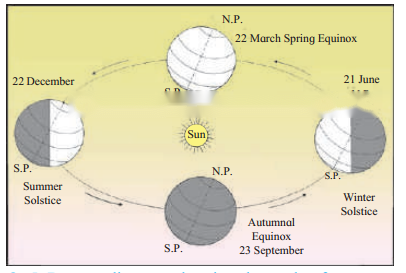
4. Spot the error in the diagram given below:
Answer:
Spring Equinox – 21st March
Summer Solstice – 21st June
Winter Solstice – 22nd December
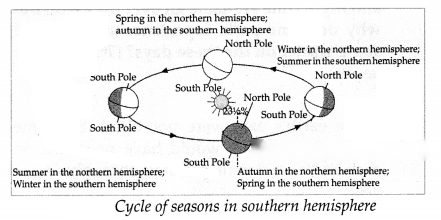
5. Draw a diagram showing the cycle of seasons in the southern hemisphere.
Answer:
ICT Question :
Activity:
Using the internet, collect pictorial information of any four migratory birds/animals.
Class 7 Geography Chapter 8 How Seasons Occur Part 2 InText Questions and Answers
Can you tell:
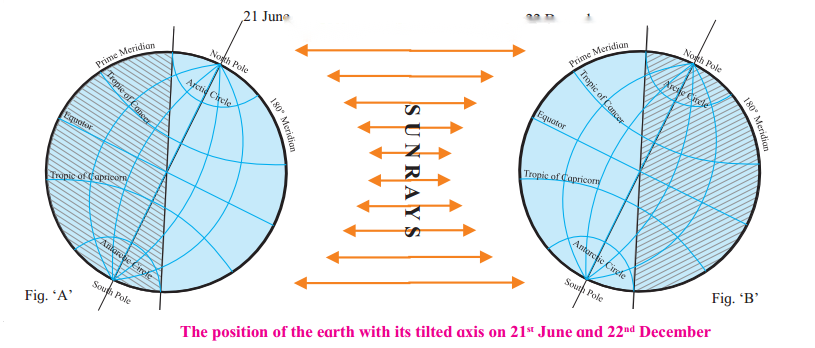
Figure shows the position of the earth with its tilted axis on 21st June and 22nd December. It also shows its illuminated and dark positions. Observe the figure and answer the following.
Question 1.
In fig ‘A which pole is receiving sunlight?
North Pole is receiving sunlight in Fig ‘A’
Question 2
Maharashtra Board Solution
In fig ‘B’ which pole is not receiving sunlight?
Solution & Step-by-Step Answer:
North Pole is not receiving sunlight in Fig. ‘B’
Question 3
Maharashtra Board Solution
Which hemisphere has the longest daytime on 21st June?
Solution & Step-by-Step Answer:
Northern hemisphere has the longest daytime on 21st June.
Question 4
Maharashtra Board Solution
Which hemisphere will have the longest night on 22nd December?
Solution & Step-by-Step Answer:
Northern hemisphere will have the largest night in 22nd December.
Question 5
Maharashtra Board Solution
On which date will the Tropic of Cancer receive perpendicular sunrays?
Solution & Step-by-Step Answer:
The Tropic of Cancer will receive perpendicular sunrays on 21st June.
Question 6
Maharashtra Board Solution
Considering the position of the north pole, which season will prevail in the northern hemisphere from 22nd March to 23rd September?
Solution & Step-by-Step Answer:
Summer season will prevail in the northern hemisphere from 22nd March to 23rd September.
Question 7
Maharashtra Board Solution
The cricket matches in Australia are generally in summer, when does Australia have summer?
Solution & Step-by-Step Answer:
Summer season prevails in Australia from 23rd September to 21st March.
Question 8
Maharashtra Board Solution
In which period is the ‘midnight sun’ observable in Norway? Which season will there be at that time?
Solution & Step-by-Step Answer:
Midnight sun is observable in Norway from 21st March to 23rd September. It will be summer in Norway that time.
Question 9
Maharashtra Board Solution
At what time will the midnight sun be visible at the “Bharati Research Station” of India at Antarctica? What will be the season there at that time?
Solution & Step-by-Step Answer:
The midnight sun will be visible at Bharati Research Station of India at Antarctica from 23rd September to 21st March. It will be summer season there.
Use your brain power:
Question 1
Maharashtra Board Solution
The summer capital of Jammu & Kashmir is Srinagar while the winter capital is Jammu. What could be the reason?
Solution & Step-by-Step Answer:
(i) Jammu is located in the southern part of the state of Jammu & Kashmir whereas Srinagar is located to its north.
(ii) Also Jammu is located at an altitude of 350m whereas Srinagar is located at an altitude of approximately 1500m. (iii) So Jammu has higher temperature in summer as compared to Srinagar. As Srinagar has pleasant climate in summer, it acts as summer capital of the state. (iv) As winters are not very cold in Jammu & it is early accessible, it acts as a winter capital of the state.
Question 2
Maharashtra Board Solution
While India & England are located in the same hemisphere why are the cricket matches in these two countries arranged in different months?
Solution & Step-by-Step Answer:
(i) As India is a tropical country summers temperature are very high. England on the other hand falls in the temperate zone which has mild summers. Hence, England is suitable for cricket matches in summer.
(ii) As England lies in the temperate zone it her very cold winters. India on the other hand has mild winters as it is a tropical country. Thus India is suitable for cricket matches in winters. Hence, although India & England are located in the same hemisphere, due to latitudinal differences, the cricket matches in these two countries are arranged in different months.
Question 3
Maharashtra Board Solution
On 21st March and 23rd September, daytime and night time are same all over the earth. But why do some parts experience summer and some winter on the these days?
Solution & Step-by-Step Answer:
(i) If the earth’s axis were not tilted, the same climatic conditions would have prevailed on each of the different parallels throughout the year.
(ii) The seasons would not have occurred. It is due to the tilt of the earth’s axis that some parts of the earth experience summer and some winter on these days.
Question 4
Maharashtra Board Solution
Mention any two countries in the world where one needs woollen clothing in the month of May. Also mention their latitudinal positions.
Solution & Step-by-Step Answer:
South Africa is on 23°S latitude. Iceland is on 65°N latitude.
Question 5
Maharashtra Board Solution
On equinox days, the two poles experience either sunrise or sunset. On which pole will it be sunrise on 21st March?
Solution & Step-by-Step Answer:
Sunrise will be experienced on the North pole.
Think about it:
Question 1
Maharashtra Board Solution
In which direction will the location of sunrise and sunset appear to move after 22nd of December?
Solution & Step-by-Step Answer:
On 22nd December the sun reaches the southernmost position as seen from the earth. The sun seems to stand still at the Tropic of Capricon and then reverses its direction. The sun appears to move northwards after 22nd December.
Observe Fig of textbook page 47 carefully & answer:
Question 2
Maharashtra Board Solution
positioned relative to the sun on the dates given in the figure?
Solution & Step-by-Step Answer:
(i) The northern hemisphere is tilted towards the sun in the period between 21st March is 23rd September. Hence, northern hemisphere experiences summer season.
(ii) It is tilted away from the sun in the period between 23rd September to 21st March. Hence, northern hemisphere experiences winter season.
Question 3
Maharashtra Board Solution
Which season will you experience in the northern hemisphere around 22nd December?
Solution & Step-by-Step Answer:
We will experience Winter season in the northern hemisphere around 22nd December.
Question 4
Maharashtra Board Solution
What would be the season in the northern hemisphere around 21st June?
Solution & Step-by-Step Answer:
It will be Summer season in the northern hemisphere around 21st June.
Question 5
Maharashtra Board Solution
If it is winter in the northern hemisphere which season will it be in opposite hemisphere?
Solution & Step-by-Step Answer:
If it is winter in the northern hemisphere, the southern hemisphere will experience summer season.
Question 6
Maharashtra Board Solution
At any given point of time why are the season in the northern and southern hemisphere different?
Solution & Step-by-Step Answer:
(i) Regardless of the time of the year, the northern and southern hemisphere experience opposite seasons.
(ii) In the period from 21st March to 23rd September the northern hemisphere is exposed to more direct sunlight because this hemisphere faces the sun. (iii) In the period from 23rd September to 21st March the southern hemisphere is exposed to more direct sunlight. (iv) It is the tilt of the Earth that causes the difference in the seasons.
Question 7
Maharashtra Board Solution
What effects do the seasons have on the biodiversity in India? Write briefly about it:
Solution & Step-by-Step Answer:
(i) The living world on the earth is affected by the cycle of seasons.
(ii) Change in seasons cause immense biodiversity loss, affecting both individual species and their ecosystem that support economic growth and human well being. (iii) Greater frequency and severity of heat waves and extreme weather is a threat to the survival of mankind and animals too. (iv) Floral and animal activity variation depends on seasonal temperature variation with different species flowering at specific times before or after monsoon seasons. (v) Any change in rainfall pattern poses a threat to agriculture. Give it a try:
Question 1
Maharashtra Board Solution
Regarding daytime & the cycle of season, what conditions would have prevailed at the following place, if the earth’s axis were not tilled? (Canada, Tasmania, Nigeria, West Indies, Peru, Borneo)
Solution & Step-by-Step Answer:
Can you tell: Discuss the activity you have been carrying out since June (Refer ch. 1) make use of the observation tables for the months of June, September & December.
Question 1
Maharashtra Board Solution
In which month the duration of the day was around 12 hours?
Solution & Step-by-Step Answer:
The duration of the day was around 12 hours in the month of September.
Question 2
Maharashtra Board Solution
What could be the reason behind it?
Solution & Step-by-Step Answer:
The duration of day is 12 hours in the month of September because both the hemispheres of the earth are at equal distance from the sun & the equator receives perpendicular rays of the sun.
Question 3
Maharashtra Board Solution
Bring out the differences between the duration of daytime in the months of June, September & December.
Solution & Step-by-Step Answer:
The duration of day is around 13 hours in the month of June. It decreases to around 12 hours in the month of September. It is around 11 hours in the month of December.
Question 4
Maharashtra Board Solution
What could be the reason for the change in the shadow of the stick?
Solution & Step-by-Step Answer:
There is a change in the shadow of the stick because there is a change in position of the sunrise & sunset.
Question 5
Maharashtra Board Solution
What did you observe about the position of the sun at the horizon at the time of sunrise & sunset?
Solution & Step-by-Step Answer:
(i) After 21st June the position of the sun at the horizon at the time of sunrise & sunset shifted southwards. (ii) After 22nd December the position of the sun at the horizon at the time of sunrise & sunset shifted north wards.
Question 6
Maharashtra Board Solution
Which of the following factors could be related with the change in the position of the shadow of the stick & the difference in the duration of daytime? (i) Rotation of the earth (ii) Distance between the earth & the sun (iii) Revolution of the earth. (iv) The axis of the earth.
Solution & Step-by-Step Answer:
(i) Revolution of the earth (ii) The axis of the earth.
Class 7 Geography Chapter 8 How Seasons Occur Part 2Additional Important Questions and Answers Fill in the blanks:
Question 1
Maharashtra Board Solution
The position of the sun at sunrise, appears to change on the ______ everyday.
Solution & Step-by-Step Answer:
horizon
Question 2
Maharashtra Board Solution
_______ occurs only with reference to the northern and the southern hemispheres.
Solution & Step-by-Step Answer:
Seasons
Question 3
Maharashtra Board Solution
The path of the revolution of the earth around the sun is ______.
Solution & Step-by-Step Answer:
elliptical
Question 4
Maharashtra Board Solution
As the earth revolves around the sun, its perpendicular rays fall on the _____ twice a year.
Solution & Step-by-Step Answer:
equator
Question 5
Maharashtra Board Solution
In the northern hemisphere prevails from 21st March to 21st June, while ______ prevails from 23rd September to 22nd December.
Solution & Step-by-Step Answer:
spring, autumn
Question 6
Maharashtra Board Solution
________ is the longest day and has the shortest night in the northern hemisphere.
Solution & Step-by-Step Answer:
21st June
Question 7
Maharashtra Board Solution
_____ marks the longest day and the shortest night in the southern hemisphere.
Solution & Step-by-Step Answer:
22nd December
Question 8
Maharashtra Board Solution
On the _____ the duration of day and night is the same throughout the year.
Solution & Step-by-Step Answer:
equator
Question 9
Maharashtra Board Solution
The occurrence of seasons one after the other leads to the ______.
Solution & Step-by-Step Answer:
cycle of seasons
Question 10
Maharashtra Board Solution
Agricultural seasons also depend on the local ________ conditions.
Solution & Step-by-Step Answer:
climatic
Question 11
Maharashtra Board Solution
Continuous, occurrence of rain in a specific period gives rise to additional _______ besides summer and winter.
Solution & Step-by-Step Answer:
season
Question 12
Maharashtra Board Solution
On _____ and ______ day time and night time are same all over the earth.
Solution & Step-by-Step Answer:
21st March, 23rd September
Question 13
Maharashtra Board Solution
The period in which the position of the rising sun keeps moving towards the south is called _______.
Solution & Step-by-Step Answer:
Dakshinayan
Question 14
Maharashtra Board Solution
The period in which the position of the rising sun keeps moving towards the north is called _______.
Solution & Step-by-Step Answer:
Uttarayan
Question 15
Maharashtra Board Solution
In the northern hemisphere 23rd September is called ____ equinox.
Solution & Step-by-Step Answer:
Autumnal
Complete the following sentence:
Question 1
Maharashtra Board Solution
The movement of the sun towards the north or south in a year is called ________.
Solution & Step-by-Step Answer:
the apparent movement of the sun
Question 2
Maharashtra Board Solution
Seasons occur only with reference to _______.
Solution & Step-by-Step Answer:
the northern and the southern hemisphere
Question 3
Maharashtra Board Solution
The diurnal apparent movement of the sun is related to _______.
Solution & Step-by-Step Answer:
the rotation of the earth
Question 4
Maharashtra Board Solution
The annual apparent movement of the sun is related to ______.
Solution & Step-by-Step Answer:
the revolution of the earth and the tilt of earth’s axis
Question 5
Maharashtra Board Solution
In the first week of July, the earth is at _______.
Solution & Step-by-Step Answer:
the farthest point from the sun.
Question 6
Maharashtra Board Solution
The circle of illumination1 divides ______.
Solution & Step-by-Step Answer:
all the parallels from the north pole to the south pole equally.
Question 7
Maharashtra Board Solution
In the northern hemisphere, spring prevails ______.
Solution & Step-by-Step Answer:
from 21st March to 21st June.
Question 8
Maharashtra Board Solution
In the northern hemisphere, autumn prevails ______.
Solution & Step-by-Step Answer:
from 23rd September to 22nd December.
Question 9
Maharashtra Board Solution
Only on 21st June and 22nd December, the sun rays become _____.
Solution & Step-by-Step Answer:
perpendicular on the Tropic of Cancer and Tropic of Capricon respectively
Question 10
Maharashtra Board Solution
Seasons have been decided on the basis of _________.
Solution & Step-by-Step Answer:
the duration of sunlight, equinoxes and solstices
Question 11
Maharashtra Board Solution
The living world on the earth is affected by ________.
Solution & Step-by-Step Answer:
the cycle of seasons.
Question 12
Maharashtra Board Solution
Continuous occurrence of rain in a specific period gives rise to _____.
Solution & Step-by-Step Answer:
an additional season besides summer and winter.
Complete the statements using the correct options:
Question 1
Maharashtra Board Solution
In the course of one year, Arctic tern has to travel in search of food. (a) around 50,000 km. (b) around 70,000 km. (c) around 90,000 km.
Solution & Step-by-Step Answer:
(b) around 70,000 km.
Question 2
Maharashtra Board Solution
Due to severe winter and lack of food, Siberian cranes from the cold northern regions visit India travelling around (a) 8 to 10 thousand kilometers. (b) 10 to 12 thousand kilometers. (c) 12 to 14 thousand kilometers.
Solution & Step-by-Step Answer:
(a) 8 to 10 thousand kilometers.
Question 3
Maharashtra Board Solution
The two Poles experience either sunrise or sunset on (a) Solstice days. (b) Equinox days. (c) Dakshinayan.
Solution & Step-by-Step Answer:
(b) Equinox days.
Question 4
Maharashtra Board Solution
The diurnal apparent movement of the sun is related to (a) the revolution of the earth. (b) rotation of the earth. (c) tilt of the earth’s axis.
Solution & Step-by-Step Answer:
(b) rotation of the earth
Answer in one sentence:
Question 1
Maharashtra Board Solution
What is the apparent movement of the sun?
Solution & Step-by-Step Answer:
The movement of the sun towards the north or south in a year is called the apparent movement of the sun.
Question 2
Maharashtra Board Solution
What is Equinox?
Solution & Step-by-Step Answer:
On 21st March and 23rd September, the north pole and the south pole are at the same distance from the earth due to which the daytime & night time are of equal duration every where on earth. This is called Equinox.
Question 3
Maharashtra Board Solution
How have seasons been decided?
Solution & Step-by-Step Answer:
Seasons have been decided on the basis of the duration of sunlight, equinoxes and solstices.
Question 4
Maharashtra Board Solution
Name the four seasons of Europe and North America.
Solution & Step-by-Step Answer:
The four seasons in Europe and North America are summer, autumn, winter and spring.
Question 5
Maharashtra Board Solution
Which living creatures are found in the Antarctic region?
Solution & Step-by-Step Answer:
Birds like penguins, fish like seal and animals like walruses are found in the Antarctic region.
Question 6
Maharashtra Board Solution
Which animals are found in the polar region of the northern hemisphere?
Solution & Step-by-Step Answer:
In the polar region of the northern hemisphere animals like reindeer, polar bears, Arctic foxes, etc are found.
Question 7
Maharashtra Board Solution
What are the factors that influence the seasons?
Solution & Step-by-Step Answer:
The changes in the atmosphere, vapour in the air, the wind and the precipitation influence the seasons.
Question 8
Maharashtra Board Solution
What do you mean by Dakshinayan?
Solution & Step-by-Step Answer:
The period in which (from 21st June to 22nd December) the position of the rising sun keeps on moving towards the south is called as Dakshinayan.
Question 9
Maharashtra Board Solution
What is Uttarayan?
Solution & Step-by-Step Answer:
The period in which (from 22nd December to 21st June) the position of the rising sun keeps on moving towards the north is called as Uttarayan.
Answer the following questions:
Question 1
Maharashtra Board Solution
What is called perihelion position of the earth?
Solution & Step-by-Step Answer:
Question 2
Maharashtra Board Solution
What is called aphelion position of the earth.
Solution & Step-by-Step Answer:
Question 3
Maharashtra Board Solution
What is called circle of illumination?
Solution & Step-by-Step Answer:
Question 4
Maharashtra Board Solution
What are Solstice days?
Solution & Step-by-Step Answer:
Question 5
Maharashtra Board Solution
Draw the diagram showing the Aphelion and perihelion position:
Solution & Step-by-Step Answer:
Maharashtra State Board Class 7 Geography Solutions |

