Maharashtra State Board Class 7 Science Solutions Chapter 13 Changes – Physical and Chemical
Class 7 Science Chapter 13 Changes – Physical and Chemical Textbook Questions and Answers
1. Distinguish between the following.
Question a.
Physical change and Chemical change
Answer:
Physical changes | Chemical changes |
1. In a physical change material may change its | 1. A change which after physical properties and |
shape, size, texture or state. | composition also. |
2. No new compound is formed. | 2. New compound /substance is formed due to chemical change. |
3. The change is temporary. It is reversible. | 3. The change is permanent and irreversible. |
4. Examples: Evaporation of water, boiling of water, melting of ice. | 4. Examples: Burning of wood, paper, souring of milk, digestion of food, rusting of iron. |
Question b.
Periodic changes and Non-periodic change
Answer:
Periodic changes | Non-periodic change |
1. Some changes occur again and again after a definite interval of time. Such changes are called periodic changes. | 1. In this, certain changes will recur after one occurrence, it cannot be said for sure, even if they occur interval is not fixed. Such changes are called non-periodic changes. |
2. Examples: movement of clock hands in clock showing time, change of season, day and night formation, heart beat, ripening of fruit, rising and setting of the sun. | 2. Examples: volcanic eruption, occurrence of an earthquake, tsunami, forest fires, freezing of water to form ice, sneezing, rusting of iron. |
3. They repeat themselves after a fixed interval of time. | 3. They do not repeat themselves after a fixed interval of time. |
Question c.
Natural change and Man-made change
Answer:
Natural change | Man-made change |
1. Changes that occur naturally on its own are called natural changes. | 1. Changes that are result of human activity. Such changes are called man-made. |
2. Examples ripening of a fruit, spoiling of milk, change in the climate | 2. Burning of fossil fuels, deforestation, pollution of air, water and soil. |
2. Under which different types can the following changes be classified?
Question a.
Conversion of milk into yoghurt.
Answer:
Manmade (useful).
Question b.
Bursting of cracker.
Answer:
Manmade (fast change).
Question c.
Occurrence of an earthquake.
Answer:
Non-periodic.
Question d.
Revolution of earth around the sun.
Answer:
Periodic. (Natural change)
Question e.
Stretching of a spring.
Answer:
Physical, reversible change.
3. Give reasons.
Question a.
While purchasing canned food, its expiry date should be checked.
Answer:
Question b.
An iron article should be given a coat of paint.
Answer:
Question c.
A Wooden article should be polished.
Answer:
Question d.
Copper and brass utensils should be tinned.
Answer:
Question e.
A dry handkerchief gets wet at once on dipping in water, but it takes long for a wet handkerchief to dry.
Answer:
4. What will you take into account while identifying the following:
Question a.
A physical change in a substance.
Answer:
I will take into account the following facts.
Question b.
A chemical change in a substance.
Answer:
I will take into account the following facts.
5. Read the paragraph and note down the various types of changes it mentions.
Question a.
Read the paragraph and note down the various types of changes it mentions.
It was nearing six o’clock in the evening. The sun was setting. A breeze was blowing. Leaves on the tree were shaking. Sahil was sitting in the courtyard, rolling balls of wet soil and shaping them into various toys. Then he felt hungry and went into the house. Mother made a dough from wheat flour and fried purees. While eating hot purees, his attention was drawn outside the window. It had started raining. There was lighting too. Sahil was enjoying his dinner in the dim light.
Answer:
Project:
Question a.
Visit a place where work like powder coating. spray painting is done. Make a note of the information you obtain.
Class 7 Science Chapter13 Changes – Physical and ChemicalImportant Questions and Answers
Fill in the blanks and rewrite the sentences:
State whether the following statements are True or False. Correct and rewrite the false statement:
Define the following.
Name or Give two example of:
Match the following:
Column ‘A’ | Column ‘B’ |
1. Photosynthesis | a. Physical change. |
2. Dissolving sugar in water | b. Chemical change |
3. Burning of wood | c. Man-made change. |
4. Melting of wax | d. Periodic changes. |
5. Digestion of food | e. Non-periodic change |
6. Heartbeat | f. Chemical change. |
7. Occurrence of earthquake. | g. Physical change. |
8. Deforestation | h. Chemical change. |
Column ‘A’ | Column ‘B’ |
1. Photosynthesis | b. Chemical change |
2. Dissolving sugar in water | a. Physical change. |
3. Burning of wood | f. Chemical change. |
4. Melting of wax | g. Physical change. |
5. Digestion of food | h. Chemical change. |
6. Heartbeat | d. Periodic changes. |
7. Occurrence of earthquake. | e. Non-periodic change |
8. Deforestation | c. Man-made change.
Question 2
Maharashtra Board Solution
|
Column ‘A’ | Column ‘B’ |
1. Depositing a layer of zinc on Iron | a. Tinning |
2. Souring of milk | b. Rust |
3. Curdling of milk | c. Galvanization |
4. Iron oxide | d. Chemical changes |
5. Depositing layer of tin on copper and brass article. | e. Man-made changes. |
Column ‘A’ | Column ‘B’ | ||||||||||||||||||||||||
1. Depositing a layer of zinc on Iron | c. Galvanization | ||||||||||||||||||||||||
2. Souring of milk | d. Chemical changes | ||||||||||||||||||||||||
3. Curdling of milk | e. Man-made changes. | ||||||||||||||||||||||||
4. Iron oxide | b. Rust | ||||||||||||||||||||||||
5. Depositing layer of tin on copper and brass article. | a. Tinning Distinguish between the following.
Question 1
Maharashtra Board Solution
Reversible change and Irreversible change
Solution & Step-by-Step Answer:
Under which different types can be following changes be classified:
Question 1
Maharashtra Board Solution
Formation of curd from milk.
Solution & Step-by-Step Answer:
Manmade change (useful), chemical
Question 2
Maharashtra Board Solution
Burning of wood or paper.
Solution & Step-by-Step Answer:
Manmade, chemical change.
Question 3
Maharashtra Board Solution
Glowing of bulb.
Solution & Step-by-Step Answer:
Manmade (fast).
Question 4
Maharashtra Board Solution
Rusting of iron.
Solution & Step-by-Step Answer:
Chemical change (harmful)
Question 5
Maharashtra Board Solution
Burning of Camphor.
Solution & Step-by-Step Answer:
Chemical change
Question 6
Maharashtra Board Solution
Souring of milk.
Solution & Step-by-Step Answer:
chemical change (harmful)
Question 7
Maharashtra Board Solution
Digestion of food.
Solution & Step-by-Step Answer:
Chemical change (useful), irreversible
Question 8
Maharashtra Board Solution
Change of season.
Solution & Step-by-Step Answer:
Periodic change, natural change
Question 9
Maharashtra Board Solution
Day and night formation.
Solution & Step-by-Step Answer:
Periodic change
Question 10
Maharashtra Board Solution
Heartbeat.
Solution & Step-by-Step Answer:
Periodic change
Question 11
Maharashtra Board Solution
Water pollution.
Solution & Step-by-Step Answer:
Manmade, harmful change
Question 12
Maharashtra Board Solution
Air pollution.
Solution & Step-by-Step Answer:
Manmade, harmful change
Question 13
Maharashtra Board Solution
Burning of fossil fuel
Solution & Step-by-Step Answer:
Manmade (irreversible change)
Question 14
Maharashtra Board Solution
Ripening of fruit.
Solution & Step-by-Step Answer:
Natural, chemical
Question 15
Maharashtra Board Solution
Change-in climate.
Solution & Step-by-Step Answer:
Natural, periodic
Question 16
Maharashtra Board Solution
Melting of ice into water
Solution & Step-by-Step Answer:
Physical change
Question 17
Maharashtra Board Solution
Germination of seed.
Solution & Step-by-Step Answer:
Natural, slow, desirable.
Question 18
Maharashtra Board Solution
Bursting of balloon.
Solution & Step-by-Step Answer:
Irreversible change (fast).
Give reasons:
Question 1
Maharashtra Board Solution
The burning of wax is a chemical change
Solution & Step-by-Step Answer:
Can you tell? Answer the following questions:
Question 1
Maharashtra Board Solution
We see many man-made materials in our day-to-day life. For what purpose are they produced.
Solution & Step-by-Step Answer:
We see many man-made matrical in our day to day life. For example,
Question 2
Maharashtra Board Solution
You made a link from the glass piece. How will you change the shape of the link to give it its original shape?
Solution & Step-by-Step Answer:
Heat the glass piece again at the link. When it becomes soft break it.
Question 3
Maharashtra Board Solution
How will you restore the original candle after melting one ?
Solution & Step-by-Step Answer:
Collect the melted wax and give the required shape when it is soft.
Question 4
Maharashtra Board Solution
What comes after daytime?
Solution & Step-by-Step Answer:
Night time (periodic change)
Question 5
Maharashtra Board Solution
What is the next stage after sunrise?
Solution & Step-by-Step Answer:
Sunset (periodic change)
Question 6
Maharashtra Board Solution
What comes after a high tide in the sea?
Solution & Step-by-Step Answer:
Low tide (periodic)
Question 7
Maharashtra Board Solution
A bird sitting on a tree flies away.
Solution & Step-by-Step Answer:
non-periodic change.
Question 8
Maharashtra Board Solution
A meteor streaking across the sky.
Solution & Step-by-Step Answer:
non-periodic change.
Use your brainpower! Answer the following questions:
Question 1
Maharashtra Board Solution
What kind of change is the falling of a tree in a storm?
Solution & Step-by-Step Answer:
Natural change.
Question 2
Maharashtra Board Solution
What kind of a change is the conversion of milk into yoghurt?
Solution & Step-by-Step Answer:
Manmade ‘ change, useful change and a chemical change
Question 3
Maharashtra Board Solution
What is meant by irreversible change? Give some examples.
Solution & Step-by-Step Answer:
Examples:
Question 4
Maharashtra Board Solution
Which type of change is the change of seasons from summer to rains to winter?
Solution & Step-by-Step Answer:
Natural and periodic change
Question 5
Maharashtra Board Solution
Which hands of a clock show periodic changes from 6.00 am to 6.00 pm? How many times?
Solution & Step-by-Step Answer:
Small (hour) hand (12 times).
Question 6
Maharashtra Board Solution
Which of the following are physical changes and which are chemical changes? (making a table from wood, burning wood, breaking of a glass object, ripening of a tomato, rusting of iron.
Solution & Step-by-Step Answer:
Question 7
Maharashtra Board Solution
What are periodic and non-periodic changes?
Solution & Step-by-Step Answer:
1. We find that some changes occur again and again after a definite interval of time. Such changes are called Periodic changes, e.g. Sunrise and Sunset. 2. On the other hand, it cannot be ‘Slid for sure when certain changes will recur after one occurrence. Even if they recur, the time interval is not fixed. Such changes are called non-periodic changes, e.g. A meteor streaking across the sky.
Question 8
Maharashtra Board Solution
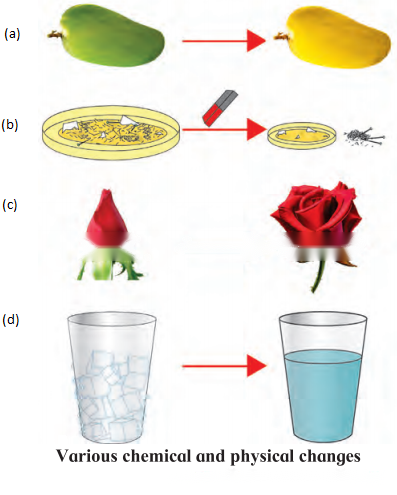
a. Which changes shown in the pictures below are temporary.
Solution & Step-by-Step Answer:
(b) Removing iron nails with help of magnet (d) Conversion of ice cubes into water.
Question b. Question c. Question d. Question e.
Question 9
Maharashtra Board Solution
Give some examples of fast and slow changes that occur in your surroundings.
Solution & Step-by-Step Answer:
|