Maharashtra State Board Class 7 Science Solutions Chapter 18 Sound: Production of Sound
Class 7 Science Chapter 18 Sound: Production of Sound Textbook Questions and Answers
1. Fill in the blanks:
Question a.
Sound is generated by the rhythmic ……………. of any object.
Answer:
vibrations
Question b.
The frequency of sound is measured in ……………...
Answer:
Hertz (Hz)
Question c.
If …………….. of sound is decreased its loudness also decreases.
Answer:
intensity
Question d.
A medium is necessary for …………… of sound.
Answer:
generation
2. Match the pairs.
Question a.
Column ‘A’ | Column ‘B’ |
1. Flute | a. Frequency less than 20 Hz |
2. Frequency | b. Frequency more than 20,000 Hz |
3. Sound level | c. Vibrations in the air |
4. Ultrasonic sound | d. Measured in Hz |
5. Infrasonic sound | e. Decibel |
Answer:
Column ‘A’ | Column ‘B’ |
1. Flute | c. Vibrations in the air |
2. Frequency | d. Measured in Hz |
3. Sound level | e. Decibel |
4. Ultrasonic sound | b. Frequency more than 20,000 Hz |
5. Infrasonic sound | a. Frequency less than 20 Hz |
3. Give scientific reasons.
Question a.
In earlier times, people used to listen for the arrival of a distant train by putting their ear to the rails.
Answer:
Question b.
The sounds generated by a tabla and sitar are different.
Answer:
Question c.
If you were both on the moon your friend will not be able to hear you call.
Answer: Yes, your friend will not be able to hear your call because sound needs a medium for transmission since it is a mechanical wave it cannot travel through vaccum.
Question d.
We can hear the movement of a mosquito wings but we cannot hear the movement of our hands.
Answer:
4. Write answers to the following questions.
Question a.
How is sound produced?
Answer:
Question b.
What does the intensity of sound depend upon?
Answer:
Question c.
Explain how the frequency of oscillation is related to the length of a pendulum and the amplitude of its oscillation.
Answer:
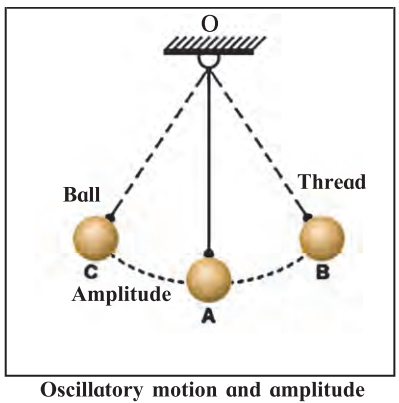
1. Given an oscillatory motion to the pendulum, the maximum distance between the original position A of the pendulum and extreme position B or C is called the amplitude of oscillation. AB, AC is the amplitude of oscillation.
2. The number of oscillations completed by an oscillator in one second is called the frequency of oscillation.
Relation between frequency and length of a pendulum: If the length of the pendulum increases the period of oscillations also increases.
We know time period of oscillations =
If time period increases, frequency decreases, therefore, if the length of the pendulum increases frequency will decrease.
Relation between frequency and amplitude: Frequency of oscillation is independent of its amplitude of oscillation.
Question d.
Explain the two ways by which the pitch of the sound generated by a stretched string can be changed?
Answer:
1. A string vibrates with a particular fundamental frequency. It is however possible to produce pitches with different frequencies from the same string.
2. The two properties of the string that affect its frequency are length and diameter.
3. When the length of a string is changed, it will vibrate with a different frequency. Shorter strings have higher frequency and therefore higher pitch.
4. When a musician presses her finger on a string, she shortens its length. The more fingers she adds to the string, the shorter she makes it, higher will be the pitch.
Diameter: Thick strings with large diameter vibrate slower and have lower frequency than the thin ones.
Project:
Question a.
The bat, a mammal, flies during the night manoeuvering with the help of the ultrasonic sounds it produces. Find out more about this.
Class 7 Science Chapter18 Sound: Production of SoundImportant Questions and Answers
Fill in the blanks:
Solution & Step-by-Step Answer:
ultrasonic waves
Solution & Step-by-Step Answer:
an oscillator
Solution & Step-by-Step Answer:
increases
Solution & Step-by-Step Answer:
amplitude
Solution & Step-by-Step Answer:
vaccum
Solution & Step-by-Step Answer:
50,000 Hz
Solution & Step-by-Step Answer:
frequency
Solution & Step-by-Step Answer:
Pitch
Solution & Step-by-Step Answer:
amplitude
Solution & Step-by-Step Answer:
decibel dB
Solution & Step-by-Step Answer:
one second
Name the following:
Solution & Step-by-Step Answer:
ultrasonic
Solution & Step-by-Step Answer:
solids
Solution & Step-by-Step Answer:
20 – 20,000 Hz
Solution & Step-by-Step Answer:
above 100 dB
Solution & Step-by-Step Answer:
echolocation
Solution & Step-by-Step Answer:
Hertz
Solution & Step-by-Step Answer:
Decibel
Solution & Step-by-Step Answer:
Alexander graham Bell
Solution & Step-by-Step Answer:
Ultra sonic sound
Solution & Step-by-Step Answer:
Ultra sonic sound
Answer in one or two sentences:
Solution & Step-by-Step Answer:
Sound is produced by vibration of an object.
Solution & Step-by-Step Answer:
The vibration of the vocal chords in our larynx or voice box produces sound.
Solution & Step-by-Step Answer:
To and fro motion of an object (oscillator) on either side of a central position is called oscillatory motion.
Solution & Step-by-Step Answer:
The motion of an object repeated again and again at fixed intervals of time is called periodic motion.
Solution & Step-by-Step Answer:
The number of oscillations completed by an oscillator in one second is called the frequency of oscillation.
Solution & Step-by-Step Answer:
The intensity of sound is proportional to the square of the amplitude of vibration. For example, if the amplitude is doubled the intensity becomes four times as much.
Solution & Step-by-Step Answer:
If frequency of sound is increased more than 100dB, the hearing can be temporarily affected which can result in temporary deafness.
Solution & Step-by-Step Answer:
A sound with a frequency less than 20Hz is called infrasonic sound.
Solution & Step-by-Step Answer:
Ultrasonic sound is used in ships as a system known as ‘SONAR’ to detect the obstacle beneath the ocean as well as the depth of an ocean.
Solution & Step-by-Step Answer:
Pitch is directly proportional to the frequency of a sound whereas frequency is the repeating vibrations per unit time.
Solution & Step-by-Step Answer:
When a rubber is stretched with a greater force and released, the amplitude increases which in turn result in a louder sound being generated.
Solution & Step-by-Step Answer:
The frequency remains the same even if the amplitude is increased or decreased.
Define:
Say True or False with explanation:
Solution & Step-by-Step Answer:
True. Sound needs a medium to travel through. Since vacuum does not provide any medium, sound cannot travel through it.
Solution & Step-by-Step Answer:
False. When the amplitude of vibration of a sound is large, the sound is very loud. The sound is feeble, when the amplitude is small. Loudness of a sound is proportional to the square of the amplitude of its vibration.
Solution & Step-by-Step Answer:
True. Human being can hear sounds only within the range of 20-20,000 Hz. We cannot hear the sound having frequency out of this range.
Solution & Step-by-Step Answer:
False. Pitch of sound increases when the frequency of vibration increases. The pitch of a sound is directly proportional to its frequency.
Solution & Step-by-Step Answer:
False. Unwanted, or unpleasant sounds are termed noise. Sounds which are melodious, and pleasing to ears are called music.
Solution & Step-by-Step Answer:
True. Unwanted, unpleasant sounds are called noise. If one is subjected to noise continuously for a long time, one may suffer from partial hearing impairment.
Solution & Step-by-Step Answer:
True. Time taken by an object to complete one oscillation is called time period.
Solve the following problems:
Solution & Step-by-Step Answer:
Frequency is the number of oscillations per second of a vibrating body. The time taken to complete one oscillation (to and fro) is known, as time period.
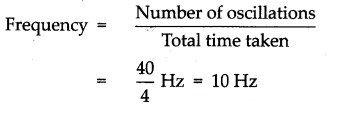
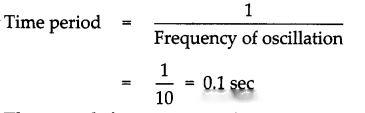
Solution & Step-by-Step Answer:
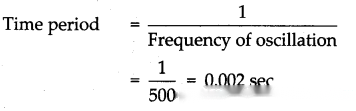
The time taken to complete one oscillation (to and fro) is know as time period.
Give scientific reasons:
Solution & Step-by-Step Answer:
Answer the following:
Solution & Step-by-Step Answer:
The ceilings of concert halls are curved because sound after reflection from the ceiling it reaches all the comers of the hall and is audible to each person in the hall.
Solution & Step-by-Step Answer:
Solution & Step-by-Step Answer:
Dogs can hear sounds upto about 65,000 Hz. That’s why dogs can receive ultrasonic sound signals produced by the vibration of the earth and start barking in advance before the actual earthquake is felt.
Solution & Step-by-Step Answer:
Uses of Ultrasonic sound are:
Use your brainpower!
Answer the following questions:
Solution & Step-by-Step Answer:
Solution & Step-by-Step Answer:
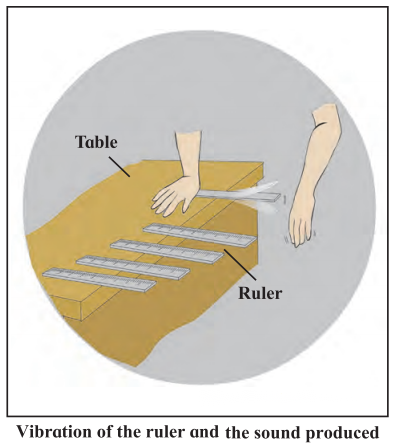
Yes, vibrating ruler pushes the molecules in the air producing sound waves. More the length of free part of ruler less will be the vibrations and less will be the frequency and pitch of the sound. If the length of free part of ruler is shorter it vibrates more quickly producing sound of higher frequency and pitch.
Solution & Step-by-Step Answer:
No, the ruler vibrates very slowly, which has frequency which is not audible.
Solution & Step-by-Step Answer: