Maharashtra State Board Class 7 Science Solutions Chapter 20 In the World of Stars
Class 7 Science Chapter 20 In the World of Stars Textbook Questions and Answers
1. Write the proper words in the blanks:
(meridian, horizon, twelve, nine, apparent, celestial, ecliptic)
Question a.
When seen from a great distance, the sky seems to be touching the ground along a circle. This circle is called the …………….
Answer:
horizon
Question b.
The ………….. is used while defining the zodiac sign.
Answer:
meridian
Question c.
Classified according to seasons, one season will have ………… nakshatras.
Answer:
nine
Question d.
The rising of the sun in the east and its setting in the west is the ………. motion of the sun.
Answer:
apparent
2. A star rises at 8 pm. tonight. At what time will it rise after a month? Why?
Question a.
A star rises at 8 pm. tonight. At what time will it rise after a month? Why?
Answer:
3. What is meant by “The sun enters a nakshatra?” It is said that in the rainy season the sun enters the mrug nakshatra. What does it mean?
Question a.
What is meant by “The sun enters a nakshatra?” It is said that in the rainy season the sun enters the mrug nakshatra. What does it mean?
Answer:
4. Answer the following questions.
Question a.
What is a constellation?
Answer:
A group of stars occupying a small portion of the celestial sphere is called a constellation.
Question b.
What points should be considered before a skywatch?
Answer:
Question c.
It is wrong to say that the planets, stars and nakshatras affect human life. Why?
Answer:
5. Write a paragraph on the birth and life cycle of stars using following figure.
Question a.
Write a paragraph on the birth and life cycle of stars using following figure.
Answer:
Stars are born out of nebulae. Nebulae are clouds made up mainly of hydrogen gas and dust particles which are attracted towards one another by the force of gravity, (i) As a result of pressure, the internal temperature increases and the cloud becomes dense and spherical in shape, (ii) From the diagram, life cycle of two stars can be explained.
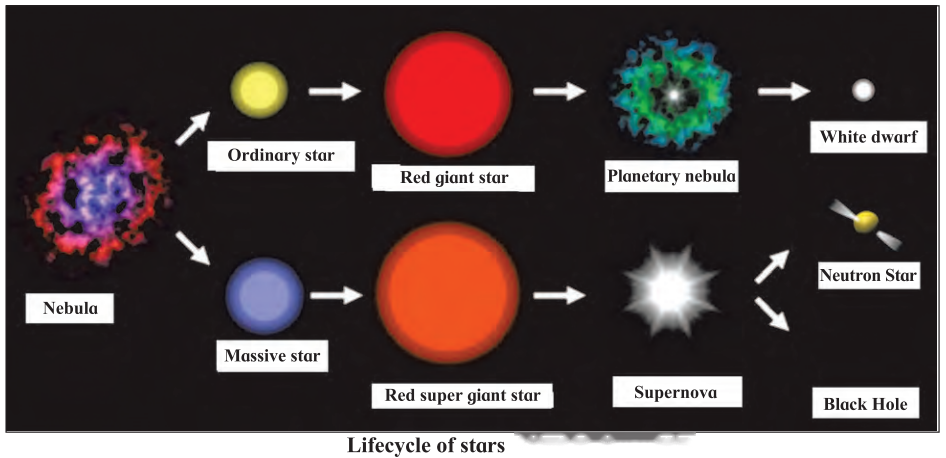
(a) Ordinary star: (i) The ordinary star forms a Red giant star at the later stage of its evolution when it runs out of hydrogen gas at its core. (ii) At the end stage of its life it forms a white dwarf. Stars like the sun become white dwarf when its nuclear fuel is totally exhausted. (iii) It is 1% in diameter of its original size.
(b) Massive Star: (i) Massive star forms Red super giant star at the end of its life cycle, (ii) They are also called super red giants with a relatively cool outer surface, (iii) Supernova is the explosive death of the star of the end of its life with the brightness of 100 million stars in a short amount of time, (iv) A neutron star is the dense core of the supernova. (v) It is the smallest and the densest star known to exist with a 10 km radius, (vi) Neutron stars sometimes end as a black hole, (vii) Black holes are not seen from telescopes and are identified by their intense gravitational pull where even light cannot escape.
Project:
Question a.
Visit a planetarium, collect information and present it in your school on Science day.
Class 7 Science Chapter20 In the World of StarsImportant Questions and Answers
Fill in the blanks:
Name the following:
State whether the following statements are True or False. Correct the false statements:
Match the following:
Question a.
Column ‘A’ | Column ‘B’ |
1. Saptarshi | a. Divided into 88 constellations |
2. Mmg nakshatra. | b. In the north direction. |
3. Orion | c. Group of 7 bright stars (kite) |
4. Vrushchik | d. Made up of 5 bright stars (M) |
5. Pole star | e. 7 – 8 stars. |
6. Celestial sphere | f. Group of 10 -12 stars |
Answer:
Column ‘A’ | Column ‘B’ |
1. Saptarshi | c. Group of 7 bright stars (kite) |
2. Mmg nakshatra. | d. Made up of 5 bright stars (M) |
3. Orion | e. 7 – 8 stars. |
4. Vrushchik | a. Divided into 88 constellations |
5. Pole star | b. In the north direction. |
6. Celestial sphere | f. Group of 10 -12 stars |
Answer in one line:
Define the following:
Find out.
Answer the following questions
Monsoon Season | Winter Season | Summer Season |
Ashwini Karthe | Krittika | Visakha |
Bharani Karthe | Rohini | Anuradha |
Arudra Karthe | Mrigashirsha | Jyeshtha |
Pushyani | Ardra | Mula |
Aslesha | Punarvasu | Purva Ashadha |
Magha | Uttara Ashadha | |
Purva Phalguni | Shravana | |
Uttara Phalguni | ||
Chitra | ||
Hasta |
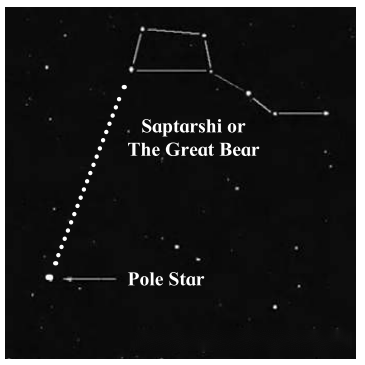
Saptarshi | Mrug nakshatra |
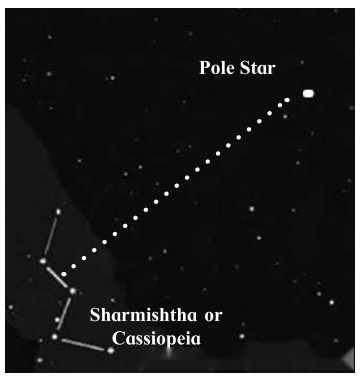
1. It is made up of five bright stars which are distributed along the figure of the letter M. | 1. It is made up of seven-eight stars of which four are at the corners of a quadrangle. |
2. Pole star is the brightest star in the constellation. | 2. Sirius is the brigh jveutr0nStarieconstellation. |
3. It is on the meridian in the month of April and in the month of October. | 3. It is on the meridian in the month of February and in June. |
4. In English, it is called the Great Bear. | 4. In English, it is called Orion. |
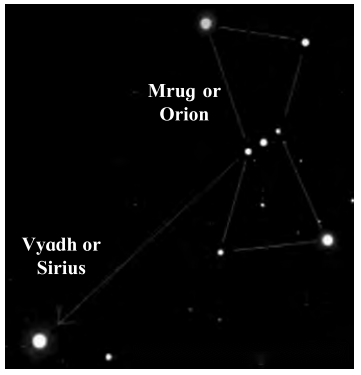
(b) Orion appears like a hunter. Three bright stars appear in the belt, 5 bright stars are arranged in the form of a quadrilateral. (It is visible during winter in the northern skies)
Use your brain power!
Answer the following questions.