Latest Maharashtra State Board (SSC & HSC) 2026-27 Syllabus Digest & Solutions Updated!
Class 7Science & Technology2026-27 Syllabus

Chapter 4 Nutrition in Living Organisms Solutions

Complete Maharashtra State Board Balbharati & Yuvakbharati textbook solutions for Chapter 4 Nutrition in Living Organisms. Step-by-step solved exercises, numerical problems, and digest answers.

59 Solved Questions8 Diagrams2623 words

Maharashtra State Board Class 7 Science Solutions Chapter 4 Nutrition in Living Organisms

Class 7 Science Chapter 4 Nutrition in Living Organisms Textbook Questions and Answers

1. Classify according to food-type.
Tiger, cow, vulture, bacteria, deer, goat, human, fungus, lion, sparrow, buffalo, frog, cockroach, tick.
Answer:

2. Nutrition In Living Organisms Class 7 Exercise Match the pairs.

Class 7 Science Chapter 4 Nutrition In Living Organisms Question Answer Question 1.

Column ‘A’

Column ‘B’

1. Parasitic plant

a. Mushroom

2. Parasitic plant

b. Lichen

3. Saprophytic plant

c. Drosera

4. Symbiotic plant

d. Cuscuta

Answer:

Column ‘A’

Column ‘B’

1. Parasitic plant

d. Cuscuta

2. Parasitic plant

c. Drosera

3. Saprophytic plant

a. Mushroom

4. Symbiotic plant

b. Lichen

3. Answer the following questions in your words.

Question a.
Why do living organisms need nutrition?
Answer:
Living organisms need nutrition due to the following: (a) To supply the energy required for doing work, (b) For growth and development of the body, (c) To replace the damaged cells and repair tissues, (d) To fight diseases.

Question b.
Explain the process of production of food in plants.
Answer:
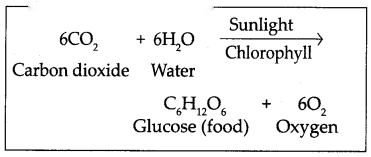
1. Green plants can produce their own food. With the help of sunlight and chlorophyll, plants make their own food in their leaves, using water and nutrients from the soil and carbon dioxide from the air.

2. This process is called as photosynthesis. In this process plants give out oxygen and take in carbon dioxide.
Question c.
What is meant by parasitic plants? Name their different types with examples of each.
Answer:
The plants that grow on the body of other plants to obtain food are called as parasitic plants.

There are two types of parasitic plants:

Question d.
Explain the various steps of nutrition in animals.
Answer:
Steps of nutrition in animals are as follows:

Question e.
Name some unicellular organisms in which all life processes take place within their unicellular body.
Answer:
Unicellular organisms like amoeba, euglena, paramoecium in which all life processes take place within their unicellular body.

4. Give reasons.

Question a.

Insectivorous plants are attractively coloured.
Answer:

Question b.
Butterflies have a long tube-like proboscis.
Answer:
Holozoic mode of nutrition means the feeding of solid and liquid food by animals. Butterflies live on nectar from flowers. Therefore to suck the nectar from flowers, they have a long tube-like structure called proboscis.

5. Prepare and complete the flowchart according to type of nutrition.

Question a.
Prepare and complete the flowchart according to type of nutrition.

Answer:
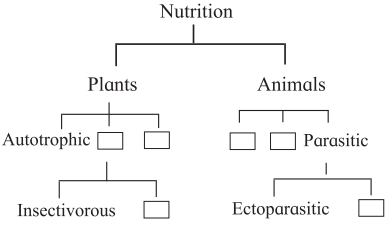
6. Think and answer.

Question a.
We prepare a variety of foodstuffs and dishes at home. Are we then autotrophic organisms?
Answer:

Question b.
Which organisms are greater in number – autotrophs or heterotrophs? Why?
Answer:

Question c.
The number of heterotrophs found in desert regions is smaller. However, they are found in greater numbers in the sea. Why is this so?
Answer:

Question d.
What damage or harm do ectoparasitic and endoparasitic animals cause?
Answer:

Question e.
Why is plant food not produced in any other parts of the plant except the green ones?
Answer:
Plant food is not produced in any other parts of the plant except the green ones because only green part contains chlorophyll and chlorophyll is very necessary for the production of food.

Class 7 Science Chapter 4 Nutrition In Living Organisms Project:

Question 1 Maharashtra Board Solution
Many heterotrophic organisms live on one and the same plant. Observe one such plant in your neighborhood and find out about the heterotrophs that depend upon it for their food. Observe and make flotes about other organisms that use these heterotrophs as their food.

Question 2 Maharashtra Board Solution
Prepare a Power point presentation on the topic ‘Nutrition in Living Organisms’.

Class 7 Science Chapter 4 Nutrition in Living Organisms Important Questions and

Solution & Step-by-Step Answer:
s

Nutrition In Living Organisms Class 7 Exercise Fill in the blanks.

Nutrition In Living Organisms Class 7 Exercise Question 1.
Leaves have microscopic openings called ……………..


Solution & Step-by-Step Answer:

Stomata

Class 7 Science Chapter 4 Nutrition In Living Organisms Question 2.
In the process of photosynthesis plants take in ……………. and ……………. gas is given out.
Answer:
Carbondioxide, oxygen

Question 3 Maharashtra Board Solution
The ……………. transports minerals and water from roots to all aerial parts of the plant.
Solution & Step-by-Step Answer:
xylem
Question 4 Maharashtra Board Solution
The ……………. transports the food from the leaves to other parts of the plant.
Solution & Step-by-Step Answer:
phloem
Question 5 Maharashtra Board Solution
Plants produce ……………. by the process of photosynthesis.
Solution & Step-by-Step Answer:
Carbohydrates
Question 6 Maharashtra Board Solution
……………. are made from carbon, hydrogen, oxygen.
Solution & Step-by-Step Answer:
Carbohydrates
Question 7 Maharashtra Board Solution
……………. are made from carbon, hydrogen and oxygen and nitrogen.
Solution & Step-by-Step Answer:
proteins
Question 8 Maharashtra Board Solution
……………. plants contain rhizobium micro-organisms.
Solution & Step-by-Step Answer:
leguminous
Question 9 Maharashtra Board Solution
Micro-organisms like ……………. are present in soil.
Solution & Step-by-Step Answer:
azotobacter
Question 10 Maharashtra Board Solution
Lichen is of a symbiosis between ……………. and ……………..
Solution & Step-by-Step Answer:
algae, fungi
Question 11 Maharashtra Board Solution
The scientist ……………. identified Drosera plant in Sri Lanka in 1737.
Solution & Step-by-Step Answer:
Johannes Burman
Question 12 Maharashtra Board Solution
Fungi like mushroom and yeast are ……………..
Solution & Step-by-Step Answer:
saprophytes
Question 13 Maharashtra Board Solution
Removal of waste products and undigested food from the body is called …………….
Solution & Step-by-Step Answer:
Egestion
Question 14 Maharashtra Board Solution
Amoeba moves with the help of ……………..
Solution & Step-by-Step Answer:
pseudopodia
Question 15 Maharashtra Board Solution
Butterflies suck food with a tube like ……………..
Solution & Step-by-Step Answer:
proboscis
Question 16 Maharashtra Board Solution
The ……………. or ……………. is an ant eating animal found in India.
Solution & Step-by-Step Answer:
bobcat, udmanjar
Question 17 Maharashtra Board Solution
Seed eating animals are called ……………..
Solution & Step-by-Step Answer:
granivores
Question 18 Maharashtra Board Solution
Fruit eating animals are called ……………..
Solution & Step-by-Step Answer:
frugivores
Question 19 Maharashtra Board Solution
Animals that obtain their food from both plants and animals are called ……………..
Solution & Step-by-Step Answer:
Omnivores
Question 20 Maharashtra Board Solution
Roundworms are known as ……………..
Solution & Step-by-Step Answer:
endoparasites

Class 7 Science Chapter 4 Nutrition In Living Organisms Match the column:

Question 1 Maharashtra Board Solution

Column ‘A’

Column ‘B’

1. Endoparasite

a. Vulture

2. Ectoparasite

b. Human

3. Seed eating animals

c. Tapeworm

4. Fruit eating animals

d. Bed bug

5. Scavenger

e. granivores

6. Omnivore

f. frugivores

Solution & Step-by-Step Answer:

Column ‘A’

Column ‘B’

1. Endoparasite

c. Tapeworm

2. Ectoparasite

d. Bed bug

3. Seed eating animals

e. granivores

4. Fruit eating animals

f. frugivores

5. Scavenger

a. Vulture

6. Omnivore

b. Human

Say whether true or false, correct and rewrite the false statements.

Question 1 Maharashtra Board Solution
Bed bug is an example of endoparasitic nutrition.
Solution & Step-by-Step Answer:
False, Bed bug is an example of ectoparasitic nutrition
Question 2 Maharashtra Board Solution
Spider shows saprozoic nutrition.
Solution & Step-by-Step Answer:
True
Question 3 Maharashtra Board Solution
The anteater is found in India.
Solution & Step-by-Step Answer:
False. The anteater is found in Central and South America
Question 4 Maharashtra Board Solution
Yellowing of leaves occur due to deficiency of iron.
Solution & Step-by-Step Answer:
True
Question 5 Maharashtra Board Solution
Mushroom is used in making bread.
Solution & Step-by-Step Answer:
False. Yeast is used in making bread
Question 6 Maharashtra Board Solution
Cuscuta is completely a parasitic plant.
Solution & Step-by-Step Answer:
True
Question 7 Maharashtra Board Solution
The nitrogen dioxide dissolves in rainwater and is converted into nitric acid.
Solution & Step-by-Step Answer:
True
Question 8 Maharashtra Board Solution
Micro-organism Rhizobium is found in soil.
Solution & Step-by-Step Answer:
False. Micro-organism Azotobacter is found in soil.
Question 9 Maharashtra Board Solution
Fixation of nitrogen occurs by biological and atmospheric methods.
Solution & Step-by-Step Answer:
True
Question 10 Maharashtra Board Solution
The chloroplasts present in the leaves contain chlorophyll.
Solution & Step-by-Step Answer:
True
Question 11 Maharashtra Board Solution
Decomposers obtain their food from living organisms.
Solution & Step-by-Step Answer:
False, They obtain their food by decomposing the dead bodies of organisms or other materials
Question 12 Maharashtra Board Solution
Carbondixode is given out during the process of photosynthesis.
Solution & Step-by-Step Answer:
False, Oxygen is given out during the process of photosynthesis
Question 13 Maharashtra Board Solution
Phloem transports the food from leaves to other parts of the plant.
Solution & Step-by-Step Answer:
True
Question 14 Maharashtra Board Solution
Carbohydrates are made up of carbon, hydrogen oxygen and nitrogen.
Solution & Step-by-Step Answer:
False, Protein are made up of carbon, hydrogen, Oxygen and nitrogen.

Give scientific reasons.

Question 1 Maharashtra Board Solution
Micro-organisms like Rhizobium are useful.
Solution & Step-by-Step Answer:
Question 2 Maharashtra Board Solution
Lichen is an example of a symbiotic nutrition.
Solution & Step-by-Step Answer:
Lichen is a symbiosis between algae and fungi in which fungi provides water, minerals, as well as shelter to algae and in return the algae Master Key General Science (Std. 7), provide food to the fungi. So Lichen, is an example of symbiotic nutrition.
Question 3 Maharashtra Board Solution
Drosera burmanii is an insectivorous plant.
Solution & Step-by-Step Answer:
Drosera burmanii grows in a soil which has nitrogen deficiency. It feeds upon insects to obtain nitrogen, so it is an insectivorous plant.
Question 4 Maharashtra Board Solution
Human is an omnivore.
Solution & Step-by-Step Answer:
Humans obtain their food from both, plants and animals so human is an omnivore.
Question 5 Maharashtra Board Solution
Tapeworm is an endoparasite.
Solution & Step-by-Step Answer:
Tapeworm lives inside the body of other animals and obtain its food. So tapeworm is an endoparasite.
Question 6 Maharashtra Board Solution
Decomposers are important for the ecosystem
Solution & Step-by-Step Answer:
Decomposers feed on dead and decaying matter and therefore indirectly clean the ecosystem. If decomposers were not there then nutrients would not be able to return back and get recycled. Therefore decomposers are very important for the ecosystem.
Question 7 Maharashtra Board Solution
Cuscuta is a total parasite while Loranthus is a partial parasite.
Solution & Step-by-Step Answer:
Cuscuta is a nongreen yellow thread-like plant completely dependent on the host plant, loranthus is a partial parasitic because it can prepare its own food and it only takes water and minerals from the host plant.

Answer the following in your own words:

Question 1 Maharashtra Board Solution

Classify the types of nutrients.

Solution & Step-by-Step Answer:

There are two types of nutrients.

Question 2 Maharashtra Board Solution
Explain the types of nutrition.
Solution & Step-by-Step Answer:
There are two types of nutrition.
Question 3 Maharashtra Board Solution
Write differences between xylem and phloem.
Solution & Step-by-Step Answer:

xylem

Phloem

1.  The xylem transports minerals and water from the root to all aerial parts of the plant.

1. The phloem transports the food (glucose) from the leaves to other parts of the plant where it is either consumed or stored.

Question 4 Maharashtra Board Solution
What is chemosynthesis? Which plants produce their food by chemosynthesis?
Solution & Step-by-Step Answer:
Question 5 Maharashtra Board Solution
Name the micro-organisms which help in biological fixation of nitrogen. How?
Solution & Step-by-Step Answer:
Two different types of micro-organisms can bring about biological nitrogen fixation.
Question 6 Maharashtra Board Solution
What is symbiotic nutrition? Give one example of it.
Solution & Step-by-Step Answer:
Question 7 Maharashtra Board Solution
Write about Drosera burmanii.
Solution & Step-by-Step Answer:
Question 8 Maharashtra Board Solution
What are called saprophytic plants? Give Examples.
Solution & Step-by-Step Answer:
Plants which obtain the food from dead and decaying bodies of other organisms are called saprophytic plants e.g. Yeast and mushrooms.
Question 9 Maharashtra Board Solution
Classify the animals according to the type of food they eat. microbes, vulture, monkey, tiger, lion, goat, cow, buffalo, crow, hyena, human, chimpanzee
Solution & Step-by-Step Answer:

Explain the terms:

Write the role of different nutrients like nitrogen, phosphorus, potassium,magnesium, Iron, manganese and zinc and effects of their deficiency on plants.

Question 1 Maharashtra Board Solution
Write the role of different nutrients like nitrogen, phosphorus, potassium, magnesium, Iron, manganese and zinc and effects of their deficiency on plants.
Solution & Step-by-Step Answer:
Role of nutrients and effects of their deficiency on plants:

Nutrients

Function

Effects of deficiency

Nitrogen

Important components of proteins, chlorophyll and cytoplasm.

Retarded/stunted growth, yellowing of leaves.

Phosphorus

Conversion of light energy into chemical energy.

Early leaf-fail, late flowering, slow growth of roots.

Potassium

Necessary for metabolic activities.

Weak stem, wilting of leaves, failure to produce carbohydrates.

Magnesium

Production of chlorophyll

Slow/retarded growth, yellowing of leaves.

Iron

Production of chlorophyll

Yellowing of leaves

Manganese

Production of main plant hormones

Retarded growth, spotted leaves

Zinc

Production of hormones and their intermediates

Retarded growth, yellowing of leaves

Can you tell?

Answer the following question:

Question 1 Maharashtra Board Solution
How does ingestion occur in unicellular animals like amoeba?
Solution & Step-by-Step Answer:

Question 2 Maharashtra Board Solution
How do plants produce their own food?
Solution & Step-by-Step Answer:
Green plants produce their own food with the help of sunlight, chlorophyll, water, nutrients from soil and carbon dioxide from the air. This process is called as photosynthesis

Use your brain power!

Answer the following questions:

Question 1 Maharashtra Board Solution
Write the uses of yeast and mushrooms.
Solution & Step-by-Step Answer:
Yeast is used in fermentation processes and making bread. Mushrooms are a rich source of vitamins and iron.
Question 2 Maharashtra Board Solution
i Which part of the loranthus plant carries out photosynthesis?
Solution & Step-by-Step Answer:
Leaves of the loranthus plant carries out photosynthesis.
Question 2 Maharashtra Board Solution
ii From where do they obtain minerals and water?
Solution & Step-by-Step Answer:
They obtain water and minerals from the xylem and phloem of the other host plant.
Question 2 Maharashtra Board Solution
iii Why is loranthus known as a partially parasitic plant?
Solution & Step-by-Step Answer:
Loranthus is known as partially parasitic plant because it does photosynthesis with the help of leaves but only for water and minerals it depends on other plants.
Question 3 Maharashtra Board Solution
Why does the pitcher plant feed on insects even though it produces food by photosynthesis?
Solution & Step-by-Step Answer:
Pitcher plants grow in a place where soil has deficiency of nitrogen compounds so to fulfill the need of nitrogen they feed on insects.

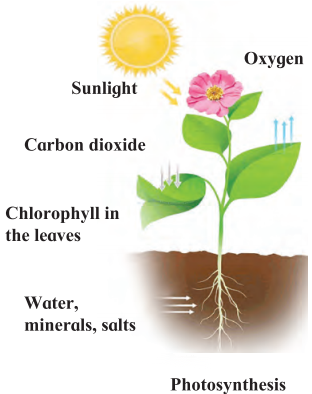
Observe the diagram and answer the following questions.

Question a.
Name the process shown in the picture.
Answer:
The process shown is photosynthesis.

Question b.
Which type of plants use the above process for their nutrition?
Answer:
Autotrophic plants (green plants) use the above process for their nutrition.

Question c.
What is the pigment in the leaf that helps in the above process?
Answer:
Chlorophyll

Question d.
Give the chemical equation of the above process?
Answer:

Question e.
What is the importance of this process to living things?
Answer:
Photosynthesis helps the plants to prepare their own food and also store it in their plant bodies. Animals depend upon this stored food for their nutrition.
During photosynthesis, oxygen is given out which is important for all living organisms for respiration.

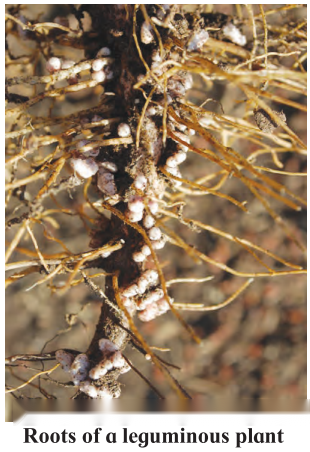
Observe the diagram and answer the following questions.

Question a.
What is shown in the picture?
Answer:
Roots of leguminous plants having root nodules.

Question b.
What is the importance of these types of plants?
Answer:
These types of plants help to provide nitrogen to the soil.

Question c.
What is the process called?
Answer:
Biological Nitrogen fixation

Question d.
Explain the process.
Answer:
Root nodules of leguminous plants contain Rhizobium micro-organisms. These micro¬organisms convert atmospheric nitrogen into nitrates. Thus the soil becomes rich in nitrogen.