Maharashtra State Board Class 8 History Solutions Chapter 4 The Freedom Struggle of 1857
Class 8 History Chapter 4 The Freedom Struggle Of 1857 Questions And Answers
Class 8 History Chapter 4 The Freedom Struggle of 1857 Textbook Questions and Answers
1. Rewrite the statements by choosing the appropriate options:
(Umaji Naik, War of Independence, Lord Dalhousie, Secretary of State, Tatya Tope)
2. Explain the following statements with reasons :
This resulted in armed rebellion of the Paikas against the British in 1817.
This proved that the wars are not fought only on bravery but also through military strategies.
3. Answer the following questions in brief:
Project:
Question 2
Maharashtra Board Solution
On an outline map of India indicate the regions where the freedom struggle of 1857 took place. |
Class 8 History Chapter 4 The Freedom Struggle of 1857 Additional Important Questions and
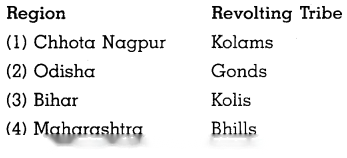
Identify the wrong pair, correct it and rewrite:
Question 1
Maharashtra Board Solution
Solution & Step-by-Step Answer:
block bg-white dark:bg-slate-900/80 border-l-4 border-emerald-500 rounded-r-xl p-5 my-3 shadow-xs border border-slate-200/60 dark:border-slate-800">
Solution & Step-by-Step Answer:
Wrong pair: Bihar – Kolis Corrected pair: Bihar – Santhals.
Name the following:
Question 1
Maharashtra Board Solution
Led the revolt of Paikas:
Solution & Step-by-Step Answer:
Bakshi Jaganbandhu Bidyadhar
Question 2
Maharashtra Board Solution
Last Mughal Emperor of Delhi:
Solution & Step-by-Step Answer:
Bahadur Shah
Question 3
Maharashtra Board Solution
Led the revolt of Bhills in Khandesh:
Solution & Step-by-Step Answer:
Kajarsingh
Question 4
Maharashtra Board Solution
Led the revolt in Satpura:
Solution & Step-by-Step Answer:
Shankarshah
Rewrite the statements by choosing the appropriate options:
Question 1
Maharashtra Board Solution
In 1806, Indian soldiers at …………. revolted. (a) Barrackpore (b) Meerut (c) Vellore (d) Delhi
Solution & Step-by-Step Answer:
(c) Vellore
Question 2
Maharashtra Board Solution
Governor General …………… annexed many states through Doctrine of Lapse. (a) Lord Warren Hastings (b) Lord Cornwallis (c) Lord Canning (d) Lord Dalhousie
Solution & Step-by-Step Answer:
(d) Lord Dalhousie
Question 3
Maharashtra Board Solution
Bahadur Shah who led the revolt was imprisoned at ……………. (a) Nepal (b) Rangoon (c) Sri Lanka (d) Andaman
Solution & Step-by-Step Answer:
(b) Rangoon
Question 4
Maharashtra Board Solution
………… fought for ten months against British but was caught due to betrayal. (a) Rango Bapuji (b) Bakht Khan (c) Tatya Tope (d) Ahmedullah
Solution & Step-by-Step Answer:
(c) Tatya Tope
Answer the following questions in one sentence:
Question 1
Maharashtra Board Solution
Why did the Indian sepoys at Meerut rebel against the British?
Solution & Step-by-Step Answer:
When the news that Mangal Pandey was arrested and hanged reached Meerut cantonment, the entire regiment of the Indian sepoys rebelled against the British.
Question 2
Maharashtra Board Solution
In which parts of North India did the revolt spread?
Solution & Step-by-Step Answer:
After Delhi, the revolt spread in Lucknow, Allahabad, Kanpur, Banaras, Bareli and Jhansi.
Question 3
Maharashtra Board Solution
Who fought the Crimean War?
Solution & Step-by-Step Answer:
The Crimean war was fought between Britain and Russia.
Question 4
Maharashtra Board Solution
Which policy did the British adopt to pollute the minds of Indians?
Solution & Step-by-Step Answer:
The British adopted the policy of ‘Divide and Rule’ to pollute the minds of the Indians.
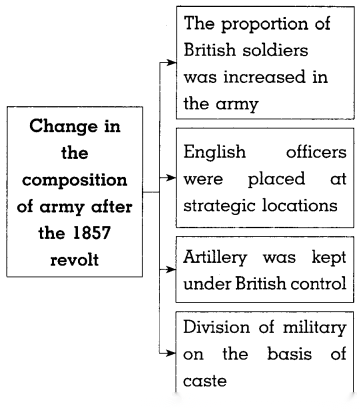
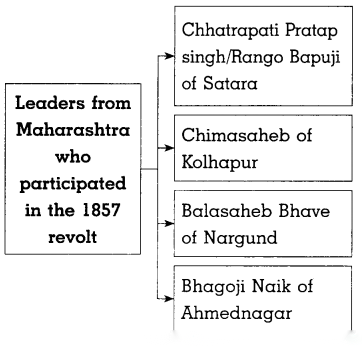
Complete the graphical presentation:
Question 1
Maharashtra Board Solution
Solution & Step-by-Step Answer:
Question 2
Maharashtra Board Solution
Solution & Step-by-Step Answer:
Question 3
Maharashtra Board Solution
Solution & Step-by-Step Answer:
Write Short Notes :
Question 1
Maharashtra Board Solution
Paika Rebellion:
Solution & Step-by-Step Answer:
Question 2
Maharashtra Board Solution
Rebellion of Umaji Naik:
Solution & Step-by-Step Answer:
1. Exploitation was on a large scale during the Company’s rule in India. There was rising discontent among the Indians. Sanyasis-Fakirs rebelled in the | Bengal province. 2. Umaji Naik organised the Ramoshis and the local youth and gave a strong fight to the British in Maharashtra. 3. They drafted a declaration and appealed to the people to support them in their fight against to overthrow the British government. 4. People in Ahmednagar, Satara, Pune, Nasik, Solapur and Bhor were inspired by them. 5. Umaji Naik was arrested and hanged to death in 1832 at Pune.
Explain the following statements with reasons:
Question 1
Maharashtra Board Solution
There was discontent among the Indian soldiers.
Solution & Step-by-Step Answer:
Question 2
Maharashtra Board Solution
Mangal Pandey was arrested and hanged.
Solution & Step-by-Step Answer:
Answer the following questions in brief :
Question 1
Maharashtra Board Solution
What changes were made in administration of India after the struggle of 1857?
Solution & Step-by-Step Answer:
After the struggle of 1857, the British Parliament made the following changes in the administration of India :
Question 2
Maharashtra Board Solution
Write about Queen’s Proclamation.
Solution & Step-by-Step Answer:
Read the given passage and answer the questions given below : Questions :
Question 1
Maharashtra Board Solution
Name the leaders of the struggle who lost their lives on the battlefield.
Solution & Step-by-Step Answer:
Rani Laxmibai, Kunwar Singh, Ahmedullah laid their lives on the battle field.
Question 2
Maharashtra Board Solution
Who was hanged to death?
Solution & Step-by-Step Answer:
Tatya Tope fought for ten months but was caught by betrayal and hanged to death.
Question 3
Maharashtra Board Solution
Which leaders took shelter in Nepal?
Solution & Step-by-Step Answer:
Nanasaheb Peshwa and Begum Hazrat Mahal took shelter in Nepal.
Answer the following questions in detail :
Question 1
Maharashtra Board Solution
Explain the reasons of the struggle of 1857 with following points : (1) Economic (2) Political
Solution & Step-by-Step Answer:
The reasons of 1857 freedom struggle : Economic :
Political : All these factors created discontent among artisans, princes and other classes f which ultimately led to the freedom struggle of 1857.
Question 2
Maharashtra Board Solution
Write about the struggles before 1857.
Solution & Step-by-Step Answer:
There was rising discontent among the Indians which led to many struggles before 1857 :
Question 3
Maharashtra Board Solution
How did the scope of the struggle increase?
Solution & Step-by-Step Answer:
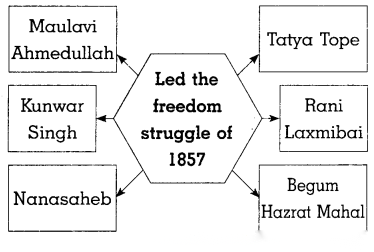
1. Mangal Pandey shot a British officer at Barrackpore cantonment who forced him to use cartridges greased with the fat of cows and pigs. 2. Mangal Pandey was arrested and hanged. News spread like fire to other cantonments. 3. The entire regiment of Indian soldiers at Meerut battled and marched towards Delhi. 4. On reaching Delhi, the rebels proclaimed Bahadur Shah as the Emperor of India. 5. It spread to the whole of north India. The soldiers in the cantonments from Bihar to Rajput ana participated in the revolt. 6. The revolt spread to Lucknow, Allahabad, Kanpur, Banaras, Bareli and Jhansi. 7. It spread to the whole of north India and in Nagpur, Satara, Kolhapur and Nargund, Khandesh in western India. 8. Many princely states, peasants and about 400 female Bhills participated in revolt at Khandesh to free themselves from the oppressive rule of the British. 9. The struggle was led by Bahadur Shah the Mughal Emperor, Nanasaheb Peshwa, Rani Laxmibai, Tatya Tope, Kunwar Singh of Bihar and Begum Hazrat Mahal of Ayodhya.
Question 4
Maharashtra Board Solution
Why did the struggle fail?
Solution & Step-by-Step Answer:
The reasons for the failure are as follows : 1. The struggle remained limited to the Northern part and it did not spread all over India at the same time. 2. Its intensity was severe in North India but Rajputana, Punjab but parts of Bengal and North-west India remained aloof. 3. Many princely states remained loyal to the British which reduced its intensity. 4. The majority of the rulers of the Indian states and the educated Indians kept away from the struggle. 5. Though the soldiers were brave they did not use military tactics. 6. As there was no commonly accepted leader to fight the British, there was no uniformity of the struggle. 7. On the other hand, the British had economic strength, experienced generals, disciplined army, latest weapons and modern means of transport and communication which made movements of the British swift. 8 The naval strength of the British was vast, while rebels were isolated.
Question 5
Maharashtra Board Solution
What lesson have we learnt from the struggle of 1857?
Solution & Step-by-Step Answer:
We learnt the following lesson from the struggle of 1857 : 1. Any challenge in front of the nation should be faced unitedly. 2. Each and every member of the society should keep in mind that if two people or groups disagree or have difference in opinion there are chances of third party creating misunderstanding and taking advantage of it. We need to be careful with such tendencies. 3. If the means to earn livelihood is taken away it creates discontent. Therefore, all should get means to earn livelihood. 4. The division in army, government offices and business should not be based on caste, race and religion. It should be based on merit and equality.
|