Maharashtra State Board Class 8 Science Solutions Chapter 10 Cell and Cell Organelles
Class 8 Science Chapter 10 Cell and Cell Organelles Textbook Questions and Answers
1. Who am I?
Question a.
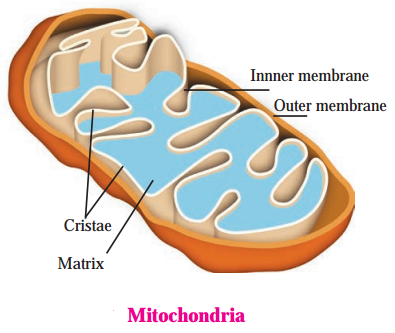
I am ATP producing factory.
Answer:
Mitochondria
Question b.
I am single-layered but maintain cellular osmotic pressure.
Answer:
Vacuole
Question c.
I support the cell, but I am not cell wall. I have a body resembling net.
Answer:
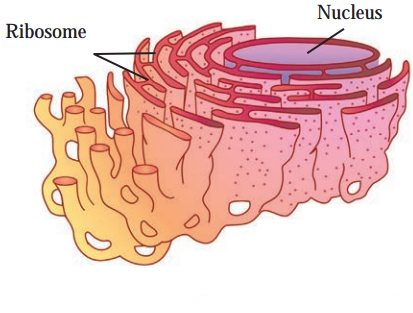
Endoplasmic reticulum
Question d.
I am chemical factory of the cell.
Answer:
Chloroplasts in case of plant cells can be called chemical factory as they synthesise carbohydrates. Ribosomes also synthesise proteins, so those can also be called chemical factory. Golgi complex is secretory in function, hence it can be also called factory. Mitochondria though mainly referred to as powerhouse of the cell, it is also mentioned as chemical factory by some authors.
Question e.
Leaves are green because of me.
Answer:
Chloroplast.
2. What would have happened? If……….
Question a.
RBCs had mitochondria.
Answer:
Mitochondria continuously carry out oxidation and form energy inside the cell. They produce energy-rich compound, ATP. In this process, they utilize carbohydrates, fats and proteins present in the cell. If RBCs has mitochondria, they would have used oxygen for this purpose than carrying it to all the cells of the body. The cells would not have obtained oxygen.
Question b.
There had been no difference between mitochondria and plastids.
Answer:
Mitochondria carry out oxidation of carbohydrates, fats, etc. with the help of enzymes. Plastids are synthesising carbohydrates with the help of solar energy and chlorophyll. Both the cell organelles have their own sets of different enzymes as per their role. If there would have been no difference between mitochondria and plastids, the specific functions would not have been taken place.
Question c.
Genes had been absent on the chromosomes.
Answer:
Genes are functional segments on the chromosomes which are responsible for transmitting the hereditary information.
Question d.
Plasma membrane had not been selectively permeable.
Answer:
Selectively permeable membrane allows some substances to enter the cell, while prevents other unwanted or harmful substances. If plasma membrane would not have been selectively permeable, there would be no control over entry and exit of any substances. The process of osmosis would also be erroneous in such case.
Question e.
Plants lacked anthocyanin.
Answer:
If plants lacked anthocyanin, no part of the plant would display purple or blue colour. Anthocyanin attracts the insects for pollination and seed dispersal. These processes will be affected due to lack of anthocyanin. These pigments are also said to be protective in nature for the plant. This protection will not be given to the plant in absence of anthocyanin.
3. Who is odd man among us? Give reason.
Question a.
Nucleolus, mitochondria, plastids, endoplasmic reticulum
Answer:
Nucleolus. (All the others are cell organelles but nucleolus is not a cell organelle present in cytoplasm.)
Question b.
DNA, Ribosomes, Chlorophyll
Answer:
Chlorophyll. (DNA and Ribosomes are present in plant as well as in animal cells. Chlorophyll is present only in plant cells.)
4. Give functions.
Question a.
Plasma membrane.
Answer:
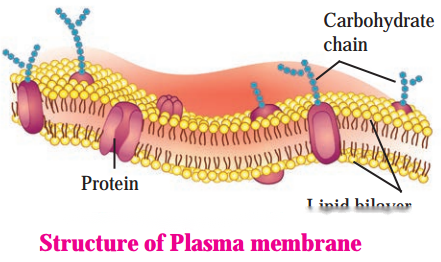
Question b.
Cytoplasm.
Answer:
Question c.
Lysosome.
Answer:

Question d.
Vacuole.
Answer:
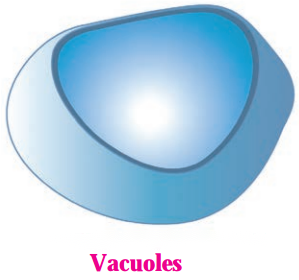
Question e.
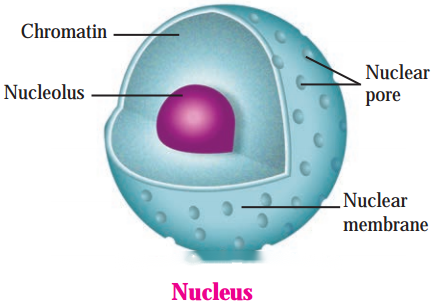
Nucleus.
Answer:
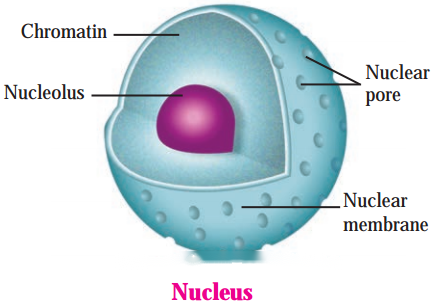
5. Who gives me the colour? (Select the correct option).
Question a.
Column ‘A’ | Column ‘B’ |
1. Red tomato | a. Chlorophyll |
2. Green leaf | b. Carotene |
3. Carrot | c. Anthocyanin |
4. Violet | d. Lycopene |
Answer:
Column ‘A’ | Column ‘B’ |
1. Red tomato | d. Lycopene |
2. Green leaf | a. Chlorophyll |
3. Carrot | b. Carotene |
4. Violet | c. Anthocyanin |
Project:
Question 2
Maharashtra Board Solution
Study osmosis using parchment paper or a similar membrane. |
Question 3. Form a friends’ group in your class. Give each one role of a cell organelle. Present a skit accordingly. |
Class 8 Science Chapter10 Cell and Cell OrganellesImportant Questions and
Rewrite the sentences after filling the blanks:
Question 1
Maharashtra Board Solution
Cell wall is mainly composed of carbohydrates like ……….. and …………..
Solution & Step-by-Step Answer:
block bg-white dark:bg-slate-900/80 border-l-4 border-emerald-500 rounded-r-xl p-5 my-3 shadow-xs border border-slate-200/60 dark:border-slate-800">
Solution & Step-by-Step Answer:
Cell wall is mainly composed of carbohydrates like cellulose and pectin.
Question 2
Maharashtra Board Solution
Plasma membrane is said to be a ……………. …………….. membrane as it allows some substances to enter the cell, while prevents other substances.
Solution & Step-by-Step Answer:
Plasma membrane is said to be a selectively permeable membrane as it allows some substances to enter the cell, while prevents other substances.
Question 3
Maharashtra Board Solution
Homeostasis is maintained in the cell by …………...
Solution & Step-by-Step Answer:
Homeostasis is maintained in the cell by plasma membrane.
Question 4
Maharashtra Board Solution
An …………… is a specialized subunit having specific function within the cell.
Solution & Step-by-Step Answer:
An organelle is a specialized subunit having specific function within the cell.
Question 5
Maharashtra Board Solution
……………. has ribosome granules on its outer surface.
Solution & Step-by-Step Answer:
Rough ER has ribosome granules on its outer surface.
Question 6
Maharashtra Board Solution
During starvation, ………………… digest stored proteins, fats.
Solution & Step-by-Step Answer:
During starvation, lysosomes digest stored proteins, fats.
Question 7
Maharashtra Board Solution
……………….. is the secretory organ of the cell.
Solution & Step-by-Step Answer:
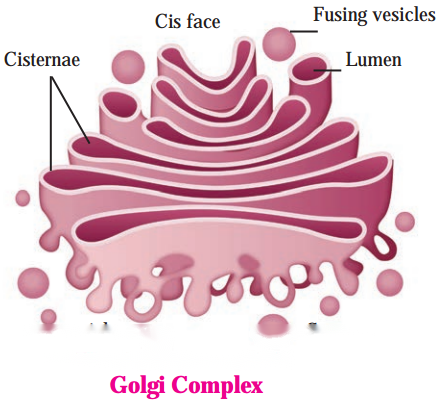
Golgi complex is the secretory organ of the cell.
Question 8
Maharashtra Board Solution
……………. compound ATP is produced in the mitochondria.
Solution & Step-by-Step Answer:
Energy-rich compound ATP is produced in the mitochondria.
Given below are incorrect statements. Rewrite them after correcting them:
Question 1
Maharashtra Board Solution
In mitochondria, the inner membrane is porous and the outer membrane is deeply folded.
Solution & Step-by-Step Answer:
In mitochondria, the outer membrane is porous and the inner membrane is deeply folded.
Question 2
Maharashtra Board Solution
Vacuole is bound by double membrane.
Solution & Step-by-Step Answer:
Vacuole is bound by single membrane.
Question 3
Maharashtra Board Solution
If fruit pieces are kept in thick saturated sugar solution, the water from fruit pieces enter the sugar solution resulting into their swelling.
Solution & Step-by-Step Answer:
If fruit pieces are kept in a thick saturated sugar solution, the water from fruit pieces enter the sugar solution resulting into their shrinking.
Question 4
Maharashtra Board Solution
Raisins kept in water shrink after an hour.
Solution & Step-by-Step Answer:
Raisins kept in water swell after an hour.
Question 5
Maharashtra Board Solution
Lysosome produces vacuoles and secretory vesicles.
Solution & Step-by-Step Answer:
Golgi complex produces vacuoles and secretory vesicles.
Who gives me the colour? (Select the correct option)
Question 1
Maharashtra Board Solution
|
Column ‘A’ | Column ‘B’ |
1. Nucleus | a. Pipelines of the cell |
2. Endoplasmic reticulum | b. Powerhouse of the cell |
3. Golgi complex | c. Suicidal bags |
4. Mitochondria | d. Packing department |
5. Lysosomes | e. Controlling centre |