Maharashtra State Board Class 8 Science Solutions Chapter 12 Introduction to Acid and Base
Class 8 Science Chapter 12 Introduction to Acid and Base Textbook Questions and Answers
1. Identify the following solutions, whether they are acid or base.
Question a.
Answer:

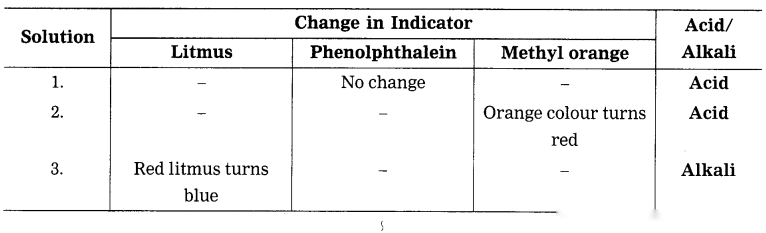
2. Write chemical names from given formulae.
H2SO4, Ca(OH)2, HCl, NaOH, KOH, NH4OH
Question a.
Write the chemical names from given formulae: H2SO4, Ca(OH)2, HCl, NaOH, KOH, NH4OH
Answer:
3. Sulphuric acid has highest importance in chemical Industry. Why?
Question a.
Sulphuric acid has highest importance in chemical Industry. Why?
Answer:
Answer:
Sulphuric acid has highest importance in the chemical industry because it is used in the manufacturing of fertilizers like ammonium sulphate and superphosphate of lime. It is used in the manufacturing of hydrochloric acid, nitric acid, phosphoric acid, ether, plastics and metal sulphates. It is also used in the manufacturing of dyes, drugs, perfumes, disinfectants and glue.
4. Give answers.
Question a.
Which acid is used for getting chloride salt?
Answer:
Hydrochloric acid is used for getting chloride salt.
Question b.
By squeezzing lemon on a piece of rock the gas liberated turned lime water milky. Which compound is present in the rock?
Answer:
Metal carbonate is present in the rock.
Question c.
The label on the bottle of chemical is spoiled. How will you find whether the chemical is acidic or not?
Answer:
The chemical is tested with blue litmus paper. If it turns red it is an acidic otherwise tested with red litmus paper, if it turns blue, it is an alkaline.
5. Answer the following questions.
Question a.
Explain the difference between acid and base.
Answer:
Acids:
Bases:
Question b.
Why indicator does not affect by salt?
Answer:
Mostly indicators are organic compounds which do not react with a salt.
Question c.
Which substances are produced i by neutralization process?
Answer:
Salt and water are produced in the f neutralization process.
Question d.
Which are the industrial uses of acids?
Answer:
Acids which are used in the industry are:
1. Sulphuric acid: Sulphuric acid is 5 used (a) in the manufacture of chemical? fertilizers like ammonium sulphate, (b) for cleaning gold and silver articles and (c) in car batteries.
2. Hydrochloric acid: Hydrochloric acid is used (a) to clean toilets and (b) to obtain glucose from starch and also for producing gelatine.
3. Nitric acid: Nitric acid is used (a) in the manufacture of perfumes (b) for engraving on copper, brass or silver and (c) in the manufacture of paints and explosives.
6. Select proper word given in bracket and fill in the blanks.
Question a.
Main constituent of acid is ……………..
Answer:
Main constituent of acid isH+ion.
Question b.
Main constituent of alkali is ……………...
Answer:
Main constituent of alkali isOH–ion.
Question c.
Tartaric acid is a …………… acid.
Answer:
Tartaric acid is aweakacid.
7. Match the pairs.
Question a.
Group A | Group B |
1. Tamarind | a. Acetic acid |
2. Curd | b. Citric acid |
3. Lemon | c. Tartaric acid |
4. Vinegar | d. Lactic acid |
Answer:
Group A | Group B |
1. Tamarind | c. Tartaric acid |
2. Curd | d. Lactic acid |
3. Lemon | b. Citric acid |
4. Vinegar | a. Acetic acid |
8. State true or false.
Question a.
Oxides of metals are alkaline in nature.
Answer:
True.
Question b.
Salt is acidic.
Answer:
False. (Salt is neutral)
Question c.
Metal corrodes due to salts.
Answer:
False. (Acids and bases corrode metals)
Question d.
Salts are neutral.
Answer:
True. (Not all salts neutral)
9. Classify the following substances into acidic, basic and neutral group:
HCl, NaCl, MgO, KCl, CaO, H2SO4, HNO3, H2O and Na2CO3.
Question a.
Classify the following substances into acidic, basic and neutral group:
HCl, NaCl, MgO, KCl, CaO, H2SO4, HNO3, H2O and Na2CO3.
Answer:
Group | Substances |
Acid | HCl, H2SO4, HNO3 |
Base | CaO, MgO, Na2CO3 |
Neutral | H2O, NaCl, KCl. |
Project:
Question a.
Write in your own language the uses and importance of neutralization reaction in daily life.
Class 8 Science Chapter12 Introduction to Acid and BaseImportant Questions and Answers
Fill in the blanks:
Rewrite the following statements by selecting the correct options:
State whether the following statements are true or false. If a statement is false, correct it and rewrite:
Find the odd one out and justify:
Match the following:
Column ‘A’ | Column ‘B’ |
1. Strong acid | a. Magnesium hydroxide |
2. Weak alkali | b. Carbonic acid |
3. Weak acid | c. NaOH |
4. Strong alkali | d. Nitric acid |
Column ‘A’ | Column ‘B’ |
1. Strong acid | d. Nitric acid |
2. Weak alkali | a. Magnesium hydroxide |
3. Weak acid | b. Carbonic acid |
4. Strong alkali | c. NaOH
Question 2
Maharashtra Board Solution
|
Column ‘A’ | Column ‘B’ |
1. Sodium hydroxide | a. Whitewashing |
2. Magnesium hydroxide | b. Fertilizers |
3. Calcium hydroxide | c. Washing soap |
4. Ammonium hydroxide | d. Antacid |
Column ‘A’ | Column ‘B’ | ||||||||||||||||||||||||||||||||||||
1. Sodium hydroxide | c. Washing soap | ||||||||||||||||||||||||||||||||||||
2. Magnesium hydroxide | d. Antacid | ||||||||||||||||||||||||||||||||||||
3. Calcium hydroxide | a. Whitewashing | ||||||||||||||||||||||||||||||||||||
4. Ammonium hydroxide | b. Fertilizers Define the following: 1. Acid: A substance which gives H+ions in water is called an acid.
2. Alkali: A substance which gives OH–ions in water is called an alkali.
3. Indicator: Substances which change their colours in presence of acid or base are called indicators. 4. Neutralization: The reaction between an acid and an alkali to form the r salt and water is termed as neutralization. Answer the following questions in one sentence each:
Question 1
Maharashtra Board Solution
What are natural acids?
Solution & Step-by-Step Answer:
Acids present in foodstuffs are called natural acids.
Question 2
Maharashtra Board Solution
State three vegetables from which natural indicators can be prepared.
Solution & Step-by-Step Answer:
Natural indicators: Red cabbage, radish, tomato.
Question 3
Maharashtra Board Solution
State names of any three strong acids.
Solution & Step-by-Step Answer:
Question 4
Maharashtra Board Solution
State the names of the acids found in lemon juice, Amla, tamarind water and curd.
Solution & Step-by-Step Answer:
Question 5
Maharashtra Board Solution
State names of any three alkalis.
Solution & Step-by-Step Answer:
Question 6
Maharashtra Board Solution
State the names of three indicators.
Solution & Step-by-Step Answer:
Question 7
Maharashtra Board Solution
State the names of three weak alkalis.
Solution & Step-by-Step Answer:
Question 8
Maharashtra Board Solution
From which plant is litmus obtained?
Solution & Step-by-Step Answer:
Litmus is obtained from plants called lichens.
Question 9
Maharashtra Board Solution
Name the antacid which is used to control the hyper acidity.
Solution & Step-by-Step Answer:
Milk of magnesia [Mg(OH)2] is used to control the hyper acidity.
Question 10
Maharashtra Board Solution
How will you neutralize the excess of acid present in the soil?
Solution & Step-by-Step Answer:
Lime stone or lime water is mixed in the soil to neutralize the excess of acid.
Question 11
Maharashtra Board Solution
When lemonuice falls on a marble kitchen counter, which is the gas that bubbled out?
Solution & Step-by-Step Answer:
Carbon dioxide.
Answer the following questions:
Question 1
Maharashtra Board Solution
What are indicators?
Solution & Step-by-Step Answer:
Substances which change their colours in presence of acid or base are called indicators.
Question 2
Maharashtra Board Solution
State two acid-base indicators and mention their colour change.
Solution & Step-by-Step Answer:
Phenolphthalein and methyl orange are two acid-base indicators. Phenolphthalein is colourless in an acidic solution while it turns pink in a basic solution. Methyl orange gives orange colour with an acidic solution and yellow colour with a basic solution.
Question 3
Maharashtra Board Solution
State the colour change for each of the following solutions with red litmus, blue litmus, phenolphthalein and methyl orange solutions.
Solution & Step-by-Step Answer:
Question 4
Maharashtra Board Solution
Name the acid present in (1) Orange (2) Vinegar (3) Tamarind (4) Curd (5) Tomato (6) Lemon.
Solution & Step-by-Step Answer:
Question 5
Maharashtra Board Solution
Classify the following into acidic substances, basic substances and salts. (1) Lime water, (2) soda water, (3) soap water, (4) sea water, (5) sweet limeuice, (6) sugar caneuice, (7) buttermilk, (8) a mixture of ash in water, (9) tamarind water.
Solution & Step-by-Step Answer:
a. Acidic substances: (1) Soda water, (2) sweet limeuice, (3) buttermilk, (4) tamarind water. b. Basic substances: (1) Lime water, (2) Soap water, (3) a mixture of ash in water. c. Salts: (1) Sea water, (2) sugar caneuice.
Question 6
Maharashtra Board Solution
What happens when sour substances like limeuice, tamarind water falls on shahabad stones or kitchen platform? Why?
Solution & Step-by-Step Answer:
When sour substances like limeuice, tamarind water falls on shahabad stones or kitchen platform, citric acid present in limeuice and tartaric acid in tamarind water reacts with metal carbonates present in shahabad stones or kitchen platform, carbon dioxide gas is evolved resulting in the formation of uneven surface.
Question 7
Maharashtra Board Solution
Collect soil samples from your surroundings and find out whether it is acidic or alkaline or neutral?
Solution & Step-by-Step Answer:
Soil samples collected from the surroundings are acidic in nature.
Question 8
Maharashtra Board Solution
Which substances are used to clean greenish stains on copper vessels and to shine blackish silver utensils?
Solution & Step-by-Step Answer:
Tamarind pulp is used to clean greenish stains on copper vessels. To shine blackish silver utensils, ammoniacal solution or limeuice or detergent is used.
Question 9
Maharashtra Board Solution
Why toothpaste is used for brushing teeth?
Solution & Step-by-Step Answer:
Question 10
Maharashtra Board Solution
State the properties of acids.
Solution & Step-by-Step Answer:
Question 11
Maharashtra Board Solution
State the uses of acids.
Solution & Step-by-Step Answer:
Question 12
Maharashtra Board Solution
The iron knife shines better after cutting the sour fruits like lemon, raw mangoes. Why?
Solution & Step-by-Step Answer:
Acids present in sour fruits clean and dissolves the salts present on the surface of iron knife as a result iron knife shines better after cutting the sour fruits.
Question 13
Maharashtra Board Solution
What is meant by neutralization? Give example.
Solution & Step-by-Step Answer:
When an acid reacts with an alkali to form a salt and water, it is called neutralization.
Give scientific reasons:
Question 1
Maharashtra Board Solution
When we have stomachache, doctors prescribe medicine containing magnesium hydroxide.
Solution & Step-by-Step Answer:
Question 2
Maharashtra Board Solution
Quicklime or slaked lime is added to the soil.
Solution & Step-by-Step Answer:
Question 3
Maharashtra Board Solution
Tarnished and stained copper vessels are brought to a shine by using tamarind pulp.
Solution & Step-by-Step Answer:
In due course, unus6d copper vessels are covered with a coating of black copper oxide and other compounds of copper which tarnish the vessel. Tamarind contains tartaric acid. When the vessel is rubbed with tamarind pulp, tartaric acid reacts with copper oxide and removes the layer. Thus, the copper vessel regains its shine.
Question 4
Maharashtra Board Solution
Copper and brass utensils are tinned.
Solution & Step-by-Step Answer:
Copper and brass reacts with i organic acids present in food materials and poisonous salts are formed. Tin does not react with organic acids present in food materials. Therefore, copper or brass vessels are tinned.
Distinguish between acid and alkali. OR Distinguish between the following:
Question 1
Maharashtra Board Solution
Acid and Alkali:
Solution & Step-by-Step Answer:
Activity-based questions: Activity 1: After drying make strips of that paper. Prepare turmeric indicator paper in this way. Put leaves of red cabbage in small quantity of water and heat it. Once solution of cabbage leaves cool down, dip papers in it and dry it. Make strips of dried paper. In this way prepare red cabbage indicator paper. Put some drops of following substances on the indicator papers prepared by the above method and write the effect in the following table:
Activity 2: Activity 3:
|


