Maharashtra State Board Class 9 English Kumarbharati Solutions Chapter 1.3 Have you ever seen…?
English Kumarbharati 9th Solutions Chapter 1.3 Have you ever seen…? Textbook Questions and Answers
Warming Up:
1. Words that have the same spelling, but differ in meaning when used in different contexts are called homographs. For example,
(a) A templefairattracts a lot of crowd.
Her performance in the test wasfair.
(b) Aroseis the king of flowers.
The sunrosewith a golden glow.
Think of 5 homographs and list them below. Then write 2 sentences of your own, to bring out the difference in meanings.
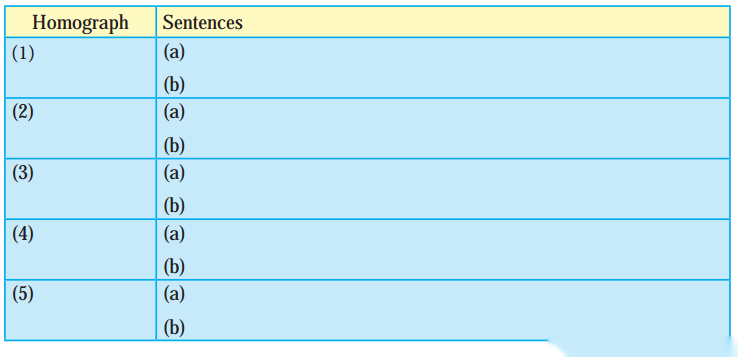
Homographs | Sentences |
1. bow | (a) The prince slowly put down the bow and arrow. |
2. content | (a) One should always be content with what one has. |
3. live | (a) One must learn to live within one’s means. |
4. minute | (a) His voice was getting louder every minute. |
5. tear | (a) A tear fell from the eye of the old woman. |
2. When words with the same spelling or pronunciation are used in such a way that they convey more than one meaning, the figure of speech involved is called pun. A pun is a play upon words. For example,
A: Hello! How’s life?
B: Hell, O! It’s a strife.
Find other examples of pun with the help of your parents/teacher.
3. In poetry, when a question is asked, not to get an answer, but to emphasise a point or fact, it is an example of Interrogation.
For example :
When can their glory fade?
Isn’t it time for the autumn’s glow?
From a popular book of poems/the internet, write down 3-4 examples of Interrogation used in poetry.
English Workshop:
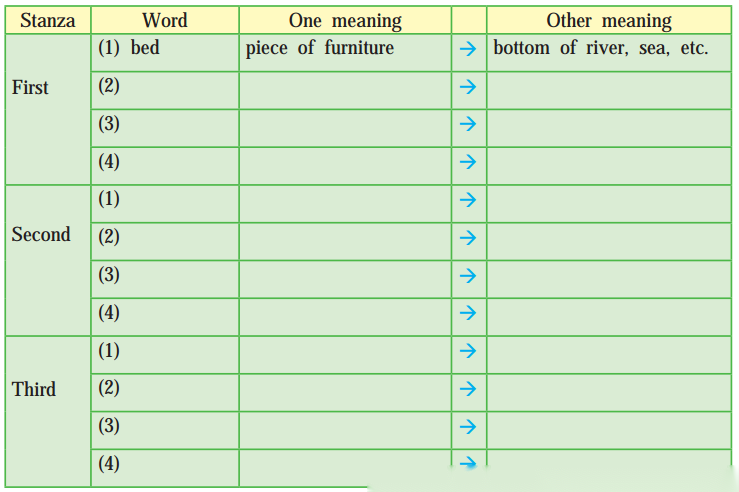
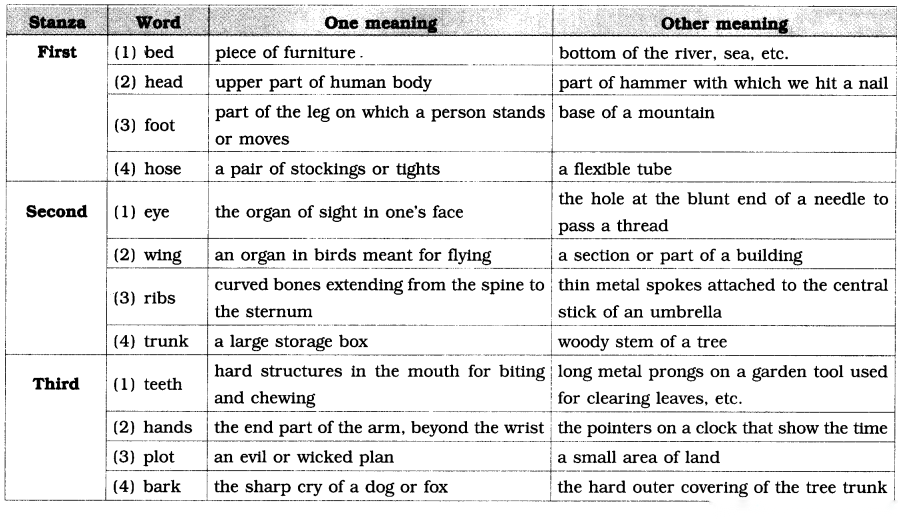
1. From each line in the poem, pick out the word that is a homograph. Write its meaning in the context of the phrase used in the poem. Then write the other meaning implied in the question.
2. Write 2 lines from this poem which you find most humorous. Justify your choice.
…………………………………………………………………………………………………………………………………………………
…………………………………………………………………………………………………………………………………………………
3. Find from the poem, three examples of each :
(a) Interrogation
1. …………………….
2. ……………………
3. ……………………
(b) Pun
1. …………………….
2. ……………………
3. ……………………
(c) Personification
1. …………………….
2. ……………………
3. ……………………
(d) Alliteration
1. …………………….
2. ……………………
3. ……………………
(b) Pun :
(c) Personification :
(d) Alliteration :
4. Form groups of four or five. Think, discuss and add at least one more stanza, using the same style and devices as the poet has used. It should include homographs, interrogation and the same rhythm and rhyme scheme.
5. Read the following sentences carefully. Then fill in the blanks using appropriate words from the brackets, to make puns.
(struck, numbered, too tired, developed, put down, homeless, old fashioned, reaction)
6. ‘Read: ‘Alice in Wonderland’ – by Lewis Carroll.
Question 1
Maharashtra Board Solution
‘Read: ‘Alice in Wonderland’ – by Lewis Carroll.
English Kumarbharati 9th Digest Chapter 1.3 Have you ever seen…? Additional Important Questions and
Read the following poem carefully and complete the activities : Simple Factual Activity : |
Complex Factual Activities :
Question 1
Maharashtra Board Solution
What does the poet want to know about a hammer?
Solution & Step-by-Step Answer:
block bg-white dark:bg-slate-900/80 border-l-4 border-emerald-500 rounded-r-xl p-5 my-3 shadow-xs border border-slate-200/60 dark:border-slate-800">
Solution & Step-by-Step Answer:
The poet asks if anyone has seen a single hair on the head of a hammer.
Question 2
Maharashtra Board Solution
What is the pun in the word ‘plot’ here?
Solution & Step-by-Step Answer:
A plot means ‘an evil or wicked plan’. A plot ’ also means an area in a garden or some place. The poet asks how a garden ‘plot’ (one meaning of the word) can be evil and dark (the other meaning of the word).
Activities based on Poetic Devices :
Question 1
Maharashtra Board Solution
Find the rhyming words from the poem.
Solution & Step-by-Step Answer:
Maharashtra State Board Class 9 English Solutions |