Maharashtra State Board Class 9 English Kumarbharati Solutions Chapter 2.5 Autumn
English Kumarbharati 9th Solutions Chapter 2.5 Autumn Textbook Questions and Answers
Warming up:
1. What changes do you see in nature in each of the following seasons? A few sentences are given below as examples. Use these and your own to describe a season appropriately.

(b) Winter:
(c) Monsoon:
Question a.
Name the six seasons according to the Indian calendar. Which of these seasons is equivalent to Autumn?
Answer:
The six seasons according to the Indian calendar are :
Vasant, Grishma, Varsha, Sharad, Hemant and Shishir. Sharad Ritu is equivalent to Autumn.
Question b.
What changes do we see in the life of human beings when the season changes? Write with reference to their (a) clothes (b) diet
(c) celebrations.
Answer:
(a) clothes :
Points :
(b) diet :
Points :
(c) celebrations :
Points :
2. Guess what is personified and fill in the gaps. Choose from the brackets.
(Sun, alarm, bird, car, wind, stars, machine)
English Workshop:
1. Find three lines each, that contain images of nature in the autumn season...
(b) At night :
2. Pick out words from the poem that describe the following. List them in Column ‘A’. Substitute each of those describing words with another word/phrase of the same meaning.
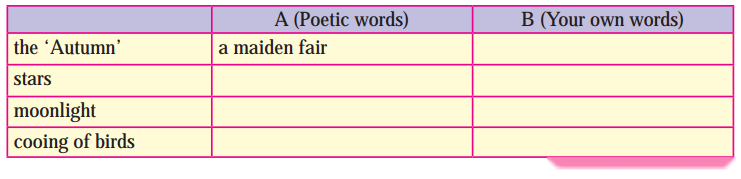
A (Poetic words) | B (Your own words) | |
1. The Autumn | A maiden fair | A beautiful maiden |
2. Stars | Multitudinous | Numerous, Countless |
3. Moonlight | White | Silvery |
4. Cooing of birds | A bracelet’s tinkling | A musical sound |
3. Find one example of each of the following from the poem :
Simile
Metaphor
4. Write the rhyme scheme of the poem.
5. Think and write in your own words.
Question a.
Why is the maiden Autumn said to wear rice stems in her hair?
Answer:
Probably the harvest of the rice crop is just over at the beginning of Autumn; hence the maiden Autumn is said to wear rice stems in her hair.
Question b.
How can the tender maiden Autumn become a full grown woman? What change in nature does it imply?
Answer:
When the Autumn season is just beginning, Autumn is a tender maiden, young and graceful. As the season progresses and sets in properly, she becomes a full grown, mature woman. It implies that time has passed and the season has changed.
Question c.
Why do you think that birds greet the autumn season gladly?
Answer:
Probably the birds enjoy the cool autumn after the hot summer. They may also get more grains and seeds to eat.
6. Compare the Indian Monsoon season to a powerful king of a prosperous kingdom. Write down a few similarities. Use them to compose a poem of your own.
7. Which is your favourite ‘Nature’ poem from your mother tongue? Write the poem and try to translate it into English. Your translation can be in the form of a poem or a paraphrase.
8. Read the ode ‘To Autumn’ by the famous poet John Keats. ‘Season of mists and mellow fruitfulness…’
English Kumarbharati 9th Digest Chapter 2.5 Autumn Additional Important Questions and Answers
Read the following poem carefully and complete the activities:
Simple Factual Activity:
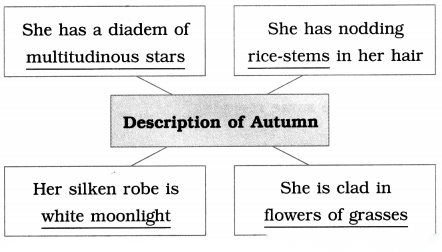
1. Complete the web:
(The answers are underlined directly.)
Complex Factual Activities:
Question 1
Maharashtra Board Solution
What is the cooing of birds compared to?
Solution & Step-by-Step Answer:
block bg-white dark:bg-slate-900/80 border-l-4 border-emerald-500 rounded-r-xl p-5 my-3 shadow-xs border border-slate-200/60 dark:border-slate-800">
Solution & Step-by-Step Answer:
The cooing of birds is compared to the tinkling song of a bracelet.
Question 2
Maharashtra Board Solution
How does Autumn dress up at night?
Solution & Step-by-Step Answer:
At night Autumn wears a twinkling crown made of countless stars. Her robe of silk is the white moonlight, set free from the cloudy patches.
Question 3
Maharashtra Board Solution
Why is Autumn called a ‘maiden fair’?
Solution & Step-by-Step Answer:
Autumn is said to be slender and graceful. She has adorned herself by having rice-stems in her hair and lilies in her face. She is dressed in flowers of grasses. Hence, she is called a ‘maiden fair’.
Paragraph Format: In the poem ‘Autumn’, the poet Kalidas has lovingly and picturesquely described the advent of the Autumn season. The original poem in Sanskrit is translated into English by Prof. A. W. Ryder. The Rhyme Scheme is ababcdcd. A Figure of Speech that stands out is Alliteration: ‘She seems a slender maid, who soon…’. Repetition of the sound of the letter ‘s’. Other figures of speech are Simile and Metaphor. The poet has compared Autumn to a slender and graceful maiden who has adorned herself in various ways. Maharashtra State Board Class 9 English Solutions |