Maharashtra State Board Class 9 Geography Solutions Chapter 6 Properties of Sea Water
Class 9 Geography Chapter 6 Properties of Sea Water Textbook Questions and Answers
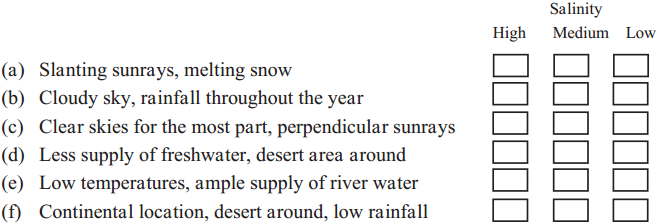
1. Tick the correct box according to the salinity of the ocean water ✓
Answer:
(a) Low
(b) Low
(c) High
(d) High
(e) Low
(f) High.
2. Give reasons.
(a) Salinity is low in the land-locked Baltic Sea.
Answer:
(b) There is higher salinity in the northern Red Sea while lower in the southern.
Answer:
(c) Oceans located at the same latitude do not have same salinity.
Answer:
(d) With increasing depth, the temperature of sea water decreases to a certain limit.
Answer:
With increasing depth, the temperature of sea water decreases to a certain limit because –
(e) There are more salt-pans on the Western coast of India than its eastern coast.
Answer:
(f) Salinity increases in the mid-latitudinal zones.
Answer:
3. Answer the following questions.
(a) What are the factors affecting the salinity of the sea water?
Answer:
(b) Explain the distribution of salinity around the Tropic of Cancer and tropic of Capricorn.
Answer:
(c) What are the factors affecting the temperature of the sea water?
Answer:
(d) Explain the changes occurring in the temperature of sea water according to the depth.
Answer:
(e) Name the factors affecting salinity.
Answer:
Due to the sun’s heat, evaporation happens at a faster rate. Evaporated water turns into water vapour and reduces in quantity. But amount of salt remains the same in the remaining water and therefore the salinity of water increases.
4. Explain how temperature affects the following.
(a) the density of sea water
Answer:
(b) the salinity of sea water
Answer:
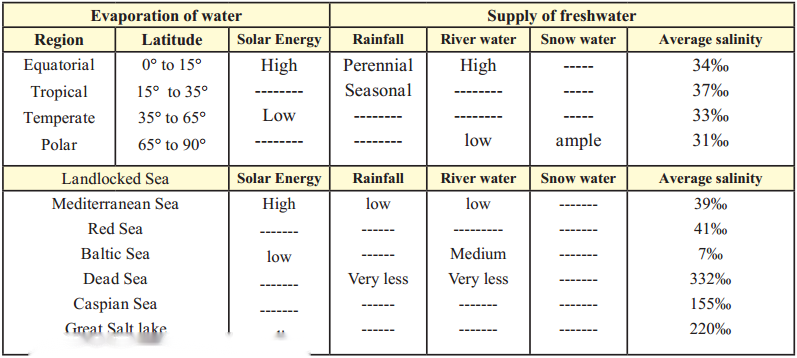
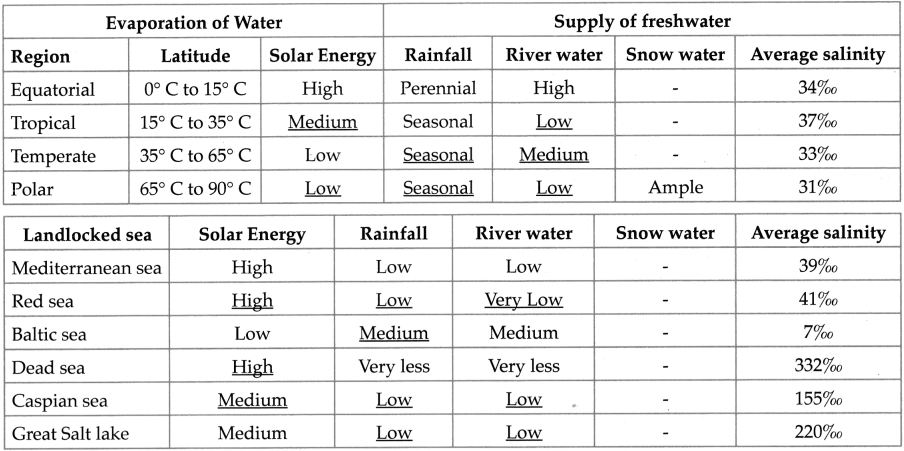
Activity:
Complete the table showing the salinity of open and land-locked seas.
Answer:
Class 9 Geography Chapter 6 Properties of Sea Water Intext Questions and Answers
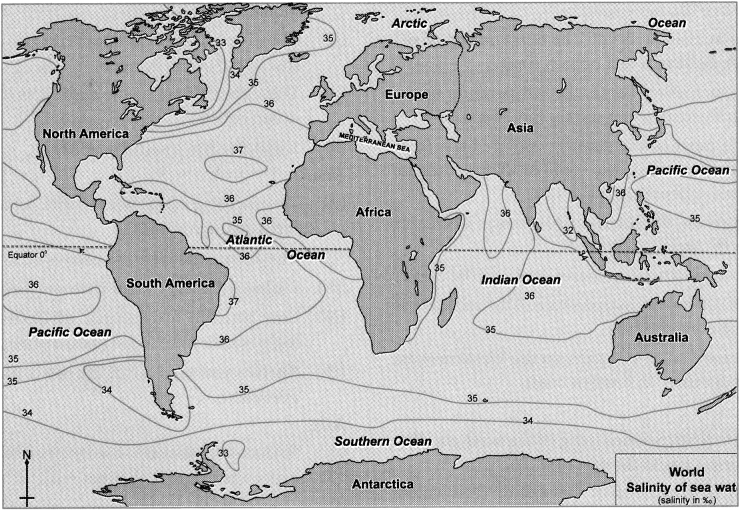
Observe the following Map and answer the questions:
Solution & Step-by-Step Answer:
The salinity around the tropics is 36%o.
Solution & Step-by-Step Answer:
The Bay of Bengal has the least salinity of 32%o.
Solution & Step-by-Step Answer:
Atlantic ocean has salinity of more than 37%o.
Solution & Step-by-Step Answer:
The uneven distribution of temperature on earth, and uneven supply of freshwater, etc. are the reasons for differences in salinity on a global level.
Observe the Graph and answer the questions:
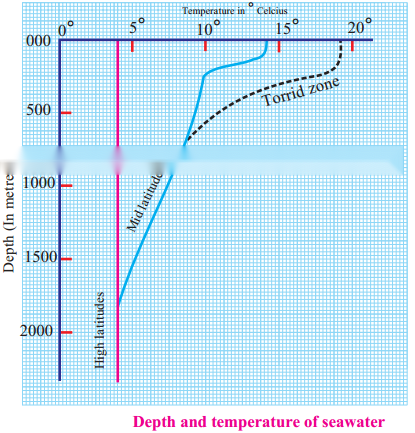
Solution & Step-by-Step Answer:
The maximum temperature of sea water in equatorial areas is 18° C. The temperature at the depth of 500 m is 11° C.
Solution & Step-by-Step Answer:
The temperature of seawater at the sea level in the mid-latitudes is 14° C approximately.
Solution & Step-by-Step Answer:
The temperature is about 5° C at the depth of 1500 m. Thus the temperature of sea water at mid-latitudes has changed from 14°C at the sea level to about 5°C at the depth of 1500 m i.e. temperature has changed (reduced) by 9°C.
Solution & Step-by-Step Answer:
In high latitudes the temperature of sea water at all depths remains constant at 4° C.
Solution & Step-by-Step Answer:
After 2000 m, the temperature of the sea water is uniform everywhere.
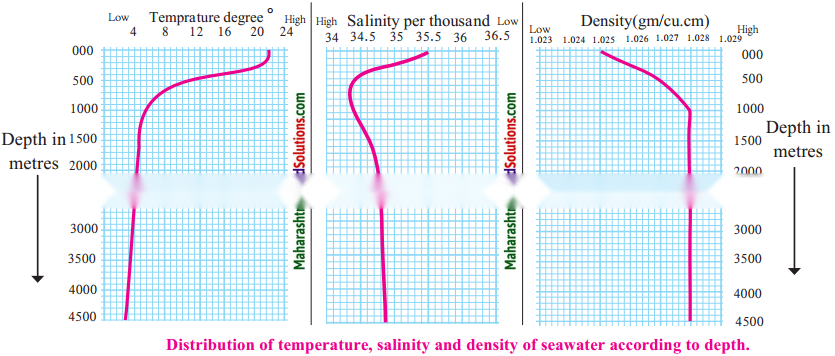
Solution & Step-by-Step Answer:
Temperature and salinity decreases with increasing depth.
Solution & Step-by-Step Answer:
After the depth of 1000 m there is no change in all these factors.
Solution & Step-by-Step Answer:
The higher change can be seen up to a depth of about 500m.
Solution & Step-by-Step Answer:
If the temperature is less, density is more. If the salinity is less, then density is also less. However temperature affects the density more as compared to the salinity. If the temperature is less, then the density is more despite less salinity.
Let’s Recall.
Solution & Step-by-Step Answer:
Oceans are the largest water storage of the world.
Solution & Step-by-Step Answer:
Solution & Step-by-Step Answer:
High rate of evaporation and low supply of fresh water leads to high salinity in the oceans:
Solution & Step-by-Step Answer:
Solution & Step-by-Step Answer:
Can You Tell?
Solution & Step-by-Step Answer:
During the daytime land is hotter than the sea whereas, during the night time land is cooler than the sea.
Solution & Step-by-Step Answer:
Latitudinally, the surface temperature of the seawater decreases from the equatorial areas towards the poles. The average temperature in equatorial areas is around 25° C while it is about 2° C near the poles.
Think about it.
Solution & Step-by-Step Answer:
Many large peninsular rivers drain their waters in the Bay of Bengal and on the contrary only small seasonal coastal rivers drain in the Arabian sea. Hence the salinity of Arabian sea is more than the Bay of Bengal.
Try this.
Solution & Step-by-Step Answer:
Solution & Step-by-Step Answer:
Solution & Step-by-Step Answer:
Class 9 Geography Chapter 6 Properties of Sea Water Additional Important Questions and Answers
Select the correct option:
Solution & Step-by-Step Answer:
(a) 25°C
Solution & Step-by-Step Answer:
(c) 16°C
Solution & Step-by-Step Answer:
(d) 2°C
Solution & Step-by-Step Answer:
(b) decreases
Solution & Step-by-Step Answer:
(b) surface water
Solution & Step-by-Step Answer:
(d) Atlantic
Solution & Step-by-Step Answer:
(d) 332
Solution & Step-by-Step Answer:
(b) salinity
Solution & Step-by-Step Answer:
(c) Dead sea
Solution & Step-by-Step Answer:
(a) Ocean currents
Solution & Step-by-Step Answer:
(a) Temperature
Solution & Step-by-Step Answer:
(b) landlocked seas
Solution & Step-by-Step Answer:
(d) 2000m
Solution & Step-by-Step Answer:
(b) less
Solution & Step-by-Step Answer:
(a) equatorial
Solution & Step-by-Step Answer:
(b) high
Solution & Step-by-Step Answer:
(a) less
Solution & Step-by-Step Answer:
(d) polar
Solution & Step-by-Step Answer:
(d) 7
Match the Column:
Column A | Column B |
(1) Equatorial areas
(2) Mid-latitudinal areas
(3) Temperate regions | (a) Salinity of 332%o
(b) Slanting sunrays, melting of snow
(c) Cloudy sky and convectional rainfall
(d) Hot deserts |
Answer:
(1-c),
(2- d),
(3 – b)
Answer in one sentence:
Solution & Step-by-Step Answer:
Temperature is a major property of seawater.
Solution & Step-by-Step Answer:
The average surface temperature of seawater is equatorial areas is around 25°C in mid-latitude it is around 16°C & 2°C near the poles.
Solution & Step-by-Step Answer:
After 2000m, the temperature of seawater is uniform everywhere
Solution & Step-by-Step Answer:
Hydrometer, Refractometer and salinometer are used to measure salinity.
Solution & Step-by-Step Answer:
The Atlantic ocean is the most saline ocean.
Give geographical reasons:
Solution & Step-by-Step Answer:
Solution & Step-by-Step Answer:
Solution & Step-by-Step Answer:
Solution & Step-by-Step Answer:
Explain
Solution & Step-by-Step Answer:
Solution & Step-by-Step Answer:
Solution & Step-by-Step Answer:
Solution & Step-by-Step Answer:
Latitudes | Temperature / Rate of evaporation | Supply of fresh water | Salinity |
Tropical Zone 5°N – 5°Sof equator | High | Abundant from (River Congo / Amazon) | High |
Midlatitudes (25° – 35° N and S) | High (hot desert are found here) | low | High |
Temperate regions | Temperature is lower due to slanting sunrays | The supply of water is more due to melting snow | low |
Polar regions | Very low | low | low |