Maharashtra State Board Class 9 History Solutions Chapter 9 Changing Life 1
Class 9 History Chapter 9 Changing Life 1 Textbook Questions and Answers
1. Choose the proper option and rewrite the completed statements:
2. Identify the wrong pair and rewrite the corrected one:
3. Explain the concepts:
(ii) These artificial body parts manufactured with the help of the Jaipur foot technology have made it easy for the differently-abled to walk bare-foot on rough surfaces, run, go cycling, work in the fields, climb trees, and even climb mountains, etc.
(ii) A few other factors affecting urbanisation are air, water and the economic as well as social organisations necessary for community life.
(iii) In the context of post-independence India, the increase in urban population is also due to factors such as a reduction in the mortality rate, industrialisation, unavailability of means of livelihood in rural areas, job opportunities in cities and the resulting migration.
4. Give reasons:
(i) It is necessary to give priority to facilities for public hygiene and health-care. However even today, the rural population faces problems related to year-round provision of drinking water, toilets, open drainage, narrow roads, inadequate electrification and lack of facilities for medical treatment.
(ii) There is a lack of good quality educational facilities from primary level to higher education, centres for recreation and libraries.
(iii) The collective development scheme had an important place in all the first four five year plans of the government of India. The State of Maharashtra registered remarkable achievements under this scheme. By 1971,1677 small dams had also been built.
5. Answer the following questions in 25-30 words:
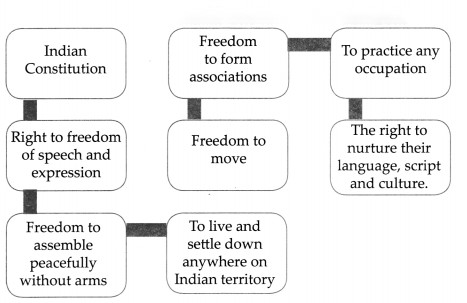
(ii) All citizens have the right to freedom of speech and expression, freedom to assemble peacefully without arms, freedom to form associations, freedom to move, to live and settle down anywhere on Indian territory and to practice any occupation.
(iii) Indian citizens living anywhere in India enjoy the right to nurture their language, script and culture.
(ii) The social welfare programmes aim to make opportunities for full-time employment, health care, education and development available to all Indian citizens. Indian society is riddled with large scale economic, social, educational and cultural inequalities.
(iii) However, it is necessary that opportunities for development reach women, children, the differently-abled, the scheduled castes and tribes as well as other minorities.
(iv) Hence on 14th June 1964, the government of India constituted the Ministry of Social Welfare. Under this ministry, various programmes are implemented for nutrition and child- development, social security and social protection, women’s welfare and development.
(i) In 1961, 82% of India’s population resided in villages. In 1971, the percentage was 80.01%.
(ii) So far, the rural area has shouldered the responsibility of providing food grains and other raw material to urban areas, supplying labour to the industrial sectors of the city, and taking care of natural resources.
(iii) However there are three major challenges with reference to rural development, namely, bringing about economic development, developing facilities to meet social needs and finally bringing about a change of attitude in matters concerning society, culture and ways of thinking.
(iv) It is also equally necessary to expedite irrigation projects and bring about land reforms.
6. Write a brief review of the significant events in the field of public health in India.
Answer:
The Constitution of India states that the primary duty of the government is to raise the people’s standard of living, to ensure proper nutrition and to improve public health. The Ministry of Health and Social Welfare at the Centre helps the state governments in this regard.
(i) To make primary health services as well as medical care available to rural people, the tribals and the poor was an objective of the Sixth Five Year plan. Efforts were made towards helping people maintain good health by giving recognition to Unani, Homoeopathy, Ayurveda and Naturopathy in addition to Allopathy.
(ii) In 1962, the first successful open heart surgery was performed under the leadership of Dr N. Gopinath at Christian Medical College Hospital at Vellore in Tamil Nadu. Hence, it is no longer necessary to go abroad for such treatment.
(iii) The invention of the ‘Jaipur Foot’ has transformed the lives of the disabled in India.
(iv) Before 1968, if a person lost a leg in an accident, he had to suffer for the rest of his life. In order to remedy the situation, Dr Pramod Sethi designed and manufactured artificial limbs, noses and ears, with the help of the skilled craftsman Ramchandra Sharma.
(v) These artificial body parts manufactured with the help of the Jaipur foot technology have made it easy for the differently-abled to walk bare-foot on rough surfaces, run, go cycling, work in the fields, climb trees, and even climb mountains, etc.
(vi) They save on the expenses on shoes as there is no need for footwear on these artificial limbs. They can bend their legs at the knees and sit cross-legged.
(vii) These feet are also convenient while working in water or under wet conditions.
Class 9 History Chapter 9 Changing Life 1 Additional Important Questions and Answers
Choose the correct option from the given options and rewrite the statements:
Identify and write the wrong pair in the following sets:
Do as Directed:
Complete the table
Institutes | Location |
Rural Electrification Co-operative societies | Andhra Pradesh, Gujarat, Karnataka, Maharashtra and Uttar Pradesh |
Agriculture Universities | Rahuri, Akola, Parbhani and Dapoli in Maharashtra |
Vidya Niketan | Satara, Aurangabad, Nasik and Chikhaldara |
Rural Community in Pre-Globalisation period | Urban Community in Pre-Globalisation period |
Priority to farming and ancillary vocations (jobs) | Priority to nonagricultural production and services. |
Small in size, homogeneous in terms of language, culture and tradition. | Large in size, heterogeneous in terms of languages, cultures and traditions. |
Elementary kinds of vocations; trend of sending villagers to cities rather than accommodating outsiders in rural occupations. | Large industries, production for global consumption, accommodating outsiders. |
Large proportion of vocations running in the family | Less proportion of vocations running in the family. |
Priority to the head of the family and to the family as an institution. Joint family system. | Family secondary, priority to individuals. Trend towards – nuclear families. |
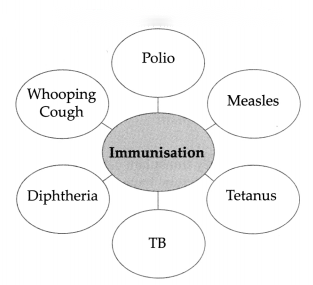
Complete the web diagram
Write short notes:
(ii) In 1971, the percentage was 80.01%. So far, the rural area has shouldered the responsibility of providing food grains and other raw material to urban areas, supplying labour to the industrial sectors of the city, and taking care of natural resources.
(iii) There are three major challenges with reference to rural development, namely, bringing about economic development, developing facilities to meet social needs and finally bringing about a change of attitude in matters concerning society, culture and ways of thinking.
(iv) It is equally necessary to expedite irrigation projects and bring about land reforms.
(ii) The social welfare programmes aim to make opportunities for full-time employment, health care, education and development available to all Indian citizens.
(iii) It is necessary that opportunities for development reach women, children, the differently abled, the scheduled castes and tribes as well as other minorities.
(iv) This was the greatest challenge facing the government during the post-independence period
(v) That is why, on 14 June 1964, the government of India constituted the Ministry of Social Welfare.
(vi) Under this ministry various programmes are implemented for nutrition and child development, social security and social protection, women’s welfare and development.
(ii) But in 1971, it was successfully performed at the Christian Medical College hospital at Vellore in Tamil Nadu.
(iii) Dr. Johny and Dr. Mohan Rao transplanted the kidney donated by a living person into the patient’s body.
(iv) Nowadays, patients from underdeveloped countries come to India for such surgeries.
Explain statements with reason:
(i) Electricity is essential for the development of rural areas. Automatic pumps are needed to water the fields.
(ii) Electricity is also needed to preserve perishable food items such as milk, eggs, fruits, and vegetables, to run fertilizer projects and for fans and TV, and for lights for studying at night.
(iii) During the first five-year plan, electricity had been provided to three thousand villages in India. By 1973, it reached 1,38,646 villages. From 1966, it was decided to supply more electricity for pumps and borewells.
(iv) ‘Rural Electrification Corporation’ was established in 1969.
(ii) Even today the rural population faces problems related to year round provision of drinking water, toilets, open drainage, narrow roads, inadequate electrification and lack of facilities for medical treatment.
(iii) There is a lack of good quality educational facilities from primary level to higher education, centres for recreation and libraries. That is why it is necessary to give special attention to rural areas.
(ii) Plans were made for improving farming technology, increasing the area of irrigated land, extending educational facilities, enacting the laws for land reform under this scheme.
(iii) It also aimed at increasing agricultural produce as well as expanding the means of transport, health services and scope for education in the rural areas.
(iv) The government undertook this work through the medium of Gram Panchayats which included the people from all castes and tribes.
(v) To achieve this, the Gram Panchayats, Panchayat Samitis and Zilla Parishads were empowered with more authority.
Read the following passage and answer the questions below:
Public health: The Constitution of India states that ‘ the primary duty of the government is to raise the people’s standard of living, to ensure proper nutrition i and to improve public health. The ministry of health i and Social Welfare at the Centre helps the state governments in this regard. To make primary health services as well as medical care available to rural people, the tribals and the poor was an objective of the Sixth Five Year plan. Efforts were made towards helping people maintain good health by giving recognition to Unani, Homoeopathy, Ayurveda and Naturopathy in addition to Allopathy, Progress in the medical field has made the life of Indians relatively free of health concerns. In 1962, the first successful open heart surgery was performed under the leadership of Dr. N. Gopinath at Christian Medical College Hospital at Vellore in Tamil Nadu, Hence, it is no longer necessary to go abroad for such treatment.

Answer the following questions in detail:
(ii) In 1971, kidney transplant was successfully performed at the Christian Medical College hospital at Vellore in Tamil Nadu. Dr Johny and Dr Mohan Rao transplanted the kidney donated by a living person into the patient’s body.
(ii) In order to remedy the situation, Dr Pramod Sethi designed and manufactured artificial limbs, noses and ears, with the help of the skilled craftsman Ramchandra Sharma.
(iii) These artificial body parts manufactured with the help of the Jaipur foot technology have made it easy for the differently abled to walk bare-foot on rough surfaces, rim, go cycling, work in the fields, climb trees, and even climb mountains, etc.
(iv) They save on the expenses on shoes as there is no need for footwear on these artificial limbs. They can bend their legs at the knees and sit cross-legged.
(v) These feet are also convenient while working in water or wet conditions.
(ii) Laws were enacted so that they got educational scholarships, and representation in Parliament as well State Assemblies. Some seats are also reserved for them in Government services.
(ii) The State of Maharashtra registered remarkable achievements under this scheme. For example, ‘Zilla Parishads’ was established in 1962.
(iii) Nutritious diet scheme was launched in 1970-1971. The State also started the ‘Rural Water Supply Scheme’ for sinking wells and providing piped water.
(iv) By 1971,1677 small dams had also been built.