Maharashtra State Board Class 9 Science Solutions Chapter 12 Study of Sound
Class 9 Science Chapter 12 Study of Sound Textbook Questions and Answers
1. Fill in the blanks and explain.
a. Sound does not travel through ……………………….………...
b The velocity of sound in steel is ……………………….………… than the velocity of sand in water.
c. The incidence of ……………………….………… in daily life shows that the velocity of sound is less than the velocity of light.
d. To discover a sunken ship or objects deep inside the sea, ……………………….………… technology is used.
2. Explain giving scientific reasons.
a. The roof of a movie theatre and a conference hall is curved.
Answer:
b. The intensity of reverberation is higher in a closed and empty house.
Answer:
c. We cannot hear the echo produced in a classroom.
Answer:
3. Answer the following questions in your own words.
a. What is an echo? What factors are important to get a distinct echo?
Answer:
b. Study the construction of the Golghumat at Vijapur and discuss the reasons for the multiple echoes produced there.
Answer:
c. What should be the dimensions and the shape of classrooms so that no echo can be produced there?
Answer:
4. Where and why are sound-absorbing materials used?
Answer:
The sound absorbing materials are used in :
5. Solve the following examples.
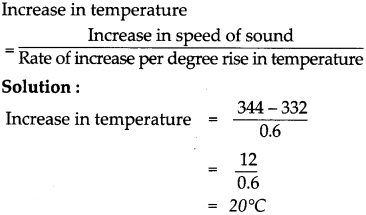
a. The speed of sound in air at O °C is 332 m/s. If it increases at the rate of 0.6 m/s per degree, what will be the temperature when the velocity has increased to 344 m/s?
Answer:
Given:
Initial speed of sound at 0°C 332 m/s.
Final speed of sound -344 m/s.
Rate of increase per degree rise in temp. = 0.6m/s
To find:
Temperature when speed is 344m/s
Formulae:
Increase in temperature
Temperature when the speed of sound is 344 m/sis 20°C
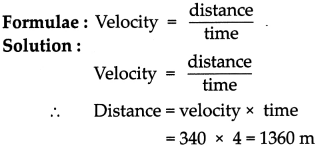
b. Nita heard the sound of lightning after 4 seconds of seeing it. What was the distance of the lightning from her? (The velocity of sound in air is 340 m/s?)
Answer:
Given : Speed of sound (v) = 340 m/s
Time taken (f) = 4 sec
To find : Distance (s) = ?
The lightning has struck at a distance of 1360 m from the observer.
c. Sunil is standing between two walls. The wall closest to him is at a distance of 360 m. If he shouts, he hears the first echo after 4 s and another after another 2 seconds.
1. What is the velocity of sound in air?
2. What is the distance between the two walls? (Ans: 330 m/s; 1650 m)
Answer:
Given:
Distance of the closer wall (S1) = 660 m
Time of echo from closer wall = 4 sec
∴ Time taken (t1) = 4/2 sec = 2 sec
Time of echo from distant wall = 6 sec
∴ Time taken (t2) = 6/2 sec = 3 sec
To find :
Velocity of sound in air (y) =?
Distance between two walls (S1+ S2) = ?
The velocity of sound in air is 330 mIs and the distance between two walls is 1650 m.

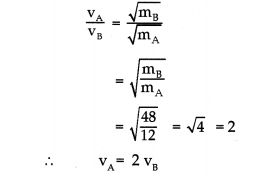
d. Hydrogen gas is filled in two identical bottles, A and B, at the same temperature. The mass of hydrogen in the two bottles is 12 gm and 48 gm respectively. In which bottle will sound travel faster? How may times as fast as the other? (Ans: In A; Twice)
Answer:
In A; Thrice
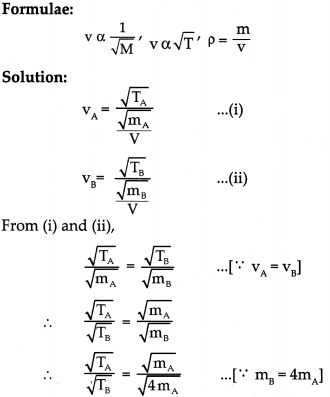
e. Helium gas is filled in two identical bottles A and B. The mass of the gas in the two bottles is 10 gm and 40 gm respectively. If the speed of sound is the same in both bottles, what conclusions will you draw? (Ans: Temperature of B is 4 times the temperature of A.)
Given:
Mass of Helium in bottle A = (mA) = 10gm
Mass of Helium in bottle B = (mB) = 40gm
The temperature of B is 4 times the temperature of A

Class 9 Science Chapter 12 Study of Sound Intext Questions and Answers
Study Of Sound Class 9 Notes Maharashtra Board Question 1.
How does the velocity of sound depend on its frequency?
Answer:
The velocity of sound is directly proportional to its frequency
ν = υ λ
when ν = velocity
υ = frequency
λ = wavelength
9th Class Science Chapter 12 Study Of Sound Exercise Question 2.
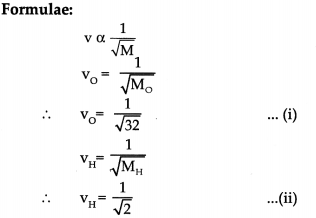
The molecular weight of oxygen gas (O2) is 32 while that of hydrogen gas (H2) is 2. Prove that under the same physical conditions, the velocity of sound in hydrogen is four times that in oxygen.
Answer:
Given:
Molecular wt of Oxygen (Mo) =32
Molecular wt of hydrogen (MH) = 2
To Find:
VH= 4 vo
Hence, proved that velocity of sound in hydrogen is four times that in oxygen.

Answer the following:
Study Of Sound Class 9 Maharashtra Board Question 1.
How will you reduce reverberation in public halls or buildings?
Answer:
(i) Reverberation in public halls or buildings will be reduced by using sound absorbing materials like curtains on wall, carpets on the floor.
(ii) By keeping the windows open, as sound will not get reflected.
12 Study Of Sound 9th Class Exercise Question 2.
How is ultrasound used in medical science?
Answer:
9th Science Chapter 12 Study Of Sound Exercise Question 3.
To hear the echo distinctly, will the distance from the source of sound to the reflecting surface be same at all temperatures? Explain your answer.
Answer:
9th Science Chapter 12 Study Of Sound Question 4.
When is the reflection of sound harmful?
Answer:
9th Class Science Chapter 12 Study Of Sound Question Answer Question 5.
What kind of waves are created when a stone is dropped in water ?
Answer:
Answer the following question:
12 Study Of Sound 9th Class Question 1.
Observe the graph/ diagram and discuss your observation.
Answer:

Answer the following question:
Study Of Sound Class 9 Question Answer Question 1.
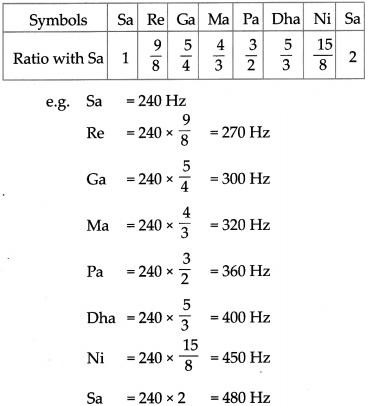
How are the frequencies of notes sa, re, ga, ma, pa, dha, ni related to each other?
Answer:
The frequencies of notes sa, re, ga, ma, pa, dha, ni are related in the ratio.
i.e if first Sa is 240Hz then the next Sa will be 240 x 2 = 480Hz
Class 9 Science Chapter 12 Study Of Sound Exercise Question 2.
What is the main difference between the frequencies of the voice of a man and that of a woman?
Answer:
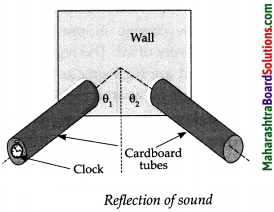
(a) In the above activity, what will happen if you lift one of the tubes to some height?
If one of the tubes is lifted, angle of incidence will not be equal to angle of reflection, hence, the sound will not be clearly audible.
(b) Measure the angle of incidence 01 and the angle of reflection 02. Try to see if they are related in any way.
Answer:
Angle of incidence is same as the angle of reflection.
Class 9 Science Chapter 12 Study of Sound Additional Important Questions and Answers
Can you recall?
12.Study Of Sound Question 1.
How is the direction of the oscillation of the particles of the medium related to the direction of propagation if the sound wave?
Answer:
Choose and write the correct option:
Class 9 Science Chapter 12 Study Of Sound Question 1.
The unit of frequency is ……………………………….
(a) Hertz
(b) m/s2
(c) Decibels
(d) m/s
Answer:
(a) Hertz
Study Of Sound Class 9 Exercise Question 2.
The normal hearing range for humans is ……………………………….
(a) 0 Hz to 20 Hz
(b) greater than 20,000 Hz
(c) 20 Hz to 20,000 Hz
(d) none of these
Answer:
(c) 20 Hz to 20,000 Hz
Class 9th Science Chapter 12 Study Of Sound Question Answer Question 3.
Sound will not travel through ……………………………….
(a) Vacuum
(b) Liquid
(c) Solid
(d) Gases
Answer:
(a) vacuum
Class 9 Science Chapter 12 Study Of Sound Question Answer Question 4.
SI unit of ………………………………. is Hertz (Hz).
(a) Wavelength
(b) Frequency
(c) Speed of wave
(d) Velocity
Answer:
(b) frequency
Reflection Of Sound Class 9 Question 5.
The velocity of sound is inversely proportional to the ……………………………….
(a) Pressure
(b) Square root of temperature
(c) Square root of density
(d) Humidity
Answer:
(c) square root of density
Question 6
Maharashtra Board Solution
Sound waves with frequency greater than 20 kHz are called ………………………………. (a) Infrasound (b) Ultrasound (c) Sonic (d) Damped sound
Solution & Step-by-Step Answer:
(b) ultrasound
Question 7
Maharashtra Board Solution
The loudness of a sound depends upon ………………………………. (a) Amplitude (b) Speed (c) Density (d) Wavelength
Solution & Step-by-Step Answer:
(a) Amplitude
Question 8
Maharashtra Board Solution
……………………………… are used in sonography. (a) High frequency ultrasound (b) Stationary waves (c) High frequency infrasound (d) High frequency micro waves
Solution & Step-by-Step Answer:
(a) High frequency ultrasound
Question 9
Maharashtra Board Solution
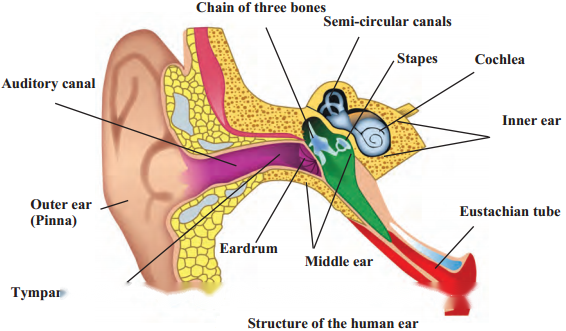
The ……………………………… receives the vibrations coming from the membrane and converts them into electrical signals which are sent to the brain through the nerve. (a) Cochlea (b) Tympanic cavity (c) Stapes (d) Pinna
Solution & Step-by-Step Answer:
(a) Cochlea
Find the odd one out:
Question 1
Maharashtra Board Solution
Bats, rats, cats, dolphins
Solution & Step-by-Step Answer:
Cats: cannot produce ultrasonic sound.
Question 2
Maharashtra Board Solution
Clothes, paper, curtains, mirror
Solution & Step-by-Step Answer:
Mirror: is a good reflector of sound, while others are poor reflectors.
Question 3
Maharashtra Board Solution
Submarines, icebergs, internal organ, sunken ships.
Solution & Step-by-Step Answer:
Internal organ: sonography is used, while for others sonar system is used.
Question 4
Maharashtra Board Solution
Temperature, density, molecular weight, pressure
Solution & Step-by-Step Answer:
Pressure: for a fixed temperature, the speed of sound does not depend on the pressure of the gas, all other factors affect speed of sound.
Answer in one sentence:
Question 1
Maharashtra Board Solution
How can one produce sound?
Solution & Step-by-Step Answer:
Vibration set up in an object produces sound (or) sound is produced when an object is disturbed and starts vibrating.
Question 2
Maharashtra Board Solution
What is velocity of sound wave ?
Solution & Step-by-Step Answer:
The distance covered by a point on the wave in unit time is the velocity of the sound wave.
Question 3
Maharashtra Board Solution
What is the minimum distance of the reflecting surface to hear an echo ?
Solution & Step-by-Step Answer:
To be able to hear a distinct echo, the reflecting surface should be at a minimum distance of 17.2 m.
Match the columns:
Question 1
Maharashtra Board Solution
|
Column ‘A’ | Column B’ | Column C |
(1) Transverse wave | (a) Particles oscillate parallel to direction of propagation | (i) Wave produced in a slinky |
(2) Longitudinal wave | (b) Particles oscillate perpendicular to direction of propagation | (ii) Frequency less than 20 Hz |
(3) Ultrasound | (c) Echo formation is heard under particular conditions | (iii) Wave produced in string |
(4) Infrasound | (d) High frequency waves | (iv) Frequency between 20 Hz to 20000 Hz |
(5) Audible frequency | (e) Low frequency waves | (v) Frequency greater than 20000 Hz |
(1-b- iii),
(2–a- i),
(3 – d – v),
(4 – e – ii),
(5 -c- iv)
Question 2
Maharashtra Board Solution
Solution & Step-by-Step Answer:
(1 -b – ii),
(2 -c – i), (3-d – iv), (4 – a – iii) Name the following:
Question 1
Maharashtra Board Solution
A form of energy which produces sensation of hearing in our ears.
Solution & Step-by-Step Answer:
Sound energy
Question 2
Maharashtra Board Solution
Repetitions of sound due to reflection.
Solution & Step-by-Step Answer:
Echo
Question 3
Maharashtra Board Solution
The audible range of sound for human being.
Solution & Step-by-Step Answer:
20 Hz to 20,000 Hz
Question 4
Maharashtra Board Solution
A method to obtain images of internal organs of the human body.
Solution & Step-by-Step Answer:
Sonography
Question 5
Maharashtra Board Solution
The matter or substance through which sound gets transmitted.
Solution & Step-by-Step Answer:
Solid, liquid, gases
Question 6
Maharashtra Board Solution
Three major parts of the ear.
Solution & Step-by-Step Answer:
External ear, the middle ear and the inner ear.
Question 7
Maharashtra Board Solution
Any two examples in which infrasound is produced.
Solution & Step-by-Step Answer:
Pendulum, earthquake.
Question 8
Maharashtra Board Solution
Name the living beings that can produce ultrasound.
Solution & Step-by-Step Answer:
Bats, dolphins, mice.
Give scientific reasons:
Question 1
Maharashtra Board Solution
Bats can navigate in dark.
Solution & Step-by-Step Answer:
Question 2
Maharashtra Board Solution
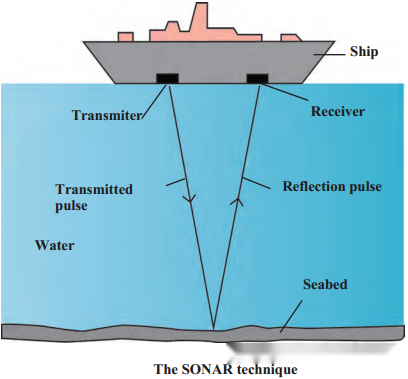
A SONAR system is installed in a ship.
Solution & Step-by-Step Answer:
Question 3
Maharashtra Board Solution
Sound travels faster in iron than in air.
Solution & Step-by-Step Answer:
Solve the following: Type – A Formula:
Question 1
Maharashtra Board Solution
Ultrasonic waves are transmitted downwards into the sea with the help of a SONAR. The reflected sound is received after 4 s. What is the depth of the sea at that place? (Velocity of sound in seawater = 1550 m/s)
Solution & Step-by-Step Answer:
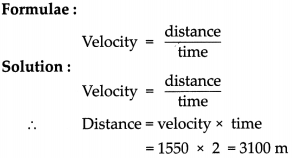
Given: Time to hear echo = 4 sec Time taken by sound waves to reach the bottom 4 of sea (t) = 4/2 sec = 2 sec Velocity of sound in sea water (v) = 1550 m/s To find: Depth of sea(s) = ? The depth of the sea at that place is 3100 m.
Question 2
Maharashtra Board Solution
A person standing near a hill fires a gun and hears the echo after 1 second. If speed of sound in air is 340 m/s. Find the distance between the hill and the person.
Solution & Step-by-Step Answer:
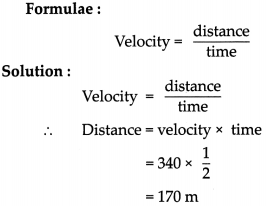
Given: Time to hear echo = 1 sec 1 Time taken (t) = 1/2 sec Velocity of sound (v) = 340 m/s To find: Distance (s) = ? Distance between the person and hill is 170 m.
Numerical For Practice
Question 3
Maharashtra Board Solution
If you hear the thunder 20 seconds after you see the flash of lightning, how far from you has the lightning occurred? (Speed of sound in air = 340 m/s)
Solution & Step-by-Step Answer:
6800m
Question 4
Maharashtra Board Solution
Aboy observes smoke from a cannon 3 seconds before he hears the bang. If the cannon is 1020 m from the observer, find the velocity of sound.
Solution & Step-by-Step Answer:
340 rn/s
Question 5
Maharashtra Board Solution
A soldier standing between the two buildings fires a gun. He heard the echo of the sounds from the first building after 2 seconds and echo from the second building after 3 seconds. Find the distance between two buildings. (Speed of sound in air = 340 m/s)
Solution & Step-by-Step Answer:
850m
Type – B
Question 1
Maharashtra Board Solution
Sound waves of wavelength 1 cm have a velocity of 340 mIs in air. What is their frequency? Can this sound be heard by the human ear?
Solution & Step-by-Step Answer:
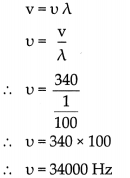
Given: wave length (λ) = 1cm = 1/100 Velocity of sound (v) = 340 m/s To fInd : frequency (u) = ? Formulae: ν = υ λ Solution: The frequency of the sound waves is 34000 Hz. The frequency is higher than 20000 Hz and therefore, this sound cannot be heard by the human ear.
Question 2
Maharashtra Board Solution
How long will it take for a sound wave of 25 cm wavelength and 1.5 kHz frequency, to travel a distance of 1.5 km?
Solution & Step-by-Step Answer:
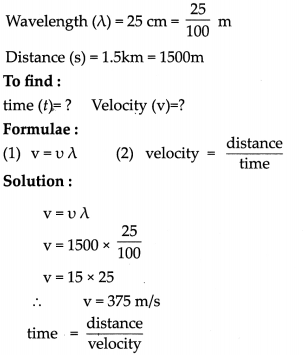
Given: frequency (u) = 1.5 kHz = 1500 Hz The sound wave takes 4 sec to travel the distance of 1.5 km.
Question 3
Maharashtra Board Solution
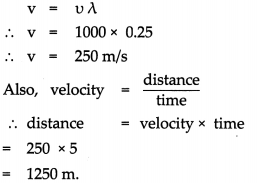
Calculate distance travelled by a sound wave having frequency 1000 Hz and wavelength 0.25 m, if it travels for 5 seconds in a certain medium.
Solution & Step-by-Step Answer:
Given: frequency (u) = 1000 Hz wavelength (λ) = 0.25 m time (t) = 5 seconds To find : Distance (d) =? Formulae: ν = υ λ Solution: The distance travelled by the sound wave is 1250 m.
Question 4
Maharashtra Board Solution
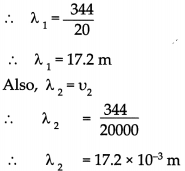
The audible range of sound is 20 Hz to 20000 Hz. At 22°C in air speed of sound is 344 mIs. Express the range of sound in terms of wavelength by calculating the respective values.
Solution & Step-by-Step Answer:
Given: frequency (u1) 20 Hz frequency ( u2) = 20,000 Hz velocity (v) = 344 rn/s To find : Wavelengths λ1 and λ2 = ? Formulae: ν = υ λ Solution: Audible range of wavelength of sound is from 17.2 x 10⁻³ m to 17.2 m.
Numerical For Practice
Question 5
Maharashtra Board Solution
A sound wave has frequency 320 Hz and wavelength 0.25 m. How much distance will it travel in 10 second?
Solution & Step-by-Step Answer:
The distance travelled is 800 m.
Type – C
Question 1
Maharashtra Board Solution
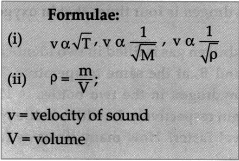
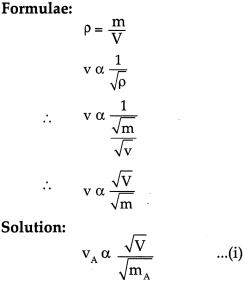
Hydrogen gas is filled in two identical bottles, A and B, at the same temperature. The mass of hydrogen in the two bottles is 12 gm and 48 gin respectively. In which bottle will sound travel faster? How many timés as fast as the other?
Solution & Step-by-Step Answer:
Given: Mass of hydrogen in bottle A (mA) = 12gm Mass of hydrogen in bottle B(mB) = 48gm To find: In which bottle sound travels faster. Formulae: Since both bottles are identical hence, the volume is the same, i.e. v Dividing (j) and (ii),
(i) Vivacity of sound will be more in bottle A. Numerical For Practice
Question 2
Maharashtra Board Solution
Argon gas is filled in two identical bottles X and Y. The mass of the gas in the two bottles is 5 gm and 25gm respectively. If the speed of sound is the same in both bottles, what conclusions will you draw?
Solution & Step-by-Step Answer:
(Temperature of Y is 5 times the temperature of X.)
Type – D Numerical For Practice
Question 1
Maharashtra Board Solution
Velocity of sound in air at 0°C is 332nVs. It increases by 0.6ni/s for each °Celsius rise in temperature. At what temperature of ait the velocity will be 359m1s?
Solution & Step-by-Step Answer:
45°C
Question 2
Maharashtra Board Solution
Velocity of sound In air at 0°C is 332m/s It increases by 0.6mIs for each degree Celsius rise In temperature. What will be the velocity of sound at 60°C?
Solution & Step-by-Step Answer:
368 rn/s
Define the following:
Question 1
Maharashtra Board Solution
Wave length (λ)
Solution & Step-by-Step Answer:
The distance between two consecutive compressions (or crests) or two consecutive rarefactions (or troughs) is called the wavelength.
Question 2
Maharashtra Board Solution
Amplitude (A)
Solution & Step-by-Step Answer:
The maximum value of pressure or density is called amplitude.
Question 3
Maharashtra Board Solution
Frequency (υ)
Solution & Step-by-Step Answer:
The frequency of a sound wave is defined as the number of complete oscillations of density (or pressure of the medium) per second.
Question 4
Maharashtra Board Solution
Time Period (T)
Solution & Step-by-Step Answer:
The time taken for one complete oscillation of pressure or density at a point in the medium is called the time period.
Question 5
Maharashtra Board Solution
Echo
Solution & Step-by-Step Answer:
An echo is the repetition of the original sound because of reflection by some surface.
Question 6
Maharashtra Board Solution
Transverse waves
Solution & Step-by-Step Answer:
Oscillations of the particles of the medium vibrate at right angles to the direction of propagation of the wave are called transverse waves.
Question 7
Maharashtra Board Solution
longitudinal waves
Solution & Step-by-Step Answer:
The particles of the medium oscillate about their central or mean position in a direction parallel to the propagation of wave is called as longitudinal waves.
Question 8
Maharashtra Board Solution
Velocity of wave
Solution & Step-by-Step Answer:
The distance covered by a point on the wave (for example the point of highest density or lowest density) in unit time is the velocity of the sound wave.’
Distinguish between:
Question 1
Maharashtra Board Solution
Infrasound and Ultrasound
Solution & Step-by-Step Answer:
Question 2
Maharashtra Board Solution
Transverse waves and Longitudinal waves
Solution & Step-by-Step Answer:
Question 3
Maharashtra Board Solution
Consider two cases (A) whistle of train (B) roar of a lion |


(I) In which case the sound is high pitch?
Whistle of a train is high pitch as compared to roar of a lion, as the frequency is higher.
(II) What is the real cause of sound production? Explain with examples.
Answer:
(III) Three sounds 5 Hz, 500 Hz and 50,000 Hz are produced by different sources.
(a) Which sound will be heard by humans?
(b) Which sounds may be produced by bats?
(c) Which sounds may be produced by elephants?
Answer:
(a) 500 Hz – Humans can hear sounds in the range of 20 Hz-20,000 Hz
(b) 50,000 Hz – Bats produce ultrasonic sounds above 20,000 Hz
(c) 5 Hz – Elephants can produce infrasonic sounds below 20 Hz
Question 6
Maharashtra Board Solution
Suppose you and your friend are on the moon. Will you be able to hear any sound
Solution & Step-by-Step Answer:
Sound waves need a material medium for their propagation. Since there is no atmosphere on the moon, we cannot hear any sound on the moon.
Answer in detail:
Question 1
Maharashtra Board Solution
What are the factors on which velocity of sound in gaseous medium depend?
Solution & Step-by-Step Answer:
The velocity of sound in a gaseous medium depends on the physical conditions i.e. the temperature, density of the gas and its molecular weight.
Question 2
Maharashtra Board Solution
What are the uses of ultrasonic sound?
Solution & Step-by-Step Answer:
Uses of ultrasonic sound are as follows:
Question 3
Maharashtra Board Solution
Explain with the help of a neat labelled diagram the working of human ear.
Solution & Step-by-Step Answer:
(a) Outer ear or Pinna (b) Middle ear (c) Inner ear
Question 4
Maharashtra Board Solution
Write a short note on SONAR
Solution & Step-by-Step Answer:
(i) SONAR is the short form for Sound Navigation and Ranging. It is used to determine the direction, distance and speed of an underwater object with the help of ultrasonic sound waves. SONAR has a transmitter and a receiver, which are fitted on ships or boats.
(ii) The transmitter produces and transmits ultrasonic sound waves. These waves travel through water, strike underwater objects and get reflected by them. The reflected waves are received by the receiver on the ship. (iii) The receiver converts the ultrasonic sound into electrical signals and these signals are properly interpreted. The time difference between transmission and reception is noted. This time and the velocity of sound in water give the distance from the ship, of the object which reflects the waves. (iv) SONAR is used to determine the depth of the sea. SONAR is also used to search underwater hills, valleys, submarines, icebergs, sunken ships etc.
Question 5
Maharashtra Board Solution
Write a short note on Sonography. How is it misused?
Solution & Step-by-Step Answer:
|