Maharashtra State Board Class 9 Science Solutions Chapter 14 Substances in Common Use
Class 9 Science Chapter 14 Substances in Common Use Textbook Questions and Answers
1. Fill in the blanks.
a. The number of molecules of water of crystallization in washing soda is …………….…..
b. The chemical name of baking soda is …………….…..
c. …………….…. is used in treatment of hyperthyroidism.
d. The chemical name of Teflon is …………….…..
Answer:
a. 10
b. Sodium bicarbonate
c. Iodine -123
d. Polytetra fluoroethylene (C2F4)n
2. Match the pairs
Group A | Group B |
1. Saturated brine | a. sodium metal freed |
2. Fused salt | b. basic salt |
3. CaOCl2 | c. crystallization of salt |
4. NaHCO3 | d. oxidation of colour |
Answer:
(1 – c),
(2 – a),
(3 – d),
(4 – b)
3. Write answers to the following
a. What is meant by radioactivity?
Answer:
b. When is said to be the nucleus unstable?
Answer:
c. Which diseases are caused by artificial food colours?
Answer:
Diseases like ADHD (Attention Deficit Hyperactivity Disorder) can affect children due to excessive consumption of foods with added food colours.
d. Where in the industrial field is radioactivity used?
Answer:
Industrial field Radiography
Measurement of thickness, density and level
Luminescent paint and radio luminescence:
Use in Ceramic articles:
e. Write down properties of teflon.
Answer:
Properties of teflon :
f. What type of colours will you use to celebrate ecofriendly Rang Panchami? Why?
Answer:
g. Why has the use of methods like Teflon coating become more common?
Answer:
The use of methods like Teflon coating became more common because of following properties of teflon:
4. Give a scientific explanation
a. Bleaching powder has the odour of chlorine.
Answer:
b. The hard water of a well becomes soft on adding washing soda to it.
Answer:
c. Soap forms a precipitate in hard water.
Answer:
d. The particles of powder are given an electric charge while spraying them to form the powder coating.
Answer:
e. The aluminium article is used as an anode in the anodising process.
Answer:
f. When the radiation coming out from certain radioactive substance is passed through an electric field, marks are found at three places on the photographic plate placed in its path.
Answer:
(i) When the radiation coming out from certain radioactive substance is passed through an electric field, marks are found at three places on the photographic plate placed in its path. This is because the radiation coming out from radioactive substance are of three types Alpha rays, Beta rays and Gamma rays.
(ii) The rays which get deviated slightly towards negatively charged plate are called alpha rays. They get deviated towards negatively charged plate because they are made of positively charged particles, called as alpha particles (He++).
(iii) The rays which get deviated substantially towards the positively charged plate are called beta rays. They get deviated towards a positively charged plate because they are made of negatively charged particles called as beta particles (e-).
(iv) The rays which do not deviate at all are called gamma rays. They are uncharged electromagnetic radiation. Hence, marks are found at three places on the photographic plate. (For diagram refer Fig. 14.2 from Q. 4(3))
g. A certain type of ceramic tiles are fixed on the outer layer of a space shuttle.
Answer:
(i) Each shuttle is covered by more than 24,000 of the six- by six-inch advance ceramic tiles. This tiles withstand high temperatures without decomposing. They are brittle, water-resistant and electrical insulator. Most of the tiles are made of silica fibres, which are produced from high-grade sand (SiO2).
(ii) Silica is an excellent insulator because it transports heat slowly. When the outer portion of a tile gets hot, the heat takes a long time to work its way down through the rest of the tile to the shuttle’s skin. The tiles keep the orbiter’s aluminium skin at 350 degrees or less.
(iii) The silica fibers are mixed with water and chemicals, and the mixture is poured into molds, which are zapped in microwave ovens at 2,350°C to fuse the silica fibres. Tiles are too brittle to attach to the orbiter directly.
(iv) The shuttle’s skin contracts slightly while in orbit, then expands during re-entry.
(v) In addition, the stresses of launch and re-entry cause the skin to flex and bend. Such motions could easily crack the tiles or shake them off. To keep them in place, workers glue the tiles to flexible felt-like pads, then glue the pads to the orbiter.
5. Write answers to the following
a. Write about artificial food colours, the substances used in them and their harmful effects.
Answer:
(a) Artificial food colour and substances in them.
(b) Harmful effects of artificial food colours
b. What is meant by water of crystallization? Give examples of salts with water of crystallization, and their uses.
Answer:
The exact number of water molecules which are chemically bonded to a molecule of a salt within a hydrated crystalline compound is called as water of crystallization are:
Some substances in our daily use which contain water of crystallization are:
Uses of these salts are as given below:
(i) Alum (Potash alum – K2SO4.Al2(SO4)3.24H2O)
(ii) Borax (Na2B4O7.10H2O)
(iii) Epsom salt (Magnesium sulphate MgSO4.7H2O)
(iv) Barium chloride (BaCl2.2H2O)
(v) Sodium sulphate (Glauber’s salt Na2SO4.10H2O)
(vi) Blue vitriol (Copper sulphate CuSO4.5H2O)
c. Write briefly about the three methods of electrolysis of sodium chloride.
Answer:
6. Write the uses.
a. Anodizing
b. Powder coating
c. Radioactive substances
d. Ceramic
Answer:
(a) Anodizing : Anodizing is done on aluminum cooking utensils like griddles and cookers.
(b) Powder coating : Powder coating is done on iron objects to prevent rusting. Also, on Plastic and Medium density fibre (MDF) board, to make them highly durable, hard and attractive.
(c) Radioactive substances:
(I) Industrial field:
(i) Industrial Radiography : Internal cracks and voids in cast iron articles and iron solder can be. detected with the help of gamma rays. For this purpose, isotopes like cobalt-60, iridium-192 are used in the radiography camera. This technique is used for detecting flaws in metal work.
(ii) Measurement of thickness, density and level: It is necessary to maintain the required thickness in the manufacture of aluminium, plastic, iron sheets of differing thickness. In the manufacturing process, a radioactive substance is placed on one side and an instrument to measure radiation on the other. The radiation read by the measuring instrument varies with the thickness of the sheet. Material inside a packing can also be examined by the same technique.
(iii) Luminescent paint and radioluminescence:
The radioactive substances radium, promethium, tritium with some phosphor are used to make certain objects visible in the dark, for example, the hands of a clock, and certain other objects. Krypton-85 is used in HID (High Intensity Discharge) lamps while promethium-147 is used in portable X-ray units as the source of beta rays.
Use in Ceramic articles – Luminous colours are used to decorate ceramic tiles, utensils, plates, etc. Earlier uranium oxide was used in these paints.
(II) Field of agriculture :
(III) Medical science:
(d) Ceramic : Pots made by a potter, Mangalore roofing tiles, construction bricks, pottery, terracotta articles are some examples of common ceramic articles that we see around.
7. Write the harmful effects
a. Artificial dye
b. Artificial food colour
c. Radioactive substances
d. Deodorant
Answer:
(a) Artificial dye:
(b) Artificial food colour:
(c) Radioactive substances :
(d) Deodorant:
8. Write the chemical formula Bleaching powder, common salt, baking soda, washing soda
Answer:
Common name | Chemical name |
Bleaching powder | CaOCl2 |
Common salt | NaCl |
Baking soda | NaHCOs |
Washing soda | Na2CO3.10 H2O |
9. Explain what you see in the following picture
Powder coating
Answer:
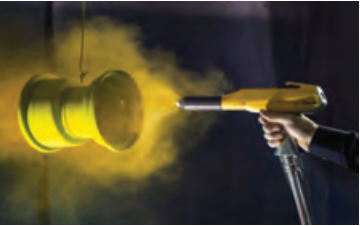
Class 9 Science Chapter 14 Substances in Common Use Intext Questions and Answers
Can you recall?
Toothpaste: for cleaning teeth and maintaining hygienic conditions of mouth.
Soap : for bathing and maintaining hygienic conditions of body.
Natural and artificial fibers : we wear them as clothes to protect our body and many other purposes.
Washing powder: for cleaning clothes. Vegetables, fruits and food grains : they provide us with necessary vitamins, minerals and carbohydrates required for proper functioning of body.
Water : very important for our survival and many other functions of day to day life.
Metals : for making buildings, bridges, roads, vehicles, trains, ships, airplanes, utensils etc.
Acids, bases and salts : used for various purposes, for example, Sodium chloride which is used as common salt, a very necessary ingredient of our daily food without which our food is tasteless.
Apparatus :
500 ml glass beaker
Burner
Flat glass tray
Knife
Soaps are essential to personal and public health. They safely remove germs, soils and other contaminants and help us to stay healthy and make our surroundings more pleasant. Soaps are made from fats and oils or their fatty acids.
Take about 20 ml of any vegetable oil (coconut oil, castor oil, soybean oil etc.) in a beaker. Put about 30 – 35 ml of NaOH in it and heat and stir the mixture till a paste is formed. Now add a little salt. Stir again and allow the mixture to cool in a flat glass tray, on cooling it solidifies. Take a knife and cut it in soap bars as per the size required.
Answer the following questions:
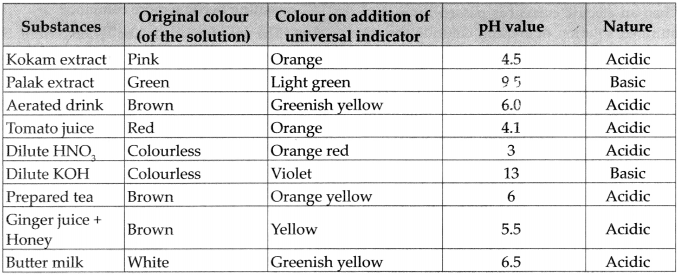
Answer the following questions:
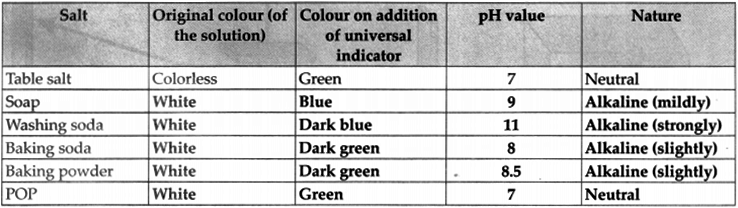
Class 9 Science Chapter 14 Substances in Common Use Additional Important Questions and Answers
Select the correct option:
Fill in the blanks and rewrite the complete statements:
(1) 25% of NaCl is known as
(2) gas is released when bleaching powder is added to water.
(3) Washing soda is as it absorbs moisture if left exposed to air.
(4) is used to make hard water soft.
(5) Molecular formula for Alum is
(6) is used in blood test for diagnosing anaemia.
(7) High grade of and are used as raw material to manufacture bathing soap.
(8) Pickles, jams and sauce contain small quantities of and
(9) Excessive consumption of foods with added food colours leads to diseases like
(10) Melting point of Teflon is
(11) Anodizing is done by
(12) The red blood cell count increases in the disease
(13) Magnesium sulphate (MgS04.7H20) is also called
Answer:
(1) Brine
(2) Chlorine
(3) hygroscopic
(4) Na2CO3(Washing soda)
(5) K2SO4.Al2(SO)3.24H2O
(6) Blue Vitriol
(7) fats, oils
(8) lead, mercury
(9) ADHD (Attention Deficit Hyperactivity Disorder)
(10) 327°C
(11) Electrolysis
(12) Polycythemia
(13) Epsom salt
(14) Soap
State whether the following statements are true or false. Correct the false statements.
(1) Bleaching powder is used in preparation of chloroform which is used as an anaesthetic.
(2) On addition of universal indicator the colour of table salt changes to pink.
(3) Borax is Na2B4O7.9H2O.
(4) Boron -10 is used to cure bone cancer.
(5) Clinical deo contains 20 to 25% of aluminium.
(6) NaHCO3is sodium carbonate.
(7) Soap is acidic in nature.
(8) Baking powder is neutral in nature.
(9) POP is crystalline in nature.
(10) pH value of universal indicator is 0 – 7.
(11) Sodium chloride is formed by neutralization reaction between sodium hydroxide and calcium carbonate.
(12) Boiling point of NaCl is 800 °C.
(13) Molten state of NaCl is also called as solid state.
(14) Mineral halite is an example of Rock Salt.
(15) Sodium bicarbonate is used to reduce acidity.
(16) Bleaching powder is also called as chloride of lime.
(17) Bleaching powder is obtained by reaction of chlorine gas with slaked lime.
(18) Bleaching powder available in market is classified on the basis of colour.
(19) The hard water becomes soft on adding baking soda (NaHCO3)
Answer:
(1) True
(2) False. On addition of universal indicator the colour of table salt changes to green.
(3) False. Borax is Na2B4O7.9H2O
(4) False. Boron – 10 is used in treatment of brain tumour.
(5) True
(6) False. NaHCO3is sodium bicarbonate.
(7) False. Soap is basic in nature.
(8) False. Baking powder is basic in nature.
(9) False. POP is amorphous in nature.
(10) False. pH value of universal indicator is 0 -14.
(11) False. Sodium chloride is formed by a neutralization reaction between sodium hydroxide and hydrochloric acid.
(12) False. Melting point of NaCl is 800°C.
(13) False. Molten state of NaCl is also called as fused state.
(14) True
(15) True
(16) True
(17) True
(18) False. Bleaching powder available in market is classified on the basis of percentage of chlorine present in it.
(19) False. Hard water becomes soft on adding washing soda (Na2CO3.10H2O)
Name the following:
Select the odd man out:
Write the correlated terms:
(1) Washing Powder : Basic :: Milk : ……………………………
(2) Na2SO4: Sodium sulphate :: K3PO4: ……………………………
(3) CaOCl2: Calcium Oxychloride : : NaHCO3: ……………………………
(4) Borax : 10H2O : : Alum : ……………………………
(5) Sodium Sulphate : Na2SO4.10H2O : : Magnesium Sulphate : ……………………………
(6) Bathing soap : High grades fats and oils :: Washing soap : ……………………………
(7) Radium – 23 : Bone cancer :: Phosphorus – 32 : ……………………………
(8) Iodine -123 : Hyperthyroidism :: Iodine -131 : ……………………………
(9) Clinical deo : 20-25% of aluminium : : Antiperspirant deo : of aluminium chlorohydrate : ……………………………
(10) Sodium carbonate : Na2CO3: : Sodium bicarbonate : ……………………………
(11) Curd : Acidic : : Soap : ……………………………
(12) Calcium Carbonate : CaCO3: : Magnesium bromide : ……………………………
(13) Baking Soda : NaHCO3: : Washing Soda : ……………………………
(14) Baking Soda : Breads and Cakes : : Washing Soda : ……………………………
(15) Borax : Na2B4O7.10H2O : : Alum : ……………………………
Answer:
(1) Acidic
(2) Potassium phosphate
(3) Sodium hydrogen carbonate
(4) 24H2O
(5) MgSO4.7H2O
(6) Low-grade fats and oils
(7) Polycythemia
(8) Tumour detection
(9) 15%
(10) NaHCO.
(11) Basic
(12) MgBr2
(13) Na2CO3.10H2O
(14) Hard water soft
(15) K2SO4.Al2(SO4)3.24H2O
Match the columns:
Column ‘A’ | Column ‘B’ | |
(1) Barium chloride | (a) | 24H2O |
(2) Sodium sulphate | (b) | 7H2O |
(3) Magnesium sulphate | (c) | 2H2O |
(4) Alum | (d) | 10H2O |
(1 – c),
(2 – d),
(3 – b),
(4 – a)
Question 2
Maharashtra Board Solution
Solution & Step-by-Step Answer:
(1 – d),
(2 – a), (3 – b), (4 -c) Give scientific reasons:
Question 1
Maharashtra Board Solution
Baking soda is used while making cakes.
Solution & Step-by-Step Answer:
Question 2
Maharashtra Board Solution
Baking soda is used to reduce acidity in the stomach.
Solution & Step-by-Step Answer:
Question 3
Maharashtra Board Solution
Tap water and water in swimming pool has a typical strong odour in the rainy season.
Solution & Step-by-Step Answer:
Question 4
Maharashtra Board Solution
Sodium carbonate is added to hard water to make it soft.
Solution & Step-by-Step Answer:
Question 5
Maharashtra Board Solution
Alum is used in the process of water purification.
Solution & Step-by-Step Answer:
Question 6
Maharashtra Board Solution
Overconsumption of artificial food colours should be avoided?
Solution & Step-by-Step Answer:
Question 7
Maharashtra Board Solution
Artificial colours in Rang Panchami should be used cautiously.
Solution & Step-by-Step Answer:
Question 8
Maharashtra Board Solution
There are various brands of bleaching powder in the market.
Solution & Step-by-Step Answer:
Question 9
Maharashtra Board Solution
We use anodized cooking utensils like griddles and cookers.
Solution & Step-by-Step Answer:
Explain the following chemical reactions with the help of balanced equations :
Question 1
Maharashtra Board Solution
Sodium hydroxide reacts with dilute Hydrochloric acid.
Solution & Step-by-Step Answer:
When Sodium hydroxide reacts with dilute Hydrochloric acid, it forms sodium chloride and water. This is a neutralization reaction.
Question 2
Maharashtra Board Solution
When an electric current is passed through a saturated solution of sodium chloride (brine)
Solution & Step-by-Step Answer:
When an electric current is passed through a saturated solution of sodium chloride (brine) it is electrolysed and hydrogen gas is released at the cathode while chlorine gas is released at the anode. Also, an important basic compound NaOH is formed in the cell.
Question 3
Maharashtra Board Solution
Baking soda (Sodium hydrogen carbonate) reacts with dilute hydrochloric acid.
Solution & Step-by-Step Answer:
When Sodium bicarbonate (Sodium hydrogen carbonate) reacts with dilute hydrochloric acid, it gives sodium chloride, water and carbon dioxide gas is liberated.
Question 4
Maharashtra Board Solution
Bleaching powder is exposed to air.
Solution & Step-by-Step Answer:
When bleaching powder is exposed to air, it undergoes slow decomposition due to the carbon dioxide in air and chlorine gas is released.
Question 5
Maharashtra Board Solution
When dry slaked lime reacts with chlorine gas.
Solution & Step-by-Step Answer:
When dry slaked lime reacts with chlorine gas, it gives bleaching powder.
Question 6
Maharashtra Board Solution
Bleaching powder reacts with dilute sulphuric acid.
Solution & Step-by-Step Answer:
Dilute sulphuric acid reacts rapidly with bleaching powder to form calcium sulphate and release chlorine gas completely.
Question 7
Maharashtra Board Solution
Bleaching powder reacts with dilute hydrochloric acid.
Solution & Step-by-Step Answer:
Dilute hydrochloric acid reacts rapidly with bleaching powder to form Calcium chloride and release chlorine gas completely.
Question 8
Maharashtra Board Solution
Sodium carbonate reacts with magnesium chloride.
Solution & Step-by-Step Answer:
When Sodium carbonate reacts with magnesium chloride, it forms insoluble magnesium carbonate and sodium chloride. This reaction is used to make hard water soft.
Question 9
Maharashtra Board Solution
Crystalline sodium carbonate is exposed to air.
Solution & Step-by-Step Answer:
When crystalline sodium carbonate is exposed to air it loses its water of crystallization readily and a white powder is obtained. This powder is called washing soda.
Question 10
Maharashtra Board Solution
Sodium carbonate reacts with sulphuric acid.
Solution & Step-by-Step Answer:
When sodium carbonate reacts with sulphuric acid it forms sodium sulphate, water and carbon dioxide gas is liberated.
Distinguish between;
Question 1
Maharashtra Board Solution
Washing soda and Baking soda
Solution & Step-by-Step Answer:
Question 2
Maharashtra Board Solution
Bathing soap and Washing soap
Solution & Step-by-Step Answer:
Answer the following:
Question 1
Maharashtra Board Solution
Give the properties and uses of Sodium bicarbonate.
Solution & Step-by-Step Answer:
Properties and uses of sodium bicarbonate
Question 2
Maharashtra Board Solution
Give the properties and uses of washing soda.
Solution & Step-by-Step Answer:
Properties and uses of washing soda :
Question 3
Maharashtra Board Solution
Name some substances in our daily use which contain water of crystallization.
Solution & Step-by-Step Answer:
Question 4
Maharashtra Board Solution
Give the uses of radioactive isotopes in the measurement of thickness, density and level.
Solution & Step-by-Step Answer:
Measurement of thickness, density and level:
Question 5
Maharashtra Board Solution
Give the uses of radioactive isotopes in Luminescent paint and radioluminescence.
Solution & Step-by-Step Answer:
Luminescent paint and radioluminescence:
Question 6
Maharashtra Board Solution
Give the uses of radioactive isotopes in Field of agriculture.
Solution & Step-by-Step Answer:
Field of agriculture:
Question 7
Maharashtra Board Solution
Give the uses of dyes.
Solution & Step-by-Step Answer:
Uses of dyes :
Question 8
Maharashtra Board Solution
What are the adverse effects of dyes?
Solution & Step-by-Step Answer:
Adverse effects dyes :
Question 9
Maharashtra Board Solution
Give the uses of teflon.
Solution & Step-by-Step Answer:
Uses of teflon :
Question 10
Maharashtra Board Solution
What is ceramic? Give examples.
Solution & Step-by-Step Answer:
Question 11
Maharashtra Board Solution
Give the uses of ceramics.
Solution & Step-by-Step Answer:
Question 12
Maharashtra Board Solution
What is brine? What happens when ^th of this solution is evaporated?
Solution & Step-by-Step Answer:
Question 13
Maharashtra Board Solution
What is baking soda? Give its chemical name and molecular formula.
Solution & Step-by-Step Answer:
Question 14
Maharashtra Board Solution
Give two uses of Blue vitriol.
Solution & Step-by-Step Answer:
Question 15
Maharashtra Board Solution
What is radioactivity and what are radioactive substances?
Solution & Step-by-Step Answer:
Question 16
Maharashtra Board Solution
What can you say about the uses of radioactive isotopes?
Solution & Step-by-Step Answer:
Question 17
Maharashtra Board Solution
Give the uses of radioactive isotopes in Radiography.
Solution & Step-by-Step Answer:
Question 18
Maharashtra Board Solution
Give the uses of radioactive isotopes in ceramic articles.
Solution & Step-by-Step Answer:
Question 19
Maharashtra Board Solution
What is a dye?
Solution & Step-by-Step Answer:
The coloured substance which on applying to an article, imparts that colour to the article, is called a dye
Question 20
Maharashtra Board Solution
What is done to fix a dye on the cloth ?
Solution & Step-by-Step Answer:
Question 21
Maharashtra Board Solution
What is Teflon? Give its chemical name.
Solution & Step-by-Step Answer:
Question 22
Maharashtra Board Solution
What is powder coating? Why is it done?
Solution & Step-by-Step Answer:
Question 23
Maharashtra Board Solution
Give the properties of ceramics.
Solution & Step-by-Step Answer:
Question 24
Maharashtra Board Solution
How is bone china made? How is it different from porcelain?
Solution & Step-by-Step Answer:
Question 25
Maharashtra Board Solution
What compounds are used instead of clay for making advanced ceramic?
Solution & Step-by-Step Answer:
Oxides like Alumina (Al2O3), Zirconia (ZrO2) Silica (SiO2) and some other compounds like silicon carbide (SiC), boron carbide (B4C) are used instead of clay for making advanced ceramic.
Question 26
Maharashtra Board Solution
|










What is sintering?
Write short notes on :
Question 1
Maharashtra Board Solution
Chernobyl disaster.
Solution & Step-by-Step Answer:
Question 2
Maharashtra Board Solution
Food colours.
Solution & Step-by-Step Answer:
Question 3
Maharashtra Board Solution
Anodizing.
Solution & Step-by-Step Answer:
Answer the following questions:
Question 1
Maharashtra Board Solution
What are salts? Give their source.
Solution & Step-by-Step Answer:
Question 2
Maharashtra Board Solution
Which are the three kinds of salts depending on their pH value? How are they formed?
Solution & Step-by-Step Answer:
The three kinds of salts depending on their pH value are:
Neutral salts: Acidic salts: Basic salts:
Question 3
Maharashtra Board Solution
Which is the most used salt? What is its chemical name? How is it formed?
Solution & Step-by-Step Answer:
Question 4
Maharashtra Board Solution
How is bleaching powder obtained?
Solution & Step-by-Step Answer:
Question 5
Maharashtra Board Solution
How is hard water from well converted to soft water?
Solution & Step-by-Step Answer:
Question 6
Maharashtra Board Solution
How is washing soda obtained from sodium carbonate?
Solution & Step-by-Step Answer:
Question 7
Maharashtra Board Solution
How is soap prepared? Why it does not form lather with hard water?
Solution & Step-by-Step Answer:
Question 8
Maharashtra Board Solution
What are the harmful effects of artificial food colours?
Solution & Step-by-Step Answer:
Question 9
Maharashtra Board Solution
Which is the main source of colour for preparing a natural dye?
Solution & Step-by-Step Answer:
Question 10
Maharashtra Board Solution
How are artificial colours harmful to us?
Solution & Step-by-Step Answer:
Question 11
Maharashtra Board Solution
What are the harmful effects of deodorants?
Solution & Step-by-Step Answer:
Question 12
Maharashtra Board Solution
How is a ceramic article made?
Solution & Step-by-Step Answer:
Question 13
Maharashtra Board Solution
What is porcelain? How is it made?
Solution & Step-by-Step Answer:
Answer the following questions:
Question 1
Maharashtra Board Solution
What are the constituents of baking powder? Where is the baking powder used?
Solution & Step-by-Step Answer:
Question 2
Maharashtra Board Solution
Take a piece of coloured cloth. Put some saturated solution of bleaching powder on a small part and observe what changes take place in the colour of the cloth.
Solution & Step-by-Step Answer:
When bleaching powder is added to a piece of coloured cloth, the fabric looses its colour due to the oxidising reaction of the chlorine present in the bleaching powder.
Answer in detail:
Question 1
Maharashtra Board Solution
Give the properties and uses of Sodium chloride.
Solution & Step-by-Step Answer:
Properties and uses of sodium chloride:
Question 2
Maharashtra Board Solution
Give the properties and uses of Bleaching Powder.
Solution & Step-by-Step Answer:
Properties and uses bleaching powder:
Question 3
Maharashtra Board Solution
Explain with neat labelled diagram the nature of radioactive radiation.
Solution & Step-by-Step Answer:
Question 4
Maharashtra Board Solution
Give the characteristics of alpha, beta and gamma rays.
Solution & Step-by-Step Answer:
Characteristics of alpha, beta and gamma rays are as given in the table.
Question 5
Maharashtra Board Solution
Give the uses of radioactive isotopes in Medical science.
Solution & Step-by-Step Answer:
Medical science:
Question 6
Maharashtra Board Solution
What are the hazards of radioactive substances and radiation?
Solution & Step-by-Step Answer:
Question 7
Maharashtra Board Solution
Why are deodorant used? Give their types and content.
Solution & Step-by-Step Answer:
Question 8
Maharashtra Board Solution
Explain how powder coating is done.
Solution & Step-by-Step Answer:
|

