Maharashtra State Board Class 9 Science Solutions Chapter 16 Heredity and Variation
Class 9 Science Chapter 16 Heredity and Variation Textbook Questions and Answers
1. Complete the following sentences by choosing the appropriate words from the brackets.
(Inheritance, sexual reproduction, asexual reproduction, chromosomes, DNA, RNA, gene)
a. Hereditary characters are transferred from parents to offsprings by …………………………….., hence they are said to be structural and functional units of heredity.
b. Organisms produced by …………………………….. show minor variations.
c. The component which is in the nuclei of cells and carries the hereditary characteristics is called ……………………………..
d. Chromosomes are mainly made up of ……………………………..
e. Organisms produced through …………………………….. show major variations.
2. Explain the following.
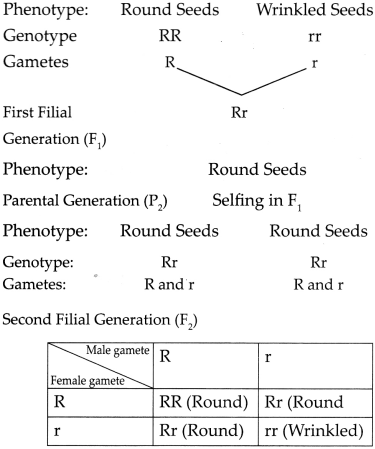
a. Explain Mendel’s monohybrid progeny with the help of any one cross.
Answer:
b. Explain Mendel’s dihybrid ratio with the help of any one cross.
Answer:
c. Distinguish between monohybrid and dihybrid cross.
Answer:
Monohybrid cross | Dihybrid cross |
(i) Cross involving a single pair of contrasting characters is called monohybrid cross. | (i) Cross involving two pairs of contrasting characters is called a dihybrid cross. |
(ii) F1plants of monohybrid cross produce two types of gametes. | (ii) F1plants of dihybrid cross produce four types of gametes. |
(iii) Monohybrid cross has a phenotypic ratio of 3 : 1 in F2generation. | (iii) Dihybrid cross has a phenotypic ratio of 9 : 3 : 3 : 1 in F2generation. |
d. Is it right to avoid living with a person suffering from a genetic disorder?
Answer:
3. Answers the following questions in your own words.
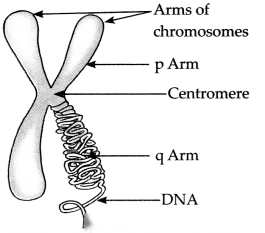
a. What is meant by ‘chromosome’. Explain its types.
Answer:
(a) Metacentric: The centromere is exactly at the mid-point in this chromosome, and therefore, it looks like the English letter ‘V’. The arms of this chromosome are equal in length.
(b) Sub-metacentric: The centromere is somewhere near the mid-point in this chromosome which, therefore, looks like the English letter ‘U. One arm is slightly shorter than the other.
(c) Acrocentric: The centromere is near one end of this chromosome which therefore looks like the English letter One arm is much smaller than the other.
(d) Telocentric: The centromere is right at the end of this chromosome making the chromosome look like the English letter ‘i’. This chromosome consists of only one arm.
b. Describe the structure of the DNA molecule.
Answer:
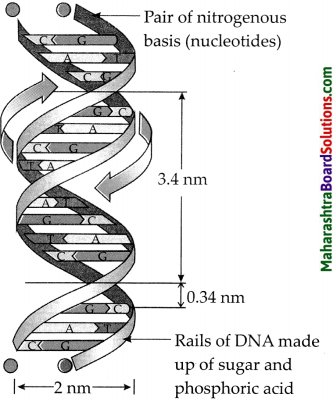
c. Express your opinion about the use of DNA fingerprinting.
Answer:
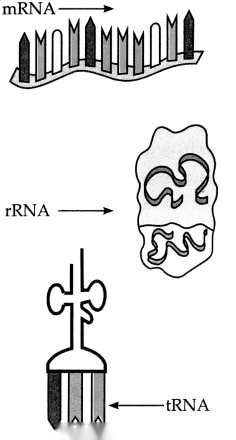
d. Explain the structure, function and types of RNA.
Answer:
e. Why is it necessary for people to have their blood examined before marriage?
Answer:
4. Write a brief note on each.
a. Down syndrome
Answer:
b. Monogenic disorders
Answer:
c. Sickle cell anaemia: symptoms and treatment.
Answer:
5. How are the items in groups A, B and C inter-releated?
6. Filling the blanks based on the given relationship.
a. 44 + X : Turner syndrome : : 44 + XXY: – ……………………………..
b. 3:1 Monohybrid : : 9:3:3:1 : ……………………………..
c. Women : Turner syndrome : : Men : ……………………………..
Answer:
a. Klinefelter syndrome
b. Dihybrid
c. Klinefelter syndrome
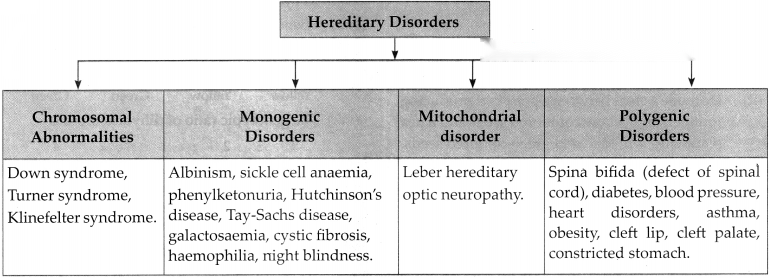
7. Complete the tree diagram below based on types of hereditary disorders.
Answer:

Class 9 Science Chapter 12 Study of Sound Intext Questions and Answers
Class 9 Science Chapter 12 Study of Sound Additional Important Questions and Answers
Choose and write the correct option:
Find the odd man out:
Complete the analogy:
a. Tall plant: Phenotype :: Tt:
b. Dominant trait : Axial position of flower :: Recessive trait:
c. Women : 44 + XX :: Men :
d. Adenine and Guanine : Purine :: Cytosine and Thymine :
Answer:
a. Genotype
b. Terminal position of flower
c. 44 + XY
d. Pyrimidine
Match the columns
Column 1 | Column 2 | Column 3 |
(1) Leber hereditary optic neuropathy | (a) 44 + XXY | (i) Pale skin, white hairs. |
(2) Diabetes | (b) 45 + X | (ii) Men are sterile. |
(3) Albinism | (c) Mitochondrial disorder | (iii) Women are sterile. |
(4) Turner syndrome | (d) Polygenic disorder | (iv) This disorder arises during development of zygote. |
(5) Klinefelter Syndrome | (e) Monogenic disorder | (v) Effect on blood- glucose level. |
(1 – c – iv),
(2 – d – v),
(3 – e – i),
(4-b- Hi),
(5 – a – ii)
Question 2
Maharashtra Board Solution
Solution & Step-by-Step Answer:
(1 – c),
(2 – d), (3 – b), (4 – a)
Question 3
Maharashtra Board Solution
|
Column ‘A’ | Column ‘B’ |
(1) Tay-Sachs disease | (a) Multifactorial disorder |
(2) Diabetes | (b) Destruction of erythrocytes |
(3) Sickle-cell anaemia | (c) Absence of melanin |
(4) Albinism | (d) Monogenic disorder |
(1 – d),
(2 – a),
(3 – b),
(4 – c)
State whether the following statements are true or false. Correct the false statement:
Question 1
Maharashtra Board Solution
Offsprings produced through asexual reproduction show greater variations as compared to those produced through sexual reproduction.
Solution & Step-by-Step Answer:
False. Offsprings produced through asexual reproduction show minor variations as compared to those produced through sexual reproduction.
Question 2
Maharashtra Board Solution
Information necessary for protein synthesis is stored in the RNA.
Solution & Step-by-Step Answer:
False. Information necessary for protein synthesis is stored in the DNA.
Question 3
Maharashtra Board Solution
The quantity of growth hormone produced by a plant depends upon the efficiency of the concerned enzyme.
Solution & Step-by-Step Answer:
True
Question 4
Maharashtra Board Solution
The chromosome in which the centromere is exactly at the mid-point is called telocentric chromosome.
Solution & Step-by-Step Answer:
False. The chromosome in which the centromere is exactly at the mid-point is called metacentric chromosome.
Question 5
Maharashtra Board Solution
RNA molecules are called master molecules.
Solution & Step-by-Step Answer:
False. DNA molecules are called master molecules.
Question 6
Maharashtra Board Solution
The pair of sex chromosomes are called autosomes.
Solution & Step-by-Step Answer:
False. The pair of sex chromosomes is called allosomes.
Question 7
Maharashtra Board Solution
In DNA, Adenine always pairs with thymine and cytosine always pairs with guanine.
Solution & Step-by-Step Answer:
True
Question 8
Maharashtra Board Solution
In humans there are 23 pairs of autosomes and one pair of allosomes.
Solution & Step-by-Step Answer:
False. In humans, there are 22 pairs of autosomes and one pair of allosomes.
Question 9
Maharashtra Board Solution
The phenotypic and genotypic ratios are not same.
Solution & Step-by-Step Answer:
True
Question 10
Maharashtra Board Solution
Phenotype means the pairs of genes responsible for the visible characteristics of organisms.
Solution & Step-by-Step Answer:
False. Phentotype means external appearance of visible characteristics of organisms.
Question 11
Maharashtra Board Solution
During gamete formation, in Pj generation the pair of gametes separate independently.
Solution & Step-by-Step Answer:
True
Question 12
Maharashtra Board Solution
Down syndrome is caused due to monosomy of X chromosome.
Solution & Step-by-Step Answer:
False. Down syndrome is caused due to trisomy of 21st chromosome.
Question 13
Maharashtra Board Solution
In Klinefelter syndrome, women are sterile.
Solution & Step-by-Step Answer:
False. In Klinefelter syndrome, men are sterile as this disorder arises in men due to abnormality in sex chromosome.
Question 14
Maharashtra Board Solution
If the father and mother are both sufferers or carriers of sickle-cell anaemia, their offsprings are likely to suffer from this disease.
Solution & Step-by-Step Answer:
True
Question 15
Maharashtra Board Solution
During fertilization, mitochondria is contributed by the sperm cell and egg cell(ovum).
Solution & Step-by-Step Answer:
False. During fertilization, mitochondria is contributed by the egg cell (ovum) alone.
Question 16
Maharashtra Board Solution
Polygenic disorders strictly follow Mendel’s principles of heredity.
Solution & Step-by-Step Answer:
False. Polygenic disorders do not strictly follow Mendel’s principles of heredity.
Question 17
Maharashtra Board Solution
Genetic material is transferred in equal quantity from parents to progeny.
Solution & Step-by-Step Answer:
True
Give scientific reasons:
Question 1
Maharashtra Board Solution
DNA molecules are called as ‘Master molecules’.
Solution & Step-by-Step Answer:
Question 2
Maharashtra Board Solution
Phenotypic and genotypic ratios are different.
Solution & Step-by-Step Answer:
Question 3
Maharashtra Board Solution
A carrier or sufferer of sickle-cell anaemia should avoid marriage with another carrier or sufferer.
Solution & Step-by-Step Answer:
Question 3
Maharashtra Board Solution
Mitochondrial disorders are inherited from the mother only.
Solution & Step-by-Step Answer:
Question 4
Maharashtra Board Solution
Tobacco smoking causes cancer.
Solution & Step-by-Step Answer:
Define the following terms:
Question 1
Maharashtra Board Solution
Gene
Solution & Step-by-Step Answer:
The segment of DNA which contains all the information for synthesis of a particular protein is called a ‘gene’.
Question 2
Maharashtra Board Solution
Chromosome
Solution & Step-by-Step Answer:
The structure in the nucleus of the cells that carries the hereditary characteristics is called chromosome.
Question 3
Maharashtra Board Solution
Genetics
Solution & Step-by-Step Answer:
The branch of biology which studies the transfer of characteristics of organism from one generation to the next and genes in particular, is called genetics.
Question 4
Maharashtra Board Solution
Heredity
Solution & Step-by-Step Answer:
Transfer of characteristics from parents to offsprings is called heredity.
Question 5
Maharashtra Board Solution
Homologous chromosomes
Solution & Step-by-Step Answer:
If the pair consists of chromosomes are similar in shape and organization, they are called homologous chromosomes.
Question 6
Maharashtra Board Solution
Heterologous chromosomes
Solution & Step-by-Step Answer:
If the pair which consists of chromosomes are not similar in shape and organization, they are called heterologous chromosomes.
Question 7
Maharashtra Board Solution
Genetic disorders
Solution & Step-by-Step Answer:
Diseases or disorders occuring due to abnormalities in chromosomes and mutations in genes are called genetic disorders.
Distinguish between:
Question 1
Maharashtra Board Solution
DNA and RNA
Solution & Step-by-Step Answer:
Question 2
Maharashtra Board Solution
Turner syndrome and Klinefelter syndrome.
Solution & Step-by-Step Answer:
Write short notes on:
Question 1
Maharashtra Board Solution
Albinism
Solution & Step-by-Step Answer:
Question 2
Maharashtra Board Solution
Polygenic disorders.
Solution & Step-by-Step Answer:
Question 3
Maharashtra Board Solution
Turner syndrome.
Solution & Step-by-Step Answer:
Answer the following questions:
Question 1
Maharashtra Board Solution
What are the main objectives of National Health Mission?
Solution & Step-by-Step Answer:
The main objectives of National Health Mission are:
Question 2
Maharashtra Board Solution
Which were the seven pairs of contrasting characteristics studied by Mendel in pea plant?
Solution & Step-by-Step Answer:
The seven pairs of contrasting characters studied by Mendel in pea plant were as follows:
Question 3
Maharashtra Board Solution
Name some dominant and recessive characteristics seen in human beings.
Solution & Step-by-Step Answer:
Some dominant and recessive characteristics of human beings.
Question 4
Maharashtra Board Solution
What is Klinefelter syndrome?
Solution & Step-by-Step Answer:
Question 5
Maharashtra Board Solution
How is the diagnosis for sickle-cell anaemia made?
Solution & Step-by-Step Answer:
Question 6
Maharashtra Board Solution
Find out the Phenotypic ratio of the following: (a) Round-Yellow (b) Wrinkled-Yellow (c) Round-Green (d) Wrinkled-Green
Solution & Step-by-Step Answer:
(a) Round-Yellow: 9 (b) Wrinkled-Yellow: 3 (c) Round-Green: 3 (d) Wrinkled-Green: 1 Phenotypic ratio: 9:3:3:1
Question 7
Maharashtra Board Solution
Find out the Genotypic ratio of the following: (a) RRYY (b) RRYy (c) RRyy (d) RrYY (e) RrYy (f) Rryy (g) rrYY (h) rrYy (i) rryy
Solution & Step-by-Step Answer:
(a) RRYY -1 (b) RRYy-2 (c) RRyy-1 (d) RrYY-2 (e) RrYy-4 (f) Rryy-2 (g) rrYY – 1 (h) rrYy – 2 (i) rryy – 1 Genotypic ratio: 1:2:1:2:4:2:1:2:1
Draw neat and labelled diagrams of the following:
Question 1
Maharashtra Board Solution
Structure of chromosome
Solution & Step-by-Step Answer:
Question 2
Maharashtra Board Solution
Types of RNA
Solution & Step-by-Step Answer:
Answer the following questions:
Question 1
Maharashtra Board Solution
What are the effects of tobacco consumption?
Solution & Step-by-Step Answer:
Question 2
Maharashtra Board Solution
Complete the table for number of chromosomes in different organisms.
Solution & Step-by-Step Answer:
|