Latest Maharashtra State Board (SSC & HSC) 2026-27 Syllabus Digest & Solutions Updated!
Class 10 (SSC Board)Mathematics & Statistics2026-27 Syllabus

Chapter 1 Linear Equations in Two Variables Practice Set 1.3 Solutions

Complete Maharashtra State Board Balbharati & Yuvakbharati textbook solutions for Chapter 1 Linear Equations in Two Variables Practice Set 1.3. Step-by-step solved exercises, numerical problems, and digest answers.

7 Solved Questions13 Diagrams997 words

Practice Set 1.3 Algebra 10th Std Maths Part 1 Answers Chapter 1 Linear Equations in Two Variables

Question 1 Maharashtra Board Solution
Fill in the blanks with correct number.
Solution & Step-by-Step Answer:

Question 2 Maharashtra Board Solution
Find the values of following determinants.
Solution & Step-by-Step Answer:

Question 3 Maharashtra Board Solution
Solve the following simultaneous equations using Cramer’s rule. i. 3x – 4y = 10 ; 4x + 3y = 5 ii. 4x + 3y – 4 = 0 ; 6x = 8 – 5y iii. x + 2y = -1 ; 2x – 3y = 12 iv. 6x – 4y = -12 ; 8x – 3y = -2 v. 4m + 6n = 54 ; 3m + 2n = 28 vi. 2x + 3y = 2 ; x – =
Solution & Step-by-Step Answer:
i. The given simultaneous equations are 3x – 4y = 10 …(i) 4x + 3y = 5 …(ii) Equations (i) and (ii) are in ax + by = c form. Comparing the given equations with a1x + b1y = c1 and a2x + b2y = c2, we get a1 = 3, b1 = -4, c1 = 10 and a2 = 4, b2 = 3, c2 = 5 ∴ (x, y) = (2, -1) is the solution of the given simultaneous equations.

ii. The given simultaneous equations are
4x + 3y – 4 = 0
∴ 4x + 3y = 4 …(i)
6x = 8 – 5y
∴ 6x + 5y = 8 …(ii)
Equations (i) and (ii) are in ax + by = c form.
Comparing the given equations with
a1x + b1y = c1and a2x + b2y = c2, we get
a1= 4, b1= 3, c1= 4 and
a2= 6, b2= 5, c2= 8

∴ (x, y) = (-2, 4) is the solution of the given simultaneous equations.

iii. The given simultaneous equations are
x + 2y = -1 …(i)
2x – 3y = 12 …(ii)
Equations (i) and (ii) are in ax + by = c form.
Comparing the given equations with
a1x + b1y = C1and a2x + b2y = c2, we get
a1= 1, b1= 2, c1= -1 and
a2= 2, b2= -3, c2= 12

∴ (x, y) = (3, -2) is the solution of the given simultaneous equations.

iv. The given simultaneous equations are
6x – 4y = -12
∴ 3x – 2y = -6 …(i) [Dividing both sides by 2]
8x – 3y = -2 …(ii)
Equations (i) and (ii) are in ax + by = c form.
Comparing the given equations with
a1x + b1y = c1and a2x + b2y = c2, we get
a1= 3, b1= -2, c1= -6 and
a2= 8, b2= -3, c2= -2

∴ (x, y) = (2, 6) is the solution of the given simultaneous equations.

v. The given simultaneous equations are
4m + 6n = 54
2m + 3n = 27 …(i) [Dividing both sides by 2]
3m + 2n = 28 …(ii)
Equations (i) and (ii) are in am + bn = c form.
Comparing the given equations with
a1m + b1n = c1and a2m + b2n = c2, we get
a1= 2, b1= 3, c1= 27 and
a2= 3, b2= 2, c2= 28


∴ (m, n) = (6, 5) is the solution of the given simultaneous equations.

vi. The given simultaneous equations are
2x + 3y = 2 …(i)
x = =
∴ 2x – y = 1 …(ii) [Multiplying both sides by 2]
Equations (i) and (ii) are in ax + by = c form.
Comparing the given equations with
a1x + b1y = c1and a2x + b2y = c2, we get
a1= 2, b1= 3, c1= 2 and
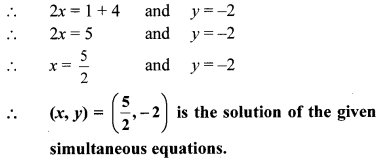
a2= 2, b2= -1, c2= 1
Question 1 Maharashtra Board Solution
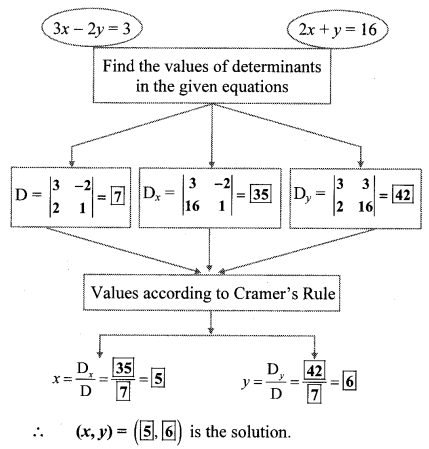
To solve the simultaneous equations by determinant method, fill in the blanks, y + 2x – 19 = 0; 2x – 3y + 3 = 0 (Textbookpg.no. 14)
Solution & Step-by-Step Answer:
Write the given equations in the form ax + by = c. 2x + y = 19 2x – 3y = -3

Question 2 Maharashtra Board Solution
Complete the following activity. (Textbook pg. no. 15)
Solution & Step-by-Step Answer:

Question 3 Maharashtra Board Solution
What is the nature of solution if D = 0? (Textbook pg. no. 16)
Solution & Step-by-Step Answer:
If D = 0, i.e. a1b2 – b1a2 = 0, then the two simultaneous equations do not have a unique solution. Examples: i. 2x – 4y = 8 and x – 2y = 4 Here, a1b2 – b1a2 = (2)(-2) – (-4) (1) = -4 + 4 = 0 Graphically, we can check that these two lines coincide and hence will have infinite solutions.

ii. 2x – y = -1 and 2x – y = -4
Here, a1b2– b1a2= (2)(-1) – (-1) (2)
= -2 + 2 = 0
Graphically, we can check that these two lines are parallel and hence they do not have a solution.

Question 4 Maharashtra Board Solution
What can you say about lines if common solution is not possible? (Textbook pg. no. 16)
Solution & Step-by-Step Answer:
If the common solution is not possible, then the lines will either coincide or will be parallel to each other.