Practice Set 1.4 Algebra 10th Std Maths Part 1 Answers Chapter 1 Linear Equations in Two Variables
Question 1
Maharashtra Board Solution
Solve the following simultaneous equations.
Solution & Step-by-Step Answer:
i. The given simultaneous equations are ∴ Equations (i) and (ii) become 2p – 3q = 15 …(iii) 8p + 5q = 77 …(iv) Multiplying equation (iii) by 4, we get 8p – 12q = 60 …(v) Subtracting equation (v) from (iv), we get


ii. The given simultaneous equations are
Substituting x = 3 in equation (vi), we get
3 + y = 5
∴ y = 5 – 3 = 2
∴ (x, y) = (3, 2) is the solution of the given simultaneous equations.
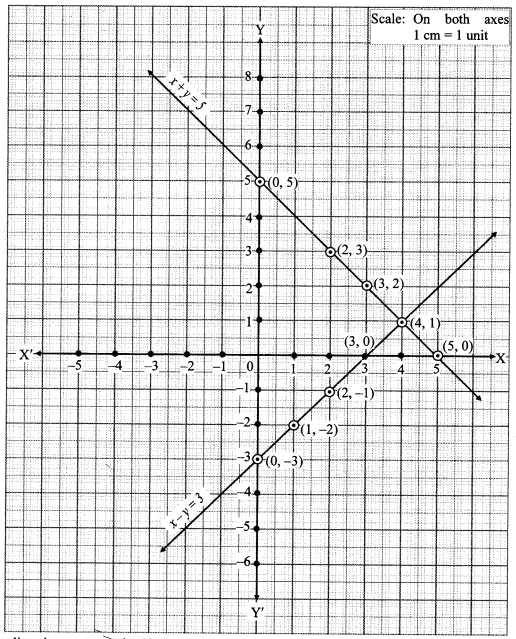

iii. The given simultaneous equations are
∴ Equations (i) and (ii) become
27p + 31q = 85 …(iii)
31p + 27q = 89 …(iv)
Adding equations (iii) and (iv), we get



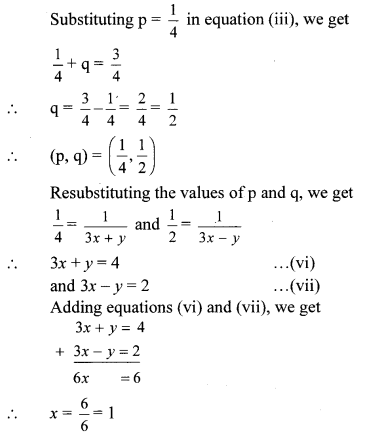
iv. The given simultaneous equations are
Substituting x = 1 in equation (vi), we get
3(1) + y = 4
∴ 3 + y = 4
∴ y = 4 – 3 = 1
∴ (x, y) = (1, 1) is the solution of the given simultaneous equations.

Question 1
Maharashtra Board Solution
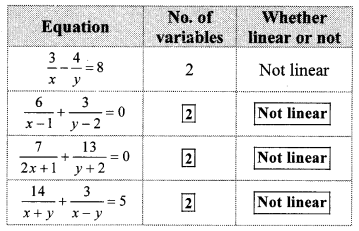
Complete the following table. (Textbook pg. no. 16)
Solution & Step-by-Step Answer:
Question 2
Maharashtra Board Solution
In the above table the equations are not linear. Can you convert the equations into linear equations? (Textbook pg. no. 17)
Solution & Step-by-Step Answer:
Yes, the above given simultaneous equations can be converted to a pair of linear equations by making suitable substitutions.
Steps for solving equations reducible to a pair of linear equations.
Question 3
Maharashtra Board Solution
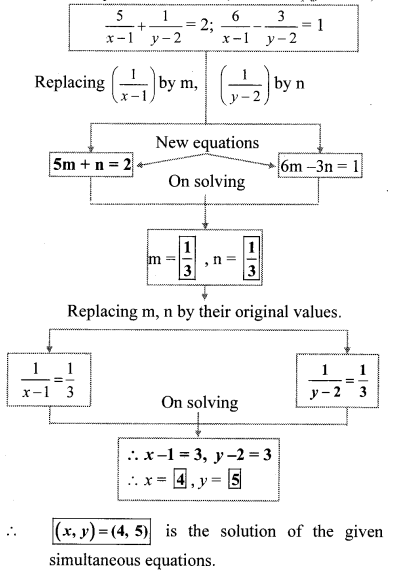
To solve given equations fill the below boxes suitably. (Text book pg.no. 19)
Solution & Step-by-Step Answer:
Question 4
Maharashtra Board Solution
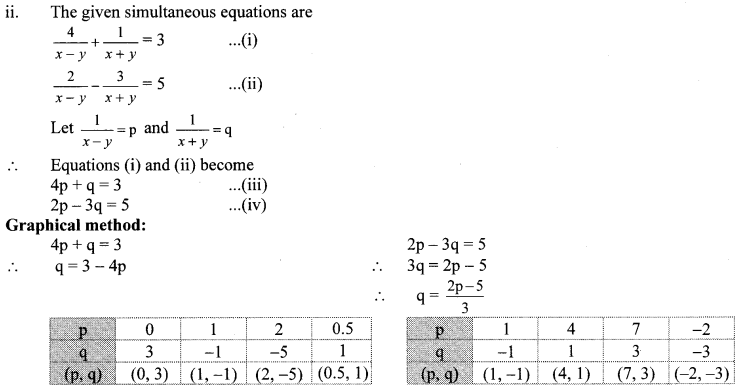
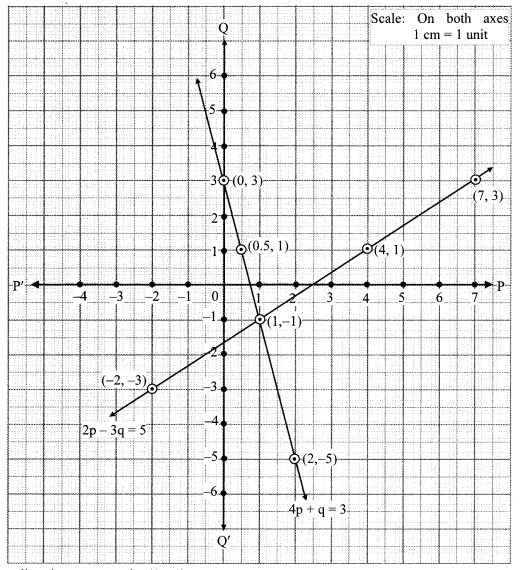
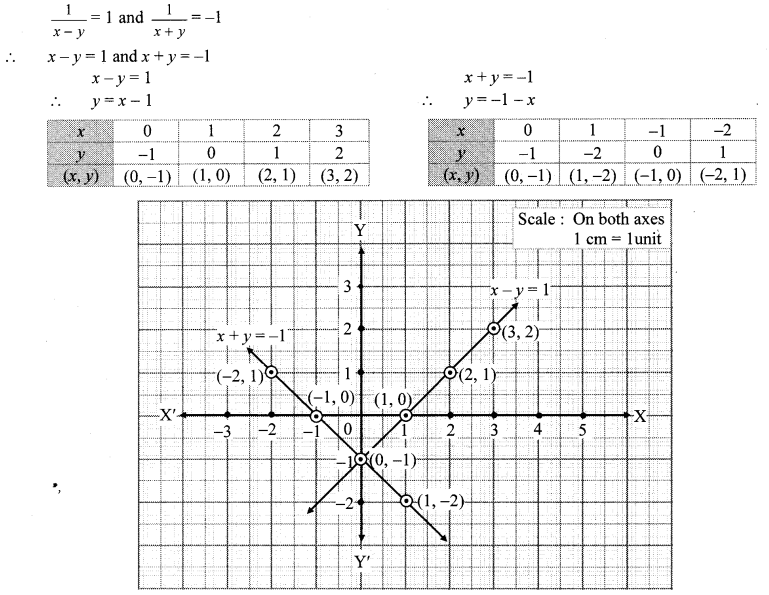
The examples on textbook pg. no. 17 and 18 obtained by transformation are solved by elimination method. If you solve these equations by graphical method and by Cramer’s rule will you get the same answers? Solve and check it. (Textbook pg. no. 18)
Solution & Step-by-Step Answer:
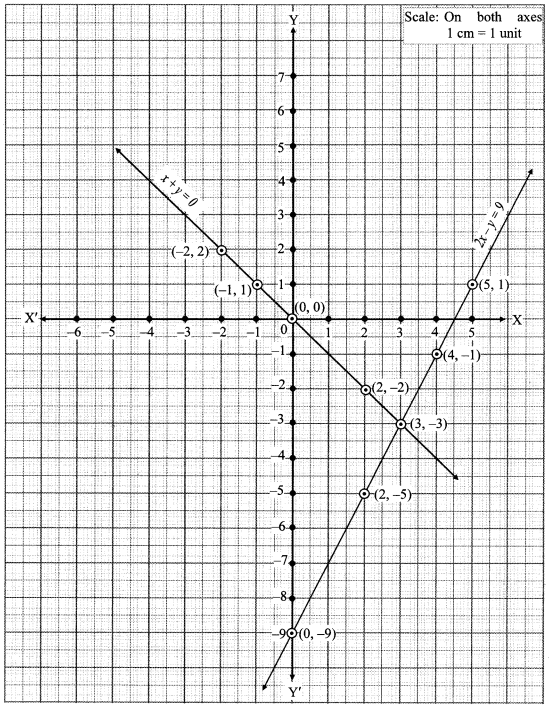
The two lines intersect at point (1,-1). ∴ p = 1 and q = -1 is the solution of the simultaneous equations 4p + q = 3 and 2p – 3q = 5. Re substituting the values of p and q, we get The two lines intersect at point (0, -1). ∴ x = 0 and y = -1 is the solution of the simultaneous equations x – y = 1 and x + y = -1. ∴ (x, y) = (0, -1) is the solution of the given simultaneous equations.