Maharashtra State Board Class 10 Political Science Solutions Chapter 2 The Electoral Process
(2) …………………………. was appointed as the first Chief Election Commissioner of independent India.
(a) Dr. Rajendra Prasad
(b) T.N. Sheshan
(c) Sukumar Sen
(d) Neela Satyanarayan
Answer:
(c) Sukumar Sen
(3) Constituencies are created by …………………………. committee of the Election Commission.
(a) Selection
(b) Delimitation
(c) Voting
(d) Timetable
Answer:
(b) Delimitation
(2) Under special circumstances the Election Commission holds re-elections in a particular constituency for a second time.
Answer:
The above statement is True. Reasons :
(3) The state government decides as to when and in how many stages the elections would be held in a particular State.
Answer:
The above statement is False. Reasons :
Therefore, it is decided by the Election Commission as to when and in how many stages it will conduct elections.
(2) Midterm Elections
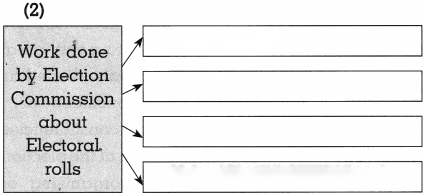
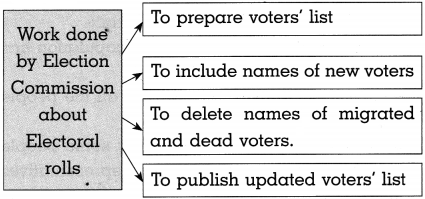
Answer:
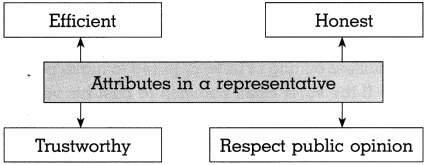
Answer:
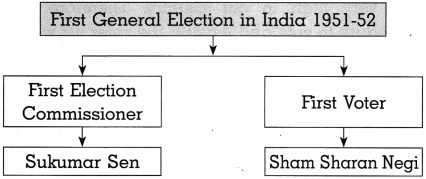
(2) Write some additional information about post of the Election Commissioner.
Answer:
(1) The Election Commission in India has one Chief Election Commissioner and two other Chief Commissioners.
(2) All the commissioners are appointed by the President.
(3) The Chief Election Commissioner of India is usually a member of the Indian Civil Service or. Indian Administrative Service.
(4) The responsibility of conducting free and fair elections to the Parliament and State Legislatures lies with the Election Commissioner.
(5) In order do safeguard the independence of the Election Commissioner, he cannot be easily removed from the post for any political reasons.
(3) Explain the meaning of Code of Conduct.
Answer:
(1) After the announcement of elections till the declaration of results, the Election Commission enforces the Code of Conduct.
(2) It explains the rules to be followed by the government, political parties candidates and voters before and during elections.
(3) Code of conduct is adopted to control malpractices during elections. It ensure free and fair ecections.
Project
Organise a mock poll in the school to understand the process of voting.
Answer:
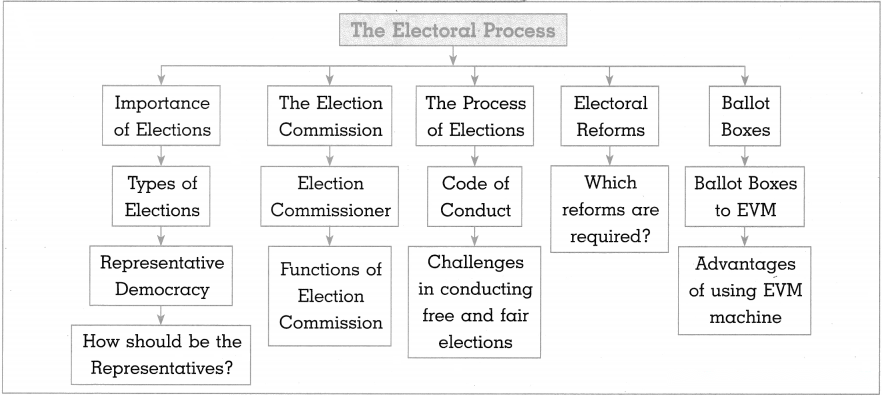
Memory Map
(b) system exists in India.
(a) Single-party
(b) Two-party
(c) Multi-party
(d) No-party
Answer:
(c) Multi-party.
(c) The right to give recognition or de-recognize a political party lies with ………………...
(a) President
(b) Election Commission
(c) Parliament
(d) Vice-President
Answer:
(b) Election Commission
(d) There are constituencies of Lok Sabha at present.
(a) 288
(b) 350
(c) 500
(d) 543
Answer:
(d) 543
(e) from the present state of Himachal Pradesh was the first voter.
(a) Sukumar Sen
(b) Sham Sharan Negi
(c) Prem Kumar Ghumal
(d) P N. Chadda
Answer:
(b) Sham Sharan Negi
(f) Due to EVM, people can also vote easily.
(a) elder
(b) salaried
(c) Divyanga
(d) Transgender
Answer:
(c) Divyanga
(g) The first elections in India were held in
(a) 1948-49
(b) 1949-50
(c) 1950-51
(d) 1951-52
Answer:
(d) 1951-52.
(b) The Election Commission has started awareness campaign for registration of voters.
Answer:
The above statement is True. Reasons :
(c) Every candidate who fills the nomination form can contest election.
Answer:
The above statement is False. Reasons :
Therefore, it is not possible for every candidate who fills the nomination form to contest election.
(d) Sometimes, the Election Commission has to conduct mid-term elections. OR Explain the concept : Mid-Term Elections.
Answer:
The above statement is True. Reasons :
(a) What is representation?
Modern democracy is a representative democracy. In a democracy it is not possible to involve the entire population in the ecision-making process. This resulted in the starting of the practice of electing some people on behalf of entire population
as representatives who would run the government. The representatives who form the government are expected to be responsible to the people and give preference to the welfare of the people.
(b) Election Commission :
Answer:
In India, the Election Commission is central to the process of elections. Art. 324 of the Indian Constitution has established this autonomous body which consists of one Chief Election Commissioner and two other commissioners.
Question 9
Maharashtra Board Solution
Write short notes : (a) Journey from Ballot box to EVM machine :
Solution & Step-by-Step Answer:
(b) Recognition to Political Parties :
Question 10
Maharashtra Board Solution
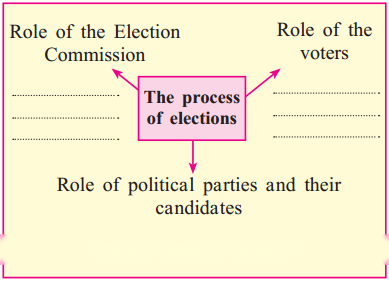
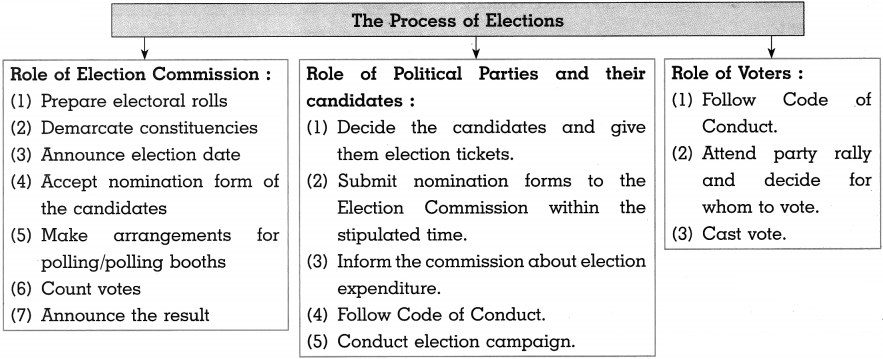
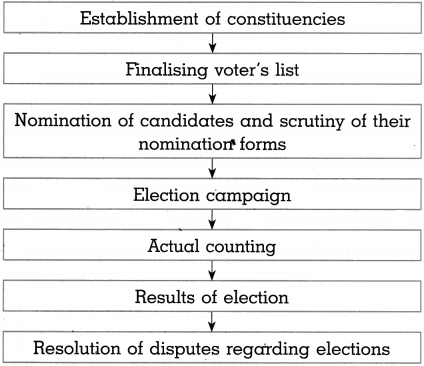
Complete the concept map : |
(a) Prepare a flow chart on the process of election.
(b) Which two conditions among following is the violation of code of conduct?
(1) The candidate distributes items of household use. –
(2) Promises made to resolve the water problem if elected.
(3) To go from door to door to meet voters and request them to vote.
(4) To appeal on the basis of caste and religion to get support.
Answer:
(1) The candidate distributes items of household use.
(2) To appeal on the basis of caste and religion to get support.
Question 11
Maharashtra Board Solution
Solution & Step-by-Step Answer:
in brief : (a) Why is it important to conduct elections? Answer: It is important to conduct elections because of the following reasons :
(b) What are the conditions for voting? (c) What action is taken by the Election Commission if disputes arise regarding elections? (d) What challenges are faced by the Election Commission to conduct free and fair elections? (e) What are the advantages of EVM machines? (f) Explain the features of procedures of voting during the first Lok Sabha Election.
Question 12
Maharashtra Board Solution
Give your opinion : (a) When candidates have only the condition of age, why should they give other information to Election Commission?
Solution & Step-by-Step Answer:
(b) Why is it so? (B) Why every political party has an election symbol? (C) At the time of voting and counting of votes, the official representatives of political parties remain present. (D) All recognised parties should get an equal opportunity to express their opinion on media such as television and radio. (c) Think! (B) What do you understand by the system ‘One Vote One Value’? (d) Voting is our duty as well as responsibility to vote. (e) What measures should be taken to increase the credibility of elections? (f) Which rules would you include in Code of Conduct for voters? |