Maharashtra State Board Class 10 Political Science Solutions Chapter 3 Political Parties
(2) National Conference is a party in ………………………….. this region.
(a) Odisha
(b) Assam
(c) Bihar
(d) Jammu and Kashmir
Answer:
(d) Jammu and Kashmir
(3) Justice Party- a non-Brahmin movement was transformed into ………………………….. Political Party.
(a) Assam Gan Parishad
(b) Shivsena
(c) Dravid Munnetra Kazhagam
(d) Jammu and Kashmir National Conference
Answer:
(c) Dravid Munnetra Kazhagam
(2) Political parties are social organisations.
Answer:
The above statement is True.
(3) Coalition politics leads to instability.
Answer:
The above statement is False.
Therefore, the belief that the coalition government brings instability was proved wrong.
(4) Shiromani Akali Dal is a national party.
Answer:
The above statement is False.
The Election Commission of India recognises a political party as National or Regional party on the basis of specific criteria namely:
(2) National Parties
Answer:
A party which functions at the national level is known as National Party.
(2) What changes have taken place in the nature of political parties in India?
Answer:
The following changes were seen in the party system in India:
Project
(1) In a map of Maharashtra, point out the Loksabha constituency that includes the names of your parents.
(2) In a map of India, point out the places where national political parties have their influence.
Answer:
Memory Map
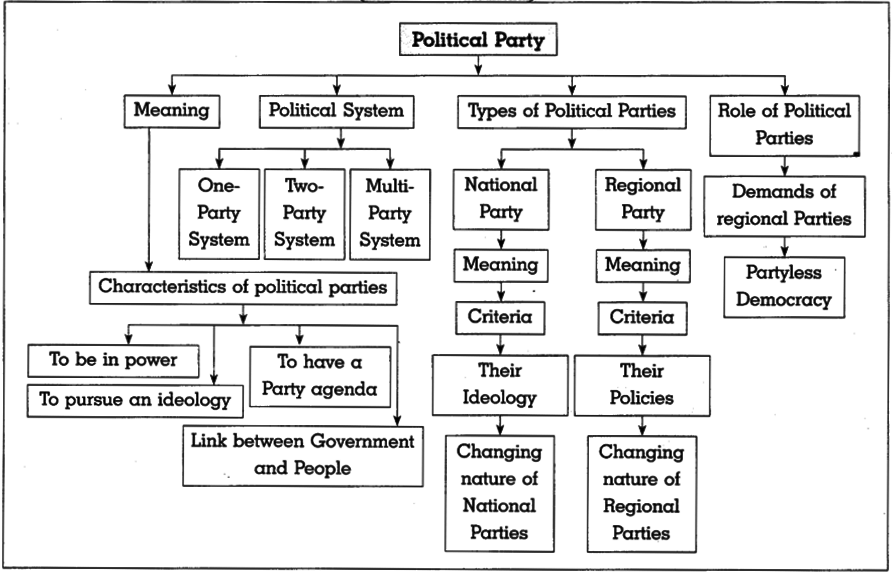
(b) ‘Bharatiya Janata Party’ which was formed in 1980 after a split with ………………………. a component of Janata Party.
(a) Jan Sangh
(b) Lok Dal
(c) Independent party
(b) Janata Dal
Answer:
(a) Jan Sangh.
(c) Social support received by a political party is called ………………………..
(a) Democracy
(b) People’s rule
(c) Mass base
(d) Public relation
Answer:
(c) Mass base
(d) Promotion of the Marathi language is the objective of the ………………………..
(a) Dravida Munnetra Kazhagam
(b) Shiromani Akali Dal
(c) Shiv Sena
(d) Assam Gana Parishad
Answer:
(c) Shiv Sena
(e) There are ………………………. recognised parties in India.
(a) five
(b) seven
(c) nine
(d) six
Answer:
(b) seven
(f) The main objective of the political party is to capture ………………………. and retain it.
(a) publicity
(b) victory
(c) power
(d) information
Answer:
(c) power
(g) The ideology of the Communist Party of India is based on ………………………. Philosophy.
(a) Capitalist
(b) Marxist
(c) Democracy
(d) Imperialist
Answer:
(b) Marxist
(h) Shiromani Akali Dal is a prominent regional party in ………………………. state.
(a) Odisha
(b) Assam
(c) Punjab
(d) Jammu and Kashmir
Answer:
(c) Punjab
(a) Political parties do not need support of the people.
Answer:
The above statement is False.
Hence, all political parties require support of the people.
(b) The Communist Party of India was split.
Answer:
The above statement is True.
(c) Sometimes the sentiments of regionalism gets strengthened in the country.
Answer:
The above statement is True.
(d) Regional parties have no influence on National Politics.
Answer:
The above statement is False.
(b) Political Party:
Answer:
(b) Indian National Congress:
Answer:
(c) Communist Party of India:
Answer:
(d) Nationalist Congress Party:
Answer:
(e) Trinamool Congress:
Answer:
(f) Shiv Sena:
Answer:
(g) Shiromani Akali Dal:
Answer:
(h) Dravid Munnetra Kazhagam:
Answer:
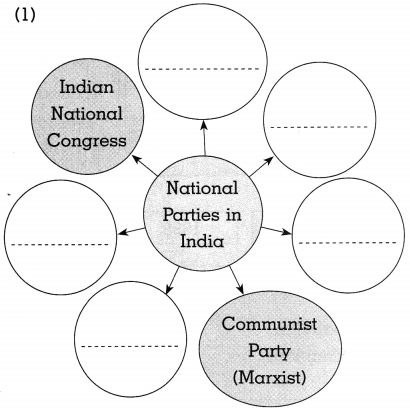
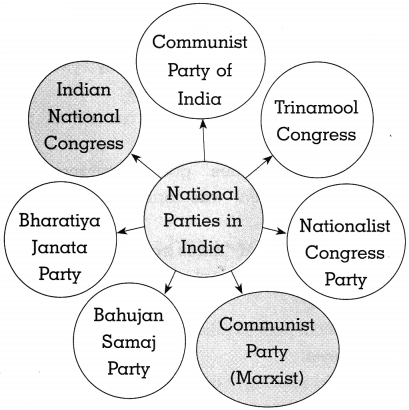
Answer:
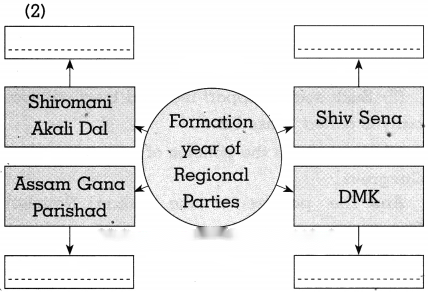
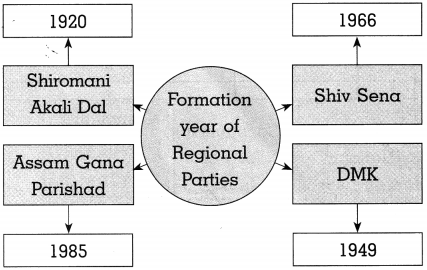
(3)
Answer:
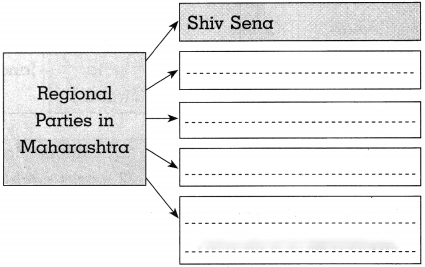
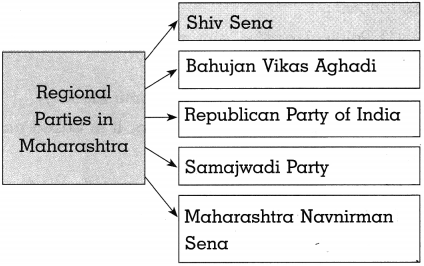
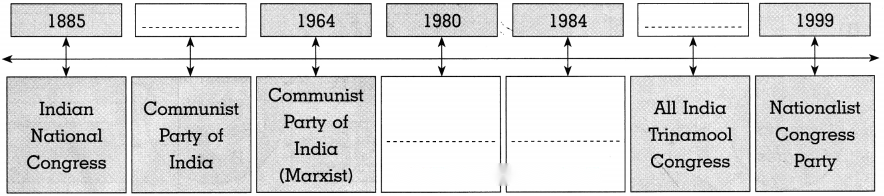
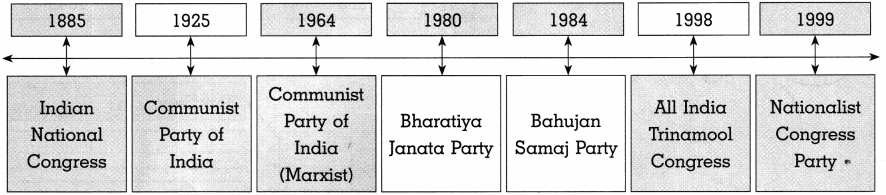
(b) Complete the Time-line writing the name of the party or the year of establishment:
Answer:
(a) What is called “mass base”?
(b) Write about the policies of Indian National Congress.
Answer:
The policies of the Indian National: Congress are as follows:
(c) Explain the role of Bharatiya Janata Party.
Answer:
Bharatiya Janata Party was formed in 1980 with the following objectives:
(d) Write about the policies of Communist Party of India (Marxist).
Answer:
Communist Party of India (Marxist) was formed in 1964 with the following objectives:
(e) Why was Bahujan Samaj Party formed?
Answer:
The Bahujan Samaj Party was formed in 1984 to achieve the following objectives:
(f) What do the regional parties give preference for?
Answer:
The regional parties give preference to the following issues:
(g) What changes are seen in the nature and role of regional parties?
Answer:
The role of regional parties changed over period of time. The changes are as follows:
(h) What are the objectives of Assam Gana Parishad?
Answer:
Assam Gana Parishad was formed in 1985 with the following objectives:
(i) What are the criteria for a regional party to get recognition?
Answer:
(j) What work is done by political parties?
Answer:
The following work is done by political parties:
Question 11
Maharashtra Board Solution
Give your opinion:
(a) Imagine you are opposition party leader and you have observed that the ruling party has not done good work in the field of health. What will you do as a leader of opposition?
Solution & Step-by-Step Answer:
As opposition leader, I will do the following to make the government realise its negligence in the health field:
(b) Think and write
(a) Opposition parties held a meeting in Mumbai to resist the Ruling party. Will take up the issue of farmers?
Solution & Step-by-Step Answer:
(b) Ruling party has organised ‘Samvad Yatra’ in rural areas. |