Maharashtra State Board Class 10 Science Solutions Part 1 Chapter 10 Space Missions
b. The initial velocity (during launching) of the Mangalyaan must be greater than ………… from the earth.
Answer:
The initial velocity (during launching) of the Mangalyaan must be greater thanthe escape velocityfrom the earth.
Explanation: If a satellite is to travel beyond the gravitational pull of the earth, its velocity must be more than the escape velocity from the earth.
[Note: The velocity must be atleast equal to the escape velocity. Refer the definition of escape velocity.]
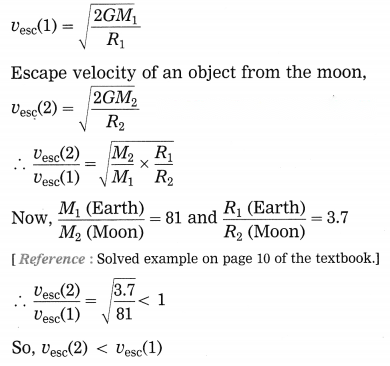
b. The escape velocity on the moon is less than that on the earth.
Answer:
True.
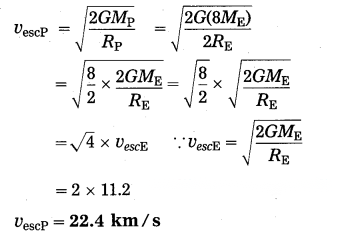
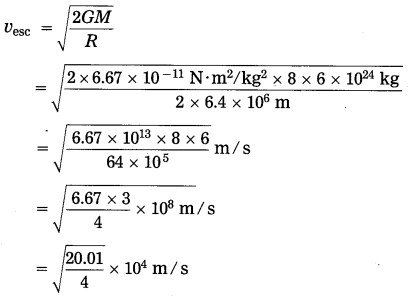
Explanation: Escape velocity of an object from the earth,
c. A satellite needs a specific velocity to revolve in a specific orbit.
Answer:
True.
Explanation:
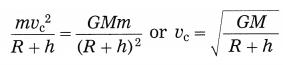
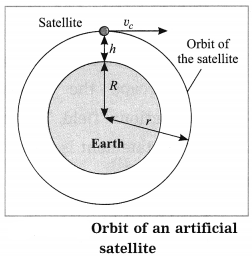
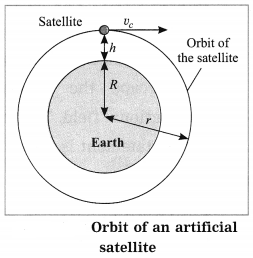
Centripetal force on the satellite = gravitational force exerted by the earth on the satellite
where,
m: mass of the satellite
υc: critical velocity of the satellite
h: height of the satellite from the surface of the earth
M: mass of the earth
R: radius of the earth
G: gravitational constant
∴
∴
Thus, if the value of h changes, the value of υcalso changes. It means a satellite needs to be given a specific velocity (in the tangential direction) to keep it revolving in a specific orbit.
d. If the height of the orbit of a satellite increases, its velocity must also increase.
Answer:
False.
Explanation:
Centripetal force on the satellite = gravitational force exerted by the earth on the satellite
where,
m : mass of the satellite
υc: critical velocity of the satellite
h : height of the satellite from the surface of the earth
M : mass of the earth
R : radius of the earth
G : gravitational constant
∴
∴
Thus, if the value of h changes, the value of υcalso changes. It means a satellite needs to be given a specific velocity (in the tangential direction) to keep it revolving in a specific orbit.
As per the formula υc= , if the value of h increases, the value of υcdecreases. Hence, if the height of the satellite from the surface of the earth increases, its velocity decreases.
Classification of satellites depending on their functions:
(1) Weather satellites: weather satellites collect the information regarding weather conditions of the region. It records temperature, air pressure, wind direction, humidity, cloud cover, etc. this information is sent to the space research station on the earth and then with this information weather forecast is made.
(2) Communication satellites: In order to establish communication between different places on the earth through mobile phones or computer assisted internet, communication satellites are used. Many artificial satellites placed at various locations in the earth’s orbit are well interconnected and help us to have communication with any place, from anywhere, at any time and in any form including voicemail, email, photographs, audio mail, etc.
(3) Broadcasting satellites: Broadcasting satel¬lites are used to transmit various radio and television programs and even live programs from any place on the earth to any other place. As a result, one can have access to information about current incidents, events, programs, sports and other events right from his drawing room with these satellites.
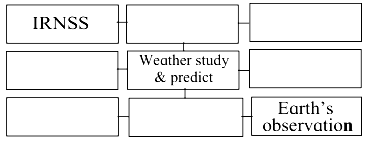
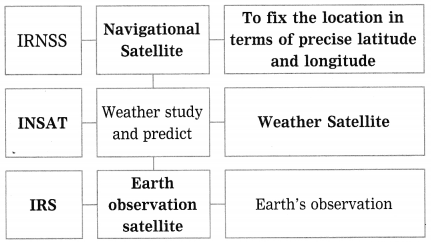
(4) Navigational satellites: Navigational satel¬lites assist the surface, water and air transportation and coordinate their busy schedule. These satellites also assist the user with current live maps as well as real time traffic conditions.
(5) Military satellites: Every sovereign nation needs to keep the real time information about the borders. Satellites help to monitor all movements of neighboring countries or enemy countries. Military satellites also help to guide the missiles effectively.
(6) Earth observation satellites: These satellites observe and provide the real time information about the earth. These satellites also help us to collect information about the resources, their management, continuous observation about a natural phenomenon and the changes within it.
(7) Other satellites: Apart from these various satellites, certain satellites for specific works or purposes are also sent in the space. E.g. India has sent EDUSAT for educational purpose; CARTOSAT for surveys and map making. Similarly, satellites with telescopes, like Hubble telescope or a satellite like International Space Station help to explore the universe. In fact, ISS (International Space Station) provides a temporary residence where astronauts can stay for a certain short or long period and can undertake the research and study space activities.
The various functions listed above show the importance of artificial satellites.
b. What is meant by the orbit of a satellite? On what basis and how are the orbits of artificial satellites classified?
Answer:
Orbit of a satellite is its path around the earth.
Orbits of artificial satellites can be classified on various basis.
(1) On the basis of the angle of the orbital plane: Orbital plane of a satellite can be the equatorial plane of the earth or it can be at an angle to it.
(2) On the basis of the nature of the orbit: Orbital plane can be circular or elliptical in shape.
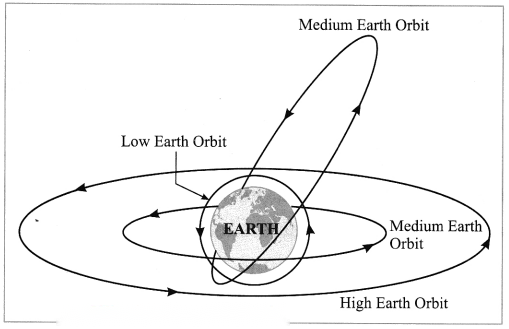
(3) On the basis of the height of the satellite: Orbit of a satellite can be HEO, MEO or LEO.
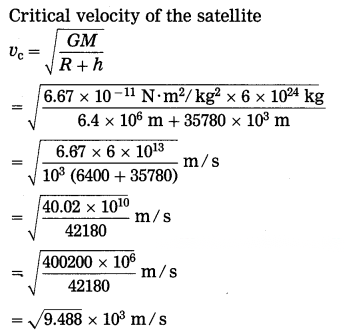
(i) High Earth Orbit (HEO) satellite: A satellite orbiting at a height equal to or greater than 35780 km above the earth’s surface is called a High Earth Orbit satellite. The critical velocity (υc) of a satellite revolving in an orbit at 35780 km above the earth surface is 3.08 km/s. Such a satellite will take about 23 hours 54 minutes to complete one revolution around the earth. The earth completes one rotation about its axis in the same time. The orbital plane of such a satellite is the equatorial plane of the earth. The satellite’s relative position appears stationary with respect to a place on the earth. This satellite is, therefore, called a geostationary satellite or geosynchronous satellite.
(ii) Medium Earth Orbit (MEO) satellite: A satellite orbiting at a height between 2000 km and 35780 km above the earth’s surface is called a Medium Earth Orbit satellite. The orbital path of such a satellite is normally elliptical and passes through the North and the South polar regions. These satellites take about 12 hours to complete one revolution around the earth.
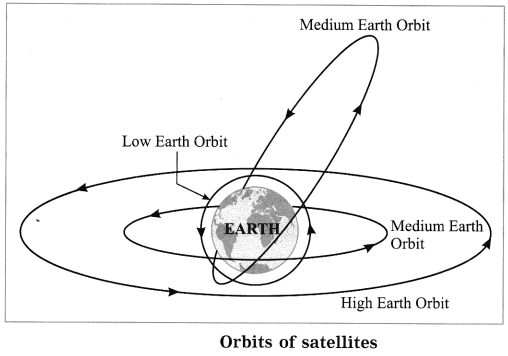
(iii) Low Earth Orbit (LEO) satellite:
A satellite orbiting at a height between 180 km and 2000 km above the earth’s surface is called a Low Earth Orbit satellite. Normally, these satellites take 90 minutes to complete one revolution around the earth. Weather satellites, space telescopes and International Space Station are Low Earth Orbit satellites.
c. Why are geostationary satellites not useful for studies of polar regions? (Practice Activity Sheet – 4)
(OR)
Explain the following statement. A geostationary satellite is not useful in the study of polar regions. (Practice Activity Sheet – 1)
Answer:
Geostationary satellites have two distinct characteristics:
(1) Geostationary satellites are HEO satellites and are placed at 35780 km above the earth’s surface.
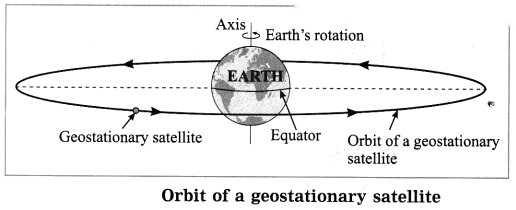
(2) A geostationary satellite revolves in the equatorial plane of the earth, and thus, it can never fly above the polar regions.
Hence, geostationary satellites are not useful for studies of polar regions.
d. What is meant by a satellite launch vehicle? Explain the satellite launch vehicle developed by ISRO with the help of a schematic diagram.
Answer:
A rocket used to carry an artificial satellite to a desired height above the earth’s surface and then project it with a proper velocity so that the satellite orbits the earth in the desired orbit is called a launch vehicle. A satellite launch vehicle needs a specific velocity as well as a thrust to reach the desired height above the earth’s surface. The velocity and the thrust of a satellite launch vehicle depend on the weight and orbital height of the satellite.
Accordingly, the structure of the launch vehicle is decided and designed. The weight of the fuel also contributes a major portion in the total weight of the launch vehicle. This also influences the structure of the launch vehicle. In order to use the fuel optimally, multiple stage launch vehicles are now designed and used.
The Polar Satellite Launch Vehicle (PSLV) developed by ISRO is shown below in a schematic diagram.
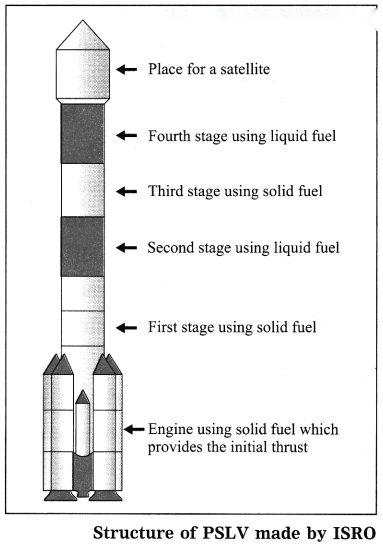
e. Why is it beneficial to use a satellite j launch vehicle made up of more than one stage?
Answer:
Earlier Satellite Launch Vehicles (SLV) used to be of a single stage vehicles. Such SLVs used to be very heavy as well as expensive in terms of its fuel consumption. As a result, SLVs with multiple stages were developed.
In multistage SLVs, as the journey of the launch vehicle progresses and the vehicle achieves a specific velocity and a certain height, the fuel of the first stage is exhausted and the empty fuel tank gets detached from the main body of the launch vehicle and falls back into a sea or on unpopulated land. As the fuel in the first stage is exhausted, the engine in the second stage is Ignited. However, the weight of the launch vehicle is now less than what it was earlier and hence it can move with higher velocity, Thus, it saves fuel consumption. Hence, it is beneficial to use a multistage satellite launch vehicle.
b. How much time would a satellite in an orbit at a height of 35780 km above the earth’s surface take to complete one revolution around the earth, if the mass of the earth were four times its original mass?
Answer:
Given: R (Earth) = 6400 km = 6.4 × 10⁶m,
M (Earth) = 6 × 1024kg
∴ M’ = 4M = 4 × 6 × 1024kg
h = 35780 km = 3.578 × 10⁷m = 35.78 × 10⁶m,
G = 6.67 × 10⁻¹¹N·m2/kg2, T = ?
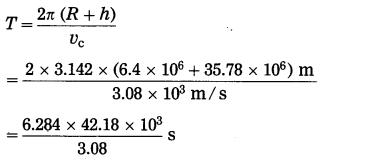
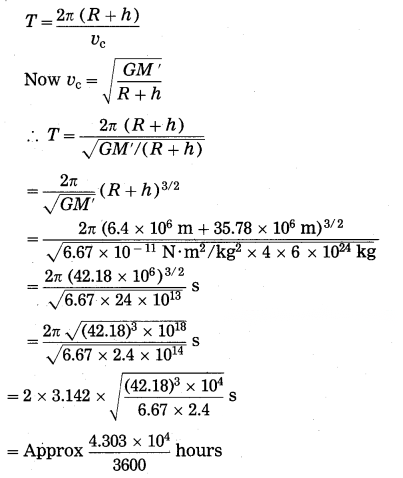
The time that the satellite would take to complete one revolution around the earth,
= Approx 4.303 × 10⁴s
= Approx 11.95 h
or 11 hours 57 minutes 10 seconds.
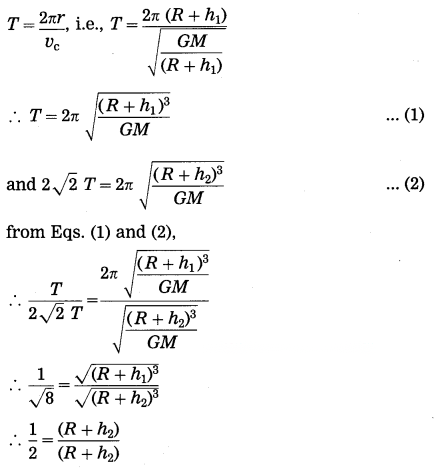
c. If the height of a satellite completing one revolution around the earth in T seconds is h1meters, then what would be the height of a satellite taking 2 T seconds for one revolution?
Answer:
Given:
(1) Time: T seconds
(2) Height: h1
Let us assume the height of the satellite completing one revolution in 2 T seconds as h2.
∴ R + h2= 2R + 2h1
∴ h2= R + 2h1
Project:
Project 1.
Collect information about the space missions undertaken by Sunita Williams.
Hints:
The following sources can be used to get the information on the above topic:
(1) Google Search Engine
(2) YouTube
(3) E-books on Sunita Williams
(4) English and other regional language books on Sunita Williams available in your library
(5) Newspaper clippings
Based on the information you have collected from the above sources, complete the project in about 5 pages. You can do value addition to your project with the help of suitable photos, clippings, charts, graphs and sketches.
Project 2.
Assume that you are interviewing Sunita Williams. Prepare a questionnaire and also the answers.
Answer:
Points to make a list of a questionnaire for the interview of Sunita Williams :
(1) Primary and higher education
(2) The source of inspiration to become an astronaut
(3) Information about her mentor
(4) General and specific training
(5) Initial experience of being an astronaut
(6) First space mission, its nature, duration and experience
(7) Natureofresearchcarriedoutinspace
(8) Some special memories
(9) Future plans
(10) Tips and guidance for the younger generation.
Can you recall? (Text Book Page No. 135)
(2) Visible light and radio waves emitted by celestial bodies in space pass through the atmosphere before reaching the earth’s surface. During this journey, some light is absorbed by the atmosphere. Hence, the intensity of the light reaching the earth’s surface decreases. Besides, temperature and air pressure cause the atmospheric turbulence. Hence, light rays change their path, resulting in a change in the position of the image of a celestial body.
City lights during night, and bright sunlight during day also put limitations on usage of optical telescopes on the earth. To minimize these problems, optical telescopes are situated on mountain top, away from inhabited places. However, limitations caused by the atmosphere still persist.
To get rid of these problems scientists have successfully launched telescopes in space. Images obtained by these telescopes are brighter and clearer than those obtained by the telescopes located on the earth’s surface.
Can you recall? (Text Book Page No. 135)
(2) Alternatively, a small portable dish antenna fixed on the rooftop is also used to receive the TV signals directly from the satellites. Finally, a cable connected to the dish antenna and TV set brings the programme to our TV set.
Fill in the blanks:
Select the appropriate answer from given options:
Considering the correlation between the words of the first pair, pair the third word accordingly with proper answer. (OR) Considering the first correlation, complete the second.
Match the column:
Column A | Column B |
(1) Clouds over India | (a) Low Earth Orbit |
(2) Global communication | (b) PSLV |
(3) Launch vehicle made by ISRO | (c) Communication satellite |
(4) International Space Station | (d) EDUSAT |
(5) Navigational satellite | (e) Weather satellite |
(f) Medium Earth Orbit |
(1) Clouds over India – Weather satellite
(2) Global communication – Communication satellite
(3) Launch vehicle made by ISRO – PSLV
(4) International Space Station – Low Earth Orbit
(5) Navigational satellite – Medium Earth Orbit.
Answer the following questions in one sentence each:
Question 1
Maharashtra Board Solution
What do you mean by the orbit of a satellite?
Solution & Step-by-Step Answer:
Orbit of a satellite is its path around the earth.
Question 2
Maharashtra Board Solution
Which factor decides the orbit of a satellite?
Solution & Step-by-Step Answer:
The function of a satellite decides the orbit of the satellite.
Question 3
Maharashtra Board Solution
What is a High Earth Orbit satellite?
Solution & Step-by-Step Answer:
A satellite orbiting at a height equal to or greater than 35780 km above the earth’s surface is called a High Earth Orbit satellite.
Question 4
Maharashtra Board Solution
Give two examples of Low Earth Orbit satellites.
Solution & Step-by-Step Answer:
Weather satellite and International Space Station are Low Earth Orbit satellites.
Question 5
Maharashtra Board Solution
What is a launch vehicle?
Solution & Step-by-Step Answer:
A rocket used to carry an artificial satellite to a desired height above the earth’s surface and then project it with a proper velocity so that the satellite orbits the earth in the desired orbit is called a launch vehicle.
Question 6
Maharashtra Board Solution
Name the launch vehicle developed by India.
Solution & Step-by-Step Answer:
The launch vehicle developed by India is known as PSLV, i.e., Polar Satellite Launch Vehicle.
Answer the following questions:
Question 1
Maharashtra Board Solution
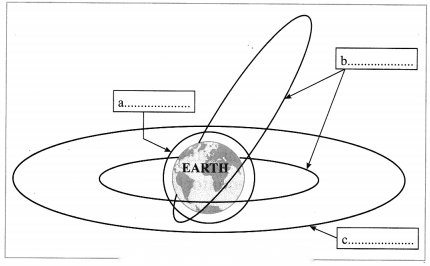
Write the proper name of the orbits of satellites shown in the following figure with their height from the earth’s surface. (Practice Activity Sheet – 4)
Solution & Step-by-Step Answer:
(a) Low earth orbits: height above the earth’s surface: 180 km to 2000 km (b) Medium earth orbits: height above the earth’s surface: 2000 km to 35780 km (c) High earth orbits: height from the earth’s surface > 35780 km
Question 2
Maharashtra Board Solution
Explain the need and importance of space missions.
Solution & Step-by-Step Answer:
Man has always been curious about the sun, moon, stars and the world beyond the earth. Initially, man tried to observe space with the help of telescopes. However, later he dreamt to fly into space and finally succeeded to reach into space.
Space missions are now essential to understand the origin and evolution of our solar system as well as to study the Universe beyond the Solar system. Space missions have given us many benefits and made our life simpler. It is because of space missions that the real-time immediate communication and exchange of information across the globe is now possible. We can receive the abundant information at the desk at our home or office. We also get information about any topic at any time and anywhere at fingertips through the Internet. Besides, the advanced alerts about some natural calamities like cyclones or storms are received through satellites sent as a part of space missions. Satellites have also helped us in entertainment. Programmes, sports events, etc., can be telecast live and can reach millions at a time throughout the world. Satellite surveillance of the enemy, exploring the reserves of various minerals resources, access to various activities like trade, tourism and navigation, and easy global reach to make world a global village is all possible due to the space missions. Thus, space missions are extremely important in defence, communication, weather forecast, observation, direction determination, etc.
Question 3
Maharashtra Board Solution
What are space expeditions? Explain their need and importance in your words. (Practice Activity Sheet – 2)
Solution & Step-by-Step Answer:
A mission planned (i) for establishing artificial satellites in the earth’s orbit, using them for research or for the benefit of life, or (ii) for sending a spacecraft to the various components of the solar system or outside is called a space expedition.
Man has always been curious about the sun, moon, stars and the world beyond the earth. Initially, man tried to observe space with the help of telescopes. However, later he dreamt to fly into space and finally succeeded to reach into space. Space missions are now essential to understand the origin and evolution of our solar system as well as to study the Universe beyond the Solar system. Space missions have given us many benefits and made our life simpler. It is because of space missions that the real-time immediate communication and exchange of information across the globe is now possible. We can receive the abundant information at the desk at our home or office. We also get information about any topic at any time and anywhere at fingertips through the Internet. Besides, the advanced alerts about some natural calamities like cyclones or storms are received through satellites sent as a part of space missions. Satellites have also helped us in entertainment. Programmes, sports events, etc., can be telecast live and can reach millions at a time throughout the world. Satellite surveillance of the enemy, exploring the reserves of various minerals resources, access to various activities like trade, tourism and navigation, and easy global reach to make world a global village is all possible due to the space missions. Thus, space missions are extremely important in defence, communication, weather forecast, observation, direction determination, etc.
Question 4
Maharashtra Board Solution
What are the objectives of the space mission?
Solution & Step-by-Step Answer:
Man initially tried to satisfy his curiosity to know the world and universe beyond the earth with the help of telescopes. However, it has some obvious limitations and to overcome these limitations, man later ventured into space missions.
Space missions carried out by man were aimed at four specific objectives:
Question 5
Maharashtra Board Solution
Write on significant space missions carried out by man.
Solution & Step-by-Step Answer:
Man has carried out many space missions within and beyond the earth’s orbit. Significant space missions are as follows: (1) Space missions within the earth’s orbit: Man has so far sent many artificial satellites of various types in the earth’s orbit. These satellites have made the life of man simpler. Besides, it has also helped us in resource management, communication, disaster management, etc.
(2) Moon missions : Moon is the natural satellite, of the earth and it is the nearest celestial body to us. Naturally, our initial space missions were directed to the moon. As of now, only Russia, USA, European Union, China, Japan and India have successfully undertaken. moon missions. Russia executed 15 moon missions between 1959 and 1976. Of these, last 4 missions brought the stone samples from the moon for study and analysis. However all these missions were unmanned. USA executed moon missions between 1962 and 1972. Some of these missions were unmanned. However, the historic moon mission took place on 20thJuly, 1969, when American astronaut Neil Armstrong became the first human to step on the moon. India has undertaken the moon mission. Indian Space Research Organisation (ISRO) successfully launched Chandrayaan-I and placed it in orbit of the moon. It sent useful information to the earth for about a year. The most important discovery made during the mission was the presence of water on moon’s surface. India was the first country to discover this. (3) Mars mission: The second nearest celestial object to the earth is Mars and many nations sent spacecraft towards it. But only few of them have been successful. However, the performance of Mangalyaan, the Indian spacecraft sent by ISRO towards Mars, was remarkable. Mangalyaan was launched in November 2013 and was placed in the orbit of Mars successfully in September 2014. It has obtained useful information about the surface and atmosphere of Mars. (4) Space missions to other planets: Other than moon and Mars missions, many other space missions were undertaken for studying other planets. Some spacecraft orbited the planets, some landed on some planets, and some just observed the planets, passed near them and went further to study other celestial bodies. Some spacecraft were sent specifically to study asteroids and comets. Some spacecraft’s have brought dust and stone samples from asteroids for the study. All these space missions are very useful in getting information and helping us in clarifying our concepts about the origin of the earth and the Solar system.
Question 6
Maharashtra Board Solution
Bring out the contribution of India’s space missions.
Solution & Step-by-Step Answer:
Successful space missions as well as scientific and technological accomplishments by India in space technology have made a significant contribution in the national and social development of our country. India has indigenously built various launchers and these launchers can put the satellites having the mass up to 2500 kg in orbit.
Indian Space Research Organisation (ISRO) has designed and built two important launchers: Polar Satellite Launch Vehicle (PSLV) and Geosynchronous Satellite Launch Vehicle (GSLV). Many satellites in INS AT and GSAT series are active in telecommunication, television broadcasting, meteorological services, disaster management and in monitoring and management of natural resources. EDUSAT is used specifically for education while satellites in IRNSS series are used for navigation. Thumba, Sriharikota and Chandipur are Indian satellite launch centers. Vikram Sarabhai Space Centre at Thiruvananthapuram, Satish Dhawan Space Research Centre at Sriharikota and Space Application Centre at Ahmedabad are space research organizations of India.
Question 7
Maharashtra Board Solution
What is meant by space debris? Why is there need to manage the debris? (March 2019)
Solution & Step-by-Step Answer:
In a space nonessential objects such as the parts of launchers and satellites, revolving around the earth are called the debris in space.
The debris can be harmful to the artificial satellites. It can collide with the satellite or spacecrafts and damage them. Therefore the future of artificial satellites or spacecrafts are in danger. Solve the following examples/numerical problems: Problem 1.
Problem 2.
Problem 3.
Problem 4. Problem 5. |