Balbharati Maharashtra State Board11th Commerce Maths Solution Book PdfChapter 1 Sets and Relations Ex 1.1 Questions and Answers.
Maharashtra State Board 11th Commerce Maths Solutions Chapter 1 Sets and Relations Ex 1.1
Solution & Step-by-Step Answer:
(i) Let A = {x / x is a letter of the word ‘MARRIAGE’} ∴ A = {M, A, R, I, G, E}
(ii) Let B = {x / x is an integer, – < x < }
∴ B = {0, 1, 2, 3, 4}
(iii) Let C = {x / x = 2n, n ∈ N}
∴ C = {2, 4, 6, 8, ….}
Solution & Step-by-Step Answer:
(i) Let A = {0} 0 is a whole number but it is not a natural number. ∴ A = {x / x ∈ W, x ∉ N}
(ii) Let B = {0, ±1, ±2, ±3}
B is the set of elements which belongs to Z from -3 to 3.
∴ B = {x / x ∈ Z, -3 ≤ x ≤ 3}
(iii) Let C =
∴ C = {x / x = , n ∈ N, n ≤ 7}
Solution & Step-by-Step Answer:
A = {x / 6x2 + x – 15 = o} ∴ 6x2 + x – 15 = 0 ∴ 6x2 + 10x – 9x – 15 = 0 ∴ 2x(3x + 5) – 3(3x + 5) = 0 ∴ (3x + 5) (2x – 3) = 0 ∴ 3x + 5 = 0 or 2x – 3 = 0 ∴ x = or x = ∴ A =
B = {x / 2x2– 5x – 3 = 0}
∴ 2x2– 5x – 3 = 0
∴ 2x2– 6x + x – 3 = 0
∴ 2x(x – 3) + 1(x – 3) = 0
∴ (x – 3)(2x + 1) = 0
∴ x – 3 = 0 or 2x + 1 = 0
∴ x = 3 or x =
∴ B = {, 3}
C = {x / 2x2– x – 3 = 0}
∴ 2x2– x – 3 = 0
∴ 2x2– 3x + 2x – 3 = 0
∴ x(2x – 3) + 1(2x – 3) = 0
∴ (2x – 3) (x + 1) = 0
∴ 2x – 3 = 0 or x + 1 = 0
∴ x = or x = -1
∴ C = {-1, }
(i) A ∪ B ∪ C = =
(ii) A ∩ B ∩ C = { }
Solution & Step-by-Step Answer:
A = {c, o, l, g, e} B = {m, a, r, i, g, e} C = {l, u, g, a, e} B ∪ C = {m, a, r, i, g, e, l, u} A – (B ∪ C) = {c, o} A – B = {c, o, l} A – C = {c, o} ∴ [(A – B) ∩ (A – C)] = {c, o} = A – (B ∪ C) ∴ [A – (B ∪ C)] = [(A – B) ∩ (A – C)]
Solution & Step-by-Step Answer:
A = {1, 2, 3, 4}, B = {3, 4, 5, 6}, C = {4, 5, 6, 7, 8}, X = {1, 2, 3, 4, 5, 6, 7, 8, 9, 10} (i) B ∩ C = {4, 5, 6} ∴ A ∪ (B ∩ C) = {1, 2, 3, 4, 5, 6} ……(i) A ∪ B = {1, 2, 3, 4, 5, 6} A ∪ C = {1, 2, 3, 4, 5, 6, 7, 8} ∴ (A ∪ B) ∩ (A ∪ C) = {1, 2, 3, 4, 5, 6} ……(ii) From (i) and (ii), we get A ∪ (B ∩ C) = (A ∪ B) ∩ (A ∪ C)
(ii) B ∪ C = {3, 4, 5, 6, 7, 8}
∴ A ∩ (B ∪ C) = {3, 4} …..(i)
A ∩ B = {3, 4}
A ∩ C = {4}
∴ (A ∩ B) ∪ (A ∩ C) = {3, 4} …..(ii)
From (i) and (ii), we get
A ∩ (B ∪ C) = (A ∩ B) ∪ (A ∩ C)
(iii) A ∪ B = {1, 2, 3, 4, 5, 6}
∴ (A ∪ B)’ = {7, 8, 9, 10} …….(i)
A’ = {5, 6, 7, 8, 9, 10}, B’ = {1, 2, 7, 8, 9, 10}
∴ A’ ∩ B’ = {7, 8, 9, 10} ……(ii)
From (i) and (ii), we get
(A ∪ B)’ = A’ ∩ B’
(iv) A ∩ B = {3, 4}
∴ (A ∩ B)’ = {1, 2, 5, 6, 7, 8, 9, 10} ……(i)
A’ = {5, 6, 7, 8, 9, 10}
B’ = {1, 2, 7, 8, 9, 10}
∴ A’ ∪ B’ = {1, 2, 5, 6, 7, 8, 9, 10} ……(ii)
From (i) and (ii), we get
(A ∩ B)’ = A’ ∪ B’
(v) A = {1, 2, 3, 4} …..(i)
A ∩ B = {3, 4}
B’ = {1, 2, 7, 8, 9, 10}
A ∩ B’ = {1, 2}
∴ (A ∩ B) ∪ (A ∩ B’) = {1, 2, 3, 4} ……(ii)
From (i) and (ii), we get
A = (A ∩ B) ∪ (A ∩ B’)
(vi) B = {3, 4, 5, 6} …..(i)
A ∩ B = {3, 4}
A’ = {5, 6, 7, 8, 9, 10}
A’ ∩ B = {5, 6}
∴ (A ∩ B) ∪ (A’ ∩ B) = {3, 4, 5, 6} …..(ii)
From (i) and (ii), we get
B = (A ∩ B) ∪ (A’ ∩ B)
(vii) A = {1, 2, 3, 4}, B = {3, 4, 5, 6},
A ∩ B = {3, 4}, A ∪ B = {1, 2, 3, 4, 5, 6}
∴ n(A) = 4, n(B) = 4,
n(A ∩ B) = 2,
n(A ∪ B) = 6 …..(i)
∴ n(A) + n(B) – n(A ∩ B) = 4 + 4 – 2
∴ n(A) + n(B) – n(A ∩ B) = 6 …..(ii)
From (i) and (ii), we get
n(A ∪ B) = n(A) + n(B) – n(A ∩ B)
Solution & Step-by-Step Answer:
n(X) = 50, n(A) = 35, n(B) = 20, n(A’ ∩ B’) = 5 (i) n(A ∪ B) = n(X) – [n(A ∪ B)’] = n(X) – n(A’ ∩ B’) = 50 – 5 = 45
(ii) n(A ∩ B) = n(A) + n(B) – n(A ∪ B)
= 35 + 20 – 45
= 10
(iii) n(A’ ∩ B) = n(B) – n(A ∩ B)
= 20 – 10
= 10
(iv) n(A ∩ B’) = n(A) – n(A ∩ B)
= 35 – 10
= 25
Solution & Step-by-Step Answer:
Let A = set of students who failed in MHT-CET B = set of students who failed in AIEEE C = set of students who failed in IIT entrance X = set of all students ∴ n(X) = 200, n(A) = 35, n(B) = 40, n(C) = 40, n(A ∩ B) = 20, n(B ∩ C) = 17, n(A ∩ C) = 15, n(A ∩ B ∩ C) = 5 (i) n(A ∪ B ∪ C) = n(A) + n(B) + n(C) – n(A ∩ B) – n(B ∩ C) – n(A ∩ C) + n(A ∩ B ∩ C) = 35 + 40 + 40 – 20 – 17 – 15 + 5 = 68 ∴ No. of students who did not fail in any exam = n(X) – n(A ∪ B ∪ C) = 200 – 68 = 132
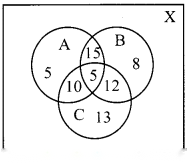
(ii) No. of students who failed in AIEEE or IIT entrance = n(B ∪ C)
= n(B) + n(C) – n(B ∩ C)
= 40 + 40 – 17
= 63
Solution & Step-by-Step Answer:
Let M = set of individuals who read Marathi newspapers E = set of individuals who read English newspapers X = set of all literate individuals ∴ n(X) = 2000, n(M) = × 2000 = 1400 n(E) = × 2000 = 1000 n(M ∩ E) = × 2000 = 650 n(M ∪ E) = n(M) + n(E) – n(M ∩ E) = 1400 + 1000 – 650 = 1750 (i) No. of individuals who read at least one of the newspapers = n(M ∪ E) = 1750. (ii) No. of individuals who read neither Marathi nor English newspaper = n(M’ ∩ E’) = n(M ∪ E)’ = n(X) – n(M ∪ E) = 2000 – 1750 = 250 (iii) No. of individuals who read only one of the newspapers = n(M ∩ E’) + n(M’ ∩ E) = n(M ∪ E) – n(M ∩ E) = 1750 – 650 = 1100

Solution & Step-by-Step Answer:
Let T = set of students who take tea C = set of students who take coffee M = set of students who take milk ∴ n(T) = 25, n(C) = 20, n(M) = 15, n(T ∩ C) = 10, n(M ∩ C) = 8, n(T ∩ M) = 0, n(T ∩ M ∩ C) = 0 ∴ Number of students in the hostel = n(T ∪ C ∪ M) = n(T) + n(C) + n(M) – n(T ∩ C) – n(M ∩ C) – n(T ∩ M) + n(T ∩ M ∩ C) = 25 + 20 + 15 – 10 – 8 – 0 + 0 = 42
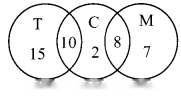
Solution & Step-by-Step Answer:
Let A = set of persons exposed to chemical A B = set of persons exposed to chemical B X = set of all persons ∴ n(X) = 260, n(A) = 150, n(B) = 74, n(A ∩ B) = 36 (i) No. of persons exposed to chemical A but not to chemical B = n(A ∩ B’) = n(A) – n(A ∩ B) = 150 – 36 = 114
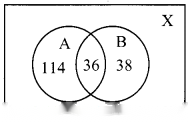
(ii) No. of persons exposed to chemical B but not to chemical A = n(A’ ∩ B)
= n(B) – n(A ∩ B)
= 74 – 36
= 38
(iii) No. of persons exposed to chemical A or chemical B = n(A ∪ B)
= n(A) + n(B) – n(A ∩ B)
= 150 + 74 – 36
= 188
Solution & Step-by-Step Answer:
A = {1, 2, 3} ∴ { }, {1}, {2}, {3}, {1, 2}, {2, 3}, {1, 3} and {1, 2, 3} are all the possible subsets of A.
Solution & Step-by-Step Answer:
(i) (-3, 0) = {x / x ∈ R, -3 < x < 0} (ii) [6, 12] = {x / x ∈ R, 6 ≤ x ≤ 12} (iii) (6, 12) = {x / x ∈ R, 6 < x < 12} (iv) (-23, 5) = {x / x ∈ R, -23 < x < 5}