Balbharati Maharashtra State Board11th Commerce Maths Solution Book PdfChapter 1 Sets and Relations Ex 1.2 Questions and Answers.
Maharashtra State Board 11th Commerce Maths Solutions Chapter 1 Sets and Relations Ex 1.2
Solution & Step-by-Step Answer:
(x – 1, y + 4) = (1, 2) By the definition of equality of ordered pairs, we have x – 1 = 1 and y + 4 = 2 ∴ x = 2 and y = -2
Solution & Step-by-Step Answer:
By the definition of equality of ordered pairs, we have and and x = 0 and y =
Solution & Step-by-Step Answer:
A = {a, b, c}, B = {x, y} A × B = {(a, x), (a, y), (b, x), (b, y), (c, x), (c, y)} B × A = {(x, a), (x, b), (x, c), (y, a), (y, b), (y, c)} A × A = {(a, a), (a, b), (a, c), (b, a), (b, b), (b, c), (c, a), (c, b), (c, c)} B × B = {(x, x), (x, y), (y, x), (y, y)}
Solution & Step-by-Step Answer:
P = {1, 2, 3}, Q = {6, 4} P × Q = {(1, 6), (1, 4), (2, 6), (2, 4), (3, 6), (3, 4)} Q × P = {(6, 1), (6, 2), (6, 3), (4, 1), (4, 2), (4, 3)}
Solution & Step-by-Step Answer:
A= {1, 2, 3, 4}, B = {4, 5, 6}, C = {5, 6} (i) B ∩ C = {5, 6} ∴ A × (B ∩ C) = {(1, 5), (1, 6), (2, 5), (2, 6), (3, 5), (3, 6), (4, 5), (4, 6)}
(ii) A × B = {(1, 4), (1, 5), (1, 6), (2, 4), (2, 5), (2, 6), (3, 4), (3, 5), (3, 6), (4, 4), (4, 5), (4, 6)}
A × C = {(1, 5), (1, 6), (2, 5), (2, 6), (3, 5), (3, 6), (4, 5), (4, 6)}
∴ (A × B) ∩ (A × C) = {(1, 5), (1, 6), (2, 5), (2, 6), (3, 5), (3, 6), (4, 5), (4, 6)}
(iii) B ∪ C = {4, 5, 6}
∴ A × (B ∪ C) = {(1, 4), (1, 5), (1, 6), (2, 4), (2, 5), (2, 6), (3, 4), (3, 5), (3, 6), (4, 4), (4, 5), (4, 6)}
(iv) A × B = {(1, 4), (1, 5), (1, 6), (2, 4), (2, 5), (2, 6), (3, 4), (3, 5), (3, 6), (4, 4), (4, 5), (4, 6)}
A × C = {(1, 5), (1, 6), (2, 5), (2, 6), (3, 5), (3, 6), (4, 5), (4, 6)}
∴ (A × B) ∪ (A × C) = {(1, 4), (1, 5), (1, 6), (2, 4), (2, 5), (2, 6), (3, 4), (3, 5), (3, 6), (4, 4), (4, 5), (4, 6)}
Solution & Step-by-Step Answer:
{(x, y) / x2 + y2 = 100, where x, y ∈ W} We have, x2 + y2 = 100 When x = 0 and y = 10, x2 + y2 = 02 + 102 = 100 When x = 6 andy = 8, x2 + y2 = 62 + 82 = 100 When x = 8 and y = 6, x2 + y2 = 82 + 62 = 100 When x = 10 and y = 0, x2 + y2 = 102 + 02 = 100 ∴ Set of ordered pairs = {(0, 10), (6, 8), (8, 6), (10, 0)}
Solution & Step-by-Step Answer:
(i) Let R1 = {(a, b)/ a ∈ N, a < 6 and b = 4} Set of values of ‘a’ are domain and set of values of ‘b’ are range. a ∈ N and a < 6 ∴ a = 1, 2, 3, 4, 5 and b = 4 Domain (R1) = {1, 2, 3, 4, 5} Range (R1) = {4}
(ii) Let R2= {(a, b)/a, b ∈ N and a + b = 12}
Now, a, b ∈ N and a + b = 12
When a = 1, b = 11
When a = 2, b = 10
When a = 3, b = 9
When a = 4, b = 8
When a = 5, b = 7
When a = 6, b = 6
When a = 7, b = 5
When a = 8, b = 4
When a = 9, b = 3
When a = 10, b = 2
When a = 11, b = 1
∴ Domain (R2) = {1, 2, 3, 4, 5, 6, 7, 8, 9, 10, 11}
Range (R2) = {11, 10, 9, 8, 7, 6, 5, 4, 3, 2, 1}
(iii) Let R3= {(2, 4), (2, 5), (2, 6), (2, 7)}
Domain (R3) = {2}
Range (R3) = {4, 5, 6, 7}
Solution & Step-by-Step Answer:
A= {6, 8}, B = {1, 3, 5} R = {(a, b)/ a ∈ A, b ∈ B, a – b is an even number} a ∈ A ∴ a = 6, 8 b ∈ B ∴ b = 1, 3, 5 When a = 6 and b = 1, a – b = 5 which is odd When a = 6 and b = 3, a – b = 3 which is odd When a = 6 and b = 5, a – b = 1 which is odd When a = 8 and b = 1, a – b = 7 which is odd When a = 8 and b = 3, a – b = 5 which is odd When a = 8 and b = 5, a – b = 3 which is odd Thus, no set of values of a and b gives a – b even. ∴ R is an empty relation from A to B.
Solution & Step-by-Step Answer:
(i) R1 = {(a, a2) / a is a prime number less than 15} ∴ a = 2, 3, 5, 7, 11, 13 ∴ a2 = 4, 9, 25, 49, 121, 169 ∴ R1 = {(2, 4), (3, 9), (5, 25), (7, 49), (11, 121), (13, 169)} ∴ Domain (R1) = {a/a is a prime number less than 15} = {2, 3, 5, 7, 11, 13} Range (R1) = {a2/a is a prime number less than 15} = {4, 9, 25, 49, 121, 169}
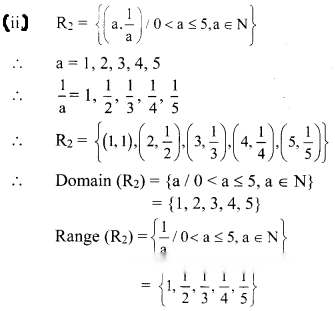
Solution & Step-by-Step Answer:
R = {(a, b) / b = a + 1, a ∈ Z, 0 < a < 5} ∴ a = 1, 2, 3, 4 ∴ b = 2, 3, 4, 5 ∴ Range (R) = {2, 3, 4, 5}
Solution & Step-by-Step Answer:
(i) {(x, y) / y = 3x, x ∈ {1, 2, 3}, y ∈ {3, 6, 9, 12}} Here y = 3x When x = 1, y = 3(1) = 3 When x = 2, y = 3(2) = 6 When x = 3, y = 3(3) = 9 ∴ Ordered pairs are {(1, 3), (2, 6), (3, 9)}
(ii) {(x, y) / y > x + 1, x ∈ {1, 2} and y ∈ {2, 4, 6}}
Here, y > x + 1
When x = 1 and y = 2, 2 ≯ 1 + 1
When x = 1 and y = 4, 4 > 1 + 1
When x = 1 and y = 6, 6 > 1 + 1
When x = 2 and y = 2, 2 ≯ 2 + 1
When x = 2 and y = 4, 4 > 2 + 1
When x = 2 and y = 6, 6 > 2 + 1
∴ Ordered pairs are {(1, 4), (1, 6), (2, 4), (2, 6)}
(iii) {(x, y) / x + y = 3, x, y ∈ {0, 1, 2, 3}}
Here, x + y = 3
When x = 0, y = 3
When x = 1, y = 2
When x = 2, y = 1
When x = 3, y = 0
∴ Ordered pairs are {(0, 3), (1, 2), (2, 1), (3, 0)}