Maharashtra State Board Class 11 Economics Solutions Chapter 6 Population in India
1. Choose the correct option:
Group ‘A’ | Group ‘B’ |
1. Year of Great Divide | (a) Stable population till 2045 |
2. A. J. Coale and E. M. Hoover | (b) 1921 |
3. Social Reforms | (c) Demographic Transition |
4. National Population Policy, 2000 | (d) Spread of education |
Options:
(1) 1-d, 2-c, 3-a, 4-b
(2) 1-b, 2-c, 3-d, 4-a
(3) 1-b, 2-a, 3-c, 4-d
(4) 1-c, 2-d, 3-a, 4-b
(2) 1-b, 2-c, 3-d, 4-a
2. Give economic terms:
Question 1
Maharashtra Board Solution
An increase in population is faster than economic growth and development.
Solution & Step-by-Step Answer:
Population explosion
Question 2
Maharashtra Board Solution
Difference between birth rate and death rate.
Solution & Step-by-Step Answer:
Survival rate
Question 3
Maharashtra Board Solution
The balance between natural resources and population growth.
Solution & Step-by-Step Answer:
Optimum population
Question 4
Maharashtra Board Solution
Programme introduced to reduce the birth rate in 1952.
Solution & Step-by-Step Answer:
Family Planning Programme
3. Identify and explain the concepts from the given illustrations:
Question 1
Maharashtra Board Solution
There were 40 births per 1000 in-country ‘A’ during a year.
Solution & Step-by-Step Answer:
Birth Rate. Birth rate means the number of births occurring per thousand of the living population during a year. It is also called the fertility rate.
Question 2
Maharashtra Board Solution
In Mumbai city, public transport service is largely affected due to the growing population.
Solution & Step-by-Step Answer:
High Density of Population. The number of people living per square kilometer is known as the density of population. In India, it is 382 people per square kilometer as per the 2011 Census which is very high.
Question 3
Maharashtra Board Solution
In-country ‘B’ there are 15 deaths taking place per 1000 during a year.
Solution & Step-by-Step Answer:
Death Rate. Death rate means the number of deaths occurring per thousand of the living population during a year. It is also called the mortality rate.
Question 4
Maharashtra Board Solution
For a certain period of time, China had adopted the policy of ‘One child per family.
Solution & Step-by-Step Answer:
Population policy. China’s ‘One Child Policy’ was part of a birth planning program designed to control the size of its population.
4. Answer the following:
Question 1
Maharashtra Board Solution
Explain the causes of the high birth rate.
Solution & Step-by-Step Answer:
The causes of the high birth rate are as follows: (i) Illiteracy: A large proportion of the population in India is illiterate which means they are bound to be traditional, superstitious, ignorant, and irrational. So they have more children.
(ii) Universalization of Marriage: (iii) Age of Marriage: (iv) Preference for the male child:
Question 2
Maharashtra Board Solution
Explain the causes of a low death rate.
Solution & Step-by-Step Answer:
The causes of the low death rate are as follows: (i) Improvement in medical and health facilities: Due to advanced medical and health facilities epidemics like the plague, cholera, malaria, smallpox, measles, TB, etc. have been controlled or eradicated. The invention of sulpha drugs, penicillin, antibiotics has helped to reduce the death rate among people. The number of hospitals, doctors, and nurses also have increased. This has reduced the death rate.
(ii) Decline in Maternal Mortality Rate: (iii) Fall in infant mortality rate: (iv) Increase in literacy:
Question 3
Maharashtra Board Solution
Explain the role of human resources in economic development.
Solution & Step-by-Step Answer:
Role of human resource in economic development:
5. State with reasons whether you agree or disagree with the following statements:
Question 1
Maharashtra Board Solution
India is experiencing Population Explosion.
Solution & Step-by-Step Answer:
Yes, I do agree with the statement.
Question 2
Maharashtra Board Solution
The death rate is falling rapidly in India.
Solution & Step-by-Step Answer:
Yes, I do agree with the statement.
Question 3
Maharashtra Board Solution
Optimum population contributes to the economic development of a country.
Solution & Step-by-Step Answer:
Yes, I do agree with the statement.
Question 4
Maharashtra Board Solution
Human resources play an important role in economic development.
Solution & Step-by-Step Answer:
Yes, I do agree with the statement.
Question 5
Maharashtra Board Solution
The birth rate is declining due to changes in the standard of living.
Solution & Step-by-Step Answer:
Yes, I do agree with the statement.
6. Solve the following:
Question 1
Maharashtra Board Solution
Find out Q3 from the given data.
Solution & Step-by-Step Answer:
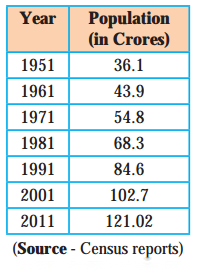
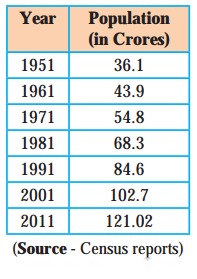
Arranging the data in ascending order: 36.1, 43.9, 54.8, 68.3, 84.6, 102.7, 121.02 Here, n = 7 Q3 = observation Q3 = observation Q3 = 6th observation Q3 = 102.7
Question 2
Maharashtra Board Solution
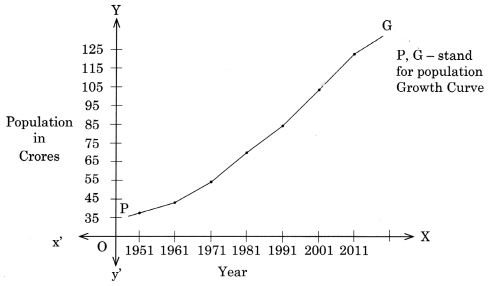
Draw a population growth curve from the given data.
Solution & Step-by-Step Answer:
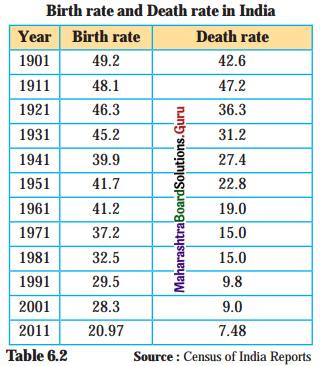
11th Economics Digest Chapter 6 Population in India Intext Questions and Answers Try this: (Textbook Page No. 38) Based on the given table 6.2, explain how demographic transition theory is applicable to India.
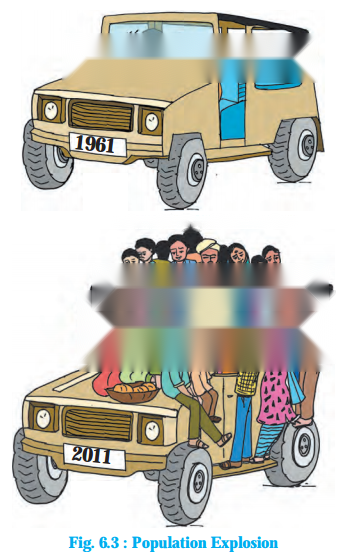
Answer: Can you tell: (Textbook Page No. 38) Observe Fig. 6.3 and draw inferences from it.
Answer: Find out: (Textbook Page No. 39) Legal age of marriage for males and females in different countries?
Note: Students may further refer to the internet for more information on the legal age of marriage. Do you know: (Textbook Page No. 41)
Question 1
Maharashtra Board Solution
What do you mean by Population Education?
Solution & Step-by-Step Answer:
According to UNESCO – “Population Education is an educational programme which provides for a study of population situation of the family, the community, nation, and world with the purpose of developing in the students rational and responsible attitude and behaviour towards the situation”.
Question 2
Maharashtra Board Solution
When does demographic dividend occur?
Solution & Step-by-Step Answer:
Demographic dividend occurs when the proportion of working people to the total population is high.
|