Maharashtra State Board Class 11 Economics Solutions Chapter 7 Unemployment in India
1. Find the odd word out:
2. Identify and explain the concepts from the given illustrations:
3. Complete the correlation:
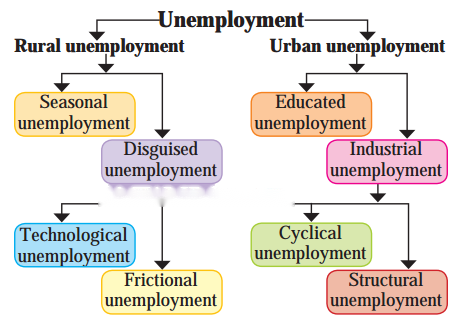
4. Observe the following charts and answer the questions.
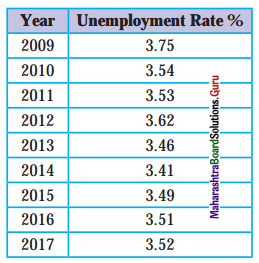
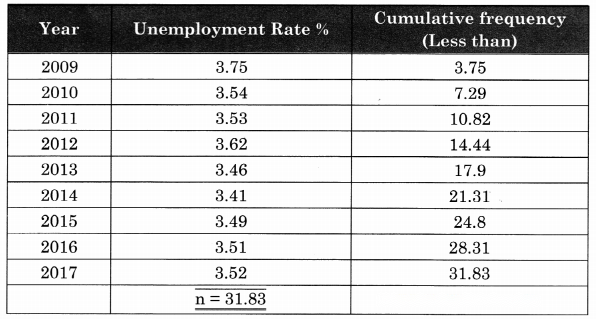
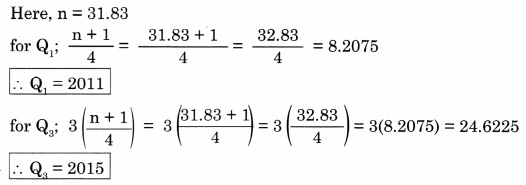
5. Find out Q1and Q3using unemployment rates as numerical data:
Answer:
6. Answer the following in detail:
(ii) Frictional unemployment:
When due to the breakdown of machines, shortage of raw materials, strikes, power failure, etc. some workers are removed from the jobs, there is said to be frictional unemployment. This is temporary in nature.
(iii) Cyclical unemployment:
During an economic recession, there is a slowdown of economic activities due to a fall in overall demand. Therefore, factory owners remove some workers from their jobs to cut down the cost such unemployment caused due to depression (trade cycle) is called cyclical unemployment.
(iv) Structural unemployment:
It takes place due to structural changes in the economy i.e when due to change in the complete business set up, some workers are removed from their jobs, there is said to be structural unemployment. E.g. introduction of power looms instead of handlooms. It is long-term in nature.
(ii) Increase in labour force:
Due to the increase in medical facilities since independence, there is a considerable fall in the death rate without a corresponding fall in the birth rate. This led to an increase in the labour force which in turn led to unemployment in India.
(iii) Excessive use of machinery:
Industries as well as agricultural producers are undergoing modernization and have started using more machines and less labour. This means the Indian economy is moving towards capital intensive technique leaving behind labour intensive technique, which led to large scale unemployment.
(iv) Lack of skill development programmes:
Though educational institutions are increasing, no proper training is given to youngsters to work. Development of vocational skill courses is comparatively less in number in India. Hence, there is a lack of skilled manpower required by the industry in India.
(v) Expectations towards employment:
Educated people have high expectations about the salary and they want ‘white-collar jobs’ which are not available in plenty. They prefer to remain unemployed rather than accepting a lower salary. This also causes unemployment.
(vi) Seasonal nature of agriculture:
Due to the seasonal nature of agriculture in India, labourers are employed only for a few months a year and for the rest of the year, they remain jobless. This leads to seasonal unemployment in the country.
(vii) Migration of rural population:
Agriculture being seasonal, there are no alternative jobs available in the off-season or slack season. So the labour migrates to urban areas leading to urban unemployment in the country.
Specific measures are undertaken by the government to generate employment opportunities:
Employment Guarantee Scheme (EGS): This Scheme was introduced on 28th March 1972. This scheme was introduced by Maharashtra Government in 1972-73. Under this scheme, work is provided to the registered job-seekers in rural areas within 15 days from the date of registration. This scheme was for unskilled manual labors above 18 years.
Swarnjayanti Gram Swarozgar Yojana (SGSY): This scheme was launched in April 1999 after restructuring the Integrated Rural Developmental Programmer (IRDP) and allied schemes. It’s the only self-employment scheme for the rural poor in India.
Swarna Jayanti Shahari Rozgar Yojana (SJSRY): This scheme was launched in December 1997, It provides gainful employment to the urban unemployed and underemployed. It includes self-employment, women self-employment programme, skill training for employment programme, for this scheme Central Government shares 75% of the cost and State Government shares 25% of the cost.
Pradhan Mantri Rozgar Yojana (PMRY): This scheme is being implemented since 1993 to create and provide sustainable self-employment opportunities to more than one million educated unemployed youth.
Training Rural Youth for Self-employment (TRYSEM): It was initiated in 1979 with the objective of tackling the unemployment problem among rural youth. It aimed at training about 2 lakh rural youth every year to enable them to become self-employed.
Besides the above measures, there are many other specific measures undertaken by the government. They can be named as:
11th Economics Digest Chapter 7 Unemployment in India Intext Questions and Answers
Do you know? (Textbook Page No. 46)
State-wise unemployment rates in India (2015-16)
Answer:
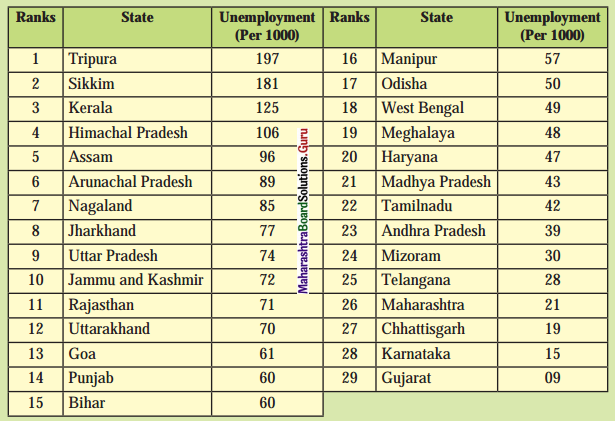
Ranks | State | No. of people | Cumulative Frequency (Less than) |
1. | Tripura | 197 | 197 |
2. | Sikkim | 181 | 378 |
3. | Kerala | 125 | 503 |
4. | Himachal Pradesh | 106 | 609 |
5. | Assam | 96 | 705 |
6. | Arunachal Pradesh | 89 | 794 |
7. | Nagaland | 85 | 879 |
8. | Jharkhand | 77 | 956 |
9. | Uttar Pradesh | 74 | 1030 |
10. | Jammu and Kashmir | 72 | 1102 |
11. | Rajasthan | 71 | 1173 |
12 | Uttarakhand | 70 | 1243 |
13. | Goa | 61 | 1304 |
14. | Punjab | 60 | 1364 |
15. | Bihar | 60 | 1424 |
16. | Manipur | 57 | 1481 |
17. | Odisha | 50 | 1531 |
18. | West Bengal | 49 | 1580 |
19. | Meghalaya | 48 | 1628 |
20. | Haryana | 47 | 1675 |
21. | Madhya Pradesh | 43 | 1718 |
22. | Tamilnadu | 42 | 1760 |
23. | Andhra Pradesh | 39 | 1799 |
24. | Mizoram | 30 | 1829 |
25. | Telangana | 28 | 1857 |
26. | Maharashtra | 21 | 1878 |
27. | Chhattisgarh | 19 | 1897 |
28. | Karnataka | 15 | 1912 |
29. | Gujarat | 09 | 1921 |
n = 1921 |
Here, n = 1921
for Q2= observation
= observation
= 2(480.5)
= 961st observation, 961st observation lies in cf 1030.
∴ Q2= 9
Hence, Rank 9 is represented by Uttar Pradesh.