Maharashtra State Board Class 11 Economics Solutions Chapter 8 Poverty in India
1. Assertion and Reasoning questions:
Solution & Step-by-Step Answer:
(iv) Both (A) and (R) are true, but (R) is not the correct explanation of (A).
Solution & Step-by-Step Answer:
(iii) Both (A) and (R) are true and (R) is the correct explanation of (A).
Solution & Step-by-Step Answer:
(i) (A) is true, but (R) is False.
Solution & Step-by-Step Answer:
(iii) Both (A) and (R) are true and (R) is the correct explanation of (A).
Solution & Step-by-Step Answer:
(iv) Both (A) and (R) are true, but (R) is not the correct explanation of (A)
2. Find the odd word out:
Solution & Step-by-Step Answer:
Green
Solution & Step-by-Step Answer:
Kerala
Solution & Step-by-Step Answer:
1800
3. Give economic terms:
Solution & Step-by-Step Answer:
Social exclusion
Solution & Step-by-Step Answer:
Multidimensional poverty
Solution & Step-by-Step Answer:
Relative poverty
Solution & Step-by-Step Answer:
Absolute poverty
Solution & Step-by-Step Answer:
Task Force on Eliminating Poverty
4. Identify and explain the concepts from the given illustration:
Solution & Step-by-Step Answer:
Absolute poverty. The absence of minimum income to satisfy the desired level of the calorie intake of food is called absolute poverty. Absolute poverty is generally found in developing countries like India. The situation of undernourishment can be overcome by taking the minimum required calorie food intake as per the standard set by the planning commission.
Solution & Step-by-Step Answer:
Relative poverty. Relative poverty can be judged by comparing the standards of living of different sections of the people. Relative poverty is found in all the countries of the world. It cannot be completely eradicated.
Solution & Step-by-Step Answer:
Absolute poverty. This is the case of absolute poverty where people have less income in which they cannot buy basic needs for living. Such poverty is generally found in developing countries like India. It can be eradicated by applying effective measures by the Government.
Solution & Step-by-Step Answer:
Absolute poverty. In absolute poverty, people are very poor and have very little income. Ration card is one of the measures to eradicate poverty by giving food-grains through ration shop at a subsidized rate.
Solution & Step-by-Step Answer:
Relative poverty. This is an example of differences between two different sections of people in terms of consumption and level of income. Such differences create relative poverty. It is found in all the countries of the world. It cannot be eradicated completely.
5. State with reasons whether you agree or disagree with the following statement:
Solution & Step-by-Step Answer:
No, I do not agree with the statement. Policy measures undertaken for the eradication of poverty are as follows:
Besides these, there are many other causes like:
Solution & Step-by-Step Answer:
Yes, I agree with the statement.
Solution & Step-by-Step Answer:
No, I do not agree with the statement. The causes of poverty besides regional imbalance are as follows:
Besides these, there are many other causes like:
6. Answer in detail:
Solution & Step-by-Step Answer:
Policy measures undertaken for the eradication of poverty are as follows:
11th Economics Digest Chapter 8 Poverty in India Intext Questions and Answers
Can you tell: (Textbook Page No. 51)
Express your opinion on the following:
Questions 1.
There is a thick line of rural-urban economic divide in India.
Answer:
Yes, there is a thick line of rural-urban economic divide in India because of around 65% population lives in a rural area but do not have proper road access for vehicles, lack of health facilities, lack of employment opportunities, lack of technology, a rural economy based on subsistence strategies, the population is spread thinly, due to slow economic growth people migrating from rural to the urban area, etc.
In an urban economy around 35% population lives with good road access, many health facilities, employment opportunities, advanced technology, the thick density of population, high economic growth rate, etc.
Solution & Step-by-Step Answer:
No, there is an unequal distribution of income and wealth in the country, that’s why India has adopted a progressive taxation policy. The government formulated many welfare policies to raise the income of poor income groups.
Solution & Step-by-Step Answer:
No, there is unequal access to education, healthy drinking water. In urban areas, people can afford all the amenities. There are many educational institutions 24 hours availability of electricity, many health centers with modern equipment and technology, clean drinking water, etc.
Solution & Step-by-Step Answer:
No, I don’t agree with the statement. In India a large number of people especially women and children are not able to get food. 14.8% (195.9 million people are undernourished, 51.4% of women age between 15 to 49 years) are anemic, 38.4% of the children aged under five are too short for their age, 21% children have weight too low for their height and there is high child mortality rate prevailing in India.
Solution & Step-by-Step Answer:
Yes, I agree with the statement. In rural areas, most of the people (300 to 522 million) still practice open defecation. In addition to considerable Indian homes having no toilets, access to water supply and drainage facilities is also another serious problem.
Solution & Step-by-Step Answer:
In India poverty is different from state to state. In India first ten poorest states or high poverty ratio is in Chhatisgarh (93%), Jharkhand (36.96%), Manipur (36.89%), Arunachal Pradesh (34.67%), Bihar (33.74%), Odisha (32.59%), Assam (31.98%), Madhya Pradesh (31.65%), Uttar Pradesh (29.43%), Karnataka (20.91%) and poverty ratio is lowest in Maharashtra, Gujarat, Kerala, Tamil Nadu, etc.
Note: The above data is according to the 2016 report.
Find out: (Textbook Page No. 51)
Prepare a list of 5 countries in the world having absolute poverty with reference to the latest World Bank Report.
Answer:
All the developing countries will face absolute poverty for e.g. India, China, Pakistan, Nepal, Bhutan, etc.
Can you tell: (Textbook Page No. 52)
Place the following individuals as per their income into the High-income group, Upper Middle-income group, Middle-income group, Low-income group.
Answer:
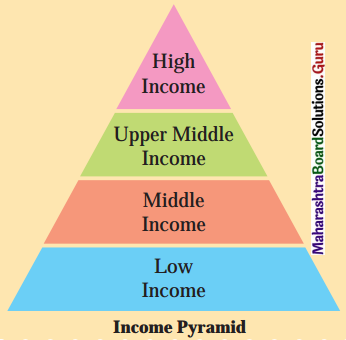
Income groups | Individuals |
(i) High Income | CEO of a Multinational Company |
(ii) Upper Middle Income | Executive in a company |
(iii) Middle Income | Salesman in a shop |
(iv) Low Income | Contract labour |
Find out: (Textbook Pg. No. 52)
Information about the informal sector and list a few activities related to it as per your observation.
Answer:
Informal Sector:
The informal sector is called as ‘unorganized sector’. It consists of unlicensed establishments that do not pay taxes to the government and does not obey the law prescribed by the law.
Activities of the informal sector are not counted in the country’s GNP as they are not disclosed by the owners of such organizations.
Examples:
Try this: (Textbook Page No. 52)
Solution & Step-by-Step Answer:
Food Items | Non Food Items |
(a) Cereals | (a) Petrol or fuel |
(b) Pulses | (b) Medicines |
(c) Milk and Milk products | (c) Entertainment |
(d) Vegetables | (d) Footwears |
(e) Fruits | (e) Clothing |
(f) Spices | (f) Bedding |
(g) Meat/Mutton | (g) Electric material |
(h) Edible oil | (h) Electronic Gadgets |
(i) Sweet Dish | (i) Scooter |
(j) Processed food | (j) Toiletries |
Solution & Step-by-Step Answer:
Note: Students should do this activity by themselves with the help of their family head.
Solution & Step-by-Step Answer:
Per capita income is the average income per head of population in one year. Per capita monthly expenditure of an individual family can be calculated by using the following formula. Per Capita monthly expenditure = Note: Students can do further calculations with the help of their family head.
Find out: (Textbook Page No. 53)
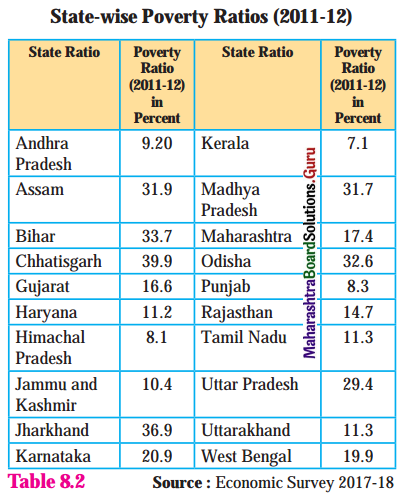
From the above data on poverty ratios, find out Q3and P10and name the states as per the derived partition values.
Answer:
Arranging the data in ascending order;
7.1, 8.1, 8.3, 9.2, 10.4, 11.2, 11.3, 11.3, 14.7, 16.6, 17.4, 19.9, 20.9, 29.4, 31.7, 31.9, 32.6, 33.7, 36.9, 39.9
Here, n = 20
Q3= 3 observation
= 3
= 3(5.25)th observation
= 15.75th observation + 0.75 (16th observation – 15th observation)
= 31.7 + 0.75 (31.9 – 31.7)
= 31.7 + 0.75(0.2)
= 31.7 + 0.15
∴ Q3= 31.85
P10= observation
= observation
= 2.1th observation
= 2nd observation + 0.1(3rd observation – 2nd observation)
= 8.1 + 0.1 (8.3 – 8.1)
= 8.1+ 0.1 (0.2)
= 8.1 + 0.02
∴ P10= 8.12
Q3lies between 31.7 and 31.9 (i.e.) Madhya Pradesh and Assam
P10lies between 8.1 and 8.3 (i.e.) Himachal Pradesh and Uttarakhand.
You should know: (Textbook Page No. 54)
What are the effects of Poverty?
Answer:
Economic effects of poverty:
You should know: (Textbook Page No. 54)
The UN Sustainable Development Goals (SDGs) were adopted by the international community in September 2015 to comprehensively cover social, economic, and environmental dimensions. The SDGs constitute a universal agreement to end poverty in all its forms and dimensions. There are 17 SDGs that have 169 targets to be achieved by 2030. India played an important role in shaping SDGs.
India is one of the signatories of the United Nations Sustainable Development Goals, is committed to the eradication of poverty by 2030 (SDGl).
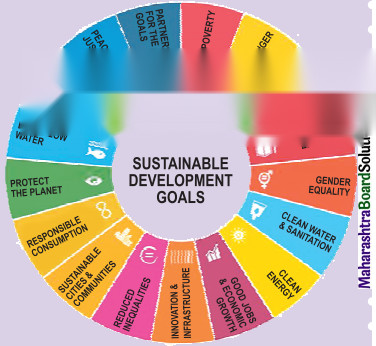
Read the above passage and answer the following questions:
Solution & Step-by-Step Answer:
SDGs stands for Sustainable Development Goals.
Solution & Step-by-Step Answer:
SDGs were adopted by the international community to cover social economic and environmental dimensions. It makes an attempt to end poverty throughout the world.
Solution & Step-by-Step Answer:
India’s goal is to eradicate poverty from the country by the year 2030.
Solution & Step-by-Step Answer:
There are 17 SDGs prevailing having 169 targets that are to be achieved by 2030.
Try this: (Textbook Page No. 55)
To ensure food security, the Government of Maharashtra has introduced Tri Colour Family Ration Card. Find out the income criteria of each ration card on the basis of information provided by the Food, Civil Supplies, and Consumer Protection Dept., GoM.
Answer:
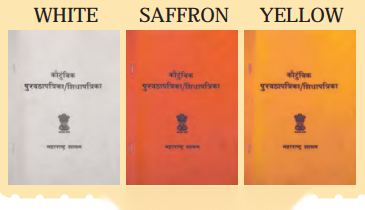
Type of Ration Card | Income Criteria |
White | Rs. 1,00,000 and above |
Saffron | Rs. 15,000 to Rs. 1,00,000 |
Yellow | People Below the poverty line |
Try this: (Textbook Page No. 55)
Correlate the following Poverty Alleviation Programmes with the given points:
Food security, wage employment, self-employment, education, health, sanitation, financial inclusion, housing.
Answer: