Maharashtra State Board Class 11 History Solutions Chapter 6 Second Urbanisation in India
1A. Choose the correct alternative and write the complete sentences.
1B. Find the incorrect pair from set B and write the correct ones.
Set ‘A’ | Set ‘B’ |
(a) Kosala | Shravasti |
(b) Anga | Champa |
(c) Matsya | Mathura |
(d) Gandhara | Taxila |
(c) Matsya – Virat Nagar
2. Choose the correct reason and complete the sentence.
Question 1
Maharashtra Board Solution
Gautam Buddha travelled continuously for 45 years ____________ (a) in search of a Guru (b) to practice austerities (c) to preach dhamma (d) to attain enlightenment
Solution & Step-by-Step Answer:
(c) to preach dhamma
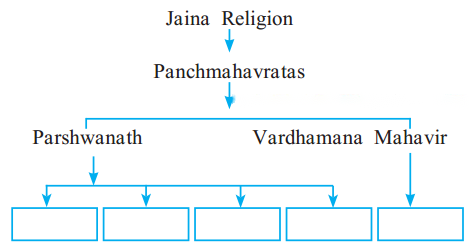
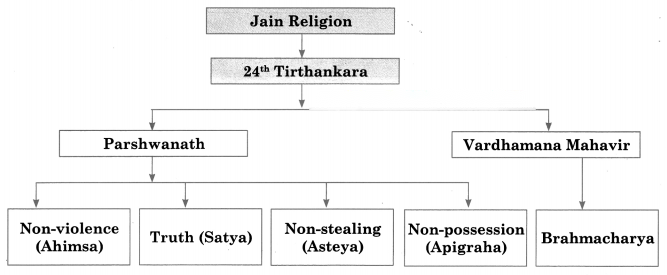
3. Complete the concept maps.
Question 1
Maharashtra Board Solution
Solution & Step-by-Step Answer:
4. Explain the following statements with reasons.
Question 1
Maharashtra Board Solution
The rise of Mahajanpadas came into being.
Solution & Step-by-Step Answer:
Question 2
Maharashtra Board Solution
The process of second urbanisation began in ancient India.
Solution & Step-by-Step Answer:
Question 3
Maharashtra Board Solution
Vardhamana Mahavira and Gautama Buddha attracted a large number of followers.
Solution & Step-by-Step Answer:
5. Explain the following concepts.
Question 1
Maharashtra Board Solution
Nastik Darshan
Solution & Step-by-Step Answer:
Question 2
Maharashtra Board Solution
The eightfold path was preached by Gautama Buddha.
Solution & Step-by-Step Answer:
Gautama Buddha explained the eightfold path by including:
6. Describe the administrative system of the Mahajanapadas with the help of the following points.
Question 1
Maharashtra Board Solution
(a) Terms showing types of states (b) King’s installation (c) Authority of the king (d) Decision-making
Solution & Step-by-Step Answer:
(a) Terms showing types of states: Rajya, Swarajya, Bhavjya, Vairajya, Maharajya, Samrajya, and Prameshthya were the different types of states that existed during the 6th B.C.E.
(b) King’s installation: A ‘Raja’ was expected to be a ‘Kshtriya’ and according to the existing norms, a Brahmin was expected to refrain from accepting the position of a Raja. The position of Raja was generally hereditary. However, at times, a king was elected by the people. (c) Authority of the king: The coronation of a king gave him absolute authority over his subjects. He was the one to decide the amount of taxes to be collected from them. He was the ultimate lord of all the land in his kingdom and so he could donate any portion of that land according to his wish. Nevertheless, his power was not totally unrestricted. (d) Decision-making: The king made his decisions by seeking advice from his officials such as Purohita, Senani, Amatya, Gramani, etc. Besides, there was an assembly of people of all classes. When it assembled everybody present could participate in the decision-making process. There were times when people’s assemblies made a king steps down from the throne. Activity 1. Collect and compile the information about Jain Tirthankaras. Activity 2. Collect information about Jataka stories. Select any of the Jataka stories and present, them as a stage play. |