Maharashtra State Board 11th Maths Solutions Chapter 3 Permutations and Combination Ex 3.5
Solution & Step-by-Step Answer:
We know that ‘n’ persons can sit around a table in (n – 1)! ways. ∴ 8 friends can sit around a table in 7! = 7 × 6 × 5 × 4 × 3 × 2 × 1 = 5040 ways.
Solution & Step-by-Step Answer:
A party has 20 participants. All of them and the host (i.e., 21 persons) can be seated at a circular table in (21 – 1)! = 20! ways. When two particular participants are seated on either side of the host. The host takes the chair in 1 way. These 2 persons can sit on either side of the host in 2! ways. Once the host occupies his chair, it is not circular permutation more. The remaining 18 people occupy their chairs in 18! ways. ∴ A total number of arrangements possible if two particular participants are seated on either side of the host = 2! × 18! = 2 × 18!
Solution & Step-by-Step Answer:
(a) Delegates of 24 countries are to participate in a round table discussion such that two specified delegates are always together. Let us consider these 2 delegates as one unit. They can be arranged among themselves in 2! ways. Also, these two delegates are to be seated with 22 other delegates (i.e. total of 23) which can be done in (23 – 1)! = 22! ways. ∴ Required number of arrangements = 2! × 22!
(b) When 2 specified delegates are never together then, other 22 delegates can be participate in a round table discussion in (22 – 1)! = 21! ways.
∴ There are 22 places of which any 2 places can be filled by those 2 delegates so that they are never together.
∴ Two specified delegates can be arranged in22P2ways.
∴ Required number of arrangements =22P2× 21!
=
= × 21!
= 22 × 21 × 21!
= 21 × 22 × 21!
= 21 × 22!
Solution & Step-by-Step Answer:
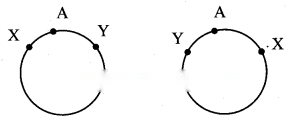
There are 15 people to sit around a table. ∴ They can be arranged in(15 – 1)! = 14! ways. But, they should not have the same neighbour in any two arrangements. Around the table, arrangements (i.e., clockwise and anticlockwise) coincide. ∴ Required number of arrangements =
Solution & Step-by-Step Answer:
A committee of 10 members sits around a table. But, President and Vice-president sit together. Let us consider President and Vice-president as one unit. They can be arranged among themselves in 2! ways. Now, this unit with the other 8 members of the committee is to be arranged around a table, which can be done in (9 – 1)! = 8! ways. ∴ Required number of arrangements = 8! × 2! = 2 × 8!
Solution & Step-by-Step Answer:
5 men, 2 women, and a child sit around a table. (a) When the child is seated between two women. 5 men, 2 women, and a child are to be seated around a round table such that the child is seated between two women. ∴ the two women can be seated on either side of the child in 2! ways. Let us consider these 3 (two women and a child) as one unit. Now, this one unit is to be arranged with the remaining 5 men, i.e., a total of 6 units are to be arranged around a round table, which can be done in (6 – 1)! = 5! ways. ∴ Required number of arrangements = 5! × 2! = 120 × 2 = 240
(b) Two men can be selected from 5 men in
5C2= = 10 ways.
Also, these two men can sit on either side of the child in 2! ways.
Let us take two men and a child as one unit.
Now, this one unit is to be arranged with the remaining 3 men and 2 women,
i.e., a total of 6 units (3 + 2 + 1) are to be arranged around a round table, which can be done in (6 – 1)! = 5! ways.
∴ Required number of arrangements = 10 × 2! × 5!
= 10 × 2 × 120
= 2400
Solution & Step-by-Step Answer:
8 men can be seated around a table in (8 – 1)! = 7! ways. No two women should sit together. There are 8 gaps created by 8 men’s seats. ∴ Women can be seated in 8 gaps in 8P6 ways. ∴ Required number of arrangements = 7! × 8P6
Solution & Step-by-Step Answer:
2 women (who wish to sit together) can be selected from 3 in 3C2 = = 3 ways. Also, these two women can sit together in 2! ways. Let us take two women as one unit. Now, this one unit is to be arranged with the remaining 3 men and 1 woman, i.e., a total of 5 units are to be arranged around a round table, which can be done in (5 – 1)! = 4! ways. ∴ Required number of arrangements = 3 × 2! × 4! = 3 × 2 × 24 = 144
Solution & Step-by-Step Answer:
Ten things can be arranged in a circular order of which 4 are alike in ways. ∴ Required number of arrangements =
Solution & Step-by-Step Answer:
Since 2 particular persons can’t be sitting side by side, the other 13 persons can be arranged around the table in (13 – 1)! = 12! ways. The two persons who are not sitting side by side may take 13 positions created by 3 persons in 13P2 ways. ∴ Required number of arrangements = 12! × 13P2 = 12! × 13 × 12 = 13 × 12! × 12 = 12 × 13!