Maharashtra State Board 11th Maths Solutions Chapter 3 Permutations and Combination Ex 3.6
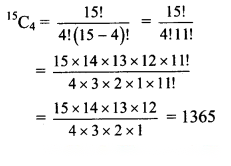
Solution & Step-by-Step Answer:
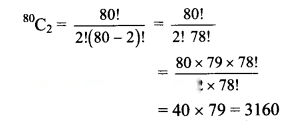
(b)80C2
Solution:
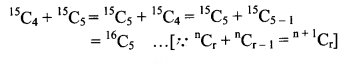
(c)15C4+15C5
Solution:
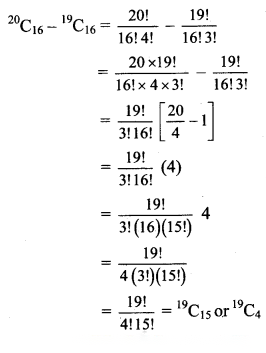
(d)20C16–19C16
Solution:
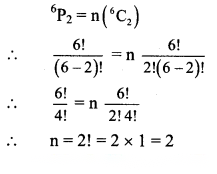
Solution & Step-by-Step Answer:
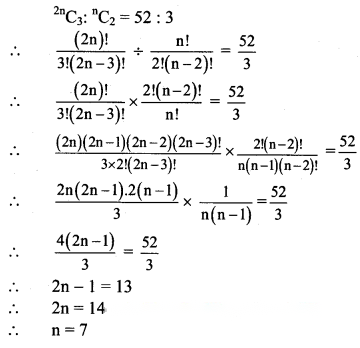
(b)2nC3:nC2= 52 : 3
Solution:
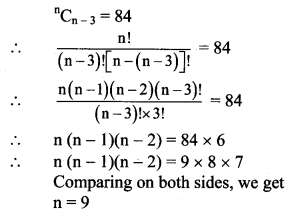
(c)nCn-3= 84
Solution:
Solution & Step-by-Step Answer:
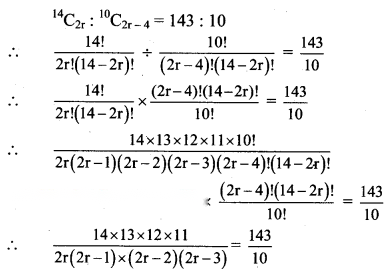
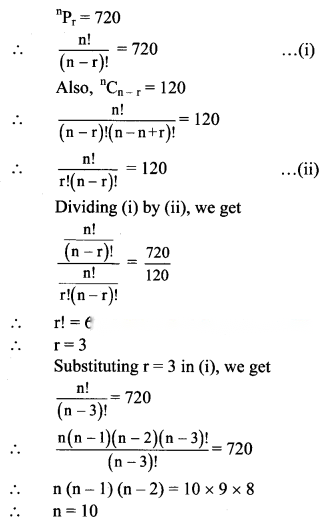
∴ 2r(2r – 1) (2r – 2) (2r – 3) = 14 × 12 × 10 ∴ 2r(2r – 1) (2r – 2) (2r – 3) = 8 × 7 × 6 × 5 Comparing on both sides, we get ∴ r = 4
Solution & Step-by-Step Answer:
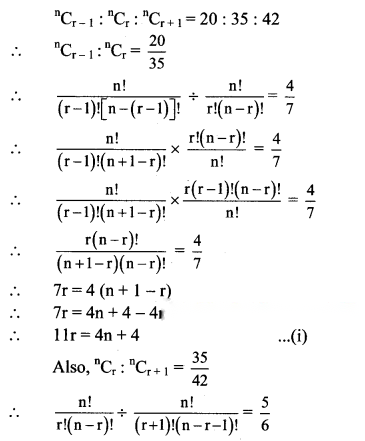
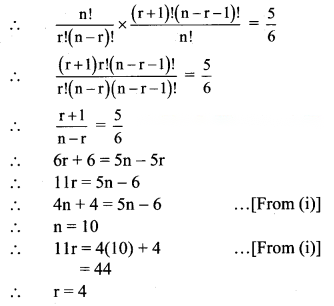
(b)nCr-1:nCr:nCr+1= 20 : 35 : 42
Solution:
Solution & Step-by-Step Answer:
Solution & Step-by-Step Answer:
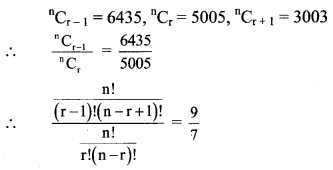
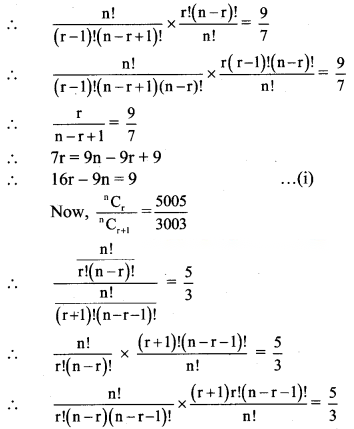
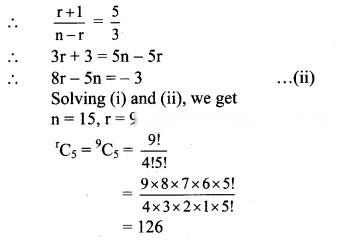
Solution & Step-by-Step Answer:
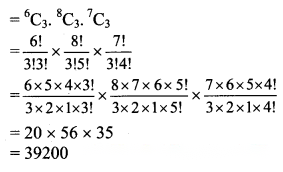
9 balls are to be selected from 6 red, 8 green, 7 blue balls such that the selection consists of 3 balls of each colour. ∴ 3 red balls can be selected from 6 red balls in 6C3 ways. 3 reen balls can be selected from 8 green balls in 8C3 ways. 3 blue balls can be selected from 7 blue balls in 7C3 ways. ∴ Number of ways selection can be done if the selection consists of 3 balls of each colour
Solution & Step-by-Step Answer:
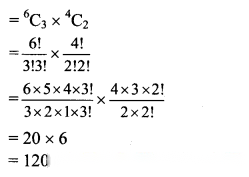
There are 6 boys and 4 girls. A team of 3 boys and 2 girls is to be selected. ∴ 3 boys can be selected from 6 boys in 6C3 ways. 2 girls can be selected from 4 girls in 4C2 ways. ∴ Number of ways the team can be selected
Solution & Step-by-Step Answer:
Let there be n participants present in the meeting. A handshake occurs between 2 persons. ∴ Number of handshakes = nC2 Given 66 handshakes were exchanged. 66 = nC2 66 = 66 × 2 = 132 = n (n – 1) n(n – 1) = 12 × 11 Comparing on both sides, we get n = 12 ∴ 12 participants were present at the meeting.
Solution & Step-by-Step Answer:
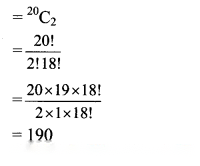
To draw a chord we need to join two points on the circle. There are 20 points on a circle. ∴ Total number of chords possible from these points
Solution & Step-by-Step Answer:
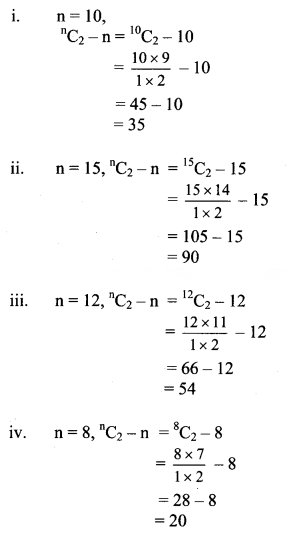
In n-sided polygon, there are ‘n’ points and ‘n’ sides. ∴ Through ‘n’ points we can draw nC2 lines including sides. ∴ Number of diagonals in n sided polygon = nC2 – n (n = number of sides)
Solution & Step-by-Step Answer:
There are 20 lines such that no two of them are parallel and no three of them are concurrent. Since no two lines are parallel, they intersect at a point. ∴ Number of points of intersection if no two lines are parallel and no three lines are concurrent = 20C2 = = = 190
Solution & Step-by-Step Answer:
There are 10 points on a plane. (a) When no three of them are collinear. A line is obtained by joining 2 points. ∴ Number of lines passing through these points = 10C2 = = = 5 × 9 = 45
(b) When 4 of them are collinear.
If no three points are collinear, we get a total of10C2= 45 lines by joining them. …..[From (i)]
Since 4 points are collinear, only one line passes through these points instead of4C2lines.
∴4C2– 1 extra lines are included in 45 lines.
Number of lines passing through these points
= 45 – (4C2– 1)
= 45 – + 1
= 45 – + 1
= 45 – 6 + 1
= 40
Solution & Step-by-Step Answer:
There are 12 points on the plane. (a) When no three of them are collinear. A triangle can be drawn by joining any three non-collinear points. ∴ Number of triangles that can be obtained from these points = 12C3 = = = 220
(b) When 4 of these points are collinear.
If no three points are collinear, total we get12C3= 220 triangles by joining them. ……[From (i)]
Since 4 points are collinear, no triangle can be formed by joining these four points.
∴4C3extra triangles are included in 220 triangles.
∴ Number of triangles that can be obtained from these points =12C3–4C3
= 220 –
= 220 –
= 220 – 4
= 216
Solution & Step-by-Step Answer:
There are 8 consonants and 3 vowels. From 8 consonants, 4 can be selected in 8C4 = = = 70 ways. From 3 vowels, 2 can be selected in 3C2 = = = 3 ways. Now, to form a word, these 6 ietters (i.e., 4 consonants and 2 vowels) can be arranged in 6P6 = 6! ways. ∴ Total number of words that can be formed = 70 × 3 × 6! = 70 × 3 × 720 = 151200 ∴ 151200 words of 4 consonants and 2 vowels can be formed.
Solution & Step-by-Step Answer:
nC8 = nC12 If nCx = nCy, then either x = y or x = n – y ∴ 8 = 12 or 8 = n – 12 But 8 = 12 is not possible ∴ 8 = n – 12 ∴ n = 20
(ii)23C3n=23C2n+3
Solution:
23C3n=23C2n+3
IfnCx=nCy, then either x = y or x = n – y
∴ 3n = 2n + 3 or 3n = 23 – 2n – 3
∴ n = 3 or n = 4
(iii)21C6n=
Solution:
21C6n=
IfnCx=nCy, then either x = y or x = n – y
∴ 6n = n2+ 5 or 6n = 21 – (n2+ 5)
∴ n2– 6n + 5 = 0 or 6n = 21 – n2– 5
∴ n2– 6n + 5 = 0 or n2+ 6n – 16 = 0
If n2– 6n + 5 = 0, then (n – 1)(n – 5) = 0
∴ n = 1 or n = 5
If n = 5 then
n2+ 5 = 30 > 21
∴ n ≠ 5
∴ n = 1
If n2+ 6n – 16 = 0, then (n + 8)(n – 2) = 0
n = -8 or n = 2
n ≠ -8
∴ n = 2
∴ n = 1 or n = 2
Check:
n = 2
∴ n2+ 5 = 22+ 5 = 9
21C6n=21C12
and =21C9
∴nCr=nCn-r
∴21C12=21C9
∴ n = 2 is a right answer.
(iv)2nCr-1=2nCr+1
Solution:
2nCr-1=2nCr+1
IfnCx=nCy, then either x = y or x = n – y
∴ r – 1 = r + 1 or r – 1 = 2n – (r + 1)
But r – 1 = r + 1 is not possible
∴ r – 1 = 2n – (r + 1)
∴ r + r = 2n
∴ r = n
Check:
2nCr-1=2nCn-1
and2nCr+1=2nCn+1
usingnCr=nCn-r, we have
2nCn+1=2nC2n-(n+1)=2nCn-1
∴2nCr-1=2nCr+1
(v)nCn-2= 15
Solution:
nCn-2= 15
∴nC2= 15 …..[∵nCr=nCn-r]
∴
∴
∴ n(n – 1) = 30
∴ n(n – 1) = 6 × 5
Equating both sides, we get
∴ n = 6
Solution & Step-by-Step Answer:
Solution & Step-by-Step Answer:

Solution & Step-by-Step Answer:
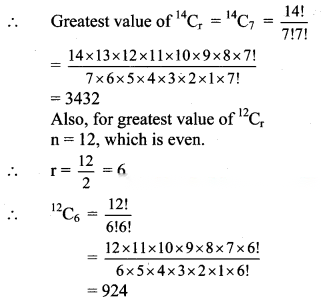
Solution & Step-by-Step Answer:
Greatest value of 14Cr. Here, n = 14, which is even. Greatest value of nCr occurs at r = if n is even. ∴ r = ∴ r = = 7 ∴ Difference between the greatest values of 14Cr and 12Cr = 14Cr – 12Cr = 3432 – 924 = 2508
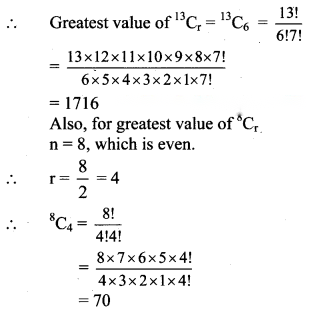
(b)13Crand8Cr
Solution:
Greatest value of13Cr.
Here n = 13, which is odd.
Greatest value of nCr occurs at r = if n is odd.
∴ r =
∴ r = = 6
∴ Difference between the greatest values of13Crand8Cr=13Cr–8Cr
= 1716 – 70
= 1646
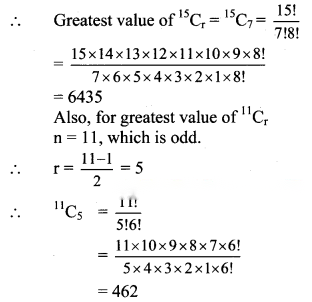
(c)15Crand11Cr
Solution:
Greatest value of15Cr.
Here n = 15, which is odd.
Greatest value of nCr occurs at r = if n is odd.
∴ r =
∴ r = = 7
∴ Difference between the greatest values of15Crand11Cr=15Cr–11Cr
= 6435 – 462
= 5973
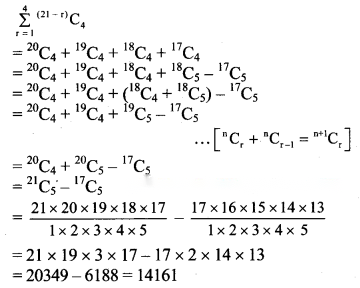
Solution & Step-by-Step Answer:
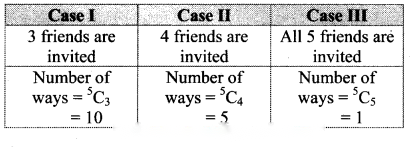
Boy can invite = (3 or 4 or 5 friends) Consider the following table: ∴ Number of ways a boy can invite his friends to a party so that three or more of join the party = 10 + 5 + 1 = 16
Solution & Step-by-Step Answer:
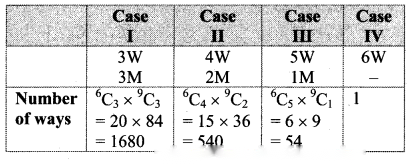
There are 9 men and 6 women. A team of 6 persons is to be formed such that it consist of at least 3 women. Consider the following table: ∴ No. of ways this can be done = 1680 + 540 + 54 + 1 = 2275 ∴ 2275 teams can be formed if team consists of at least 3 women.
Solution & Step-by-Step Answer:
(i) A committee of 10 persons is to be formed from 10 women and 8 men such that the committee contains at least 5 women. Consider the following table: ∴ Number of committees with at least 5 women = 14112 + 14700 + 6720 + 1260 + 81 = 36873
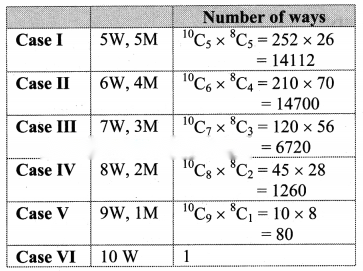
(ii) Number of committees with men in majority = Total number of committees – (Number of committees with women in majority + women and men equal in number)
=18C10– 36873
=18C8– 36873
= 43758 – 36873
= 6885
Solution & Step-by-Step Answer:
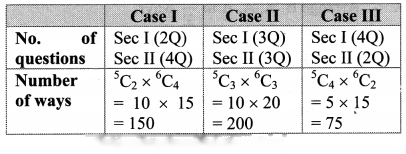
There are 11 questions, out of which 5 questions are from section I and 6 questions are from section II. The student has to select 6 questions taking at least 2 questions from each section. Consider the following table: ∴ Number of choices = 150 + 200 + 75 = 425 ∴ In 425 ways students can select 6 questions, taking at least 2 questions from each section.
Solution & Step-by-Step Answer:
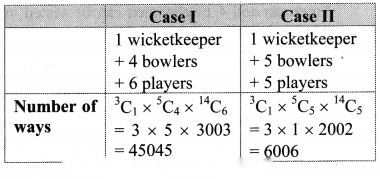
There are 22 cricket players, of which 3 are wicketkeepers and 5 are bowlers. A team of 11 players is to be chosen such that exactly one wicket keeper and at least 4 bowlers are to be included in the team. Consider the following table: ∴ Number of ways a team of 11 players can be selected = 45045 + 6006 = 51051
Solution & Step-by-Step Answer:
5 students are to be selected from 11 students. (a) When 2 specified students are included, then remaining 3 students can be selected from (11 – 2) = 9 students. ∴ Number of ways of selecting 3 students from 9 students = 9C3 = = = 84 ∴ Selection of students is done in 84 ways when 2 specified students are included.
(b) When 2 specified students are not included, then 5 students can be selected from the remaining (11 – 2) = 9 students.
∴ Number of ways of selecting 5 students from 9 students =9C5
=
=
= 126
∴ Selection of students is done in 126 ways when 2 specified students are not included.