Maharashtra State Board 11th Maths Solutions Chapter 4 Determinants and Matrices Ex 4.2
ii. ≤ft|{array}{ccc}
2 & 3 & 4 \\
5 & 6 & 8 \\
6 x & 9 x & 12 x
{array}
Taking (3x) common from R3, we get
D = 3x ≤ft|{array}{lll}
2 & 3 & 4 \\
5 & 6 & 8 \\
2 & 3 & 4
{array}
= (3x)(0) = 0
… [∵ R1and R3are identical]
= 0
iii. Let D = ≤ft|{array}{lll}
2 & 7 & 65 \\
3 & 8 & 75 \\
5 & 9 & 86
{array}
Applying Cx3→ C3– 9C2, we get
D = ≤ft|{array}{lll}
2 & 7 & 2 \\
3 & 8 & 3 \\
5 & 9 & 5
{array}
= 0 …[∵ C1and C3are identical]

ii.
ii. ≤ft|{array}{ccc}
x-1 & x & x-2 \\
0 & x-2 & x-3 \\
0 & 0 & x-3
{array}=0
Applying R2→ R2– R3, we get
≤ft|{array}{ccc}
x-1 & x & x-2 \\
0 & x-2 & 0 \\
0 & 0 & x-3
{array}=0
∴ (x – 1)(x – 2)(x – 3) – 0] – x(0 – 0) + (x – 2)(0 – 0) =
∴ (x – 1)(x – 2)(x – 3) = 0
∴ x — 1 = 0 or x-2 = 0 or x-3 = 0
∴ x = 1 or x = 2 or x = 3
Question 5
Maharashtra Board Solution
If = 0, then find the values of x.
Solution & Step-by-Step Answer:
block bg-white dark:bg-slate-900/80 border-l-4 border-emerald-500 rounded-r-xl p-5 my-3 shadow-xs border border-slate-200/60 dark:border-slate-800">
Solution & Step-by-Step Answer:
(12 -x)[1(4x2 – 0) – (4 – x)(0 – 0) + (4 – x)(0 – 0)] = 0 ∴ (12 – x)(4x2) = 0 ∴ x2(12 – x) = 0 ∴ x = 0 or 12 – x = 0 ∴ x = 0 or x = 12
Question 6
Maharashtra Board Solution
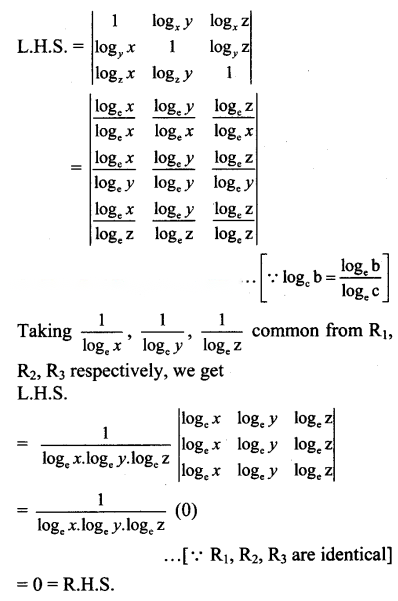
Without expanding determinant, show that
Solution & Step-by-Step Answer:
L.H.S. = In 1st determinant, taking 2 common from C3 we get Interchanging rows and columns, we get L.H.S. = Taking 10 common from R1, we get L.H.S = 10 = R.H.S.
|

