Maharashtra State Board 11th Maths Solutions Chapter 4 Determinants and Matrices Ex 4.3
Dx= ≤ft|{array}{ccc}
6 & 1 & 1 \\
2 & -1 & 1 \\
2 & 2 & -1
{array}
= 6(1 – 2) – 1(-2 – 2) + 1(4 + 2)
= 6(-1) -1 (-4) + 1(6)
= -6 + 4 + 6
= 4
Dy= ≤ft|{array}{ccc}
1 & 6 & 1 \\
1 & 2 & 1 \\
1 & 2 & -1
{array}
= 1(-2 – 2) – 6(-l – 1) + 1(2 = 1 (- 4) – 6 (- 2) + 1(0)
= -4+12 + 0 = 8
Dz= ≤ft|{array}{ccc}
1 & 1 & 6 \\
1 & -1 & 2 \\
1 & 2 & 2
{array}
= l(-2 – 4) – 1(2 – 2) + 6(2 + 1)
= l(-6)-l(0) + 6(3)
= -6 + 0+18 = 12
By Cramer’s Rule,
∴ x = 1, y = 2 and z = 3 are the solutions of the given equations.

ii. Given equations are x+y- 2z = -10,
2x + y – 3z = -19,
Ax + 6y + z = 2.
D = ≤ft|{array}{ccc}
1 & 1 & -2 \\
2 & 1 & -3 \\
4 & 6 & 1
{array}
= 1(1 + 18)- 1(2+ 12)-2(12-4)
= 1(19)-1(14)-2(8)
= 19-14-16 = -11 ≠ 0
Dx= ≤ft|{array}{ccc}
-10 & 1 & -2 \\
-19 & 1 & -3 \\
2 & 6 & 1
{array}
= -10(1 + 18) – 1(-19 + 6) – 2(- 114 – 2)
= -10(19)- 1(-13) -2(-l 16)
= -190+ 13 + 232 = 55
Dy= ≤ft|{array}{ccc}
1 & -10 & -2 \\
2 & -19 & -3 \\
4 & 2 & 1
{array}
= 1(-19 + 6) – (-10)(2 + 12) – 2(4 + 76) = 1(-13) + 10(14) – 2(80)
= -13 + 140-160 = -33
Dz= ≤ft|{array}{ccc}
1 & 1 & -10 \\
2 & 1 & -19 \\
4 & 6 & 2
{array}
= 1(2+ 114)-1(4+ 76)-10(12-4)
= 1(116)-1(80)-10(8)
= 116-80-80.
= -44
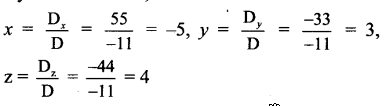
By Cramer’s Rule,
∴ x = -5, y = 3 and z = 4 are the solutions of the given equations.
[Note: The question has been modified]
iii. Given equations are
x + z = 1, i.e.,x + 0y + z = 1,
y + z = 1, i.e., 0x + y + z = 1,
x + y = 4, i.e., x + y + 0z = 4.
D = ≤ft|{array}{lll}
1 & 0 & 1 \\
0 & 1 & 1 \\
1 & 1 & 0
{array}
= 1(0 – 1) – 0 + 1(0 – 1)
= 1(-1)+1(-1)
= -1-1 = -2 ≠ 0
Dx= ≤ft|{array}{lll}
1 & 0 & 1 \\
0 & 1 & 1 \\
1 & 1 & 0
{array}
= 1(0 – 1) – 0 + 1(1 -4) = l(-l)+l(-3)
= -1 – 3
= -4
Dy= ≤ft|{array}{lll}
1 & 1 & 1 \\
0 & 1 & 1 \\
1 & 4 & 0
{array}
= 1(0 – 4) – 1(0 – 1) + 1(0 – 1)
= 1(-4) – 1(-1) + 1(-1)
= -4 + 1 – 1
= -4
Dz= ≤ft|{array}{lll}
1 & 0 & 1 \\
0 & 1 & 1 \\
1 & 1 & 4
{array}
= 1(4 – 1) – 0 + 1(0 – 1)
= 1(3) + 1(-1)
= 3 – 1
= 2
By Cramer’s Rule,
∴ x = 2, y = 2 and z = -1 are the solutions of the given equations.

Let = p, = q, = r
∴ The given equations become
-2p – q – 3r = 3, i.e., 2p + q + 3r = -3,
2p-3q + r = -13,
2p – 3r = -11, i.e., 2p + 0q – 3r = -11.
D = ≤ft|{array}{ccc}
2 & 1 & 3 \\
2 & -3 & 1 \\
2 & 0 & -3
{array}
= 2(9 – 0) – 1(-6 – 2) + 3(0 + 6)
= 2(9) – 1(-8) + 3(6)
= 18 + 8 + 18
= 44 ≠ 0
DP= ≤ft|{array}{ccc}
-3 & 1 & 3 \\
-13 & -3 & 1 \\
-11 & 0 & -3
{array}
= -3(9 – 0) – 1(39 + 11) + 3(0 – 33)
= -3(9) – 1(50) + 3(-33)
= -27 – 50 – 99
= -176
Dq= ≤ft|{array}{ccc}
2 & -3 & 3 \\
2 & -13 & 1 \\
2 & -11 & -3
{array}
= 2(39 + 11)- (-3)(-6 – 2) + 3(-22 + 26)
= 2(50) + 3(-8) + 3(4)
= 100 – 24 + 12
= 88
Dr= ≤ft|{array}{ccc}
2 & 1 & -3 \\
2 & -3 & -13 \\
2 & 0 & -11
{array}
= 2(33 – 0) – 1(-22 + 26) – 3(0 + 6)
= 2(33) – 1(4) – 3(6)
= 66 – 4 – 18
= 44
By Cramer’s Rule,
∴ x = , y = z = 1 are the solutions of the given equations.

Dx= ≤ft|{array}{ccc}
15 & 1 & 1 \\
5 & -1 & 1 \\
4 & 1 & -1
{array}
= 15(1 – 1) – 1(-5 – 4) + 1(5 + 4)
= 15(0) – 1(-9) + 1(9)
= 0 + 9 + 9
= 18
Dy= ≤ft|{array}{ccc}
1 & 15 & 1 \\
1 & 5 & 1 \\
2 & 4 & -1
{array}
= 1(-5 – 4) – 15(-1 – 2) + 1(4 – 10)
= 1(-9) – 15(-3) + 1(-6)
= -9 + 45 – 6 = 30
Dz= ≤ft|{array}{ccc}
1 & 1 & 15 \\
1 & -1 & 5 \\
2 & 1 & 4
{array}
= 1(-4 – 5) – 1(4 – 10) + 15(1 + 2)
= 1(-9) – 1(-6) + 15(3)
= -9 + 6 + 45
= 42
By Cramer’s Rule,
∴ The three numbers are 3, 5 and 7.

ii. Given equations are 2x + 3y – 4 = 0,
x + 2y = 3, i.e., x + 2y – 3 = 0,
3x + 4y + 5 = 0.
≤ft|{array}{ccc}
2 & 3 & -4 \\
1 & 2 & -3 \\
3 & 4 & 5
{array}
= 2(10 + 12) – 3(5 + 9) – 4(4 – 6)
= 2 (22) – 3(14) – 4(-2)
= 44 – 42 + 8
= 10 ≠ 0
∴ The given equations are not consistent.
iii. Given equations are x + 2y – 3 =
7x + 4y – 11 =0,
2x + 4y – 6 = 0.
≤ft|{array}{ccc}
1 & 2 & -3 \\
7 & 4 & -11 \\
2 & 4 & -6
{array}
= 1(-24 + 44) – 2(-42 + 22) – 3(28 – 8)
= 1(20) – 2(-20) – 3(20)
= 20 + 40 – 60
= 0
∴ The given equations are consistent.
Given equations are are
kx + 3y + 1 = 0,
x + 2y +1=0,
x + y = 0, i.e., x + y + 0 = 0.
Since these equations are consistent,
≤ft|{array}{lll}
k & 3 & 1 \\
1 & 2 & 1 \\
1 & 1 & 0
{array} = 0
∴ k(0 – 1) – 3(0 – 1) + 1(1 – 2) = 0
∴ k(-1) – 3(-1) + 1(-1) = 0
∴ -k + 3 – 1 = 0
∴ k = 2.
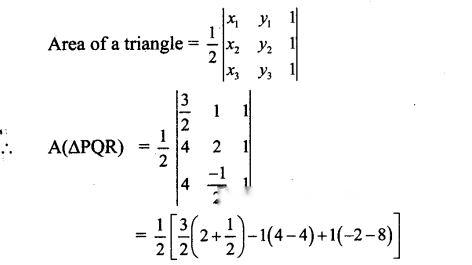
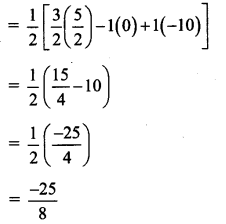
ii. Here, P(x1, y1) ≡ P(3/2, 1), Q(x2, y2) ≡ Q(4, 2), R(x3, y3) ≡ R(4,- )
Since area cannot be negative
A(ΔPQR) = 25/8 sq. units
iii. Here, M(x1, y1) ≡ M(0, 5), N(x2, y2) ≡ N(-2, 3)
T(x3, y3) ≡ T(1, -4)
Area of a triangle = ≤ft|{array}{lll}
x_{1} & y_{1} & 1 \\
x_{2} & y_{2} & 1 \\
x_{3} & y_{3} & 1
{array}
∴ A(ΔMNT) = ≤ft|{array}{ccc}
0 & 5 & 1 \\
-2 & 3 & 1 \\
1 & -4 & 1
{array}
= [ 0 – 5 (-2 -1) + 1 (8 – 3)]
= [-5 (-3) + 1(5)]
= (15 + 5)
= (20)
= 10 sq. units

ii. Here, P(x1, y1) ≡ P(3, -5), Q(x2, y2) ≡ Q(6, 1), R(x3, y3) ≡ R(4,2)
∴ If A(∆PQR) = 0, then the points P,Q, R are collinear
∴ A(∆PQR) = ≤ft|{array}{ccc}
3 & -5 & 1 \\
6 & 1 & 1 \\
4 & 2 & 1
{array}
= [3(1-2) – (-5)(6 – 4) + 1(12 – 4)]
= [3(-1) + 5(2) + 1(8)]
= (-3 + 10 + 8)= ≠ 0
∴ The points P, Q, R are non-collinear.
iii. Here, L(x1, y1) ≡ L(0,1/2), M(x2, y2) ≡ M(2, -1), N(x3, y3) ≡ N(-4, 7/2)
If A(∆LMN) = 0, then the points L, M, N are collinear.
∴ A(∆LMN) = ≤ft|{array}{ccc}
0 & & 1 \\
2 & -1 & 1 \\
-4 & & 1
{array}
= [0 – ] (2 + 4) + 1(7 – 4)]
= [ – (6) + 1(3)]
= (-3 + 3) = 0
∴ The points L, M, N are collinear.