Latest Maharashtra State Board (SSC & HSC) 2026-27 Syllabus Digest & Solutions Updated!
Class 11 (FYJC / HSC)Mathematics & Statistics2026-27 Syllabus

Chapter 4 Determinants and Matrices Miscellaneous Exercise 4(A) Solutions

Complete Maharashtra State Board Balbharati & Yuvakbharati textbook solutions for Chapter 4 Determinants and Matrices Miscellaneous Exercise 4(A). Step-by-step solved exercises, numerical problems, and digest answers.

26 Solved Questions43 Diagrams3195 words

Maharashtra State Board 11th Maths Solutions Chapter 4 Determinants and Matrices Miscellaneous Exercise 4(A)

I. Select the correct option from the given alternatives.
Question 1 Maharashtra Board Solution
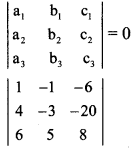
The determinant D = = 0, if (a) a, b, c are in A.P. (b) a, b, c are in G.P. (c) a, b, c are in H.P. (d) α is a root of ax2 + 2bx + c = 0
Solution & Step-by-Step Answer:
(b) a, b, c are in G.P. Hint: Applying R3 → R3 – (R1 + R2), we get ∴ a[-c(a + 2b + c) – 0] – b[-b(a + 2b + c) – 0] + (a + b) (0 – 0) = 0 ∴ (-ac + b2) (a + 2b + c) = 0 ∴ -ac + b2 = 0 or a + 2b + c = 0 ∴ b2 = ac ∴ a, b, c are in G.P.
Question 2 Maharashtra Board Solution
If = (x – y) (y – z) (z – x) then (a) k = -3 (b) k = -1 (c) k = 1 (d) k = 3
Solution & Step-by-Step Answer:
(b) k = -1 Hint:

Question 3 Maharashtra Board Solution
Let D = then (a) D is independent of θ (b) D is independent of φ (c) D is a constant (d) at θ = is equal to 0
Solution & Step-by-Step Answer:
(b) D is independent of φ
Question 4 Maharashtra Board Solution
The value of a for which the system of equations a3x + (a + 1)y + (a + 2)3 z = 0, ax + (a + 1)y + (a + 2)z = 0 and x + y + z = 0 has a non zero solution is (a) 0 (b) -1 (c) 1 (d) 2
Solution & Step-by-Step Answer:
(b) -1 Hint: The given system of equations will have a non-zero solution, if

Question 5 Maharashtra Board Solution
(a) 2 (b) 2 (c) 2 (d) 2
Solution & Step-by-Step Answer:
(c) 2 Hint:

Question 6 Maharashtra Board Solution
The system 3x – y + 4z = 3, x + 2y – 3z = -2 and 6x + 5y + λz = -3 has atleast one solution when (a) λ = -5 (b) λ = 5 (c) λ = 3 (d) λ = -13
Solution & Step-by-Step Answer:
(a) λ = -5 Hint: The given system of equations will have more than one solution if

Question 7 Maharashtra Board Solution
If x = -9 is a root of , has other two roots are (a) 2, -7 (b) -2, 7 (c) 2, 7 (d) -2, -7
Solution & Step-by-Step Answer:
(c) 2, 7 Hint:

Question 8 Maharashtra Board Solution
If = x + iy, then (a) x = 3, y = 1 (b) x = 1, y = 3 (c) x = 0, y = 3 (d) x = 0, y = 0
Solution & Step-by-Step Answer:
(d) x = 0, y = 0
Question 9 Maharashtra Board Solution
If A(0, 0), B(1, 3) and C(k, 0) are vertices of triangle ABC whose area is 3 sq.units, then the value of k is (a) 2 (b) -3 (c) 3 or -3 (d) -2 or 2
Solution & Step-by-Step Answer:
(d) -2 or 2
Question 10 Maharashtra Board Solution
Which of the following is correct? (a) Determinant is a square matrix (b) Determinant is number associated to matrix (c) Determinant is a number associated with a square matrix (d) None of these
Solution & Step-by-Step Answer:
(c) Determinant is a number associated with a square matrix

II. Answer the following questions.
Question 1 Maharashtra Board Solution
Evaluate: (i) (ii)
Solution & Step-by-Step Answer:
(i) = 2(4 – 0) + 5(10 – 9) + 7(0 – 18) = 2(4) + 5(1) + 7(-18) = 8 + 5 – 126 = -113

(ii) ≤ft|{array}{ccc}
1 & -3 & 12 \\
0 & 2 & -4 \\
9 & 7 & 2
{array}
= 1(4 + 28) + 3(0 + 36) + 12(0 – 18)
= 1(32) + 3(36) + 12(-18)
= 32 + 108 – 216
= -76
Question 2 Maharashtra Board Solution
Evaluate determinant along second column
Solution & Step-by-Step Answer:

Question 3 Maharashtra Board Solution
Evaluate: (i) (ii) by using properties.
Solution & Step-by-Step Answer:

Question 4 Maharashtra Board Solution
Find the minors and cofactors of elements of the determinants. (i) (ii)
Solution & Step-by-Step Answer:

Question 5 Maharashtra Board Solution
Find the values of x, if (i) (ii)
Solution & Step-by-Step Answer:
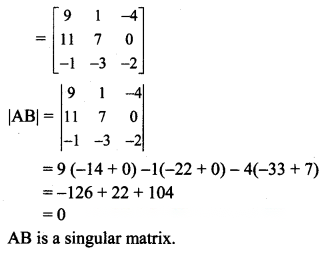
(i) ⇒ 1(-10x2 + 10x) – 4(5x2 + 5) + 20(2x + 2) = 0 ⇒ -10x2 + 10x – 20x2 – 20 + 40x + 40 = 0 ⇒ -30x2 + 50x + 20 = 0 ⇒ 3x2 – 5x – 2 = 0 …..[Dividing throughout by (-10)] ⇒ 3x2 – 6x + x – 2 = 0 ⇒ 3x(x – 2) + 1(x – 2) = 0 ⇒ (x – 2) (3x + 1) = 0 ⇒ x – 2 = 0 or 3x + 1 = 0 ⇒ x = 2 or x =

(ii) ≤ft|{array}{ccc}
1 & 2 x & 4 x \\
1 & 4 & 16 \\
1 & 1 & 1
{array}=0
⇒ 1(4 – 16) – 2x(1 – 16) + 4x(1 – 4) = 0
⇒ 1(-12) – 2x(-15) + 4x(-3) = 0
⇒ -12 + 30x – 12x = 0
⇒ 18x = 12
⇒ x =
Question 6 Maharashtra Board Solution
By using properties of determinant, prove that
Solution & Step-by-Step Answer:

Question 7 Maharashtra Board Solution
Without expanding the determinants, show that
Solution & Step-by-Step Answer:

Question 8 Maharashtra Board Solution
If then show that
Solution & Step-by-Step Answer:

Question 9 Maharashtra Board Solution
Solve the following linear equations by Cramer’s Rule. (i) 2x – y + z = 1, x + 2y + 3z = 8, 3x + y – 4z = 1 (ii) (iii) 2x + 3y + 3z = 5, x – 2y + z = -4, 3x – y – 2z = 3 (iv) x + y + 2z = 7, 3x + 4y – 5z = 5, 2x – y + 3z = 12
Solution & Step-by-Step Answer:
(i) Given equations are 2x – y + z = 1 x + 2y + 3z = 8 3x + y – 4z = 1 D = = 2(-8 – 3) – (-1)(-4 – 9) + 1(1 – 6) = 2(-11) + 1(-13) + 1(-5) = -22 – 13 – 5 = -40 ≠ 0

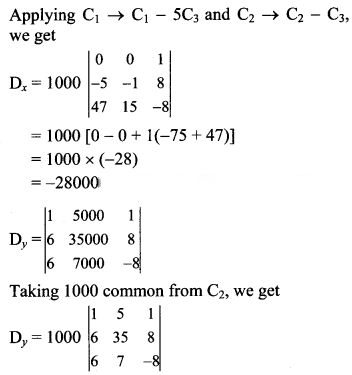
Dx = ≤ft|{array}{ccc}
1 & -1 & 1 \\
8 & 2 & 3 \\
1 & 1 & -4
{array}
= 1(-8 – 3) – (-1)(-32 – 3) + 1(8 – 2)
= 1(-11) + 1(-35) + 1(6)
= -11 – 35 + 6
= -40

Dy = ≤ft|{array}{ccc}
2 & 1 & 1 \\
1 & 8 & 3 \\
3 & 1 & -4
{array}
= 2(-32 – 3) -1(-4 – 9) + 1(1 – 24)
= 2(-35) – 1(-13) + 1(-23)
= -70 + 13 – 23
= -80

Dz = ≤ft|{array}{ccc}
2 & -1 & 1 \\
1 & 2 & 8 \\
3 & 1 & 1
{array}
= 2(2 – 8) – (-1)(1 – 24) + 1(1 – 6)
= 2(-6) + 1(-23) + 1(-5)
= -12 – 23 – 5
= -40
By Cramer’s Rule,
∴ x = 1, y = 2 and z = 1 are the solutions of the given equations.
(ii) Let = p, = q, = r
∴ The given equations become
p + q =
i.e., 2p + 2q = 3
i.e., 2p + 2q + 0 = 3
q + r =
i.e., 6q + 6r = 5,
i.e., 0p + 6q + 6r = 5
r + p =
i.e., 3r + 3p = 4,
i.e., 3p + 0q + 3r = 4
D = ≤ft|{array}{lll}
2 & 2 & 0 \\
0 & 6 & 6 \\
3 & 0 & 3
{array}
= 2(18 – 0) -2(0 – 18) + 0
= 2(18) – 2(-18)
= 36 + 36
= 72 ≠ 0

Dp = ≤ft|{array}{lll}
3 & 2 & 0 \\
5 & 6 & 6 \\
4 & 0 & 3
{array}
= 3(18 – 0) – 2(15 – 24) + 0
= 3(18) – 2(-9)
= 54 + 18
= 72

Dq = ≤ft|{array}{lll}
2 & 3 & 0 \\
0 & 5 & 6 \\
3 & 4 & 3
{array}
= 2(15 – 24) – 3(0 – 18) + 0
= 2(-9) – 3(-18)
= -18 + 54
= 36

Dr = ≤ft|{array}{lll}
2 & 2 & 3 \\
0 & 6 & 5 \\
3 & 0 & 4
{array}
= 2(24 – 0) – 2(0 – 15) + 3(0 – 18)
= 2(24) – 2(-15) + 3(-18)
= 48 + 30 – 54
= 24
By Cramer’s Rule,
∴ x = 1, y = 2 and z = 3 are the solutions of the given equations.
(iii) Given equations are
2x + 3y + 3z = 5
x – 2y + z = -4
3x – y – 2z = 3
D = ≤ft|{array}{ccc}
2 & 3 & 3 \\
1 & -2 & 1 \\
3 & -1 & -2
{array}
= 2(4 + 1) – 3(-2 – 3) + 3(-1 + 6)
= 2(5) – 3(-5) + 3(5)
= 10 + 15 + 15
= 40 ≠ 0

Dx = ≤ft|{array}{ccc}
5 & 3 & 3 \\
-4 & -2 & 1 \\
3 & -1 & -2
{array}
= 5(4 + 1) – 3(8 – 3) + 3(4 + 6)
= 5(5) – 3(5) + 3(10)
= 25 – 15 + 30
= 40

Dy = ≤ft|{array}{ccc}
2 & 5 & 3 \\
1 & -4 & 1 \\
3 & 3 & -2
{array}
= 2(8 – 3) – 5(-2 – 3) + 3(3 + 12)
= 2(5) – 5(-5) + 3(15)
= 10 + 25 + 45
= 80

Dz = ≤ft|{array}{ccc}
2 & 3 & 5 \\
1 & -2 & -4 \\
3 & -1 & 3
{array}
= 2(-6 – 4) – 3(3 + 12) + 5(-1 + 6)
= 2(-10) – 3(15) + 5(5)
= -20 -45 + 25
= -40
By Cramer’s Rule,
∴ x = 1, y = 2 and z = -1 are the solutions of the given equations.
(iv) Given equations are
x – y + 2z = 7
3x + 4y – 5z = 5
2x – y + 3z = 12
D = ≤ft|{array}{ccc}
1 & -1 & 2 \\
3 & 4 & -5 \\
2 & -1 & 3
{array}
= 1(12 – 5) – (-1)(9 + 10) + 2(-3 – 8)
= 1(7) + 1(19) + 2(-11)
= 7 + 19 – 22
= 4 ≠ 0

Dx = ≤ft|{array}{ccc}
7 & -1 & 2 \\
5 & 4 & -5 \\
12 & -1 & 3
{array}
= 7(12 – 5) – (-1)(15 + 60) + 2(-5 – 48)
= 7(7) + 1(75) + 2(-53)
= 49 + 75 – 106
= 18

Dy = ≤ft|{array}{ccc}
1 & 7 & 2 \\
3 & 5 & -5 \\
2 & 12 & 3
{array}
= 1(15 + 60) – 7(9 + 10) + 2(36 – 10)
= 1(75) – 7(19) + 2(26)
= 75 – 133 + 52
= -6

Dz = ≤ft|{array}{ccc}
1 & -1 & 7 \\
3 & 4 & 5 \\
2 & -1 & 12
{array}
= 1(48 + 5) – (-1)(36 – 10) + 7(-3 – 8)
= 1(53) + 1(26) + 7(-11)
= 53 + 26 – 77
= 2
By Cramer’s Rule,
∴ x = , y = and z = are the solutions of the given equations.
Question 10 Maharashtra Board Solution
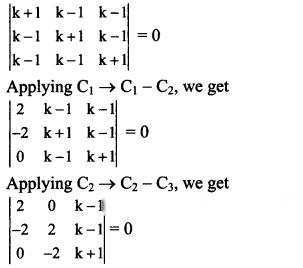
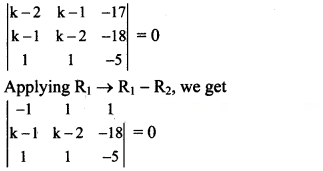
Find the value of k, if the following equations are consistent. (i) (k + 1)x + (k – 1)y + (k – 1) = 0 (k – 1)x + (k + 1)y + (k – 1) = 0 (k – 1)x + (k – 1)y + (k + 1) = 0 (ii) 3x + y – 2 = 0, kx + 2y – 3 = 0 and 2x – y = 3 (iii) (k – 2)x + (k – 1)y = 17, (k – 1)x +(k – 2)y = 18 and x + y = 5
Solution & Step-by-Step Answer:
(i) Given equations are (k + 1)x + (k – 1)y + (k – 1) = 0 (k – 1)x + (k + 1)y + (k – 1) = 0 (k – 1)x + (k – 1)y + (k + 1) = 0 Since these equations are consistent, ⇒ 2(2k + 2 + 2k – 2) – 0 + (k – 1) (4 – 0) = 0 ⇒ 2(4k) + (k – 1)4 = 0 ⇒ 8k + 4k – 4 = 0 ⇒ 12k – 4 = 0 ⇒ k =

(ii) Given equations are
3x + y – 2 = 0
kx + 2y – 3 = 0
2x – y = 3, i.e., 2x – y – 3 = 0.
Since these equations are consistent,
≤ft|{array}{rrr}
3 & 1 & -2 \\
k & 2 & -3 \\
2 & -1 & -3
{array}=0
⇒ 3(-6 – 3) – 1(-3k + 6) – 2(-k – 4) = 0
⇒ 3(-9) – 1(-3k + 6) – 2(-k – 4) = 0
⇒ -27 + 3k – 6 + 2k + 8 = 0
⇒ 5k – 25 = 0
⇒ k = 5

(iii) Given equations are
(k – 2)x + (k – 1)y = 17
⇒ (k – 2)x + (k – 1)y – 17 = 0
(k – 1)x + (k – 2)y = 18
⇒ (k – 1)x + (k – 2)y – 18 = 0
x + y = 5
⇒ x + y – 5 = 0
Since these equations are consistent,

⇒ -1(-5k + 10 + 18) – 1(-5k + 5 + 18) + 1(k – 1 – k + 2) = 0
⇒ -1(-5k + 28) – 1(-5k + 23) + 1(1) = 0
⇒ 5k – 28 + 5k – 23 + 1 = 0
⇒ 10k – 50 = 0
⇒ k = 5
Question 11 Maharashtra Board Solution
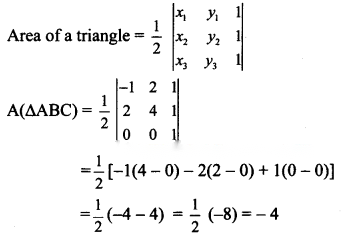
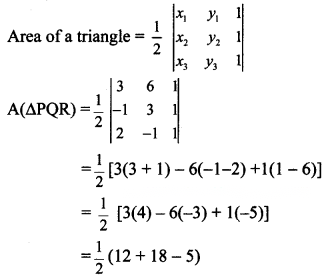
Find the area of triangle whose vertices are (i) A(-1, 2), B(2, 4), C(0, 0) (ii) P(3, 6), Q(-1, 3), R(2, -1) (iii) L(1, 1), M(-2, 2), N(5, 4)
Solution & Step-by-Step Answer:
(i) Here, A(x1, y1) = A(-1, 2) B(x2, y2) = B(2, 4) C(x3, y3) = C(0, 0) Since area cannot be negative, A(ΔABC) = 4 sq.units

(ii) Here, P(x1, y1) = P(3, 6)
Q(x2, y2) = Q(-1, 3)
R(x3, y3) = R(2, -1)

A(ΔPQR) = sq.units
(iii) Here, L(x1, y1) = L(1, 1)
M(x2, y2) = M(-2, 2)
N(x3, y3) = N(5, 4)

Since area cannot be negative,
A(ΔLMN) = sq.units

Question 12 Maharashtra Board Solution
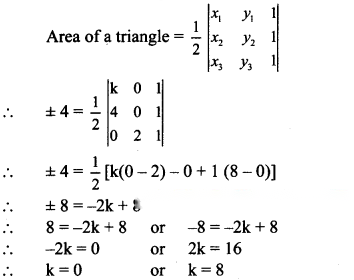
Find the value of k, (i) if the area of a triangle is 4 square units and vertices are P(k, 0), Q(4, 0), R(0, 2). (ii) if area of triangle is square units and vertices are L(3, -5), M(-2, k), N(1, 4).
Solution & Step-by-Step Answer:
(i) Here, P(x1, y1) = P(k, 0) Q(x2, y2) = Q(4, 0) R(x3, y3) = R(0, 2) A(ΔPQR) = 4 sq.units

(ii) Here, L(x1, y1) = L(3, -5), M(x2, y2) = M(-2, k), N(x3, y3) = N(1, 4)
A(ΔLMN) = sq. units
Area of a triangle = ≤ft|{array}{lll}
x_{1} & y_{1} & 1 \\
x_{2} & y_{2} & 1 \\
x_{3} & y_{3} & 1
{array}
± =≤ft|{array}{ccc}
3 & -5 & 1 \\
-2 & k & 1 \\
1 & 4 & 1
{array}
⇒ [3(k – 4) – (-5) (-2 – 1) + 1 (-8 – k)]
⇒ ±33 = 3k – 12 – 15 – 8 – k
⇒ ±33 = 2k – 35
⇒ 2k – 35 = 33 or 2k – 35 = -33
⇒ 2k = 68 or 2k = 2
⇒ k = 34 or k = 1
Question 13 Maharashtra Board Solution
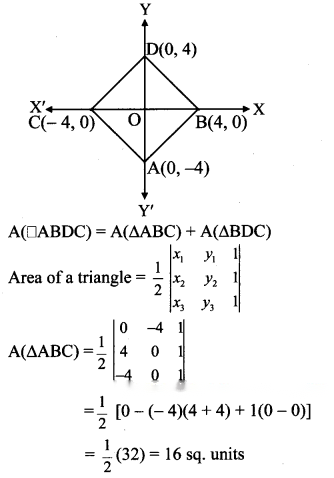
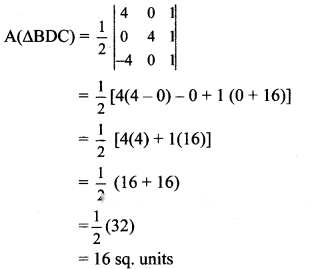
Find the area of quadrilateral whose vertices are A(0, -4), B(4, 0), C(-4,0), D (0, 4).
Solution & Step-by-Step Answer:
A(0, -4), B(4, 0), C(-4, 0), D(0, 4) ∴ A(ABDC) = A(ΔABC) + A(ΔBDC) = 16 + 16 = 32 sq.units

Question 14 Maharashtra Board Solution
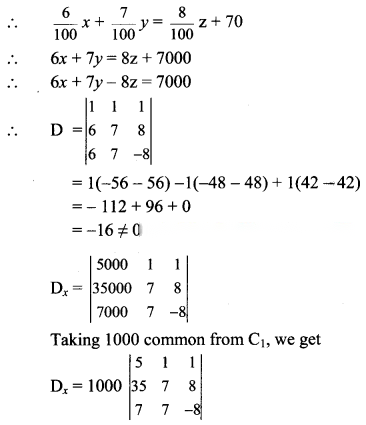
An amount of ₹ 5000 is put into three investments at the rate of interest of 6%, 7%, and 8% per annum respectively. The total annual income is ₹ 350. If the combined income from the first two investments is ₹ 70 more than the income from the third, find the amount of each investment.
Solution & Step-by-Step Answer:
Let the amount of each investment be ₹ x, ₹ y and ₹ z. According to the given conditions, x + y + z = 5000, 6% x + 7% y + 8% z = 350 ∴ The amounts of investments are ₹ 1750, ₹ 1500, and ₹ 1750.

Question 15 Maharashtra Board Solution
Show that the lines x – y = 6, 4x – 3y = 20 and 6x + 5y + 8 = 0 are concurrent. Also, find the point of concurrence.
Solution & Step-by-Step Answer:
Given equations of the lines are x – y = 6, i.e., x – y – 6 = 0 ……(i) 4x – 3y = 20, i.e., 4x – 3y – 20 = 0 …..(ii) 6x + 5y + 8 = 0 ……(iii) The given lines will be concurrent, if = 1(-24 + 100) – (-1) (32 + 120) – 6(20 + 18) = 1(76) + 1(152) – 6(38) = 76 + 152 – 228 = 0 ∴ The given lines are concurrent. To find the point of concurrence, solve any two equations. Multiplying (i) by 5, we get 5x – 5y – 30 = 0 …….(iv) Adding (iii) and (iv), we get 11x – 22 = 0 ∴ x = 2 Substituting x = 2 in (i), we get 2 – y – 6 = 0 ∴ y = -4 ∴ The point of concurrence is (2, -4).

Question 16 Maharashtra Board Solution
Show that the following points are collinear using determinants: (i) L(2, 5), M(5, 7), N(8, 9) (ii) P(5,1), Q(1, -1), R(11, 4)
Solution & Step-by-Step Answer:
(i) Here, L(x1, y1) = L(2, 5) M(x2, y2) = M(5, 7) N(X3 y3) = N(8, 9) If A(ΔLMN) = 0, then the points L, M, N are collinear. ∴ The points L, M, N are collinear.

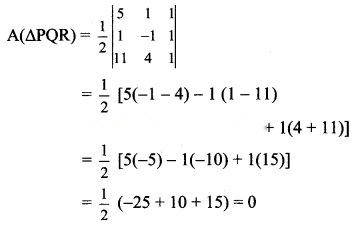
(ii) Here, P(x1, y1) = P(5, 1)
Q(x2, y2) = Q(1, -1)
R(x3, y3) = R(11, 4)
If A(ΔPQR) = 0, then the points P, Q, R are collinear.

∴ The points P, Q, R are collinear.