Maharashtra State Board 11th Maths Solutions Chapter 4 Determinants and Matrices Miscellaneous Exercise 4(B)
(I) Select the correct option from the given alternatives.
Solution & Step-by-Step Answer:
(b) λ2 – 3λ – 4 = 0 Hint:

Solution & Step-by-Step Answer:
(c) Exactly three are defined Hint: A is of order 3 × 3, B is of order 3 × 2 and C is of order 3 × 1. (AB)TC is of order 2 × 1. CTC and (AB)T are of different orders. CTC (AB)T is not defined. CTAB is of order 1 × 2. ATABBTC is of order 3 × 1.
Solution & Step-by-Step Answer:
(a) A + B = B + A Hint: Matrix addition is commutative. ∴ A + B = B + A
Solution & Step-by-Step Answer:
(d) (-2, -1)
Solution & Step-by-Step Answer:
(a) ±3 Hint: |A3| = 125 |A|3 = 53 …….[∵ |An| = |A|n, n ∈ N] ∴ |A| = 5 α2 – 4 = 5 α2 = 9 ∴ α = ± 3
Solution & Step-by-Step Answer:
(c) x = 1, y = 2
Solution & Step-by-Step Answer:
(b)
Solution & Step-by-Step Answer:
(a) x = 3, y = 7, z = 1, w = 14
Solution & Step-by-Step Answer:
(a) (AB)T = ATBT Hint: (AB)T = BTAT
Solution & Step-by-Step Answer:
(c) Hint:

(II) Answer the following questions.
Solution & Step-by-Step Answer:


Solution & Step-by-Step Answer:

Solution & Step-by-Step Answer:
i. Given equations are 2A – B = …….(i)


Solution & Step-by-Step Answer:


Solution & Step-by-Step Answer:

Solution & Step-by-Step Answer:


Solution & Step-by-Step Answer:

Solution & Step-by-Step Answer:

Solution & Step-by-Step Answer:

Solution & Step-by-Step Answer:

Solution & Step-by-Step Answer:
ω is the complex cube root of unity. ω3 = 1 ω3 – 1 = 0 (ω – 1) (ω2 + ω + 1) = 0 ω = 1 or ω2 + ω + 1 = 0 But, ω is a complex number. 1 + ω + ω2 = 0 …….(i) AB + BA + A – 2B which is a null matrix.

Solution & Step-by-Step Answer:

Solution & Step-by-Step Answer:

Solution & Step-by-Step Answer:

Solution & Step-by-Step Answer:

Solution & Step-by-Step Answer:
(A + B)(A – B) = A2 – B2 A2 – AB + BA – B2 = A2 – B2 -AB + BA = 0 AB = BA By equality of matrices, we get 2 – 4x = -3x ∴ x = 2 and 2y = 2x y = x ∴ y = 2 ∴ x = 2, y = 2

Solution & Step-by-Step Answer:
We have to prove that (A + B). (A – B) ≠ A2 – B2 i.e., to prove that A(A – B) + B(A – B) ≠ A2 – B2 i.e., to prove that A2 – AB + BA – B2 ≠ A2 – B2 i.e., to prove that AB ≠ BA. ∴ AB ≠ BA

Solution & Step-by-Step Answer:
∴ A2 = I Multiplying throughout by A, we get A3 = A. I ∴ A3 = A

Solution & Step-by-Step Answer:
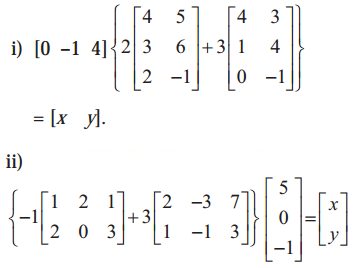
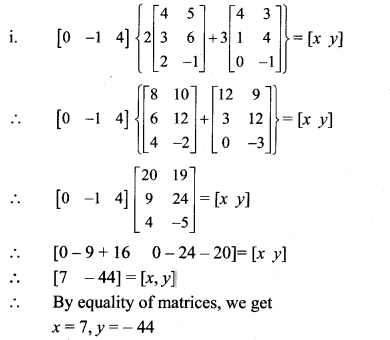
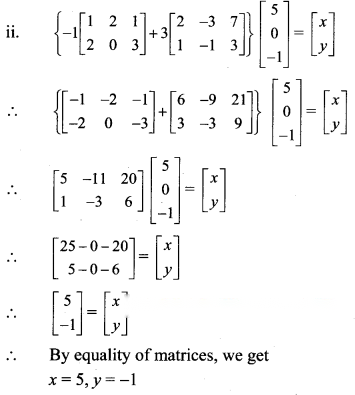
Solution & Step-by-Step Answer:
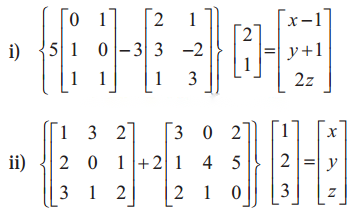
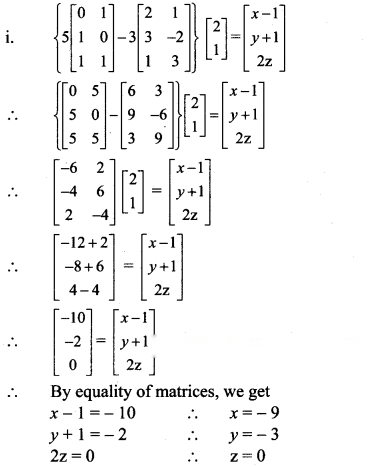
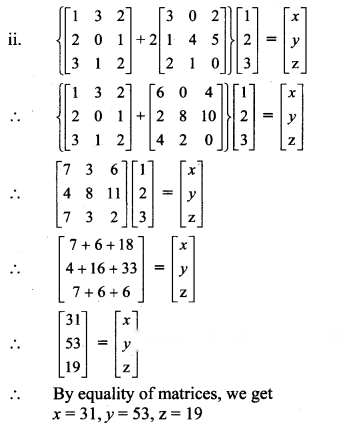
Solution & Step-by-Step Answer:
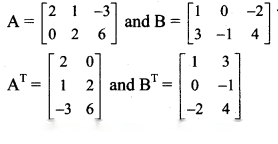
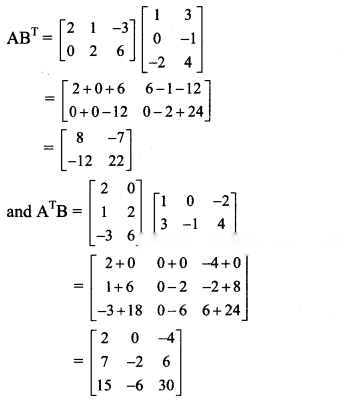
Solution & Step-by-Step Answer:
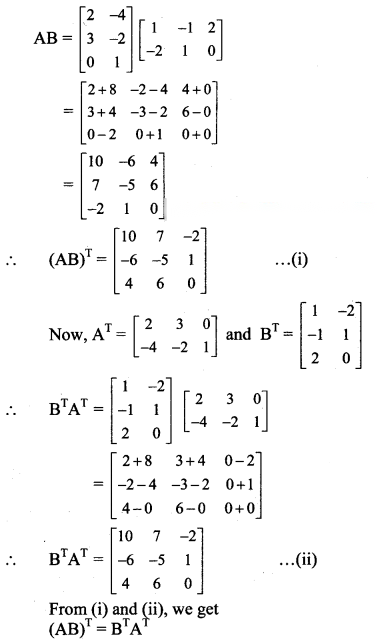
Solution & Step-by-Step Answer:
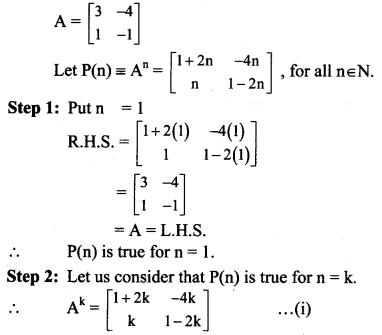

Solution & Step-by-Step Answer:

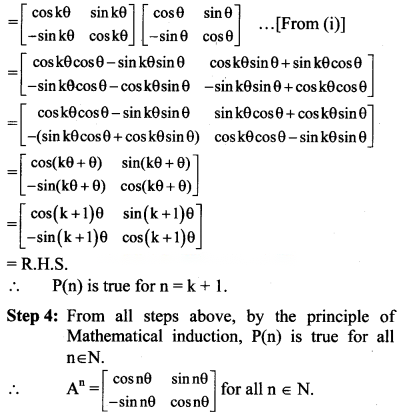
Solution & Step-by-Step Answer:
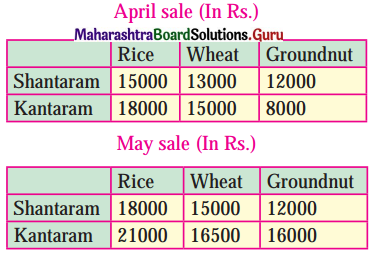
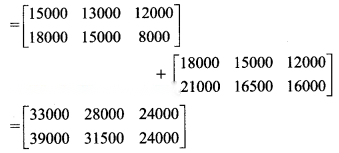
(i) Total sale for Shantaram: For rice = 15000 + 18000 = ₹ 33000. For wheat = 13000 + 15000 = ₹ 28000. For groundnut = 12000 + 12000 = ₹ 24000. Total sale for Kantaram: For rice = 18000 + 21000 = ₹ 39000 For wheat = 15000 + 16500 = ₹ 31500 For groundnut = 8000 + 16000 = ₹ 24000
Alternate method:
Matrix form
∴ The total sale of April and May of Shantaram in ₹ is ₹ 33000 (rice), ₹ 28000 (wheat), ₹ 24000 (groundnut), and that of Kantaram in ₹ is ₹ 39000(rice), ₹ 31500(wheat), and ₹ 24000 (groundnut).
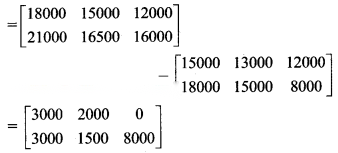
(ii) Increase in sale from April to May for Shantaram:
For rice = 18000 – 15000 = ₹ 3000
For wheat = 15000 – 13000 = ₹ 2000
For groundnut = 12000 – 12000 = ₹ 0
Increase in sale from April to May for Kantaram:
For rice = 21000 – 18000 = ₹ 3000
For wheat = 16500 – 15000 = ₹ 1500
For groundnut = 16000 – 8000 = ₹ 8000
Alternate method:
Matrix form
∴ The increase in sales for Shantaram from April to May in each crop is ₹ 3000 (rice), ₹ 2000(wheat), 0 (groundnut), and that for Kantaram is ₹ 3000 (rice), ₹ 1500 (wheat), and ₹ 8000 (groundnut).