Maharashtra State Board 11th Maths Solutions Chapter 5 Straight Line Ex 5.1
Solution & Step-by-Step Answer:
Let P(x, y) be any point on the required locus. Given, A(1, 3), B(2, 1) and PA = PB ∴ PA2 = PB2 ∴ (x – 1)2 + ( y – 3)2 = (x – 2)2 + (y – 1)2 ∴ x2 – 2x + 1 + y2 – 6y + 9 = x2 – 4x + 4 + y2 – 2y + 1 -2x – 6y + 10 = -4x – 2y + 5 ∴ 2x – 4y + 5 = 0 ∴ The required equation of locus is 2x – 4y + 5 = 0.
Solution & Step-by-Step Answer:
Let P(x, y) be any point on the required locus. P is equidistant from A(- 5, 2) and B(4, 1). ∴ PA = PB ∴ PA2 = PB2 ∴ (x + 5)2 + (y – 2)2 = (x – 4)2 + (y – 1)2 ∴ x2 + 10x + 25 + y2 — 4y + 4 = x2 – 8x + 16 + y2 – 2y + 1 ∴ 10x – 4y + 29 = -8x – 2y + 17 ∴ 18x – 2y + 12 = 0 ∴ 9x – y + 6 = 0 The required equation of locus is 9x -y + 6 = 0.
Solution & Step-by-Step Answer:
Let P(x, y) be any point on the required locus. Given, A(2, 0), B(0, 3) and AP = 2BP ∴ AP2 = 4BP2 ∴ (x – 2)2 + (y – 0)2 = 4[(x – 0)2 + (y – 3)2] ∴ x2 – 4x + 4 + y2 = 4(x2 + y2 – 6y + 9) x2 – 4x + 4 + y2 = 4x2 + 4y2 – 24y + 36 ∴ 3x2 + 3 y2 + 4x – 24y + 32 = 0 ∴ The required equation of locus is 3x2 + 3y2 + 4x – 24y + 32 = 0. [Note: Answer given in the textbook, is ‘3x2 + 3y2 + 4x + 24y + 32 = O’. However, as per our calculation it is ‘3x2 + 3y2 + 4x – 24y + 32 = 0’.]
Solution & Step-by-Step Answer:
Let P(x, y) be any point on the required locus. Given, A(4,1), B(5,4) and PA2 = 3PB2 ∴ (x – 4)2 + (y – 1)2 = 3[(x – 5)2 + (y – 4)2] ∴ x2 – 8x + 16 + y2 – 2y + 1 = 3(x2 – 10x + 25 + y2 – 8y + 16) ∴ x2 – 8x + y2 – 2y + 17 = 3x2 -30x + 75 + 3y2 – 24y + 48 ∴ 2x2 + 2y2 – 22x – 22y + 106 = 0 ∴ x2 + y2 – 11x – 11y + 53 = 0 ∴ The required equation of locus is x2 + y2 – 11x – 11y + 53 = 0.
Solution & Step-by-Step Answer:
Let P(x, y) be any point on the required locus. Given, A(2,4), B(5, 8) and PA2-PB2 = 13 ∴ [(x -2)2 + (y – 4)2] – [(x -5)2 + (y- 8)2] = 13 ∴ (x2 – 4x + 4 + y2 – 8y + 16) – (x2 – 10x + 25 + y2 – 16y + 64) =13 ∴ x2 – 4x+ y2 – 8y + 20 – x2 + 10x – y2 + 16y – 89 = 13 ∴ 6x + 8y- 69 = 13 ∴ 6x + 8y – 82 = 0 ∴ 3x + 4y – 41 = 0 ∴ The required equation of locus is 3x + 4y- 41 = 0.
Solution & Step-by-Step Answer:
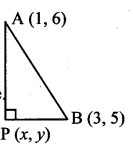
Let P(x, y) be any point on the required locus. Given, A(l, 6) and B(3, 5), ∠APB = 90° ∴ ΔAPB is a right angled triangle, By Pythagoras theorem, AP2 + PB2 = AB2 P (x,y) ∴ [(x – 1)2 + (y – 6)2] + [(x – 3)2 + (y – 5)2] = (1 – 3)2 + (6 -5)2 ∴ x2 — 2x + 1 + y2 — 12y + 36 + x2 – 6x + 9 + y2 – 10y + 25 = 4 + 1 ∴ 2x2 + 2y2 – 8x – 22y + 66 = 0 ∴ x2 + y2 – 4x – 11y + 33 = 0 ∴ The required equation of locus is x2 + y2 – 4x – 11y + 33 = 0. [Note: Answer given in the textbook is ‘3x2 + 4y2 – 4x – 11y + 33 = 0’. However, as per our calculation it is ‘x2 + y2 – 4x – 11y + 33 = O
Solution & Step-by-Step Answer:
Origin is shifted to (2, 3) = (h, k) Let the new co-ordinates be (X, Y). x = X + handy = Y + k x = X + 2 andy = Y + 3 …(i)
i. Given, A(x, y) = A( 1, 3)
x = X + 2 andy = Y + 3 …[From(i)]
∴ 1 = X + 2 and 3 = Y + 3 X = – 1 and Y = 0
∴ The new co-ordinates of point A are (- 1,0).
ii. Given, B(x, y) = B(2, 5)
x = X + 2 and y = Y + 3 …[From(i)]
∴ 2 = X + 2 and 5 = Y + 3
∴ X = 0 and Y = 2
∴ The new co-ordinates of point B are (0, 2).
Solution & Step-by-Step Answer:
Origin is shifted to (1,3) = (h, k) Let the new co-ordinates be (X, Y). x = X + h andy = Y + k ∴ x = X+1 andy = Y + 3 …(i)
i. Given, C(X, Y) = C(5, 4)
x = X +1 andy = Y + 3 …[From(i)]
∴ x = 5 + 1 = 6 andy = 4 + 3 = 7
∴ The old co-ordinates of point C are (6, 7).
ii. Given, D(X, Y) = D(3, 3)
x = X + 1 andy = Y + 3 …[From(i)]
∴ x = 3 + 1 = 4 and y = 3 + 3 = 6
∴ The old co-ordinates of point D are (4, 6).
Solution & Step-by-Step Answer:
Let the origin be shifted to (h, k). Given, A(x, y) = A(5,14), B(X, Y) = B(8, 3) Since x = X + h andy = Y + k, 5 = 8 + hand 14 = 3 + k, ∴ h = – 3 and k = 11 The co-ordinates of the point, where the origin is shifted are (- 3, 11).
Solution & Step-by-Step Answer:
Given, (h,k) = (2,2) Let (X, Y) be the new co-ordinates of the point (x,y). ∴ x = X + handy = Y + k ∴ x = X + 2 andy = Y + 2 i. Substituting the values of x and y in the equation 3x -y + 2 = 0, we get 3(X + 2) – (Y + 2) + 2 = 0 ∴ 3X + 6-Y-2 + 2 = 0 ∴ 3 X – Y + 6 = 0, which is the new equation of locus.
ii. Substituting the values of x and y in the equation
x2+ y2– 3x = 7, we get
(X + 2)2+ (Y + 2)2– 3(X + 2) = 7
∴ X2+ 4X + 4 + Y2+ 4Y + 4 – 3X – 6 = 7
∴ X2+ Y2+ X + 4Y – 5 = 0, which is the new
equation of locus.
iii; Substituting the values of x and y in the equation xy – 2x – 2y + 4 = 0, we get
(X + 2) (Y + 2) – 2(X + 2) – 2(Y + 2) + 4 = 0
∴ XY + 2X + 2Y + 4 – 2X – 4-2Y- 4 + 4 = 0
∴ XY = 0, which is the new equation of locus.
iv. Substituting the values of x and y in the equation y2– 4x – 4y + 12 = 0, we get
(Y + 2)2– 4(X + 2) – 4(Y + 2) + 12 = 0
∴ Y2+ 4Y + 4 – 4X – 8 – 4Y -8 + 12 = 0
∴ Y2– 4X = 0, which is the new equation of locus.