Latest Maharashtra State Board (SSC & HSC) 2026-27 Syllabus Digest & Solutions Updated!
Class 11 (FYJC / HSC)Mathematics & Statistics2026-27 Syllabus

Chapter 9 Probability Ex 9.1 Solutions

Complete Maharashtra State Board Balbharati & Yuvakbharati textbook solutions for Chapter 9 Probability Ex 9.1. Step-by-step solved exercises, numerical problems, and digest answers.

17 Solved Questions4 Diagrams3850 words

Maharashtra State Board 11th Maths Solutions Chapter 9 Probability Ex 9.1

Question 1 Maharashtra Board Solution
There are four pens: Red, Green, Blue, and Purple in a desk drawer of which two pens are selected at random one after the other with replacement. State the sample space and the following events. (a) A : Select at least one red pen. (b) B : Two pens of the same colour are not selected.
Solution & Step-by-Step Answer:
The drawer contains 4 pens out of which one is red (R), one is green (G), one is blue (B) and the other one is purple (P). From this drawer, two pens are selected one after the other with replacement. ∴ The sample space S is given by S = {RR, RG, RB, RP, GR, GG, GB, GP, BR, BG, BB, BP, PR, PG, PB, PP} (a) A : Select at least one red pen. At least one means one or more than one. ∴ A = {RR, RG, RB, RP, GR, BR, PR}

(b) B : Two pens of the same colour are not selected.
B = {RG, RB, RP, GR, GB, GP, BR, BG, BP, PR, PG, PB}

Question 2 Maharashtra Board Solution
A coin and a die are tossed simultaneously. Enumerate the sample space and the following events. (a) A : Getting a tail and an odd number. (b) B : Getting a prime number. (c) C : Getting head and a perfect square.
Solution & Step-by-Step Answer:
When a coin and a die are tossed simultaneously, the sample space S is given by S = {(H, 1), (H, 2), (H, 3), (H, 4), (H, 5), (H, 6), (T, 1), (T, 2), (T, 3), (T, 4), (T, 5), (T, 6)} (a) A : Getting a tail and an odd number. ∴ A = {(T, 1), (T, 3), (T, 5)}

(b) B : Getting a prime number.
∴ B = {(H, 2), (H, 3), (H, 5), (T, 2), (T, 3), (T, 5)}

(c) C : Getting a head and a perfect square.
∴ C = {(H, 1), (H, 4)}

Question 3 Maharashtra Board Solution
Find n(S) for each of the following random experiments. (a) From an urn containing 5 gold and 3 silver coins, 3 coins are drawn at random. (b) 5 letters are to be placed into 5 envelopes such that no envelope is empty. (c) 6 books of different subjects are arranged on a shelf. (d) 3 tickets are drawn from a box containing 20 lottery tickets.
Solution & Step-by-Step Answer:
(a) There are 5 gold and 3 silver coins, i.e., 8 coins. 3 coins can be drawn from these 8 coins in ways. ∴ n(s) =

(b) 5 letters have to be placed in 5 envelopes in such a way that no envelope is empty.
∴ The first letter can be placed into 5 envelopes in 5 different ways, the second letter in 4 ways.
Similarly, the third, fourth and fifth letters can be placed in 3 ways, 2 ways and 1 way, respectively.
∴ Total number of ways = 5!
= 5 × 4 × 3 × 2 × 1
= 120
∴ n(S) = 120

(c) 6 books can be arranged on a shelf in = 6! ways.
∴ n(S) = 6! = 6 × 5 × 4 × 3 × 2 × 1 = 720

(d) 3 tickets are drawn at random from 20 tickets.
∴ 3 tickets can be selected in ways.
∴ n(S) = = 1140

Question 4 Maharashtra Board Solution
Two fair dice are thrown. State the sample space and write the favourable outcomes for the following events. (a) A : Sum of numbers on two dice is divisible by 3 or 4. (b) B : The sum of numbers on two dice is 7. (c) C : Odd number on the first die. (d) D : Even number on the first die. (e) Check whether events A and B are mutually exclusive and exhaustive. (f) Check whether events C and D are mutually exclusive and exhaustive.
Solution & Step-by-Step Answer:
When two dice are thrown, the sample space is S = {(1, 1), (1, 2), (1, 3), (1, 4), (1, 5), (1, 6), (2, 1), (2, 2), (2, 3), (2, 4), (2, 5), (2, 6), (3, 1), (3, 2), (3, 3), (3, 4), (3, 5), (3, 6), (4, 1), (4, 2), (4, 3), (4, 4), (4, 5), (4, 6), (5, 1), (5, 2), (5, 3), (5, 4), (5, 5), (5, 6), (6, 1), (6, 2), (6, 3), (6,4), (6, 5), (6, 6)} ∴ n(S) = 36 (a) A: Sum of the numbers on two dice is divisible by 3 or 4. ∴ A = {(1, 2), (1, 3), (1, 5), (2, 1), (2, 2), (2, 4), (2, 6), (3, 1), (3, 3), (3, 5), (3, 6), (4, 2), (4, 4), (4, 5), (5, 1), (5, 3), (5, 4), (6, 2), (6, 3), (6, 6)}

(b) B: Sum of the numbers on two dice is 7.
∴ B = {(1, 6), (2, 5), (3, 4), (4, 3), (5, 2), (6, 1)}

(c) C: Odd number on the first die.
∴ C = {(1, 1), (1, 2), (1, 3), (1, 4), (1, 5), (1, 6), (3, 1), (3, 2), (3, 3), (3, 4), (3, 5), (3, 6), (5, 1), (5, 2), (5, 3), (5, 4), (5, 5), (5, 6)}

(d) D: Even number on the first die.
∴ D = {(2, 1), (2, 2), (2, 3), (2, 4), (2, 5), (2, 6), (4, 1), (4, 2), (4, 3), (4, 4), (4, 5), (4, 6), (6, 1), (6, 2), (6, 3), (6, 4), (6, 5), (6, 6)}

(e) A and B are mutually exclusive events as A ∩ B = Φ.
A ∪ B = {(1, 2), (1, 3), (1, 5), (1, 6), (2, 1), (2, 2), (2, 4), (2, 5), (2, 6), (3, 1), (3, 3), (3, 4), (3, 5), (3, 6), (4, 2), (4, 3), (4, 4), (4, 5), (5, 1), (5, 2), (5, 3), (5, 4), (6, 1), (6, 2), (6, 3), (6, 6)} ≠ S
∴ A and B are not exhaustive events as A ∪ B ≠ S.

(f) C and D are mutually exclusive events as C ∩ D = Φ.
C ∪ D = {(1, 1), (1, 2), (1, 3), (1, 4), (1, 5), (1, 6), (2, 1), (2, 2), (2, 3), (2, 4), (2, 5), (2, 6), (3, 1), (3, 2), (3, 3), (3, 4), (3, 5), (3, 6), (4, 1), (4, 2), (4, 3), (4, 4), (4, 5), (4, 6), (5, 1), (5, 2), (5, 3), (5, 4), (5, 5), (5, 6), (6, 1), (6, 2), (6, 3), (6, 4), (6, 5), (6, 6)} = S
∴ C and D are exhaustive events.

Question 5 Maharashtra Board Solution
A bag contains four cards marked as 5, 6, 7, and 8. Find the sample space if two cards are drawn at random (a) with replacement. (b) without replacement.
Solution & Step-by-Step Answer:
The bag contains 4 cards marked 5, 6, 7, and 8. Two cards are to be drawn from this bag. (a) If the two cards are drawn with replacement, then the sample space is S = {(5, 5), (5, 6), (5, 7), (5, 8), (6, 5), (6, 6), (6, 7), (6, 8), (7, 5), (7, 6), (7, 7), (7, 8), (8, 5), (8, 6), (8, 7), (8, 8)}

(b) If the two cards are drawn without replacement, then the sample space is
S = {(5, 6), (5, 7), (5, 8), (6, 5), (6, 7), (6, 8), (7, 5), (7, 6), (7, 8), (8, 5), (8, 6), (8, 7)}

Question 6 Maharashtra Board Solution
A fair die is thrown two times. Find the probability that (a) the sum of the numbers on them is 5. (b) the sum of the numbers on them is at least 8. (c) the first throw gives a multiple of 2 and the second throw gives a multiple of 3. (d) product of numbers on them is 12.
Solution & Step-by-Step Answer:
When two dice are thrown, the sample space is S = {(1, 1), (1, 2), (1, 3), (1, 4), (1, 5), (1, 6), (2, 1), (2, 2), (2, 3), (2, 4), (2, 5), (2, 6), (3, 1), (3, 2), (3, 3), (3, 4), (3, 5), (3, 6), (4, 1), (4, 2), (4, 3), (4, 4), (4, 5), (4, 6), (5, 1), (5, 2), (5, 3), (5, 4), (5, 5), (5, 6), (6, 1), (6, 2), (6, 3), (6,4), (6, 5), (6, 6)} ∴ n(S) = 36 (a) Let event A: Sum of the numbers on uppermost face is 5. ∴ A = {(1, 4), (2, 3), (3, 2), (4, 1)} ∴ n(A) = 4 ∴ P(A) =

(b) Let event B: Sum of the numbers on uppermost face is at least 8 (i.e., 8 or more than 8)
∴ B = {(2, 6), (3, 5), (3, 6), (4, 4), (4, 5), (4, 6), (5, 3), (5, 4), (5, 5), (5, 6), (6, 2), (6, 3), (6, 4), (6, 5), (6, 6)}
∴ n(B) = 15
∴ P(B) =

(c) Let event C: First throw gives a multiple of 2 and second throw gives a multiple of 3.
∴ C = {(2, 3), (2, 6), (4, 3), (4, 6), (6, 3), (6, 6)}
∴ n(C) = 6
∴ P(C) =

(d) Let event D: The product of the numbers on uppermost face is 12.
∴ D = {(2, 6), (3, 4), (4, 3), (6, 2)}
∴ n(D) = 4
∴ P(D) =

Question 7 Maharashtra Board Solution
Two cards are drawn from a pack of 52 cards. Find the probability that (a) one is a face card and the other is an ace card. (b) one is a club and the other is a diamond. (c) both are from the same suit. (d) both are red cards. (e) one is a heart card and the other is a non-heart card.
Solution & Step-by-Step Answer:
Two cards can be drawn from a pack of 52 cards in ways. ∴ n(S) =

(a) Let event A: Out of the two cards drawn, one is a face card and the other is an ace card.
There are 12 face cards and 4 ace cards in a pack of 52 cards.
∴ One face card can be drawn from 12 face cards in ways and one ace card can be drawn from 4 ace cards in ways.
∴ n(A) =
∴ P(A) =

(b) Let event B: Out of the two cards drawn, one is club and the other is a diamond card.
There are 13 club cards and 13 diamond cards.
∴ One club card can be drawn from 13 club cards in ways and one diamond card can be drawn from 13 diamond cards in ways.
∴ n(B) =
∴ P(B) =

(c) Let event C: Both the cards drawn are of the same suit.
A pack of 52 cards consists of 4 suits each containing 13 cards.
∴ 2 cards can be drawn from the same suit in ways.
∴ n(C) =
∴ P(C) =

(d) Let event D: Both the cards drawn are red.
There are 26 red cards in the pack of 52 cards.
∴ 2 cards can be drawn from them in ways.
∴ n(D) =
∴ P(D) =

(e) Let event E: Out of the two cards drawn, one is heart and other is non-heart.
There are 13 heart cards in a pack of 52 cards, i.e., 39 cards are non-heart.
∴ One heart card can be drawn from 13 hdart cards in ways and one non-heart card can be drawn from 39 cards in ways.
∴ n(E) =
∴ P(E) =

Question 8 Maharashtra Board Solution
Three cards are drawn from a pack of 52 cards. Find the chance that (a) two are queen cards and one is an ace card. (b) at least one is a diamond card. (c) all are from the same suit. (d) they are a king, a queen, and a jack.
Solution & Step-by-Step Answer:
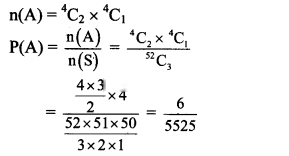
3 cards can be drawn from a pack of 52 cards in ways. ∴ n(S) =

(a) Let event A: Out of the three cards drawn, 2 are queens and 1 is an ace card.
There are 4 queens and 4 aces in a pack of 52 cards.
∴ 2 queens can be drawn from 4 queens in ways and 1 ace can be drawn out of 4 aces in ways.
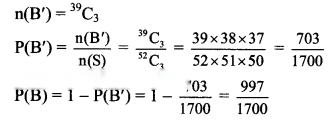
(b) Let event B: Out of the three cards drawn, at least one is a diamond.
∴ B’ is the event that all 3 cards drawn are non-diamond cards.
In a pack of 52 cards, there are 39 non-diamond cards.
∴ 3 non-diamond cards can be drawn in ways.
(c) Let event C: All the cards drawn are from the same suit.
A pack of 52 cards consists of 4 suits each containing 13 cards.
∴ 3 cards can be drawn from the same suit in ways.

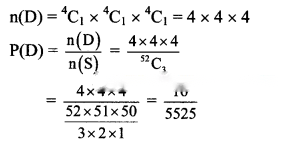
(d) Let event D: The cards drawn are a king, a queen, and a jack.
There are 4 kings, 4 queens and 4 jacks in a pack of 52 cards.
∴ 1 king can be drawn from 4 kings in ways,
1 queen can be drawn from 4 queens in ways and
1 jack can be drawn from 4 jacks in ways.
Question 9 Maharashtra Board Solution
From a bag containing 10 red, 4 blue, and 6 black balls, a ball is drawn at random. Find the probability of drawing (a) a red bail. (b) a blue or black ball. (c) not a black ball.
Solution & Step-by-Step Answer:
The bag contains 10 red, 4 blue, and 6 black balls, i.e., 10 + 4 + 6 = 20 balls. One ball can be drawn from 20 balls in ways. ∴ n(S) = = 20

(a) Let event A: Ball drawn is red.
There are total 10 red balls.
∴ 1 red ball can be drawn from 10 red balls in ways.
∴ n(A) = = 10
∴ P(A) =

(b) Let event B: The ball drawn is blue or black.
There are 4 blue and 6 black balls.
∴ 1 blue ball can be drawn from 4 blue balls in ways
or 1 black ball can be drawn from 6 black balls in ways.
∴ n(B) = + = 4 + 6 = 10
∴ P(B) =

(c) Let event C: Ball drawn is not black,
i.e., ball drawn is red or blue.
There are total 14 red and blue balls.
∴ 1 ball can be drawn from 14 balls in ways.
∴ n(C) = = 14
∴ P(C) =

Question 10 Maharashtra Board Solution
A box contains 75 tickets numbered 1 to 75. A ticket is drawn at random from the box. Find the probability that, (a) number on the ticket is divisible by 6. (b) the number on the ticket is a perfect square. (c) the number on the ticket is prime. (d) the number on the ticket is divisible by 3 and 5.
Solution & Step-by-Step Answer:
The box contains 75 tickets numbered 1 to 75. ∴ 1 ticket can be drawn from the box in = 75 ways. ∴ n(S) = 75

(a) Let event A: Number on the ticket is divisible by 6.
∴ A = {6, 12, 18, 24, 30, 36, 42, 48, 54, 60, 66, 72}
∴ n(A) = 12
∴ P(A) =

(b) Let event B: Number on the ticket is a perfect square.
∴ B = (1, 4, 9, 16, 25, 36, 49, 64}
∴ n(B) = 8
∴ P(B) =

(c) Let event C: Number on the ticket is a prime number.
∴C = {2, 3, 5, 7, 11, 13, 17, 19, 23, 29, 31, 37, 41, 43, 47, 53, 59, 61, 67, 71, 73}

(d) Let event D: Number on the ticket is divisible by 3 and 5,
i.e., divisible by L.C.M. of 3 and 5,
i.e., 15.
∴D = {15, 30, 45, 60, 75}
∴ n(D) = 5
∴ P(D) =

Question 11 Maharashtra Board Solution
What is the chance that a leap year, selected at random, will contain 53 Sundays?
Solution & Step-by-Step Answer:
A leap year consists of 366 days. It has 52 complete weeks and two more days. These two days can be {(Sun, Mon), (Mon, Tue), (Tue, Wed), (Wed, Thur), (Thur, Fri), (Fri, Sat), (Sat, Sun)}. ∴ n(S) = 7 Let event E : There are 53 Sundays. ∴ E = {(Sun, Mon), (Sat, Sun)} ∴ n(E) = 2 ∴ P(E) =
Question 12 Maharashtra Board Solution
Find the probability of getting both red balls, when from a bag containing 5 red and 4 black balls, two balls are drawn, (i) with replacement (ii) without replacement
Solution & Step-by-Step Answer:
The bag contains 5 red and 4 black balls, i.e., 5 + 4 = 9 balls. (i) 2 balls can be drawn from 9 balls with replacement in ways. ∴ n(S) = = 9 × 9 = 81 Let event A: Balls drawn are red. 2 red balls can be drawn from 5 red balls with replacement in ways. ∴ n(A) = = 5 × 5 = 25 ∴ P(A) =

(ii) 2 balls can be drawn from 9 balls without replacement in ways.
∴ n(S) = = 9 × 8 = 72
2 red balls can be drawn from 5 red balls without replacement in ways.
∴ n(B) = = 5 × 4 = 20
∴ P(B) =

Question 13 Maharashtra Board Solution
A room has three sockets for lamps. From a collection of 10 bulbs of which 6 are defective. At night a person selects 3 bulbs, at random and puts them in sockets. What is the probability that (i) room is still dark. (ii) the room is lit.
Solution & Step-by-Step Answer:
Total number of bulbs = 10 Number of defective bulbs = 6 ∴ Number of non-defective bulbs = 4 3 bulbs can be selected out of 10 bulbs in ways. ∴ n(S) =

(i) Let event A: The room is dark.
For event A to happen the bulbs should be selected from the 6 defective bulbs. This can be done in ways.
∴ n(A) =
∴ P(A) =

(ii) Let event A’: The room is lit.
∴ P(Room is lit) = 1 – P(Room is not lit)
∴ P(A’) = 1 – P(A) = 1 – =

Question 14 Maharashtra Board Solution
Letters of the word MOTHER are arranged at random. Find the probability that in the arrangement (a) vowels are always together. (b) vowels are never together. (c) O is at the beginning and end with T. (d) starting with a vowel and ending with a consonant.
Solution & Step-by-Step Answer:
There are 6 letters in the word MOTHER. These letters can be arranged among themselves in = 6! ways. ∴ n(S) = 6! (a) Let event A: Vowels are always together. The word MOTHER consists of 2 vowels (O, E) and 4 consonants (M, T, H, R). 2 vowels can be arranged among themselves in = 2! ways. Let us consider 2 vowels as one group. This one group with 4 consonants can be arranged in = 5! ways. ∴ n(A) = 2! × 5! ∴ P(A) =

(b) Let event B: Vowels are never together.
4 consonants create 5 gaps, in which vowels are arranged.
Consider the following arrangement of consonants
_C_C_C_C_
2 vowels can be arranged in 5 gaps in ways.
Also 4 consonants can be arranged among themselves in = 4! ways.
∴ n(B) = 4! ×
∴ P(B) =

(iii) Let event C: Word begin with O and end with T.
Thus first and last letters can be arranged in one way each and the remaining 4 letters can be arranged in = 4! ways
∴ n(C) = 4! × 1 × 1 = 4!
∴ P(C) =

(d) Let event D: Word starts with a vowel and ends with a consonant.
There are 2 vowels and 4 consonants in the word MOTHER.
∴ The first place can be arranged in 2 different ways and the last place can be arranged in 4 different ways.
Now, the remaining 4 letters (3 consonants and 1 vowel) can be arranged in = 4! ways.
∴ n(D) = 2 × 4 × 4!
∴ P(D) =

Question 15 Maharashtra Board Solution
4 letters are to be posted in 4 post boxes. If any number of letters can be posted in any of the 4 post boxes, what is the probability that each box contains only one letter?
Solution & Step-by-Step Answer:
There are 4 letters and 4 post boxes. Since any number of letters can be posted in all 4 post boxes, so each letter can be posted in different ways. ∴ n(S) = 4 × 4 × 4 × 4 Let event A: Each box contains only one letter. ∴ 1st letter can be posted in 4 different ways. Since each box contains only one letter, 2nd letter can be posted in 3 different ways. Similarly, 3rd and 4th letters can be posted in 2 different ways and 1 way respectively. ∴ n(A) = 4 × 3 × 2 × 1 ∴ P(A) =
Question 16 Maharashtra Board Solution
15 professors have been invited for a round table conference by the Vice-chancellor of a university. What is the probability that two particular professors occupy the seats on either side of the Vice-chancellor during the conference?
Solution & Step-by-Step Answer:
Since a Vice-chancellor invited 15 professors for a round table conference, there were all 16 persons in the conference. These 16 persons can be arranged among themselves around a round table in (16 – 1)! = 15! ways. ∴ n(S) = 15! Let event A: Two particular professors be seated on either side of the Vice-chancellor. Those two particular persons sit on either side of a Vice chancellor in = 2! ways. Thus the remaining 13 persons can be arranged in = 13! ways. ∴ n(A) = 13! 2! ∴ P(A) =
Question 17 Maharashtra Board Solution
A bag contains 7 black and 4 red balls. If 3 balls are drawn at random, find the probability that (i) all are black. (ii) one is black and two are red.
Solution & Step-by-Step Answer:
The bag contains 7 black and 4 red balls, i.e., 7 + 4 = 11 balls. ∴ 3 balls can be drawn out of 11 balls in ways. ∴ n(S) = (i) Let event A: All 3 balls drawn are black. There are 7 black balls. ∴ 3 black balls can be drawn from 7 black balls in ways. ∴ n(A) = ∴ P(A) =

(ii) Let event B: Out of 3 balls drawn, one is black and two are red.
There are 7 black and 4 red balls.
∴ One black ball can be drawn from 7 black balls in ways and 2 red balls can be drawn from 4 red balls in ways.
∴ n(A) =
∴ P(A) =