Maharashtra State Board 11th Physics Solutions Chapter 3 Motion in a Plane
1. Choose the correct option.
2. Answer the following questions.
Vectors
Velocity, displacement, force, acceleration, angular velocity (pseudo vector).
Instantaneous velocity:
In case of uniform rectilinear motion, i.e., when an object is moving with constant velocity along a straight line, the average and instantaneous velocity remain same.

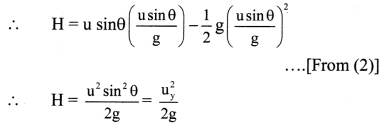
Expression for maximum height of a projectile:
The maximum height H reached by the projectile is the distance travelled along the vertical (y) direction in time tA.
Substituting sy= H and t = tain equation (1),
we have,
H = (u sin θ)tA– gtA2
This equation represents maximum height of projectile.
Expression for centripetal force on a particle undergoing uniform circular motion:
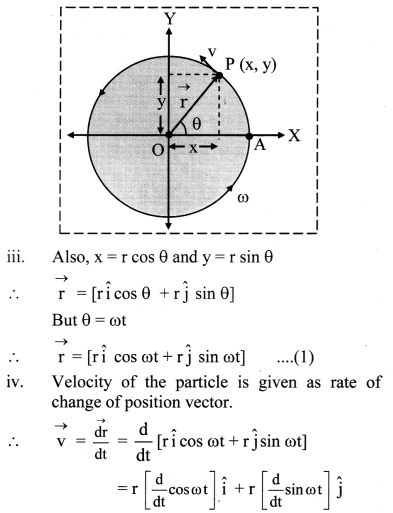
i) Suppose a particle is performing U.C.M in anticlockwise direction.
The co-ordinate axes are chosen as shown in the figure.
Let,
A = initial position of the particle which lies on positive X-axis
P = instantaneous position after time t
θ = angle made by radius vector
ω = constant angular speed
= instantaneous position vector at time t
ii) From the figure,
where, and are unit vectors along X-axis and Y-axis respectively.
Negative sign shows that direction of acceleration is opposite to the direction of position vector. Equation (3) is the centripetal acceleration.
vii) Magnitude of centripetal acceleration is given by a = ω2r

viii) The force providing this acceleration should also be along the same direction, hence centripetal.
∴ = m = -mω2
This is the expression for the centripetal force on a particle undergoing uniform circular motion.
ix) Magnitude of F = mω2r = = mωv
[Note: The definition of angular velocity is not mentioned in this chapter but is in Ch.2 Mathematical Methods.]
3. Solve the following problems.
Formulae: i) v2– u2= 2as
ii) v = u + at
Calculation: From formula (i),

i) Average retardation of the car is ms2(in magnitude).
ii) Time taken by the car to come to rest is 6 s.

Question 5
Maharashtra Board Solution
A man throws a ball to maximum horizontal distance of 80 meters. Calculate the maximum height reached.
Solution & Step-by-Step Answer:
Given: R = 80m To find: Maximum height reached (Hmax) Formula: Rmax = 4Hmax Calculation: From formula, ∴ Hmax = = 20 m The maximum height reached by the ball is 20m.
Question 6
Maharashtra Board Solution
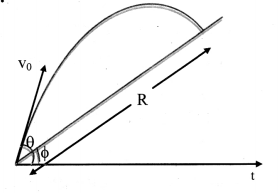
A particle is projected with speed v0 at angle θ to the horizontal on an inclined surface making an angle Φ (Φ < θ) to the horizontal. Find the range of the projectile along the inclined surface.
Solution & Step-by-Step Answer:
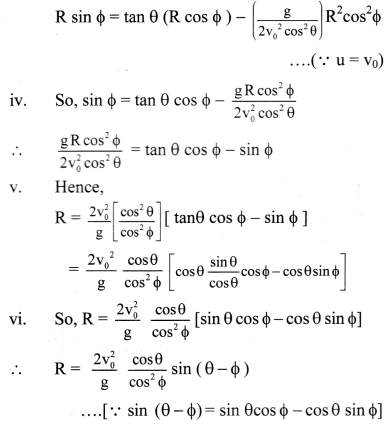
i) The equation of trajectory of projectile is given by, y(tan θ)x – ()x2 …………..(1)
ii) In this case to find R substitute, iii) From equations (1), (2) and (3),
Question 7
Maharashtra Board Solution
A metro train runs from station A to B to C. It takes 4 minutes in travelling from station A to station B. The train halts at station B for 20 s. Then it starts from station B and reaches station C in the next 3 minutes. At the start, the train accelerates for 10 sec to reach the constant speed of 72 km/hr. The train moving at the constant speed is brought to rest in 10 sec. at next station. (i) Plot the velocity-time graph for the train travelling from station A to B to C. (ii) Calculate the distance between stations A, B, and C.
Solution & Step-by-Step Answer:
The metro train travels from station A to station B in 4 minutes = 240 s. The trains halts at station B for 20 s. The train travels from station B’ to station C in 3 minutes= 180 s. ∴ Total time taken by the metro train in travelling from station A to B to C = 240 + 20 + 180 = 440 s. At start, the train accelerates for 10 seconds to reach a constant speed of 72 km/hr = 20 m/s. The train moving is brought to rest in 10 s at next station. The velocity-time graph for the train travelling from station A to B to C is as follows: Distance travelled by the train from station A to station B = Area of PQRS = A ( △PQQ’) A (☐QRR’) + A(SRR’) = ( × 10 × 20 + (220 × 20) + ( 10 × 20) = 100 + 4400 + 100 = 4600m = 4.6km
Distance travelled by the train from station B’ to station C
Question 8
Maharashtra Board Solution
A train is moving eastward at 10 m/sec. A waiter is walking eastward at 1.2m/sec; and a fly is flying toward the north across the waiter’s tray at 2 m/s. What is the velocity of the fly relative to Earth.
Solution & Step-by-Step Answer:
Given
Question 9
Maharashtra Board Solution
A car moves in a circle at the constant speed of 50 m/s and completes one revolution in 40 s. Determine the magnitude of the acceleration of the car.
Solution & Step-by-Step Answer:
Given: v = 50 m/s, t = 40 s, s = 2πr To find: acceleration (a) Formulae: i) v = ii) a = Calculation: From formula (i), 50 = ∴ r = ∴ r = cm From formula (ii), a = ∴ a = = 7.85 m/s2 The magnitude of acceleration of the car is 7.85 m/s.
Alternate method:
Question 10
Maharashtra Board Solution
A particle moves in a circle with constant speed of 15 m/s. The radius of the circle is 2 m. Determine the centripetal acceleration of the particle.
Solution & Step-by-Step Answer:
Given: v = 15 m/s, r = 2m To find: Centripetal acceleration (a) Formula: a = Calculation: From formula, a = ∴ a = 112.5m/s2 The centripetal acceleration of the particle is 112.5 m/s2.
Question 11
Maharashtra Board Solution
A projectile is thrown at an angle of 30° to the horizontal. What should be the range of initial velocity (u) so that its range will be between 40m and 50 m? Assume g = 10 m s-2.
Solution & Step-by-Step Answer:
Given: 40 ≤ R ≤ 50, θ = 300, g = 10 m/s2 To find: Range of initial velocity (u) Formula: R = Calculation: From formula, The range of initial velocity, ∴ 21.49m/s ≤ u ≤ 24.03m/s The range of initial velocity should be between 21.49 m/s ≤ u ≤ 24.03 m/s.
11th Physics Digest Chapter 3 Motion in a Plane Intext Questions and Answers Can you recall? (Textbook Page No. 30)
Question 1
Maharashtra Board Solution
What ¡s meant by motion?
Solution & Step-by-Step Answer:
The change ¡n the position of an object with respect to its surroundings is called motion.
Question 2
Maharashtra Board Solution
What Is rectilinear motion?
Solution & Step-by-Step Answer:
Motion in which an object travels along a straight line is called rectilinear motion.
Question 3
Maharashtra Board Solution
What is the difference between displacement and distance travelled?
Solution & Step-by-Step Answer:
Question 4
Maharashtra Board Solution
What is the difference between uniform and non-uniform motion?
Solution & Step-by-Step Answer:
Internet my friend (Textbook Page No. 44) i. hyperphysics.phy-astr.gsu.eduJhbase/mot.html#motcon |