Maharashtra State Board 11th Physics Solutions Chapter 4 Laws of Motion
1. Choose the correct answer.
2. Answer the following questions.
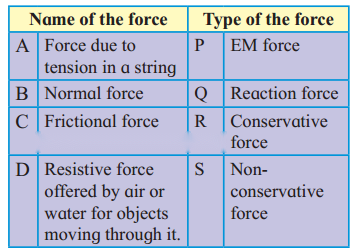
Thus, out of the four fundamental forces, electromagnetic force governs our daily life almost entirely.
In Chapter 5, you will study about force of gravitation in detail.
No | Real force | Pseudo Force |
i. | A force which is produced due to interaction between the objects is called real force. | A pseudo force is one which arises due to the acceleration of the observer’s frame of reference. |
ii. | Real forces obey Newton’s laws of motion. | Pseudo forces do not obey Newton’s laws of motion. |
iii. | Real forces are one of the four fundamental forces. | Pseudo forces are not among any of the four fundamental forces. |
Example: The earth revolves around the sun in circular path due to gravitational force of attraction between the sun and the earth. | Example: Bus is moving with an acceleration (a) on a straight road in forward direction, a person of mass ‘m’ experiences a backward pseudo force of magnitude ‘ma’. |
(B) Conservative and non-conservative forces,
No | Conservative | Non-conservative forces |
i. | If work done by or against a force is independent’ of the actual path, the force is said to be a conservative force. | If work done by or against a force is dependent of the actual path, the force is said to be a non- conservative force. |
ii. | During work done by a conservative force, the mechanical energy is conserved. | During work done by a non conservative force, the mechanical energy may not be conserved. |
iii. | Work done is completely recoverable. | Work done is not recoverable. |
Example: | Example: |
(C) Contact and non-contact forces,
No | Contact forces | Non-contact forces |
i. | The forces experienced by a body due to physical contact are called contact forces. | The forces experienced by a body without any physical contact are called non-contact forces. |
ii. | Example: gravitational force, electrostatic force, magnetostatic force etc. | Example: Frictional force, force exerted due to collision, normal reaction etc. |
(D) Inertial and non-inertial frames of reference.
No. | Inertial frame of reference | Non-inertial frame of reference |
i | The body moves with a constant velocity (can be zero). | The body moves with variable velocity. |
ii. | Newton’s laws are | Newton’s laws are |
iii. | The body does not accelerate. | The body undergoes acceleration. |
iv. | In this frame, force acting on a body is a real force. | The acceleration of the frame gives rise to a pseudo force. |
Example: A rocket in inter-galactic space (gravity free space between galaxies) with all its engine shut. | Example: If a car just starts its motion from rest, then during the time of acceleration the car will be in a non- inertial frame of reference. |
Conditions/limitations for application of work formula:
Integral method to find work done by a variable force:
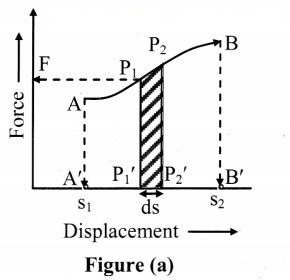
Thus, work and energy are the two sides of the same
i. For two colliding bodies, the negative of ratio of relative velocity of separation to relative velocity of approach is called the coefficient of restitution.
ii. Consider an head-on collision of two bodies of masses m1and m2with respective initial velocities u1and u2. As the collision is head on, the colliding masses are along the same line before and after the collision. Relative velocity of approach is given as,
ua= u2– u1
Let v1and v2be their respective velocities after the collision. The relative velocity of recede (or separation) is then vs= v2– v1
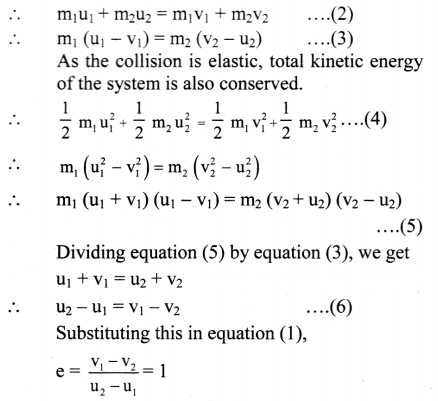
iii. For a head on elastic collision, According to the principle of conservation of linear momentum,
Total initial momentum = Total final momentum
iv. For a perfectly inelastic collision, the colliding bodies move jointly after the collision, i.e., v1= v2
∴ v1– v2= 0
Substituting this in equation (1), e = 0.

ii. A very heavy object collides with a lighter object, initially at rest.
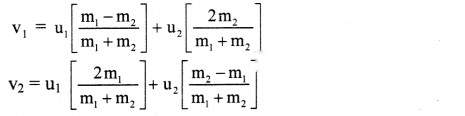
Let m1be the mass of the heavier body and m2be the mass of the lighter body i.e., m1>> m2; lighter particle is at rest i.e., u2= 0 then,
i.e., the heavier colliding body is left unaffected and the lighter body which is struck, travels with double the speed of the massive striking body.
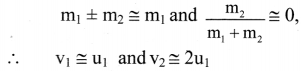
iii. A very light object collides on a comparatively much massive object, initially at rest.
If m1is mass of a light body and m2is mass of heavy body i.e., m1<< m2and u2= 0. Thus, m1can be neglected.
Hence v1≅ -u1, and v2≅ 0.
i.e., the tiny (lighter) object rebounds with same speed while the massive object is unaffected.
Loss in the kinetic energy during a perfectly inelastic head on collision:
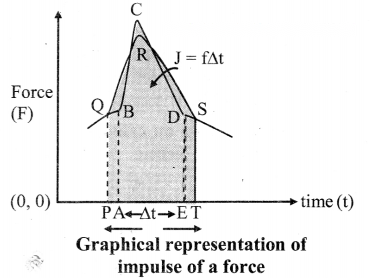
Need to define impulse:
Impulse for a variable force:
In chapter 3, you have studied the concept of using area under the curve.
No. | Moment of a force | Moment of a couple |
i. | Moment of a force is given as, | Moment of a couple is given as, |
ii. | It depends upon the axis of rotation and the point of application of the force. | It depends only upon the two forces, i.e., it is independent of the axis of rotation or the points of application of forces. |
iii. | It can produce translational acceleration also, if the axis of rotation is not fixed or if friction is not enough. | Does not produce any translational acceleration, but produces only rotational or angular acceleration. |
iv. | Its rotational effect can be balanced by a proper single force or by a proper couple. | Its rotational effect can be balanced only by another couple of equal and opposite torque. |
3. Solve the following problems.
Numerical Analysis


i. Consider FBD for 20 kg-wt load. Initially, the block kept on the table is moving towards left, because of the movement of block of mass 20 kg in downward direction.
Thus, for block of mass 20 kg,
ma = mg – T1…. (1)
Consider the forces acting on the block of mass 35 kg in horizontal direction only as shown in figure (b). Thus, the force equation for this block is, m1a = T1– T2– f ….(2)
To prevent the block from sliding across the table,
m1a = ma = 0
∴ T1= mg = 200 N ….[From (1)]
T1= T2+ f ….[From (2)]
∴ T2+ f = 200
∴ T2= 200 – 35 = 165 N
Thus, the total force acting on the block from right hand side should be 165 N.
∴ Total mass = 16.5 kg
∴ Minimum weight to be added = 16.5 – 2 = 14.5 kg
≈ 15 weights of 1 kg each
ii. Now, considering motion of the block towards right, the force equations for the masses in the pan and the block of mass 35 kg can be determined from FBD shown
From figure (c)
m1a = T2– T1– f ….(iii)
From figure (d),
m2a = m2g – T2….(iv)
To prevent the block of mass 35 kg from sliding across the table, m1a = m2a = 0
From equations (iii) and (iv),
T2= T1+ f
T2= m2g
∴ m2g = 200 + 35 = 235 N
∴ The maximum mass required to stop the sliding = 23.5 – 2 = 21.5kg ≈ 21 weights of 1 kg
Answer:
The minimum 15 weights and maximum 21 weights of 1 kg each are required to stop the block from sliding.

i. A constant force F is applied to a body of mass (m) initially at rest (u = 0).
ii. We have,
v = u + at
∴ v = 0 + at
∴ v = at …. (1)
iii. Now, power is the rate of doing work,
∴ P =
∴ P = F. [∵ dW = F. ds]
iv. But = v, the instantaneous velocity of the particle.
∴ P = F.V … (2)
v. According to Newton’s second law,
F = ma … (3)
vi. Substituting equations (1) and (3) in equation (2)
P = (ma) (at)
∴ P = ma2t
∴ P = × t
∴ P =
vii. As F and m are constant, therefore, P ∝ t.


Alternate solution:
Work done, w = Area of trapezium ADCB
∴ W = (AD + CB) × DC
∴ W = 1 (5N + 3N) × (5m – 3m)
= × 8 × 2 = 8J
ii. From equation (1),
∴ v = – eu
∴ After first bounce,
v1= – eu
after second bounce,
v2= -ev1= -e(-eu)= e2u
and after third bounce,
v3= – ev2= – e(e2u) = – e3u
But u =
iii. Impulse given by the ball during third bounce, is,
iv. Average force exerted in 250 ms,
v. Average pressure for area
0.5 cm2= 0.5 × 10⁻⁴m2
P = = 9.216 × 10⁴N/m2
i. m1u1+m2u2= m1v1+ m2v2
ii. e =
Calculation: From formula (i),
[(2m) × 6] + (m × 12) = (2m × 9) + mv2
∴ v2= 6cm/s
From formula (ii),
e = = = 0.5
Answer: The coefficient of restitution is 0.5
The ladder exerts horizontal force on the wall at A and is the force exerted on the ground at C.
As || = … (iii)
Let monkey climb upto distance x along BC (Horizontal) i.e., CM’ = x....(iv)
Then, the net normal reaction at point C will be, N = 100 + 200 = 300N
From equation (iii),
H = = 150N
By condition of equilibrium, taking moments about C,
(-H × AB) + (W1× CD’) + (W2× CM’) + (F × 0)’0
∴ (-150 × 1.6) + (100 × 0.6) + (200 × x) = 0
∴ 60 + 200x = 240
∴ 200x = 180
∴ x = 0.9
From figure, it can be shown that,
∆ABC ~ ∆MM’C
∴ = ∴ =
∴ CM = 1.5 m
Answer:
11th Physics Digest Chapter4 Laws of MotionIntext Questions and Answers
Can you recall? (Textbook Page No. 47)
Can you tell? (Textbook Page No. 48)
Can you tell? (Textbook Page No. 48)