Maharashtra State Board 11th Physics Solutions Chapter 7 Thermal Properties of Matter
1. Choose the correct option.
Solution & Step-by-Step Answer:
(B) 34 ºC to 42 ºC
Solution & Step-by-Step Answer:
(C) Water expands on freezing
Solution & Step-by-Step Answer:
(B) 45°
Solution & Step-by-Step Answer:
(B) α:β:γ 1:2:3
Solution & Step-by-Step Answer:
(A) I and II are both correct
Solution & Step-by-Step Answer:
(C) 0.46 °C
2. Answer the following questions.
Solution & Step-by-Step Answer:
| Heat | Temperature |
i. | Heat is energy in transit. When two bodies at different temperatures are brought in contact, they exchange heat.
OR
Heat is the form of energy transferred between two (or more) systems or a system and its surroundings by virtue of their temperature difference. | Temperature is a physical quantity that defines the thermodynamic state of a system.
OR
Heat transfer takes place between the body and the surrounding medium until the body and the surrounding medium are at the same temperature. |
ii. | Heat exchange can be measured with the help of a calorimeter. | Temperature is measured with the help of a thermometer. |
iii. | Heat (being a form of energy) is a derived quantity. | Temperature is a fundamental quantity. |
Solution & Step-by-Step Answer:
Solution & Step-by-Step Answer:
Relation between different scales of temperature:
where,
TF= temperature in fahrenheit scale,
TC= temperature in celsius scale,
TK= temperature in kelvin scale,
[Note: At zero of the kelvin scale, every substance in nature has the least possible activity.]
Solution & Step-by-Step Answer:
Solution & Step-by-Step Answer:
Consider a square plate of side l0 at 0 °C and h at T °C.
Relation between coefficient of linear expansion (α) and coefficient of cubical expansion (γ).
Relation between α, β and γ is given by,
α =
where, α = coefficient of linear expansion.
β = coefficient of superficial expansion,
γ = coefficient of cubical expansion.
Solution & Step-by-Step Answer:
Applications of thermal expansion:
Solution & Step-by-Step Answer:
Solution & Step-by-Step Answer:
Though freezing point and melting point mark same temperature (0°C or 32° F), state of change is different for the two points. At freezing point liquid gets converted into solid, whereas at melting point solid gets converted into its liquid state.
Solution & Step-by-Step Answer:
Solution & Step-by-Step Answer:
Solution & Step-by-Step Answer:
Coefficient of thermal conductivity of a material is defined as the quantity of heat that flows in one second between the opposite faces of a cube of side 1 m, the faces being kept at a temperature difference of 1°C (or 1 K).
Expression for coefficient of thermal conductivity:
Solution & Step-by-Step Answer:
Answer: Applications of thermal conductivity:
Solution & Step-by-Step Answer:
The SI unit of thermal resistance is °C s/kcal or °C s/J and its dimensional formula is [L-2M-1T3K1].
Solution & Step-by-Step Answer:
Solution & Step-by-Step Answer:
The rate of loss of heat dT/dt of the both’ is directly proportional to the difference of temperature (T – T0) of the body and the surroundings provided the difference in temperatures is small.
Mathematically, Newton’s law of cooling can be expressed as:
∝ (T – T0)
∴ ∝ C(T – T0)
where, C is constant of proportionality. Experimental verification of Newton’s law of cooling:
Solution & Step-by-Step Answer:
Solution & Step-by-Step Answer:
3. Solve the following problems.
Solution & Step-by-Step Answer:
Given: V1 = 1 × 10⁻⁴ m3 = 10-4 m3, T1 = 30°C, T2 = 100 °C To find: Volume of liquid that overflows Formula: γ = Calculation: From formula, Increase is volume = V2 – V1 = γV1(T2 – T1) increase in volume of beaker = γglass × V1 (T2 – T1) = 1.2 × 10-5 × 10-4 × (100 – 30) = 1.2 × 70 × 10-9 = 4 × 10⁻⁹ m3 ∴ Increase in volume of beaker = 84 × 10-9 m3 Increase in volume of liquid = γliquid × V1 (T2 – T1) = 75 × 10-5 × 10 × (100 – 30) = 75 × 70 × 10 = 5250 × 10-9 m3 ∴ Increase in volume of liquid = 5250 × 10-9 m3 ∴ Volume of liquid which overflows = (5250 – 84) × 10-9 m3 = 5166 × 10-9 m3 = 0.5166 × 10⁻⁷ m3 Volume of liquid that overflows is 0.5166 × 10⁻⁷ m3. [Note: The answer given above is presented considering standard conventions of writing number with its correct order of magnitude.]
Solution & Step-by-Step Answer:
Given: mlead = 2 kg, ∆Tlead = 30 K, slead = 128 J/kg K, mCu =4 kg, ∆TCu = 5 K, sCu = 387 J/kg K To find: Substance requiring more heat energy. Formula: Q = ms ∆T Calculation: From formula, For lead, Qlead = 2 × 128 × 30 = 7680J For Copper, QCu = 4 × 387 × 5 = 7740 J QCu > Qlead, copper will require more heat energy. Copper will require more heat energy.
Solution & Step-by-Step Answer:
Given: Lvap = 2.26 × 10⁶ J/kg m = 5g = 5 × 10⁻³ kg In this case, no temperature change takes place only change of state occurs. To find: Heat required to convert water into steam. Formula: Heat required = mLvap Calculation: From formula, Heat required = 5 × 10-3 × 2.26 × 106 = 11300J = 1.13 × 10⁴ J Heat required to convert water into steam is 1.13 × 10⁴ J [Note: The answer given above is presented considering standard conventions of writing number with its correct order of magnitude.]
Solution & Step-by-Step Answer:
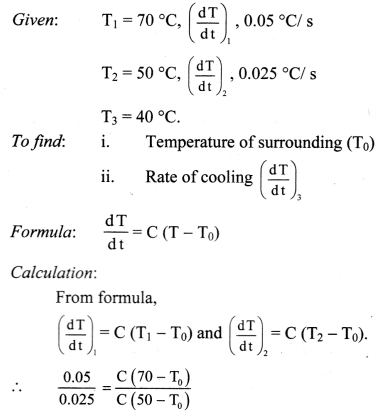
∴ 2(50 – T0) = 70 – T0 ∴ T0 = 30 πC Substituting value of T0. 0.05 = C (70 – 30) ∴ C = = 0.00125/s. For T3 = 40 °C = C(T3 – T0) = 0.00125 (40 – 30) = 0.00125 × 10 = 0.0125°C/s. i) Temperature of surrounding is 30 °C. ii) Rate of cooling at 40 °C is 0.0125 °C/s.
Solution & Step-by-Step Answer:
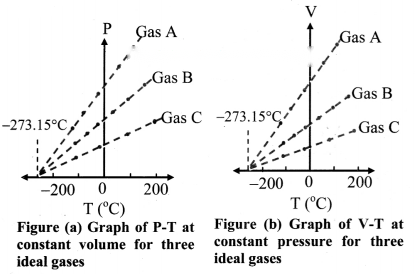
At temperature of -273.15 °C, the volume of the gas will be ideally zero.
Solution & Step-by-Step Answer:
Given. T1 = 27 °C, T2 = 45 °C, L1 = 10m. α = 1.2 × 10⁻⁵ K-1 To find: Gap that should be left (L2 – L1) Formula: L2 – L1 = L1 α(T2 – T1) Calculation: From formula, L2 – L1 = 10 × 1.2 × 10-5 × (45 – 27) = 2.16 × 10⁻³ m = 2.16 mm The gap that should be left between rail sections is 2.16 mm.
Solution & Step-by-Step Answer:
Given: dw = 1.5 m, d = 1.47 m, T1 = 27 °C. αi = 1.2 × 10⁻⁵/ K To find: Temperature (T2) Formula. α = Calculation: From formula, T2 = + T1 = + 27 = 1700.7 + 27 = 1727.7 °C Iron ring should be heated to temperature of 1727.7 °C.
Solution & Step-by-Step Answer:
Here thermometric property P is temperature at some random scale X. Using equation, T = For P1 = 20 °X, P2 = 200 °X, T = 62°C ∴ 62 = ∴ PT = + 20 = 111.6 + 20 = 131.6 °X The boiling point of a liquid in this scale is 131.6 °X.
Solution & Step-by-Step Answer:
Given: T1 = 900 °C = 900 + 273.15 = 1173.15 K V2 = , P2 = To find: Final temperature (T2) Formula: Calculation: From formula. ∴ T2 = = 293.29 K Final temperature of gas is 293.29 K.
Solution & Step-by-Step Answer:
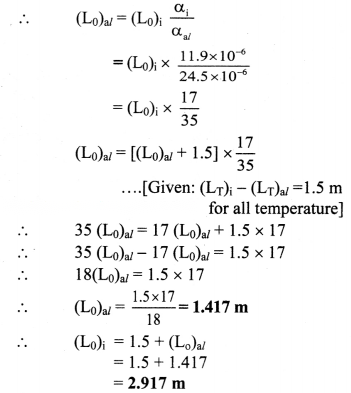
Given: (LT)i – (LT)al = 1.5 m, T0 = 0 °C αal = 24.5 × 10⁻⁶/°C αi = 11.9 × 10⁻⁶ /°C To find: Lengths of aluminium and iron rod (L0)al and (L0)i Formula: LT = L0[(1 + α(T – T0)] Calculation: For T0 = 0 °C From formula, LT = L0(1 + αT) For aluminium, (L0)al = (L0)al(1 + αalT) ……………. (1) For iron, (LT)i = (L0)i (1 + αiT) ………….. (2) Subtracting equation (2) by (1), (LT)i – (LT)al = [(L0)i + (L0)i αiT] – [(L0)al + (L0)alαalT] = (L0)i – (L0)al + [(L0)i αi – (L0)al αal]T ∴ 1.5 = 1.5 + [(L0)i αi – (L0)al αal)]T ⇒ [(L0)iαi – (L0)alαal] T = 0 ∴ (L0)alαal = (L0)iαi Length of aluminium rod at 0 °C is 1.417 m and that of iron rod is 2.917 m.
Solution & Step-by-Step Answer:
Given: Q = 50 cal, m =6 kg, ∆T = 62 – 20 = 42 °C To find: Specific heat (s) Formula: Q = ms ∆T Calculation: From formula, s = = 0.198 cal/kg °C Specific heat of metal is copper 0.198 cal/kg °C.
Solution & Step-by-Step Answer:
Given: ∆T = 30 °C, Pcond = 1500 cal/s To find: Thermal resistance (RT) Formula: RT = Calculation: From formula, RT = = 0.02 °C s/cal. Thermal resistance of copper rod is 0.02 °C s/cal.
Solution & Step-by-Step Answer:
Let heat supplied by kettle in 20 minutes be Q1 and that in 90 min. be Q2. Using heat temperature of water is raised from O °C to 100 °C. If mass of water in the kettle is ‘m’ then. Q1 = mswater∆T m × 1 × (100 – 0) = 100 m ………….. (i) …………. (∵ Swater = 1 cal/g °C) Similarly using heat Q2 water is converted from liquid to gas, ∴ Q2 = mLvap ……………. (ii) Given that heat Q1, Q2 are supplied to water in 20 min. (t1) and 90 min (t2) respectively. Kettle being same its conduction rate (Pcond) is same. Using Pcond = …………… (iii) From (i), (ii) and (iii), , ∴ Lvap = 5 × 90 = 450 cal/g Latent heat of vaporisation for water is 450 cal/g.
Solution & Step-by-Step Answer:
Temperature difference between two sides is 10.26 K. [Note: Above answer is expressed in K (‘kelvin considering that thermal conductivity is expressed in units of kcal / ms K, and not as kcal / m s °C. As 1 °C equivalent to 1 K. conceptually temperature difference of 10.26 K will correspond to 10.26 t]

Solution & Step-by-Step Answer:
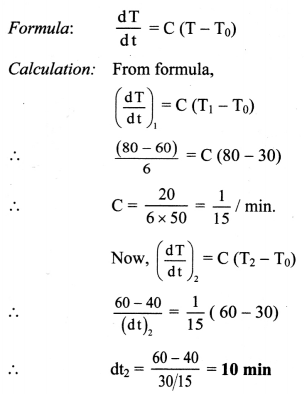
Given: T1 = 80 °C, T2 = 60 °C, T3 = 40 °C, T0 = 30 °C, (dt)1 = 6 min. To find: Time taken in cooling (dt)2 Time taken in cooling is 10 min.
11th Physics Digest Chapter 7 Thermal Properties of Matter Intext Questions and Answers
Can you tell? (Textbook Page No. 125)
Solution & Step-by-Step Answer:
Intext question. (Textbook Page No 124)
Solution & Step-by-Step Answer:
Can you tell? (Textbook Page No. 125)
Solution & Step-by-Step Answer:
Activity (Textbook Page No. 129)
Solution & Step-by-Step Answer:
[Students are expected to attempt the activity on their own.]
Can you tell? (Textbook Page No. 130)
Solution & Step-by-Step Answer:
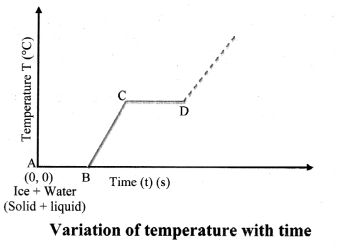
Beyond point D, thermometer again shows rise in temperature. This means, steam can be hotter than 100 °C and is termed as superheated steam.
Solution & Step-by-Step Answer:
Activity (Textbook Page No. 130)
Activity to understand the dependence of boiling point on pressure:
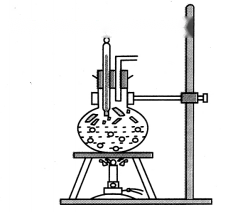
Take a round bottom flask, more than half filled with water. Keep it over a burner and fix a thermometer and steam outlet through the cork of the flask as shown in figure. As water in the flask gets heated, note that first the air, which was dissolved in the water comes out as small bubbles. Later bubbles of steam form at the bottom but as they rise to the cooler water near the top, they condense and disappear. Finally, as the temperature of the entire mass of the water reaches 100 oc, bubbles of steam reach the surface and boiling is said to occur. The steam in the flask may not be visible hut as it comes out of the flask, It condenses as tiny droplets of water giving a foggy appearance.
If now the steam outlet is closed for a few seconds to increase the pressure in the flask, you will notice that boiling stops. More heat would be required to raise the temperature (depending on the increase in pressure) before boiling starts again. Thus, boiling point increases with increase in pressure. Let us now remove the burner. Allow water to cool to about 80°C. Remove the thermometers and steam outlet. Close the flask with a air tight cork. Keep the flask turned upside down on a stand. Pour icecold water on the flask. Water vapours in the flask condense reducing the pressure on the water surface inside the flask. Water begins to boil again, now at a lower temperature. Thus boiling point decreases with decrease in pressure and increases with increase in pressure.
Answer:
[Students are expected to attempt the activity an their own.]
Can you tell? (Textbook Page No. 131)
Solution & Step-by-Step Answer:
Internet my friend (Textbook Page No. 139)
i) https ://hyperphysics. phy-astr.gsu.edul/base/hframe.html
ii)
iii)info/expansion
Answer:
[Students are expected to visit the above mentioned webs it es and collect more information about the thermal properties of matter.]