Maharashtra State Board 11th Physics Solutions Chapter 8 Sound
1. Choose the correct alternatives
2. Answer briefly.
Characteristics of transverse waves:
ii. Thus, the velocity of sound depends upon density and elasticity of medium. It is given by
v = ….(1)
Where, E is the modulus of elasticity of medium and ρ is density of medium.
Assumptions:
1. Newton assumed that during propagation of sound wave in air, average temperature of the medium remains constant. Hence, propagation of sound wave in air is an isothermal process and isothermal elasticity should be considered.
2. The volume elasticity of air determined under isothermal change is called isothermal bulk modulus.
Calculations:
1. For a gas or air, the isothermal elasticity E is equal to the atmospheric pressure P.
Substituting this value in equation (1), the velocity of sound in air or a gas is given by
v = ….(∵ E = P)
This is the Newton’s formula for velocity of sound in air.
2. But atmospheric pressure is given by,
P = hdg
∴ v = ….(2)
3. At N.T.P., h = 0.76 m of mercury, density of mercury d = 13600 kg/m³ and acceleration due to gravity, g = 9.8 m/s², density of air ρ = 1.293 kg/m³
4. From equation (2) we have velocity of sound,
v = = 279.9 m/s at N.T.P
ii. Using Laplace’s formula, we can write,
v = ….(1)
iii. If V be the volume of a gas having mass M then, ρ =
iv. Substituting ρ in equation (1), we get,
v = ….(2)
v. But according to Boyle’s law,
PV = constant (at constant temperature)
Also, M and γ are constant.
∴ v = constant
vi. Hence, the velocity of sound does not depend upon the change in pressure, as long as the temperature remains constant.
vii. For a gaseous medium, PV= nRT.
Substituting in equation (2), we get,
v =
viii. Thus, even for a gaseous medium obeying ideal gas equation, the velocity of sound does not depend upon the change in pressure, as long as the temperature remains constant.

ii. Humid air contains a large proportion of water vapour. Density of water vapour at 0 °C is 0.81 kg/m³ while that of dry air at 0°C is 1.29 kg/m³. So, the density ρmof moist air is less than the density ρdof dry air i.e., ρm< ρd.
iii. Thus > 1
∴ vm> vd
iv. Hence, sound travels faster in moist air than in dry air. It means that velocity of sound increases with increase in moistness (humidity) of air.
ii. Dolphins navigate underwater with the help of an analogous system. They emit subsonic frequencies which can be about 100 Hz. They can sense an object about 1.4 m or larger.
Medical applications of acoustics:
i. High pressure and high amplitude shock waves are used to split kidney stones into smaller pieces without invasive surgery. A reflector or acoustic lens is used to focus a produced shock wave so that as much of its energy as possible converges on the stone. The resulting stresses in the stone causes the stone to break into small pieces which can then be removed easily.
ii. Ultrasonic imaging uses reflection of ultrasonic waves from regions in the interior of body. It is used for prenatal (before the birth) examination, detection of anomalous conditions like tumour etc. and the study of heart valve action.
iii. Ultrasound at a very high-power level, destroys selective pathological tissues which is helpful in treatment of arthritis and certain type of cancer.
Underwater applications of acoustics:
i. SONAR (Sound Navigational Ranging) is a technique for locating objects underwater by transmitting a pulse of ultrasonic sound and detecting the reflected pulse.
ii. The time delay between transmission of a pulse and the reception of reflected pulse indicates the depth of the object.
iii. Motion and position of submerged objects like submarine can be measured with the help of this system.
Applications of acoustics in environmental and geological studies:
i. Acoustic principle has important application to environmental problems like noise control. The quiet mass transit vehicle is designed by studying the generation and propagation of sound in the motor’s wheels and supporting structures.
Reflected and refracted elastic waves passing through the Earth’s interior can be measured by applying the principles of acoustics. This is useful in studying the properties of the Earth.
Principles of acoustics are applied to detect local anomalies like oil deposits etc. making it useful for geological studies.
ii. Wavelength (λ): The distance between two successive particles which are in the same state of vibration is called wavelength of the wave.
SI unit: (m)
ii. v = i.e., v = λ × () …………….. (1)
iii. But reciprocal of the period is equal to the frequency (n) of the waves.
∴ = n …………… (2)
iv. From equations (1) and (2), we get
v = nλ
i.e., wave velocity = frequency × wavelength.
Explanation:
i. Consider two waves travelling through a medium arriving at a point simultaneously.
ii. Let each wave produce its own displacement at that point independent of the others. This displacement can be given as,
y1= displacement due to first wave.
y2= displacement due to second wave.
iii. Then according to superposition of waves, the resultant displacement at that point is equal to the vector sum of the displacements due to all the waves.
∴ = +
ii. Apparent frequency heard by the listener is given by,
n = n0()
Where upper signs (+ ve in numerator and -ve in denominator) indicate that source and observer move towards each other. Lower signs (-ve in numerator and +ve in denominator) indicate that source and listener move away from each other.
iii. If source and listener are moving towards each other, then apparent frequency is given by,
n = n0() i.e., apparent frequency increases.
iv. If source and listener are moving away from each other, then apparent frequency is given by,
n = n0() i.e., apparent frequency decreases.
i. If listener is moving towards source then apparent frequency is given by,
n = n0() i.e., apparent frequency increases.
ii. If listener is receding away from source then apparent frequency is given by,
n = n0() i.e., apparent frequency decreases.
(i) moving towards the listener
(ii) moving away from the listener
Let,
n = actual frequency of the source.
n0= apparent frequency of the source,
v = velocity of sound in air.
vs= velocity of the source.
vl= velocity of the listener.
i. If source is moving towards observer then apparent frequency is given by,
n = n0() i.e., apparent frequency increases.
ii. If source is receding away from observer then apparent frequency is given by,
n = n0() i.e., apparent frequency decreases.
Question 17
Maharashtra Board Solution
Explain what is meant by phase of a wave.
Solution & Step-by-Step Answer:
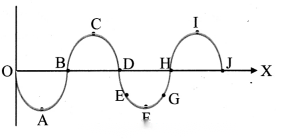
i. The state of oscillation of a particle is called the phase of the particle.
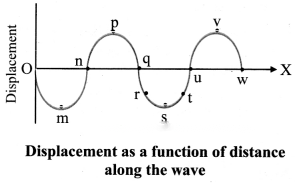
ii. The displacement, direction of velocity and oscillation number of the particle describe the phase of the particle at a place. iii. Particles r and t (q and u or v and s) have same displacements but the directions of their velocities are opposite. iv. Particles having same magnitude of displacements and same direction of velocity are said to be in phase during their respective oscillations. Example: particles v and p. v. Separation between two particles which are in phase is wavelength (λ). vi. The two successive particles differ by ‘1’ in their oscillation number i.e., if particle v is at its nthoscillation, particle p will be at its (n + 1)thoscillation as the wave is travelling along + X direction. vii. In the given graph, if the disturbance (energy) has just reached the particle w, the phase angle corresponding to particle is 0°. At this instant, particle v has completed quarter oscillation and reached its positive maximum (sin θ = +1). The phase angle θ of this particle v is = 90° at this instant. viii. Phase angles of particles u and q are πc(180°) and 2rcc (360°) respectively. ix. Particle p has completed one oscillation and is at its positive maximum during its second oscillation. x. v and p are the successive particles in the same state (same displacement and same direction of velocity) during their respective oscillations. Phase angle between these two differs by 2πc.
Question 18
Maharashtra Board Solution
Define progressive wave. State any four properties.
Solution & Step-by-Step Answer:
i. Waves in which a disturbance created at one place travels to distant points and keeps travelling unless stopped by an external force are known as travelling or progressive waves. Properties of progressive waves are: Amplitude, wavelength, period, double periodicity, frequency and velocity.
Question 19
Maharashtra Board Solution
Distinguish between traverse waves and longitudinal waves.
Solution & Step-by-Step Answer:
Question 20
Maharashtra Board Solution
Explain Newtons formula for velocity of sound. What is its limitation?
Solution & Step-by-Step Answer:
Newton’s formula for velocity of sound: i. Sound wave travels through a medium in the form of compression and rarefaction. At compression, the density of medium is greater while at rarefaction density is smaller. This is possible only in elastic medium.
ii. Thus, the velocity of sound depends upon density and elasticity of medium. It is given by Assumptions: 2. The volume elasticity of air determined under isothermal change is called isothermal bulk modulus. Calculations: 2. But atmospheric pressure is given by, 3. At N.T.P., h = 0.76 m of mercury, density of mercury d = 13600 kg/m³ and acceleration due to gravity, g = 9.8 m/s², density of air ρ = 1.293 kg/m³ 4. From equation (2) we have velocity of sound, Limitations: 2. Experimental value is 16% greater than the value given by the formula. Newton failed to provide a satisfactory explanation for the difference. 3. Solve the following problems.
Question 1
Maharashtra Board Solution
A certain sound wave in air has a speed 340 m/s and wavelength 1.7 m for this wave, calculate (i) the frequency (ii) the period.
Solution & Step-by-Step Answer:
Given: v = 340 m/s, λ = 1.7 m To find: frequency (n), period (T) Formulae: i. n = ii. T = Calculation: From formula, (i) n = ∴ n = 200 Hz From formula, (ii) T = = = 5 × 10⁻³ …….. (using reciprocal Table) ∴ T = 0.005 s
Question 2
Maharashtra Board Solution
A tuning fork of frequency 170 Hz produces sound waves of wavelength 2m. Calculate speed of sound.
Solution & Step-by-Step Answer:
Given: n = 170 Hz, λ = 2 m To find: velocity of sound (v) Formula: v = nλ Calculation: From formula, v = 170 × 2 ∴ v = 340 m/s
Question 3
Maharashtra Board Solution
An echo-sounder in a fishing boat receives an echo from a shoal of fish 0.45s after it was sent. If the speed of sound in water is 1500 m/s, how deep is the shoal?
Solution & Step-by-Step Answer:
Given: t = 0.45 s, v = 1500 m/s, To Find: depth (d) Formula: speed (v) = Calculation: For an echo distance travelled by the sound wave = 2 × (distance between echo sounder and shoal) (d) v = ∴ d = = 337.5 m
Question 4
Maharashtra Board Solution
A girl stands 170 m away from a high wall and claps her hands at a steady rateso that each clap coincides with the echo of the one before. a) If she makes 60 claps in 1 minute, what value should be the speed of sound in air? b) Now, she moves to another location and finds that she should now make 45 claps in 1 minute to coincide with successive echoes. Calculate her distance for the new position from the wall.
Solution & Step-by-Step Answer:
i. When the girl makes 60 claps in 1 minute, the value of speed of is 340 m/s.
ii. The girl is at a distance of 226.67 m from the wall when she produces 45 claps per minute.
Question 5
Maharashtra Board Solution
Sound wave A has period 0.015 s, sound wave B has period 0.025. Which sound has greater frequency?
Solution & Step-by-Step Answer:
Given: TA = 0.015 s, TB = 0.025 s To find: greater frequency (n) Formula: n = Calculation: From formula, nA = = = ∴ nA = 66.67 …. (using reciprocal table) nB = = = ∴ nB = 40 Hz …. (using reciprocal table) ∴ nA > nB
Question 6
Maharashtra Board Solution
At what temperature will the speed of sound in air be 1.75 times its speed at N.T.P?
Solution & Step-by-Step Answer:
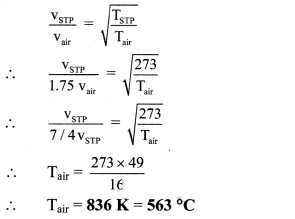
Given: vair = 1.75 VS.T.P = vS.T.P TS.T.P = 273 K To find: temperature Tair Formula: v ∝ √T Calculation: From formula,
Question 7
Maharashtra Board Solution
A man standing between 2 parallel eliffs fires a gun. He hearns two echos one after 3 seconds and other after 5 seconds. The separation between the two cliffs is 1360 m, what is the speed of sound?
Solution & Step-by-Step Answer:
distance (s) = 1360 m, time for first echo = 3 s, time for second echo = 5 s To Find : speed of sound (v) Formula : speed = Calculation: Time for first echo = 3 s ∴ time taken by sound to travel given distance t1 = = 1.5 s Time for second echo = 5 s ∴ time taken by sound to travel given distance t2 = = 2.5 s ∴Total time taken by sound to travel given distance, T = 1.5 + 2.5 = 4 s From formula, v = ∴v = 340 m/s
Question 8
Maharashtra Board Solution
If the velocity of sound in air at a given place on two different days of a given week are in the ratio of 1 : 1.1. Assuming the temperatures on the two days to be same what quantitative conclusion can your draw about the condition on the two days?
Solution & Step-by-Step Answer:
Let v1 and v2 be the velocity of sound on day 1 and day 2 respectively. = We know, v ∝ Let ρ1 and ρ2 be the density of air on day 1 and day 2 respectively. ∴ = ∴ = ()² ∴ ρ1 = 1.1² ρ2 = 1.21 ρ² From above equation, we can conclude, ρ1 > ρ2 ∴ v2 > v1 i.e., the velocity of sound is greater on the second day than on the first day. We know, speed of sound in moist air (vm) is greater than speed of sound in dry air (vd). ∴ We can conclude, air is moist on second day and dry on the first day.
Question 9
Maharashtra Board Solution
A police car travels towards a stationary observer at a speed of 15 m/s. The siren on the car emits a sound of frequency 250 Hz. Calculate the recorded frequency. The speed of sound is 340 m/s.
Solution & Step-by-Step Answer:
Given: vs = 15 m/s, n0 = 250 Hz, v = 340 m/s To find: Frequency (n) Formula: n = n0() Calculation: As the source approaches listener, apparent frequency is given by, n = 250 () = ∴ n = 261.54 Hz
Question 10
Maharashtra Board Solution
The sound emitted from the siren of an ambulance has frequency of 1500 Hz. The speed of sound is 340 m/s. Calculate the difference in frequencies heard by a stationary observer if the ambulance initially travels towards and then away from the observer at a speed of 30 m/s.
Solution & Step-by-Step Answer:
Given: vs = 30 m/s, n0 = 1500 Hz, v = 340 m/s To find: Difference in apparent frequencies (nA – n’A) Formulae: i. When the ambulance moves towards he stationary observer then nA = n0()
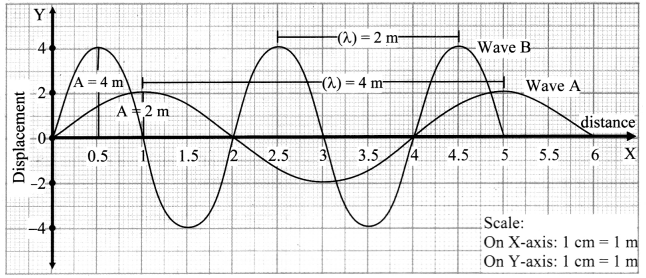
ii. When the ambulance moves away from the stationary observer then, n’A= n0() Calculation: 11th Physics Digest Chapter 8 Sound Intext Questions and Answers Can you recall? (Textbook page no. 142) i. What type of wave is a sound wave? ii. Sound cannot travel in vacuum. iii. a. Reverberation is the phenomenon in which sound waves are reflected multiple times causing a single sound to be heard more than once. iv. The characteristic of sound which is determined by the value of frequency is called as the pitch of the sound. Activity (Textbook page no. 144) i. Using axes of displacement and distance, sketch two waves A and B such that A has twice the wavelength and half the amplitude of B.
|