Maharashtra State Board Class 11 Political Science Solutions Chapter 9 The World Since 1945 – I
1A. Choose the correct alternative and complete the following statements.
1B. State the appropriate concept for the given statement.
1C. Find the odd word in the given set.
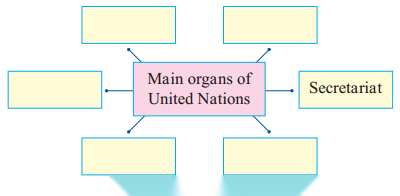
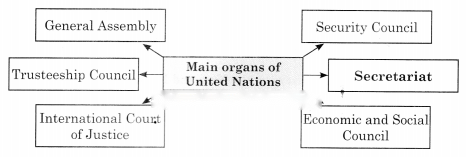
2A. Complete the concept maps.
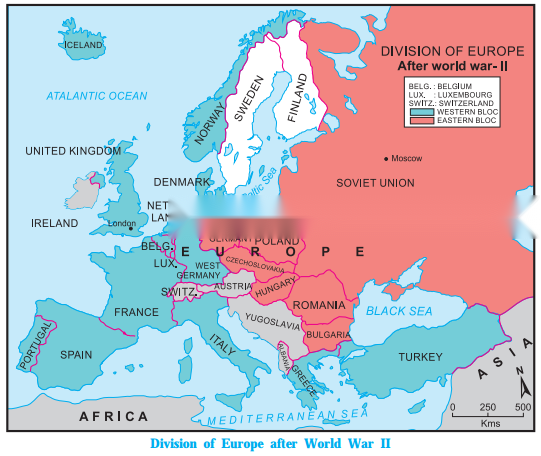
2B. Observe the given map and answer the following questions.
See a map of the Division of Europe after World War II.
Question i.
Name two East European countries under influence of the Soviet Union.
Answer:
Poland, Hungary, Czechoslovakia, Bulgaria, Romania.
3. State whether the following statements are true or false with reasons.
4. Answer the following.
While geographic linkages are important, sometimes some functional issues become the basis of regional cooperation. These can be in areas like transport and communication, energy, health, etc.
The process of regionalism usually begins with a political dialogue amongst the participants. Such a dialogue may lead to the creation of an organisation. Organisations like the European Union (EU), Association of South-East Asian Nations (ASEAN), or South Asian Association for Regional Cooperation (SAARC) are examples of such regional groupings.
(ii) Protect Human Rights: The promotion and protection of human rights is a key purpose and guiding principle of the UN. On 10th December 1948, the Universal Declaration of Human Rights was adopted.
(iii) Deliver Humanitarian Aid: One of the purposes of the United Nations is “to achieve international cooperation in solving international problems of an economic, social, cultural or humanitarian character.” The international community relies on the UN to coordinate humanitarian relief operations in times of natural and man-made disasters.
(iv) Promote Sustainable Development: The global understanding of development has changed over the years. The UN seeks to promote sustainable development, that is, a development that promotes prosperity and economic opportunity, greater social well-being, and protection of the environment.
(v) Uphold International Law: The development of and respect for international law has been a key part of the work of the UNO. This work is carried out in many ways – by courts, tribunals, multilateral treaties, and by the Security Council and ICJ.
5. Answer the following in detail with reference to the given points.
(b) Ideological dimension: Eastern Europe adopted Socialist ideology under the influence of the Soviet Union and followed a Socialist form of government. Western Europe adopted capitalist ideology under the leadership of the United States. These countries had democratic governments.
(c) Economic dimension: East European countries with socialist governments followed the socialist economic system. This meant that the government or the public sector would play a dominant role in the economic system. West European countries that followed the democratic system of government had a capitalist form of economy. Here the private sector played a dominant role in the economic system.
(d) Security dimension: Military alliances were created in Europe to protect these countries. The North Atlantic Treaty Organisation (NATO) was created in 1949 as a military alliance to defend West European countries and the United States from the threat of invasion from the Soviet Union and East Europe. Warsaw Pact was created in 1955 to defend East European countries and the Soviet Union from the threat from Western Europe and the United States.