Maharashtra State Board Class 11 Sociology Solutions Chapter 7 Social Stratification
1. (A) Choose the correct alternative and complete the statements.
1. (B) Correct the incorrect pair.
1. (C) Correct underlined words and complete the sentence.
2. Write short notes.
2. Hierarchy: Castes or segments are arranged in terms of hierarchy. According to Dr. Ghurye, castes are graded and arranged into a hierarchy on the basis of the concept of ‘purity and pollution’.
3. Restriction on feeding and social intercourse : This fact of separation is reinforced by the notion of ‘purity and pollution’. Each caste imposes restrictions on its members with regard to food and social intercourse.
4. Differential civil and religious privileges and disabilities : In a caste society there is an unequal distribution of privileges and disabilities among its members. The higher castes enjoy all privileges and lower caste suffer from all kinds of disabilities.
5. Lack of unrestricted choice of occupation : Choice of occupation is not free under caste system. Occupations are hereditary and the members of the caste are expected to follow their traditional occupation.
6. Endogamy : Endogamy is the essence of caste system. Every caste of sub-caste insists that its member should marry within the group.
2. Vertical Mobility : Vertical mobility refers to any change in the occupational, economic, political status of an individual or a group which leads to change of their position. Vertical Mobility stands for change of social position, either upward or downward.
3. Intergenerational Mobility : This type of mobility means that one generation changes its social status in contrast to the previous generation. However, this mobility may be upward or downward. For e.g., people of lower caste or class may provide facilities to their children to get higher education, training and skills, with the help of which the younger generation may get employment in higher position.
4. Intragenerational Mobility : This type of mobility takes place in the lifespan of one generation. A person may start one’s career as a clerk and after acquiring more education, becomes an IFS Officer. Here the individual moves up and occupies a higher social position than previously.
3. Differentiate between.
Caste | Class |
(i) Different castes form a hierarchy of social preference and each position in the caste structure is defined in terms of its ‘purity and pollution’. | (i) A social class is made up of similar social status who regard one another as social equals. |
(ii) In a caste stratification system, an individual’s position depends on the status attributes ascribed by birth. | (ii) In a class stratification system and individual’s position depends on the possession of substantial amounts of wealth, occupation, education and prestige which is achieved. |
(iii) Caste is an example of closed stratification. | (iii) Class system is an example of open stratification. |
(iv) In this type of social stratification there is no scope for social mobility. | (iv) In this type of social stratification there is scope for social mobility. |
Intragenerational Mobility | Intergenerational Mobility |
(i) This type of mobility takes place in the lifespan of one generation. | (i) This type of mobility means that one generation changes its social status in contrast to the previous generation. |
(ii) This mobility is upward. | (ii) The mobility may be upward or downward. |
(iii) A person may start one’s own career as a clerk. He / she acquires more education and over a period of time becomes an IFS Officer. Here the individual moves up and occupies a higher social position than previously. | (iii) People of lower caste or class may provide facilities to their children to get higher education, training and skills. With the help of these skills the younger generation may get employment in higher position. |
(iv) It refers to advancement in one’s social level during the course of one’s lifetime. | (iv) It refers to a change in the status of family members, one generation to the next. |
4. Explain the following concept with suitable examples.
Example : A person who works as a customer assistant, works hard and starts his own business successfully. In such a position there is a clear change in the position of the individual.
Example : People of lower caste or class may provide facilities to their children to get higher education, training and skills, with the help of which the younger generation may get employment in higher position.
5. (A) Complete the concept maps.
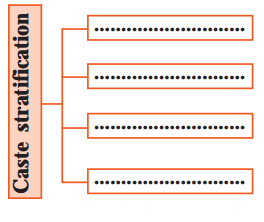

5. (B) State whether the following statements are true or false with reasons.
6. Answer the following in detail (About 150-200 words).
Example : Within this system, individuals can move from one class to another through hard work, education and skills. Ownership of wealth and occupation are the chief criteria of class differences but education, hereditary, prestige, group participation, self identification and recognition by others, also play an important role in class distinction.
Gender as a form of social stratification:
Gender stratification refers to social ranking, where men typically inhabit higher statuses than women. A common general definition of gender stratification refers to the unequal distribution of wealth, power and privilege between the two sexes. Throughout the world, most societies allocate fewer resources to women than men. Almost all societies are characterized by sexism. Sexism is the belief that one sex is superior than the other. Although, societies have been believing in the superiority of men over women and therefore have been dominating women. This male dominance is supported further by patriarchy. The process of socialization is gendered and creates gender hierarchy. Example : Boys are given toy cars or lego sets or bat and ball to play whereas girls are given household sets, medical sets, dolls, etc.
11th Sociology Digest Chapter 7 Social Stratification Intext Questions and Answers
ACTIVITY (Textbook Page No. 75)
In theory, Jabya’s school is supposed to uplift him to a modern and caste-less society where he should be able to choose the work he wants to do. Yet we see how modern education itself is not free from caste. In caste system social set up everything is pre-decided by one’s caste, whom one can love and be friends with, the occupation he has to choose etc. Fandry makes visible the way in which caste is so central to all our relatives.
2. The Polity : Explains about women exercising the power of right to vote, in spite of reservation for women, the number of women in official positions of power are less as world leaders, less number of women at war and peace movements.
3. Crime : Explains the crime committed by women, increase in number of women coming in conflict with the law; women prisons in India are relatively less crowded, women commit fewer and different crimes compared to men.
4. Religion : Most religions elevate the status of men over women and have striker sanctions against women and require them to be submissive.
5. Family : In spite of women sharing the economic role, the role of men in raising children is still minimum or negligible. Traditional sexual division of labour where women looked after the house and men played the role of economic provider is still prevalent in the society. Women are expected to balance between home and work.
6. Health : Women neglect their health and nutrition. The frequency of women to visit a doctor is very less as most of the time they manage with home remedies.
2. Intragenerational mobility this type of mobility takes place in the life span of one generation. Example : A person may start one’s career as a clerk and after acquiring more education over a period of time he becomes an IAS officer. Students should find out similar examples of intergenerational and intragenerational mobility from their surroundings.
Daya Pawar – ‘Baluta’ : It generalizes the status of rural untouchables. Baluta is a collection of memories of life trapped within the framework of India’s caste system. The frustration and helplessness of being born as a Dalit and the inner conflict in the writer’s mind. He thinks of education as a means to escape from his downtrodden life but ends up being the agent of his lifelong distress.
Urmila Pawar – ‘Aaydaan’: The lives of different members of the family are woven together in a narrative that gradually reveals different aspects of the everyday life of Dalits the manifold ways in which caste assets itself and grinds them down.
Omprakash Valmiki – ‘Jhootan’ : An autobiography by Omprakash Valmiki in which he has explored the issues of Dalits. Being socially segregated for centuries the Dalits are obliged to live a helpless life.
Kishor Shantabai Kale – ‘Against all Odds: The book raises many questions about the exploitation life of women in Kolhati community.