Maharashtra State Board Class 11 Sociology Solutions Chapter 6 Socialization
1. (A) Choose the correct alternative and complete the statements.
1. (B) Correct the incorrect pair.
1. (C) Identify the appropriate term from the given options.
(Internet, Peer Group, Childhood, Socialization)
Question 1.
Takes place in the early years of life.
Answer:
Socialization
1. (D) Correct the underlined words and complete the sentence.
2. Write short notes.
Stage 2 – Play stage : A child plays, sometimes as being a mother or a teacher, at times a postal worker, a police officer etc. In this stage, responses are not organized. A child internalises the attitudes of others who are significant to her/his through enacting the roles of others. A significant other is someone whose opinions matter to us and who is in a position to influence our thinking.
Stage 3 – Game stage : As a child matures, and as the self gradually develops, one internalises the expectations of a large number of people. Children learn to behave according to the impressions of others. They understand that role play in each situation involves following a consistent set of rules and expectations. For example, a child at this stage is likely to be aware of the different responsibilities of people in a restaurant who together, make for a smooth dining experience. Thus, the self is mainly formed through our interactions with others and our understanding of others responses. Socialization, in this sense is a process of self-awareness.
2. Peer groups : Peer groups are friendship groups made up of people of similar age. In peer groups, the interactions are reasonably egalitarian as there is a greater amount of give and take, when compared to family or school. Peer groups use informal sanctions including positive sanctions like approving gestures or laughing at your jokes, and negative sanctions like disapproving jokes, labelling or rejecting your company.
3. Schools : Schooling and education are considered as secondary agencies. School involves learning values and norms at a step higher than those learnt in a family. Skills and values like team work, discipline, conformity to authority are learnt in schools and this helps prepare students for the adult world.
4. Mass Media : One of the significant forces of socialization in modern culture is mass media. Mass media are the means for delivering impersonal communication directed to a vast audience. Mass media includes traditional print media like newspapers and magazines, electronic media like radio and television and current IT enabled media and social media. Television has an influence on children from a very young age and affects their cognitive and social development. Modern technological advancements have strengthened and changed the role of mass media. Technology has certainly increased the spread of mass media.
5. Neighbourhood : A neighbourhood community is an important agency of socialization. A neighbourhood is a geographically localized community within a larger city, town or suburb. Neighbourhoods are formed through considerable face to face interaction among members often living near one another. A neighbourhood community provides the base for an individual to extend social relations and interactions beyond the narrow limits of the home.
6. Workplace : Socialization is a life long process. Adult socialization indicates this continuous process of learning. One of the significant agents of adult socialization is the workplace.
Adult individuals spend significant amount of time at the workplace. Socialization through work place involves acquiring new skills, knowledge and behaviour patterns suitable to the requirements of the job.
The person may be in a jail, hospital, in religious organization, police, army etc. In such institutions there is total break up from the normal social life outside. A prison sentence is a good example. The individual not only has to change and rehabilitate one’s behaviour in order to return to society but must also accommodate the new norms required for living, while in prison.
3. Explain the following concept with an example.
Example : Family is the main agent of primary socialization. Peer group and neighbourhood is also seen as a primary socializing agency.
Example : Schooling and education are considered as secondary agencies of socialization. What we learn through a formal curriculum with specific subjects and skills. Schooling involves learning values and norms at a step higher than those learnt in family.
4. (A) Complete the concept maps.

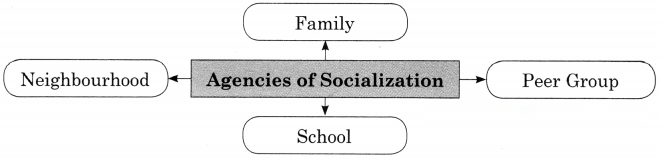
4. (B) State whether the following statements are true or false with reasons.
(ii) Socialization is an ongoing process of continuous learning The birth of a child is a new experience of parenting for a couple. Similarly, older people become grandparents thus creating another set of relationships connecting different generations with each other.
(iii) Thus, socialization as a learning process is life long even though the most critical process happens in the early years but secondary socialization extends over the entire life of a person.
5. Give your personal response.
6. Answer the following question in detail (About 150-200 words).
Internet has helped to transmit information and create awareness about a wide range of issues and events among members of the society. It influences attitudes, values and moulds public opinion and acts as an effective way to change the society. Through the internet we can access online educational courses or training. In fact, any type of information from any part of the world can be accessed through the internet.
There is also negative impact of internet on society as – Youth access the internet and indulge in chatting, emailing, watching restricted site that leads to cyber crimes instead of creating interest in reading and creative activities. Sometimes internet may not give accurate information hence the validity and accuracy of the messages must be considered. Internet reaches the masses in developing countries, but there are many tribal, rural and poor urban people having no access to any kind of information. Communication technologies are expensive and need maintenance. Thus, internet may help to develop knowledge and spread information but it also has adverse effects on the society and have promoted values like individualism and materialism.
11th Sociology Digest Chapter 6 Socialization Intext Questions and Answers
ACTIVITY (Textbook Page No. 68)
Most games are addictive become of the challenges involved. Once the children are engrossed in it, there is no coming back and they strive hard to achieve the next level, the next goal. This sense of achievement targets the brain’s reward system and compels the gamer to perform the act again and again.
Are parents to be blamed?
Children are becoming addictive to online games because they are designed to be addictive and not because parents allow them to play too much.
What is the role of Law?
With dangerous online games like ‘Blue Whale’ claiming several innocent lives in the recent past, the supreme court has directed the centre to constitute a panel of experts to block such life-threatening games.
Uses:
Social networking sites allow users living at distant places within their network to connect to another thus increasing social connection, share ideas, photographs, videos, information and other happenings around the world.
Problem: