Maharashtra State Board 12th Biology Solutions Chapter 3 Inheritance and Variation
1. Multiple Choice Questions
2. Very Short Answer Questions
b. (1) There are many traits in many organisms which show dominance. For example, widow’s peak in human beings is a dominant trait. Yellow seed colour and round seed shape are dominant traits in pea plant.
(2) However, there are characters which are either co-dominant, such as genes for human blood group A and B or incompletely dominant as in flower colour of Mirabilis jalapa.
(3) Therefore the law of dominance is not universally applicable.
3. Short Answer Questions
(2) The separation of one allele does not affect other. Since single allele enters a gamete means gametes will be pure for a trait.
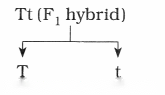
E.g. The contrasting characters such as tall (T) and dwarf (t) present in F1hybrid (Tt) segregate during the formation of gametes.
(3) Owing to this, two types of gametes i.e. T and t are formed which are pure for the characters which they carry.
(4) Thus for example:
X-chromosome | Y-chromosome |
1. X-chromosome is straight, rod like and longer 1. than Y chromosome. It is metacentric. | 1. Y-chromosome is shorter chromosome which is acrocentric. |
2. X-chromosome has large amount of euchromatin and small amount of heterochromatin. | 2. Y-chromosome has small amount of euchromatin and large amount of heterochromatin. |
3. X-chromosome has large amount of DNA, hence it is genetically active due to more genes. | 3. Y-chromosome has less amount of DNA, hence it is genetically less active or inert due to lesser genes. |
4. Non-homologous region of X-chromosome is longer and contains more genes. | 4. Non-homologous region of Y-chromosome is shorter and contains lesser genes. |
5. Contains X-linked genes on non-homologous region. | 5. Contains Y-linked genes on non-homologous region. |
6. X-chromosome is present in men as well as women. | 6. Y-chromosome is present only in men. |
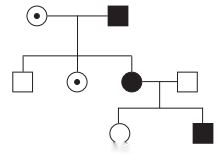
(a) The above pedigree show sex-linked (X-linked) trait. Since criss-cross inheritance is seen in the trait, it must be sex-linked inheritance.
(b) Such trait and its inheritance can be seen in colour blindness.
4. Match the Columns
rewrite the matching pairs.
Column I | Column II |
(1) 21 trisomy | (a) Turner’s syndrome |
(2) X-monosomy | (b) Klinefelter’s syndrome |
(3) Holandric traits | (c) Down’s syndrome |
(4) Feminized male | (d) Hypertrichosis |
Answer:
Column I | Column II |
(1) 21 trisomy | (c) Down’s syndrome |
(2) X-monosomy | (a) Turner’s syndrome |
(3) Holandric traits | (d) Hypertrichosis |
(4) Feminized male | (b) Klinefelter’s syndrome |
5. Long Answer Questions
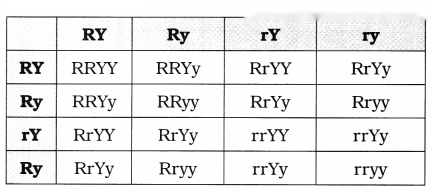
(2) Thus for example, when we cross a true breeding pea plant bearing round and yellow seeds with a true breeding pea plant bearing wrinkled and green seeds we get pea plants bearing round and yellow seeds in the F1generation.
(3) When F1plants are selfed, we get a ratio of 9 : 3 : 3 : 1 in the F2generation, where 9 plants bear yellow round seeds, 3 plants bear yellow wrinkled seeds, 3 plants bear green round seeds and 1 plant bears green wrinkled seeds.
(4) Parents (P1) : RRYY × rryy
Gametes of P1RY and ry
F1generation : RrYy(Yellow round)
On selfing F1: RrYy × RrYy
Gametes of F1: RY, Ry, rY, ry
P2generation:
Round Yellow : 9 Round green : 3 Wrinkled yellow : 3 Wrinkled green : 1
Phenotypic ratio : 9 : 3 : 3 : 1
Genotypic ratio : 1 : 2 : 1 : 2 : 4 : 2 : 1 : 2 : 1
(i) Homozygous tall purple – TTPP
(ii) Homozygous dwarf white – ttpp
Tall purple = 9. Tall white = 3
Dwarf purple = 3, Dwarf white = 1,
Phenotypic ratio = 9 : 3 : 3 : 1
Results : The offspring of F1generation will be in the proportion of 9 : 3 : 3 : 1, where 9 are tall purple, 3 are tall white, 3 are dwarf purple and 1 is dwarf white.

II. In honey bee:

Thus she becomes a carrier without showing any physical characters. She is physically normal and does not suffer from such X-linked recessive disorder. Thus, Madhav will get his answer wrong due to incorrect concept.
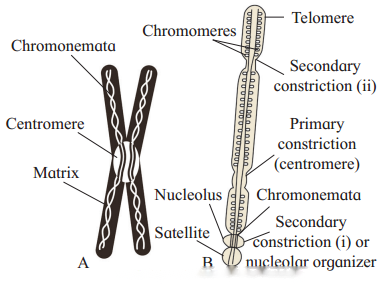
(2) Chromosome shows two identical halves, called sister chromatids. Chromatids are held together at centromere which is also called primary constriction.
(3) Primary constriction has disc shaped plate called kinetochore. This plate is useful for attachment of spindle fibres at the time of cell division.
(4) Additional narrow areas called secondary constrictions are seen in some chromosomes which are known as nucleolar organizers. They help in the formation of nucleolus. At secondary constriction (i) there is nucleolar organising region. Secondary constriction (ii) shows attachment of satellite body or SAT body.
(5) Each chromatid is made up of sub¬chromatids called chromonemata. Each chromonema consists of a long, unbranched, slender, highly coiled DNA thread. This double stranded DNA molecule extends throughout the length of the chromosome.
(6) The ends of the chromatid arms are called telomeres.
I. Inheritance of Colour blindness show criss-cross pattern.
(1) Colour blindness is a sex-linked disorder in which the person concerned cannot distinguish between red and green colours.
(2) It is recessively X-linked disorder, which is expressed in males. It is rarely seen in females.
(3) The genes for normal vision are dominant whereas those for colour blindness are recessive.
(4)
II. Crosses showing the inheritance of colour blindness:
(i) A cross between normal female and colour-blind male.

(ii) A cross of carrier female with normal male.
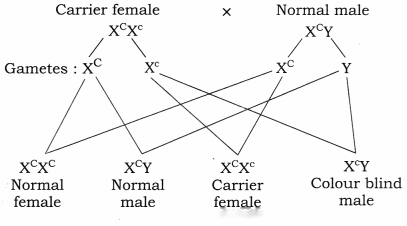
(1) Normal female with Colour blind male. Such cross produces 50% carrier daughters and 50% normal sons.
(2) Carrier female with normal male. Such a cross produces 25% normal daughters, 25% normal sons, 25% carrier daughters and 25% colour blind sons.
(3) Colour blind father transmits the disorder to his grandson through his carrier daughter. The inheritance of characters from the father to his grandson through his daughter is called criss-cross inheritance.
(2) Sub-metacentric : In sub-metacentric chromosome, the centromere is situated some distance away from the middle. Due to this, one arm of the chromosome is shorter than the other. It appears T-shaped during anaphase.
(3) Acrocentric : In acrocentric chromosome, the centromere is situated near the end of the chromosome. One arm of the acrocentric chromosome is very short while the other is long making it appear like ‘J’-shaped during anaphase.
(4) Telocentric : In telocentric chromosome, the centromere is situated at the tip of the chromosome. Telocentric chromosome has only one arm thus it appears rod-shaped.
II. Based on the functions, chromosomes are divided into autosomes and allosomes. Autosomes are somatic chromosomes which decide the body characters. Allosomes are sex chromosomes which decide the sex of the individual.