Chapter 4 Molecular Basis of Inheritance Solutions
Complete Maharashtra State Board Balbharati & Yuvakbharati textbook solutions for Chapter 4 Molecular Basis of Inheritance. Step-by-step solved exercises, numerical problems, and digest answers.
34 Solved Questions• 6 Diagrams• 1710 words
Maharashtra State Board 12th Biology Solutions Chapter 4 Molecular Basis of Inheritance
1. Multiple Choice Questions
Question 1Maharashtra Board Solution
Griffith worked on ……………….. (a) Bacteriophage (b) Drosophila (c) Frog eggs (d) Streptococci
Solution & Step-by-Step Answer:
(d) Streptococci
Question 2Maharashtra Board Solution
The molecular knives of DNA are ……………….. (a) Ligases (b) Polymerases (c) Endonucleases (d) Transcriptase
Solution & Step-by-Step Answer:
(c) Endonucleases
Question 3Maharashtra Board Solution
Translation occurs in the ……………….. (a) Nucleus (b) Cytoplasm (c) Nucleolus (d) Lysosomes
Solution & Step-by-Step Answer:
(b) Cytoplasm
Question 4Maharashtra Board Solution
The enzyme required for transcription is ……………….. (a) DNA polymerase (b) RNApolymerase (c) Restriction enzyme (d) RNase
Solution & Step-by-Step Answer:
(b) RNA polymerase
Question 5Maharashtra Board Solution
Transcription is the transfer of genetic information from ……………….. (a) DNA to RNA (b) t-RNA to m-RNA (c) DNA to m-RNA (d) m-RNA to t-RNA
Solution & Step-by-Step Answer:
(a) DNA to RNA
Question 6Maharashtra Board Solution
Which of the following is NOT part of protein synthesis? (a) Replication (b) Translation (c) Transcription (d) All of these
Solution & Step-by-Step Answer:
(a) Replication
Question 7Maharashtra Board Solution
In the RNA molecule, which nitrogen base is found in place of thymine? (a) Guanine (b) Cytosine (c) Thymine (d) Uracil
Solution & Step-by-Step Answer:
(d) Uracil
Question 8Maharashtra Board Solution
How many codons are needed to specify three amino acids? (a) 3 (b) 6 (c) 9 (d) 12
Solution & Step-by-Step Answer:
(a) 3
Question 9Maharashtra Board Solution
Which out of the following is NOT an example of inducible operon? (a) Lactose operon (b) Histidine operon (c) Arabinose operon (d) Tryptophan operon
Solution & Step-by-Step Answer:
(d) Tryptophan operon
Question 10Maharashtra Board Solution
Place the following event of translation in the correct sequence ……………….. i. Binding of met-t-RNA to the start codon. ii. Covalent bonding between two amino acids. iii. Binding of second t-RNA. iv. Joining of small and large ribosome subunits. (a) iii, iv, i, ii (b) i, iv, iii, ii (c) iv, iii, ii, i (d) ii, iii, iv, i
Solution & Step-by-Step Answer:
(b) i, iv, iii, ii
2. Very Short Answer Questions
Question 1Maharashtra Board Solution
What is the function of an RNA primer during protein synthesis?
Solution & Step-by-Step Answer:
During DNA replication, RNA primer provides 3’ OH to which DNA polymerase enzyme can add nucleotides to synthesize new strand using parental strand of DNA as template. [Note : RNA primer has no direct role in protein synthesis.]
Question 2Maharashtra Board Solution
Why is the genetic code considered as commaless?
Solution & Step-by-Step Answer:
The triplet codon are arranged one after the other on m-RNA molecule without any gap or space and therefore genetic code is considered as commaless.
Question 3Maharashtra Board Solution
Genome
Solution & Step-by-Step Answer:
Genome is the total genetic constitution of an organism or a complete copy of genetic information (DNA) or one complete set of chromosomes (monoploid or haploid) of an organism.
Question 4Maharashtra Board Solution
Which enzyme does remove supercoils from replicating DNA?
Solution & Step-by-Step Answer:
Super-helix relaxing enzyme (Topoisomerase) removes supercoils from replicating DNA.
Question 5Maharashtra Board Solution
Why are Okazaki fragments formed on lagging strand only?
Solution & Step-by-Step Answer:
Okazaki fragments are formed only on lagging template as only short stretch of lagging template becomes available for replication at one time.
Question 6Maharashtra Board Solution
When does DNA replication take place?
Solution & Step-by-Step Answer:
In eukaryotes DNA-replication takes place during S-phase of interphase of cell cycle and in prokaryotes. DNA replicates prior to cell division.
Question 7Maharashtra Board Solution
Define term Codogen and Codon
Solution & Step-by-Step Answer:
Codogen is a triplet of nucleotides present on the DNA which specifies one particular amino acid. Codon is a triplet of nucleotides present on the m-RNA which specifies one particular amino acid.
Question 8Maharashtra Board Solution
What is degeneracy of genetic code?
Solution & Step-by-Step Answer:
Genetic code is degenerate as 61 codons code for 20 amino acids, that is two or more codons can specify the same amino acid. E.g. Cysteine has two codons, while isoleucine has three codons.
Question 9Maharashtra Board Solution
Which are the nucleosomal ‘core’ histones?
Solution & Step-by-Step Answer:
Two molecules each of histone proteins, viz. H2A. H2B, H3 and H4 are the nucleosomal ‘core’ histones.
3. Short Answer Questions
Question 1Maharashtra Board Solution
DNA packaging in eukaryotic cell.
Solution & Step-by-Step Answer:
Question 2Maharashtra Board Solution
Enlist the characteristics of genetic code.
Solution & Step-by-Step Answer:
The characteristics of genetic code are
Question 3Maharashtra Board Solution
Applications of DNA fingerprinting.
Solution & Step-by-Step Answer:
Applications of DNA fingerprinting are as follows:
Question 4Maharashtra Board Solution
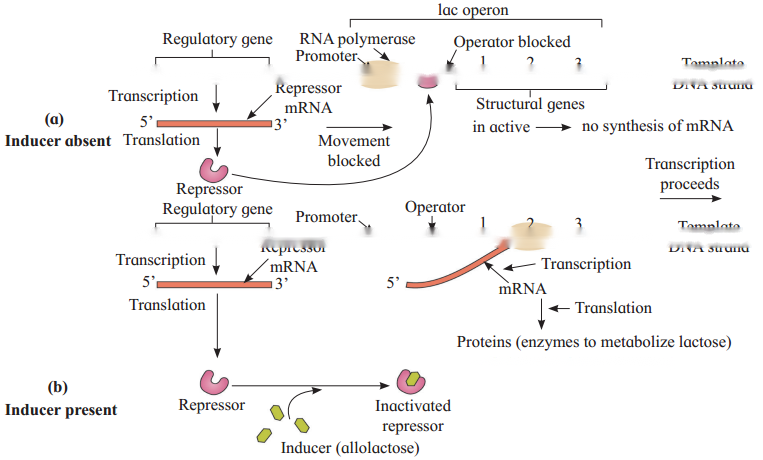
Explain the role of lactose in ‘Lac Operon’.
Solution & Step-by-Step Answer:
4. Short Answer Questions
Question 1Maharashtra Board Solution
Human genome project.
Solution & Step-by-Step Answer:
1. Human Genome Project (HGP) was initiated in 1990 under the International administration of the Human Genome Organization (HUGO) and it was completed r in 2003.
2. The main aims:
3. Significance:
Question 2Maharashtra Board Solution
Describe the structure of operon.
Solution & Step-by-Step Answer:
Question 3Maharashtra Board Solution
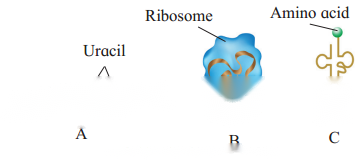
In the figure below A, B and C are three types of
Solution & Step-by-Step Answer:
Answer: A, B and C are A : m-RNA, B : r-RNA, C : t-RNA
Question 4Maharashtra Board Solution
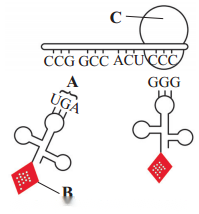
Identify the labelled structures on the following diagram of translation. Part A is the ……………… Part B is the ……………… Part C is the ………………
Solution & Step-by-Step Answer:
Part A is the anti-codon. Part B is the amino acid. Part C is the larger subunit of ribosome.
Question 5Maharashtra Board Solution
Match the entries in Column I with those of Column II and choose the correct
Solution & Step-by-Step Answer:
Column I
Column II
A. Alkali treatment
i. Separation of DNA fragments on gel slab
B. Southern blotting
ii. Splits DNA fragments into single strands
C. Electrophoresis
iii. DNA transferred to nitrocellulose sheet
D. PCR
iv. X-ray photography
E. Autoradiography
v. Produce fragments different sizes
F. DNA treated with REN
vi. DNA amplification
Answer:
Column I
Column II
A. Alkali treatment
ii. Splits DNA fragments into single strands
B. Southern blotting
iii. DNA transferred to nitrocellulose sheet
C. Electrophoresis
i. Separation of DNA fragments on gel slab
D. PCR
vi. DNA amplification
E. Autoradiography
iv. X-ray photography
F. DNA treated with REN
v. Produce fragments different sizes
5. Long Answer Questions
Question 1Maharashtra Board Solution
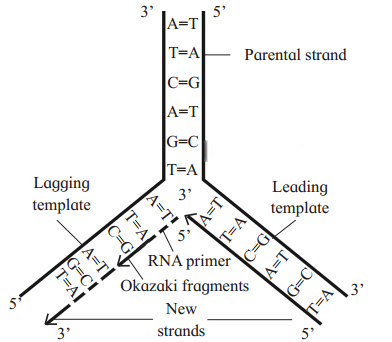
Explain the process of DNA replication.
Solution & Step-by-Step Answer:
DNA replication is semi-conservative replication. It involves following steps: Activation of Nucleotides:
Point of Origin or Initiation point:
Unwinding of DNA molecule:
Replicating fork:
Synthesis of new strands:
Leading and Lagging strand:
Formation of two daughter DNA molecules:
Question 2Maharashtra Board Solution
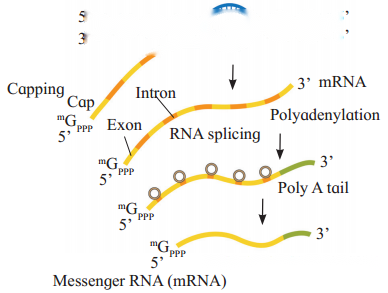
Describe the process of transcription in protein synthesis.
Solution & Step-by-Step Answer:
Transcription involves three stages, viz. Initiation, Elongation and Termination. (1) Initiation:
(2) Elongation:
(3) Termination: When RNA polymerase reaches the terminator site on the DNA, both enzyme and newly formed m-RNA (primary transcript) gets released.
Question 3Maharashtra Board Solution
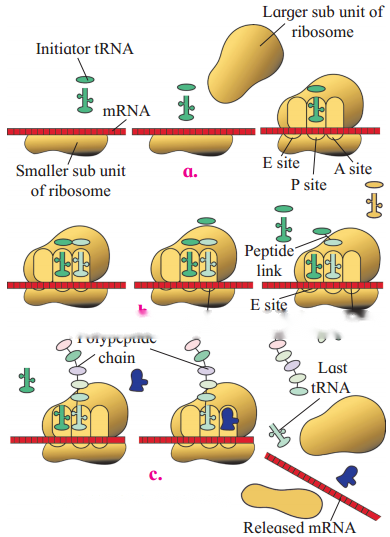
Describe the process of translation in protein synthesis.
Solution & Step-by-Step Answer:
Translation involves the following steps: 1. Activation of amino acids and formation of charged t-RNA (t-RNA – amino acid complex): i. In the presence of an enzyme amino acyl t-RNA synthetase, the amino acid is activated and then attached to the specific t-RNA molecule at 3’ end to form charged t-RNA (t-RNA – amino acid complex).
ii. ATP is essential for the reaction.
2. Initiation of Polypeptide chain:
3. Elongations of polypeptide chain: Addition of amino acid occurs in 3 Step cycle- i. Codon recognition. Anticodon of second (and subsequent) amino acyl t-RNA molecule recognizes and binds with codon at A-site by hydrogen bonds.
ii. Peptide bond formation.
iii. Translocation.
4. Termination and release of polypeptide: When stop codon (UAA, UAG, UGA) gets exposed at the A-site, the release factor binds to the stop codon, thereby terminating the translation process The polypeptide gets released in the cytoplasm. Two subunits of ribosome dissociate and last t-RNA and m-RNA are released in the cytoplasm. m-RNA gets denatured by nucleases immediately.
Question 4Maharashtra Board Solution
Describe Lac ‘Operon’.
Solution & Step-by-Step Answer:
Lac operon consists of the following components: (1) Regulator gene:
(2) Promoter gene:
(3) Operator gene:
(4) Structural gene:
Question 5Maharashtra Board Solution
Justify the statements. If the answer is false, change the underlined word(s) to make the statement true. (i) The DNA molecule is double stranded and the RNA molecule is single stranded.
Solution & Step-by-Step Answer:
(ii) The process of translation occurs at the ribosome. Answer:
(iii) The job of m-RNA is to pick up amino acids and transport them to the ribosomes. Answer: The job of t-RNA is to pick up amino acids and transport them to ribosomes. t-RNA is an adapter molecule. It reads the codons of m-RNA and also simultaneously transfer specific amino acid to m-RNA Ribosome complex. It binds with amino acid at its 3′ end.
(iv) Transcription must occur before translation may occur. Answer: In prokaryotes, translation can start before transcription is complete, as both these processes occur in the same compartment, i.e. cytoplasm. But in eukaryotes, transcription and processing of hnRNA occurs in nucleus. hnRNA then comes out of the nucleus through nuclear pores and then it is translated at ribosomes in the cytoplasm.
Question 6Maharashtra Board Solution
Guess (i) the possible locations of DNA on the collected evidence from a crime scene and (ii) the possible sources of DNA.