Maharashtra State Board Class 12 Chemistry Solutions Chapter 8 Transition and Inner Transition Elements
1. Choose the most correct option.
Question i.
Which one of the following is diamagnetic
a. Cr3⊕
b. Fe3⊕
c. Cu2⊕
d. Sc3⊕Answer:
d. Sc3⊕
Question ii.
Most stable oxidation state of Titanium is
a. +2
b. +3
c. +4
d. +5
Answer:
c. +4
Question iii.
Components of Nichrome alloy are
a. Ni, Cr, Fe
b. Ni, Cr, Fe, C
c. Ni, Cr
d. Cu, Fe
Answer:
(c) Ni, Cr
Question iv.
Most stable oxidation state of Ruthenium is
a. +2
b. +4
c. +8
d. +6
Answer:
(b) +4
Question v.
Stable oxidation states for chromium are
a. +2, +3
b. +3, +4
c. +4, +5
d. +3, +6
Answer:
d. +3, +6
Question vi.
Electronic configuration of Cu and Cu+1
a. 3d10, 4s0; 3d9, 4s0
b. 3d9, 4s1; 3d94s0
c. 3d10, 4s1; 3d10, 4s0
d. 3d8, 4s1; 3d10, 4s0Answer:
c. 3d10, 4s1; 3d10, 4s°
Question vii.
Which of the following have d0s0 configuration
a. Sc3⊕
b. Ti4⊕
c. V5⊕
d. all of the above
Answer:
d. All of the above
Question viii.
Magnetic moment of a metal complex is 5.9 B.M. Number of unpaired electrons in the complex is
a. 2
b. 3
c. 4
d. 5
Answer:
d. 5
Question ix.
In which of the following series all the elements are radioactive in nature
a. Lanthanoids
b. Actinoids
c. d-block elements
d. s-block elements
Answer:
b. Actinides
Question x.
Which of the following sets of ions contain only paramagnetic ions
a. Sm3⊕, Ho3⊕, Lu3⊕
b. La3⊕, Ce3⊕, Sm3⊕
c. La3⊕, Eu3⊕, Gd3⊕
d. Ce3⊕, Eu3⊕, Yb3⊕Answer:
d. Ce3⊕, Eu3⊕, Yb3⊕
Question xi.
Which actinoid, other than uranium, occur in a significant amount naturally?
a. Thorium
b. Actinium
c. Protactinium
d. Plutonium
Answer:
a. Thorium
Question xii.
The flux added during extraction of Iron from hematite are its?
a. Silica
b. Calcium carbonate
c. Sodium carbonate
d. Alumina
Answer:
b. Calcium carbonate
2. Answer the following
Question i.
What is the oxidation state of Manganese in
Answer:
Oxidation state of Manganese in
(i) MnO_{4}^{2-} is +6
(ii) MnO_{4}^{-}is +7
*Question ii.
Give uses of KMnO4
Question iii.
Why salts of Sc3⊕, Ti4⊕, V5⊕are colorless?
Answer:
(i) Sc3+salts are colourless :
(ii) Ti4+salts are colourless :
(iii) Vs5+salts are eolourless :
Question iv.
Which steps are involved in the manufacture of potassium dichromate from chromite ore?
Answer:
Steps in the manufacture of potassium dichromate from chromite ore are :
Question v.
Balance the following equation
(i) KMnO4+ H2C2O4 + H2SO4→ MnSO4+ K2SO4+ H2O + O2
(ii) K2Cr2O7+ KI + H2SO4→ K2SO4+ Cr2(SO4)3+ 7H2O + 3I2Answer:
(i) 2KMnO4+ 3H2SO4+ 5H2C2O4→ K2SO4+ 2MnSO4+ 8H2O + 10CO2(ii) Acidified potassium dichromate oxidises potassium iodide (KI) to iodine (I2). Potassium dichromate is reduced to chromic sulphate. Liberated iodine turns the solution brown K2Cr2O7+ 6KI + 7H2SO4→ 4K2SO4+ Cr2(SO4)3+ 7H2O + 3I2[Oxidation state of iodine increases from – 1 to zero]
Question vi.
What are the stable oxidation states of plutonium, cerium, manganese, Europium?
Answer:
Stable oxidation states :
Plutonium + 3 to + 7
Cerium + 3, + 4
Manganese + 2, + 4, + 6, + 7
Europium +2, +3
Question vii.
Write the electronic configuration of chromium and copper.
Answer:
Chromium (24Cr) has electronic configuration,
24Cr (Expected) : Is22s22p63s23p63d44s2
(Observed) : Is22s22p63s23p63d54s1
Explanation :
Copper (29CU) has electronic configuration,
29Cu (Expected) : Is22s32p63s33p63d94s2
(Observed) : Is22s22p63s23p63d104s1
Explanation :
Hence, the configuration of Cu is [Ar] 3d104s1and not [Ar] 3d94s2.
Question viii.
Why nobelium is the only actinoid with +2 oxidation state?
Answer:
Question ix.
Explain with the help of balanced chemical equation, why the solution of Ce(IV) is prepared in acidic medium.
Answer:
Ce4+undergoes hydrolysis as, Ce4++ 2H2O → Ce(OH)4+ 4H+.
Due to the presence of H+in the solution, the solution is acidic.
Question x.
What is meant by ‘shielding of electrons’ in an atom?
Answer:
The inner shell electrons in an atom screen or shield the outermost electron from the nuclear attraction. This effect is called the shielding effect.
The magnitude of the shielding effect depends upon the number of inner electrons.
Question xi.
The atomic number of an element is 90. Is this element diamagnetic or paramagnetic?
Answer:
The 90th element thorium has an electronic configuration, [Rn] 6d27s2. Since it has 2 unpaired electrons it is paramagnetic.
3. Answer the following
Question i.
Explain the trends in atomic radii of d-block elements
Answer:
Question ii.
Name different zones in the Blast furnace. Write the reactions taking place in them.
Answer:
(i) Zone of combustion : The hot air oxidises coke to CO which is an exothermic reaction, due to which the temperature of furnace rises.
C +1/2O2→ CO ΔH= – 220kJ
Some part of CO dissociates to give finely divided carbon and O2.
2CO → 2C + O2The hot gases with CO rise up in the furnace and heats the charge coming down. CO acts as a fuel as well as a reducing agent.
(ii) Zone of reduction : At about 900 °C, CO reduces Fe2O3to spongy (or porous) iron.
Fe2O3+ 3CO → 2Fe + 3CO2Carbon also reduces partially Fe203to Fe.
Fe2O3+ 3C → 2Fe + 3CO
(iii) Zone of slag formation : At 1200 K limestone, CaCO3in the charge, decomposes and forms a basic flux CaO which further reacts at 1500 K with gangue (SiO2, Al2O3) and forms a slag of CaSiO3and Ca3AlO3.
CaCO3+ CaO + CO2.
CaO + SiO2→ CaSiO312CaO + 2Al2O3→ 4Ca3AlO3+ 3O2
The slag is removed from the bottom of the furnace through an outlet.
(iv) Zone of fusion : The impurities in ore like MnO2and Ca3(PO4)2are reduced to Mn and P while SiO2is reduced in Si. The spongy iron moving down in the furnace melts in the fusion zone and dissolves the impurities like C, Si, Mn, phosphorus and sulphure. The molten iron collects at the bottom of furnace. The lighter slag floats on the molten iron and prevents its oxidation.
The molten iron is removed and cooled in moulds. It is called pig iron or cast iron. It contains about 4% carbon.
Question iii.
What are the differences between cast iron, wrought iron and steel?
Answer:
Cast iron | Wrought iron | Steel |
(1) Hard and brittle | (1) Very soft | (1) Neither too hard nor too soft. |
Question iv.
Iron exhibits +2 and +3 oxidation states. Write their electronic configuration. Which will be more stable? Why?
Answer:
The electronic configuration of Fe2 +and Fe3+:
Fe2+:Is22s22p63s23p63d6Fe3+:Is22s22p63s23p63d5
Due to loss of two electrons from the 4.v-orbital and one electron from the 3d-orbital, iron attains 3+oxidation state. Since in Fe3+, the 3d-orbital is half-filled, it gets extra stability, hence Fe3+is more stable than Fe2+.
Question v.
Give the similarities and differences in elements of 3d, 4d and 5d series.
Answer:
Similarity :
Differences :
Question vi.
Explain trends in ionisation enthalpies of d-block elements.
Answer:
Question vii.
What is meant by diamagnetic and paramagnetic metal? Give one example of diamagnetic and paramagnetic transition metal and lanthanoid metal.
Answer:
Question viii.
Why the ground-state electronic configurations of gadolinium and lawrencium are different than expected?
Question ix.
Write steps involved in the metallurgical process
Answer:
The various steps and principles involved in the extraction of pure metals from their ores are as follows.:
Question x.
Cerium and Terbium behaves as good oxidising agents in +4 oxidation state. Explain.
Answer:
Question xi.
Europium and Ytterbium behave as good reducing agents in +2 oxidation state explain.
Answer:
Activity :
Make groups and each group prepare a PowerPoint presentation on the properties and applications of one element. You can use your imagination to create some innovative ways of presenting data.
You can use pictures, images, flow charts, etc. to make the presentation easier to understand. Don’t forget to cite the reference(s) from where data for the presentation is collected (including figures and charts). Have fun!
12th Chemistry Digest Chapter 8 Transition and Inner Transition Elements Intext Questions and Answers
Do you know? (Textbook Page No 165)
Use your brain power! (Textbook Page No 167)
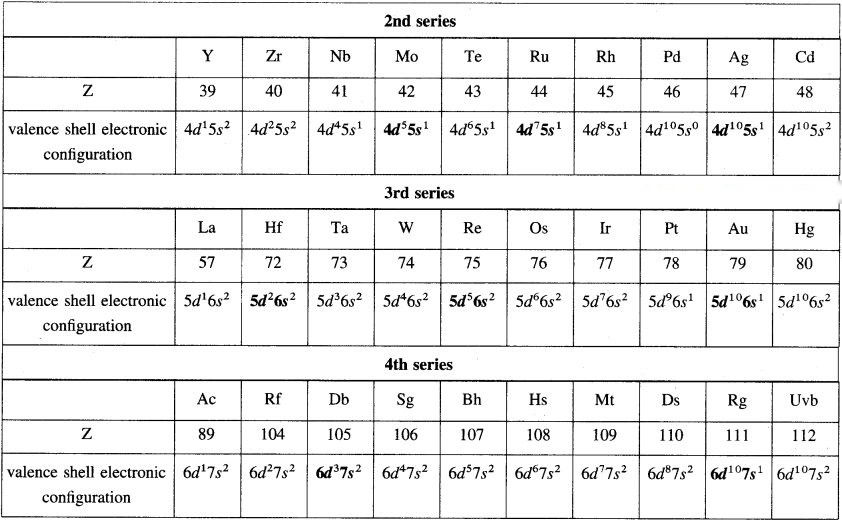
Try this….. (Textbook Page No 168)
Can you tell? (Textbook Page No 168)
Try this ….. (Textbook Page No 168)
Ions | Electronic configuration of valence shell |
Mn6+ | [Ar] 3d1 |
Mn4+ | [Ar] 3d3 |
Fe4+ | [Ar] 3d4 |
Co5+ | [Ar] 3d4 |
Ni2+ | [Ar] 3d8 |
Try this ….. (Textbook Page No 171)
Try this ….. (Textbook Page No 171)
Use your brain power! (Textbook Page No 171)
Problem (Textbook Page No 172)

Try this….. (Textbook Page No 172)

Can you tell? (Textbook Page No 172)
Can you tell? (Textbook Page No 181)
Problem (Textbook Page No 184)
Use your brain power! (Textbook Page No 185)

