Maharashtra State Board Class 12 Chemistry Solutions Chapter 9 Coordination Compounds
1. Choose the most correct option.
Question i.
The oxidation state of cobalt ion in the complex [Co(NH3)5Br]SO4is ……………………….
a. + 2
b. + 3
c. + 1
d. + 4
Answer:
(b) + 3
Question ii.
IUPAC name of the complex [Pt(en)2(SCN)2]2+is ………………………
a. bis (ethylenediamine dithiocyanatoplatinum (IV) ion
b. bis (ethylenediamine) dithiocyantoplatinate (IV) ion
c. dicyanatobis (ethylenediamine) platinate IV ion
d. bis (ethylenediammine)dithiocynato platinate (IV) ion
Answer:
(a) bis(ethylenediamine dithiocyanatoplatinum (IV) ion
Question iii.
Formula for the compound sodium hexacynoferrate (III) is
a. [NaFe(CN)6]
b. Na2[Fe(CN)6]
c. Na[Fe(CN)6]
d. Na3[Fe(CN)6]
Answer:
(d) Na3[Fe(CN)6]
Question iv.
Which of the following complexes exist as cis and trans isomers?
1. [Cr(NH2)2Cl4]⊕
2. [Co(NH3)5Br]2⊕
3. [PtCl2Br2]2⊕(square planar)
4. [FeCl2(NCS)2]2⊕(tetrahedral)
a. 1 and 3
b. 2 and 3
c. 1 and 3
d. 4 only
Answer:
(a) 1 and 3
Question v.
Which of the following complexes are chiral?
1. [Co(en)2Cl2]⊕
2. [Pt(en)Cl2]
3. [Cr(C2O4)3]3⊕
4. [Co(NH3)4CI2]⊕
a. 1 and 3
b. 2 and 3
c. 1 and 4
d. 2 and 4
Answer:
(a) 1 and 3
Question vi.
On the basis of CFT predict the number of unpaired electrons in [CrF6]3⊕.
a. 1
b. 2
c. 3
d. 4
Answer:
(c) 3
Question vii.
When an excess of AgNO3is added to the complex one mole of AgCl is precipitated. The formula of the complex is ……………..
a. [CoCl2(NH3)4]Cl
b. [CoCl(NH3)4] Cl2
c. [CoCl3(NH3)3]
d. [Co(NH3)4]Cl3Answer:
(a) [COCI3(NH3)4]CI
Question viii.
The sum of coordination number and oxidation number of M in [M(en)2C2O4]Cl is
a. 6
b. 7
c. 9
d. 8
Answer:
(c) 9
2. Answer the following in one or two sentences.
Question i.
Write the formula for tetraammineplatinum (II) chloride.
Answer:
Formula of tetraamineplatinum(II) chloride : [Pt(NH3)4]CI2
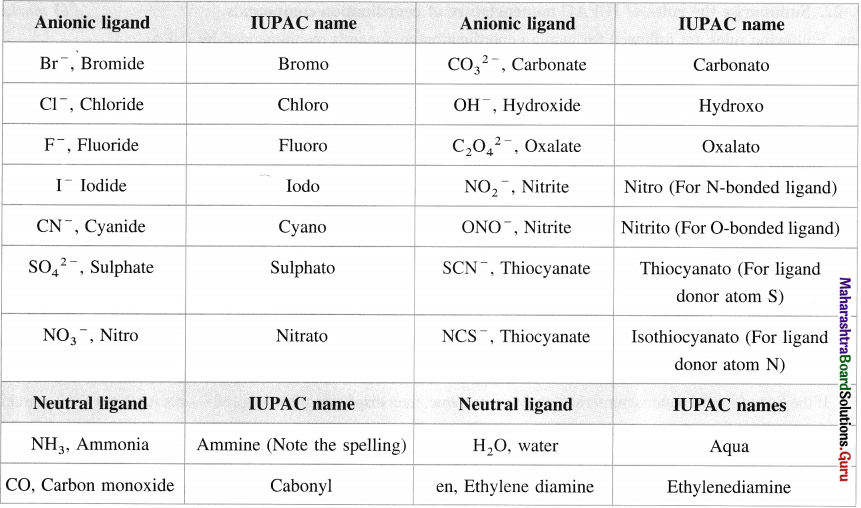
Table 9.1 : IUPAC names of anionic and neutral ligands
Table 9.2: IUPAC names of anionic complexes
Metal | Name |
A1 | Aluminate |
Table 9.3 : IUPAC names of some complexes
Complex | IUPAC name |
(i) Anionic complexes : | |
(a) [Ni(CN)J2-(b) [Co(C204)3]3-(c) [Fe(CN)6]4- | Tetracyanonickelate(II) ion Trioxalatocobaltate(III) ion |
(ii) Compounds containing complex anions and metal cations : | |
(a) Na3[Co(N02)6] | Sodium hexanitrocobaltate(III) |
(iii) Cationic complexes : | |
(a) [Cu(NH3)4]2+(b) [Fe(H20)5(NCS)]2+(c) [Pt(en)2(SCN)2]2+ | Tetraamminecopper(II) ion |
(iv) Compounds containing complex cation and anion : | |
(a) [PtBr2(NH3)4]Br2(b) [Co(NH3)5C03]CI | Tetraamminedibromoplatinum(IV) bromide, Pentaamminecarbonatocobalt(III) chloride, Pentaammineaquacobalt(III) iodide |
(v) Neutral complexes : | |
(a) Co(N02)3(NH3)3(b) Fe(CO)5(c) Rh(NH3)3(SCN)3 | Triamminetrinitrocobalt(III) Pentacarbonyliron(0) Triamminetrithiocyanatorhodium(III) |
Question ii.
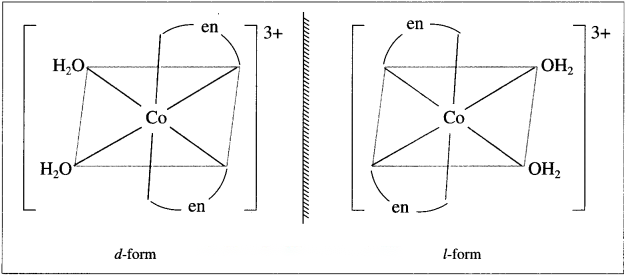
Predict whether the [Cr(en)2(H2O)2]3+complex is chiral. Write structure of its enantiomer.
Answer:
(i) Complex is chiral.
(ii) The following are its enantiomers
Question iv.
Name the Lewis acids and bases in the complex [PtCl2(NH3)2].
Answer:
Lewis acid : Pt2+
Lewis bases : Cl–and NF3
Question v.
What is the shape of a complex in which the coordination number of central metal ion is 4?
Answer:
A complex with the coordination number of central metal ion equal to 4 may be tetrahedral or square planar.
Question vi.
Is the complex [CoF6] cationic or anionic if the oxidation state of cobalt ion is +3?
Answer:
In the complex, Co carries + 3 charge while 6F–carry – 6 charge. Hence the net charge on the complex is – 3.
Therefore it is an anionic complex.
Question vii.
Consider the complexes [Cu(NH3)4][PtCl4] and [Pt(NH3)4] [CuCl4]. What type of isomerism these two complexes exhibit?
Answer:
Since in these two given complexes, there is an exchange of ligands between cationic and anionic constituents, they exhibit coordination isomerism.
Question viii.
Mention two applications of coordination compounds.
Answer:
(1) In biology : Several biologically important natural compounds are metal complexes which play an important role in number of processes occurring in plants and animals.
For example, chlorophyll in plants is a complex of Mg2+ions, haemoglobin in blood is a complex of iron, vitamin B12is a complex of cobalt.
(2) In medicine : The complexes are used on a large scale in medicine. Many medicines in the complex form are more stable, more effective and can be assimilated easily.
For example, platinum complex [Pt(NH3)2CI2] known as cisplatin is effectively used in cancer treatment. EDTA is used to treat poisoning by heavy metals like lead.
(3) To estimate hardness of water :
Similarly these ions can be selectively estimated due to the difference in their stability constants.
(4) Electroplating : This involves deposition of a metal on the other metal. For smooth plating, it is necessary to supply continuously the metal ions in small amounts.
For this purpose, a solution of a coordination compound is used which dissociates to a very less extent. For example, for uniform and thin plating of silver and gold, the complexes K[Ag(CN)2] and K[Au(CN)2] are used.
3. Answer in brief.
Question i.
What are bidentate ligands? Give one example.
Answer:
Bidentate ligand : This ligand has two donor atoms in the molecule or ion. For example, ethylenediamine, H2N – (CH2)2– NH2.
Question ii.
What is the coordination number and oxidation state of metal ion in the complex [Pt(NH3)Cl5]2?
Answer:
Coordination number = 6
Oxidation state of Pt = +4.
Question iii.
What is the difference between a double salt and a complex? Give an example.
Answer:
Double salt | Coordination compound (complex) |
(1) Double salts exist only in the solid state and dissociate into their constituent ions in the aqueous solutions. | (1) Coordination compounds exist in the solid-state as well as in the aqueous or non-aqueous solutions. |
(2) Double salts lose their identity in the solution. | (2) They do not lose their identity completely. |
(3) The properties of double salts are same as those of their constituents. | (3) The properties of coordination compounds are different from their constituents. |
(4) Metal ions in the double salts show their normal valence. | (4) Metal ions in the coordination compounds show two valences namely primary valence and secondary valence satisfied by anions or neutral molecules called ligands. |
(5) For example in K2SO4. K2SO4. A12(SO4)3. 24H2O. The ions K+, Al3 +and SO4show their properties. | (5) In K4[Fe(CN)6], ions K+and [Fe(CN)6]4‘~ ions show their properties. |
Question iv.
Classify the following complexes as homoleptic and heteroleptic
[Cu(NH3)4]SO4, [Cu(en)2(H2O)Cl]3⊕, [Fe(H2O)5(NCS)]2⊕, tetraammine zinc (II) nitrate.
Answer:
Homoleptic complex :
(a) [Cu(NH3)4]SO4
(d) Tetraaminezinc (II) nitrate : [Zn(NH3)4](NO3)2
Heteroleptic Complex :
(b) [Cu(en)2(H2O)CI]2+
(c) [Fe(H2O)5(NCS)]2+
Question v.
Write formulae of the following complexes
a. Potassium ammine-tri chloroplatinate (II)
b. Dicyanoaurate (I) ion
Answer:
(a) Potassium amminetrichloroplatinate(II) K[Pt(NH3)CI3]
(b) Dicyanoaurate (I) ion [AU(CN)2]–
Question vi.
What are ionization isomers? Give an example.
Answer:
Ionisation isomers : The coordination compounds having same molecular composition but differ in the compositions of coordination (or inner) sphere and outer sphere and produce different ions on ionisation in the solution are called ionisation isomers. For example, Pentaamminesulphatocobalt (III) bromide [Co(NH3)5SO4] Br, Pentaamminebromocobalt(III) sulphate [Co(NH3)5Br] SO4.
Question vii.
What are the high-spin and low-spin complexes?
Answer:
(1) High spin complex (HS) :
(2) Low spin complex (LS) :
Table 9.5 : d-orbitai diagrams fir high spin and low spin complexes
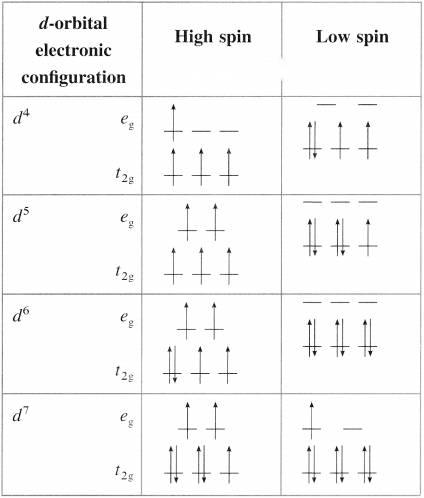
(Only the electronic configurations c4 to d1 render the high spin and low spin complexes)
Question viii.
[CoCl4]2⊕is a tetrahedral complex. Draw its box orbital diagram. State which orbitals participate in hybridization.
Answer:
27Co [Ar] 3d74s2
Oxidation state of Co = +2 Co2+[Ar] 3d74s°
Since CI–is a weak ligand, there is no pairing of electrons. Since C.N. is 4, there is sp3hybridisation.

Question ix.
What are strong field and weak field ligands? Give one example of each.
Answer:
The ligands are then classified as (a) strong field and (b) weak field ligands. Strong field ligands are those in which donor atoms are C,N or P. Thus CN–, NC–, CO, HN3, EDTA, en (ethylenediammine) are considered to be strong ligands. They cause larger splitting of d orbitals and pairing of electrons is favoured. These ligands tend to form low spin complexes. Weak field ligands are those in which donor atoms are halogens, oxygen or sulphur.
For example, F–, CI–, Br–, I–, SCN–, C2O42-. In case of these ligands the A0 parameter is smaller compared to the energy required for the pairing of electrons, which is called as electron pairing energy. The ligands then can be arranged in order of their increasing field strength as
I–< Br–< CI–< S2-< F–< OH–< C2O42-< H2O < NCS–< EDTA < NH3< en < CN–< CO.
Question x.
With the help of a crystal field energy-level diagram explain why the complex [Cr(en)3]3⊕is coloured?
Answer:
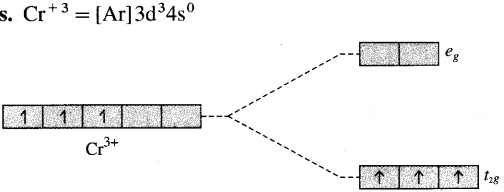
Since (en) is a strong field ligand there is pairing of electrons. The electrons occupy the t2gorbitals of lower energy. It has one unpaired electron. Due to d-d transition, it is coloured.
4. Answer the following questions.
Question i.
Give valence bond description for the hybrid orbitals are used by the metal? State the number of unpaired electrons.
Answer:
Since CI–is a weak ligand, there is no pairing of electrons.
Number of unpaired electrons = 2
Type of hybridisation = sp3
Geometry of complex ion = Tetrahedral
The complex ion is paramagnetic.
Question ii.
Draw a qualitatively energy-level diagram showing d-orbital splitting in the octahedral environment. Predict the number of unpaired electrons in the complex [Fe(CN)6]4⊕. Is the complex diamagnetic or paramagnetic? Is it coloured? Explain.
Answer:
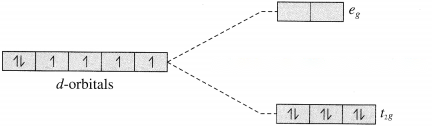
(A) r-orbital splitting in the octahedral environment :
(B) [Fe (CN)6]4-is an octahedral complex.
(C) Since CN–is a strong ligand, there is pairing of electrons and the complex is diamagnetic.
(D) The complex exists as lemon yellow crystals.
(In the complex all electrons in t2gare paired and requires high radiation energy for excitation.)
Question iii.
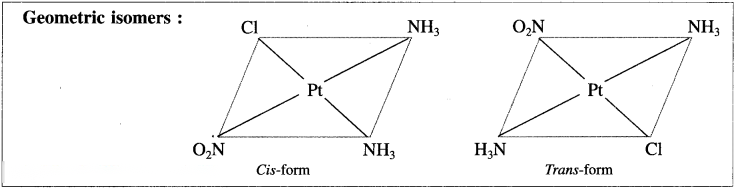
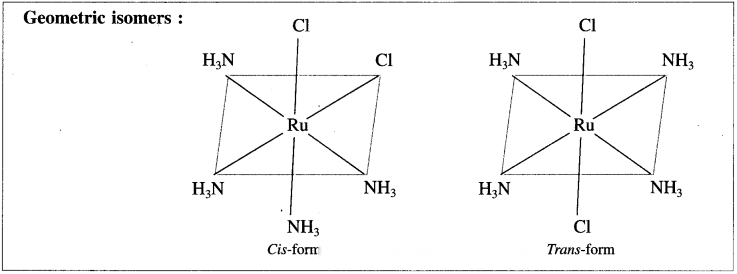
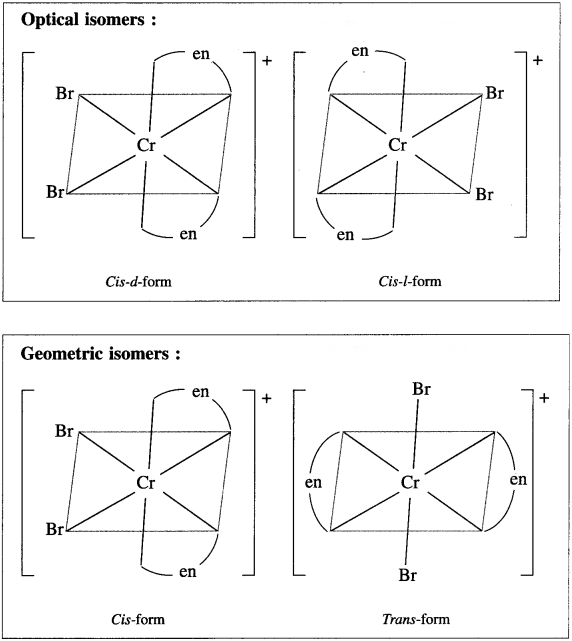
Draw isomers in each of the following
a. [Pt(NH3)2ClNO2]
b. [Ru(NH3)4Cl2]
c. [Cr(en2)Br2]⊕Answer:
(a) [Pt(NH3)2CINO2]
(b) [RU(NH3)4CI2]
(c) [Cr(en2)Br2]+
Question iv.
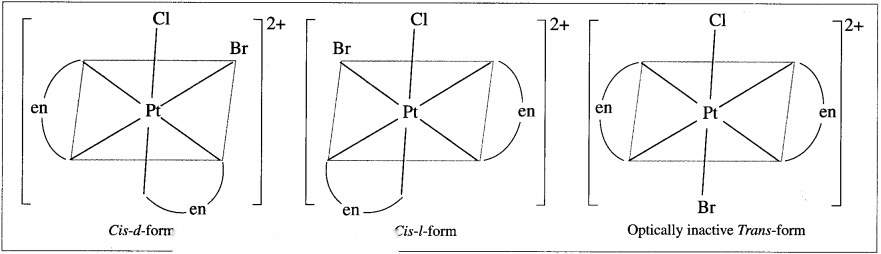
Draw geometric isomers and enantiomers of the following complexes.
a. [Pt(en)3]4⊕
b. [Pt(en)2ClBr]2⊕Answer:
The complex [Pt(en)3]4+has two optical isomers.

Question v.
What are ligands? What are their types? Give one example of each type.
Answer:
Ligands : The neutral molecules or negatively charged anions (or rarely positive ions) which are bonded by coordinate bonds to the central metal atom or metal ion in a coordination compound are called ligands or donor groups. For example in [Cu(CN)4]2-, four CN–ions are ligands coordinated to central metal ion Cu2+. Ligands can be classified on the basis of number of electron donor atoms in the ligand i.e. denticity.
(1) Monodentate or unidentate ligand : A ligand molecule or an ion which has only one donor atom with a lone pair of electrons forming only one coordinate bond with metal atom or ion in the complex is called monodentate or unidentate ligand. For example NH3, Cl–, OH–, H2O, etc.
(2) Polydentate or multidentate ligand : A ligand molecule or an ion which has two or more donor atoms with the lone pairs of electrons forming two or more coordinate bonds with the central metal atom or ion in the complex is called polydentate or multidentate ligand. For example, ethylene diamine, H2N – (CH2)2– NH2.
According to the number of donor atoms they are classified as follows :
(3) Ambidentate ligand : A ligand molecule or an ion which has two or more donor atoms, however in the formation of a complex, only one donor atom is attached to the metal atom or an ion is called ambidentate ligand. For example, NO–2which has two donor atoms N and O forming a coordinate bond, M ← ONO (nitrito) or M ← NO2(nitro).
(4) Bridging ligand : A monodentate ligand having more than one lone pairs of electrons, hence can attach to two or more metal atoms or ions and hence acts as a bridge between different metal atoms is called bridging ligand. For example : OH–, F–, SO4-2, etc.
Question vi.
What are cationic, anionic and neutral complexes? Give one example of each.
Answer:
(1) Cationic sphere complexes : A positively charged coordination sphere or a coordination compound having a positively charged coordination sphere is called cationic sphere complex.
For example : [Zn(NH3)4]2+and [Co(NH3)5CI] SO4are cationic complexes. The latter has coordination sphere [Co(NH3)5CI]2+, the anion SO42+makes it electrically neutral.
(2) Anionic sphere complexes : A negatively charged coordination sphere or a coordination compound having negatively charged coordination sphere is called anionic sphere complex. For example, [Ni(CN)4]2+and K3[Fe(CN)6] have anionic coordination sphere; [Fe(CN)6]3-and three K+ ions make the latter electrically neutral.
(3) Neutral sphere complexes : A neutral coordination complex does not possess cationic or anionic sphere.
[Pt(NH3)2CI2] or [Ni(CO)4] are neither cation nor anion but are neutral sphere complexes.
Question vii.
How stability of the coordination compounds can be explained in terms of equilibrium constants?
Answer:
Stability of the coordination compounds : The stability of coordination compounds can be explained on the basis of their stability constants. The stability of coordination compounds depends on metal-ligand interactions. In the complex, metal serves as electron-pair acceptor (Lewis acid) while the ligand as Lewis base (since it is electron
donor). The metal-ligand interaction can be realized as the Lewis acid-Lewis base interaction. Stronger the interaction greater is stability of the complex.
Consider the equilibrium for the metal-ligand interaction :
Ma++ nLx-⇌ [MLn]a+(-nx)
where a, x, [a + ( – nx)] denote the charge on the metal, ligand and the complex, respectively. Now, the equilibrium constant K is given by
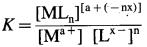
Stability of the complex can be explained in terms of K. Higher the value of K larger is the thermodynamic stability of the complex hence K is called stability constant, and denoted by Kstah. The equilibria for the complex formation with the corresponding K values are given below.
Ag++ 2CN–⇌ [Ag(CN)2]–K = 5.5 x 10¹⁸
Cu2++ 4CN–⇌ [CU(CN)4]2-K = 2.0 x 1027
Co3++ 6NH3⇌ [CO(NH3)6]3+K = 5.0 x 1033
From the above data, the stability of the complexes is [Co(NH3)6]3+> [Cu(CN)4]2-> [Ag(CN)2]–.
Question viii.
Name the factors governing the equilibrium constants of the coordination compounds.
Answer:
The equilibrium constant of the complex depends on the following factors :
(a) Charge to size ratio of the metal ion : Higher the ratio greater is the stability. For the divalent metal ion complexes their stability shows the trend : Cu2+> Ni2+> Co2+> Fe2+> Mn2+> Cd2+. The above stability order is called the Irving-William order. In the above list both Cu and Cd have the charge + 2, however, the ionic radius of Cu2 + is 69 pm and that of Cd2 + is 97 pm. The charge to size ratio of Cu2+is greater than that of Cd2+. Therefore the Cu2+forms stable complexes than Cd2+.
(b) Nature of the ligand : A second factor that governs stability of the complexes is related to how easily the ligand can donate its lone pair of electrons to the central metal ion that is, the basicity of the ligand. The ligands those are stronger bases tend to form more stable complexes.
Activity :
1. The reaction of chromium metal with H 2SO4 in the absence of air gives blue solution of chromium ion.
Cr(s) + 2H⊕(aq) → Cr2⊕(aq) + H2(s)
Cr2⊕forms octahedral complex with H2O ligands.
a. Write formula of the complex
b. Describe bonding in the complex using CFT and VBT.
Draw crystal field splitting and valence bond orbital diagrams.
2. Reaction of complex [Co(NH3)3(NO2)3with HCl gives a complex [Co(NH3)3H2OCl2]⊕in which two chloride ligands are trans to one another.
a. Draw possible stereoisomers of starting material
b. Assuming that NH3groups remain in place, which of two starting isomers would give the observed product?
12th Chemistry Digest Chapter 9 Coordination Compounds Intext Questions and Answers
Use your brain power ……. (Textbook page 192)
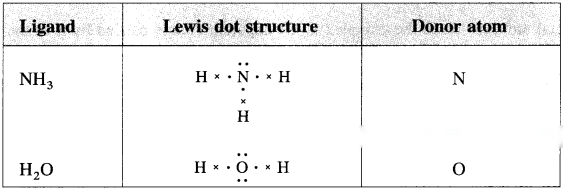
Try this ………. (Textbook page 193)
Can you tell ? (Textbook page 193)
Use vour brain power………………(Textbook page 193)
Can you tell? ……………….(Textbook page 194)
Use your brain power ……… (Textbook page 195)
Use your brain power ……… (Textbook page 195)
Try this ……. (Textbook page 197)
Try this ……(Textbook page 196)
(Note : This is atomic number of the nearest inert element 36Kr.)
(b) For the complex ion, [Fe(CN)J4-:
For Fe, Z = 26 (Atomic number)
X = 2 (Due to + 2 charge on Fe)
Y = 12 (Due to 6 CN–ligands)
∴ EAN = Z – X + Y
= 26 – 2 + 12
= 36
Use your brain power ……(Textbook page 197)
(d) Fe(CO)5 : EAN = Z – X + Y
= 26 – 0 + 10
= 36
Conclusion :
(a) Cr(CO)4and (c) Mn(CO)5do not follow EAN Rule.
Try this ….. (Textbook page 199)
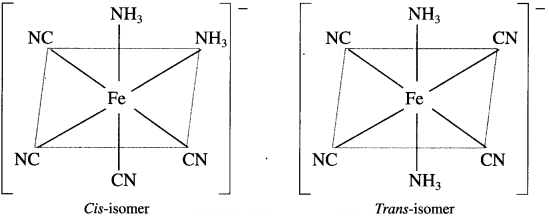
Remember ….. (Textbook page 199)
Our hands are non-superimposable mirror images. When you hold your left hand up to a mirror the image looks like right hand.
Try this ….. (Textbook page 199)


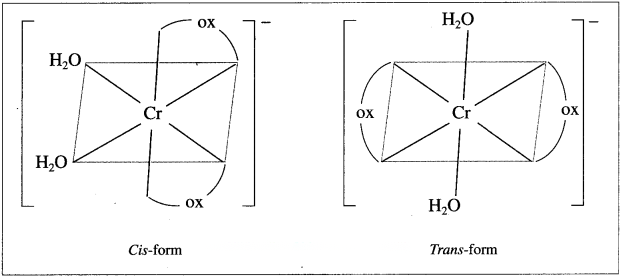
(B) as and trans isomers :
Can you tell ? ….. (Textbook page 200)


Use your brain power …..(Textbook page 201)
Remember …… (Textbook Page 202)
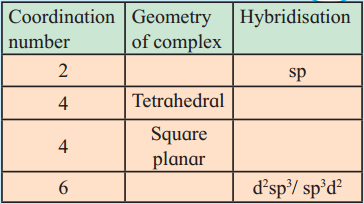
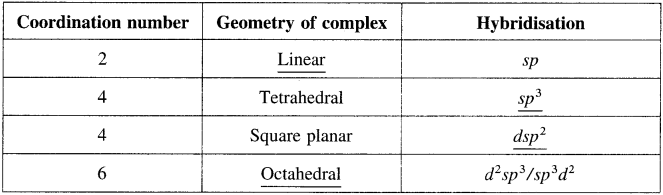
(Note : The missing entries are underlined.)
Table 9.3: Type of hybridisation and geometry of a complex

Try this ….. (Textbook page 204)
Question 1
Maharashtra Board Solution
Based on the VBT predict structure and magnetic behaviour of the [Ni(NH3)6]
Solution & Step-by-Step Answer:
block bg-white dark:bg-slate-900/80 border-l-4 border-emerald-500 rounded-r-xl p-5 my-3 shadow-xs border border-slate-200/60 dark:border-slate-800">
Solution & Step-by-Step Answer:
28Ni [Ar] 3d8 4s2 Ni3+ [Ar] 3d7 4s° Hybridisation : sp3d2 Geometry : Octahedral Magnetic property : Paramagnetic
Try this ……(Textbook page 202)
Question 1
Maharashtra Board Solution
Give VBT description of bonding in each of following complexes. Predict their magnetic behaviour. (a) [ZnCI4]2+ (b) [CO(H2O)6]2- (high spin) (c) [Pt(CN)4]2- (square planar) (d) [CoCI4]2- (tetrahedral) (e) [Cr(NH3)6]3+ |
Try this …….(Textbook page 206)
Question 1
Maharashtra Board Solution
Sketch qualitatively crystal field d orbital energy level diagrams for each of the following complexes : (a) [Ni(en)3]2+ (b) [Mn(CN)6]3- (c) [Fe(H2O)6]2+ Predict whether each of the complexes is diamagnetic or paramagnetic.
Solution & Step-by-Step Answer:
block bg-white dark:bg-slate-900/80 border-l-4 border-emerald-500 rounded-r-xl p-5 my-3 shadow-xs border border-slate-200/60 dark:border-slate-800">
Solution & Step-by-Step Answer:
(a) The complex ion, [Ni(en)3]2+ is octahedral. 28Ni [Ar] 3d8 4s2 Ni2+ [Ar] 3d8 4s°.
Since en is a strong ligand there is pairing of electrons. The complex ion is paramagnetic. (b) The complex ion [Mn(CN)6]3-is octahedral.
Since CN–is a strong ligand there is pairing of electrons. The complex ion is paramagnetic. (c) The complex ion [Fe(H2O)6]2+is octahedral.
Since H2O is a weak ligand, there is no pairing of electrons. |


