Balbharati Maharashtra State Board12th Commerce Maths Solution Book PdfChapter 1 Mathematical Logic Miscellaneous Exercise 1 Questions and Answers.
Maharashtra State Board 12th Commerce Maths Solutions Chapter 1 Mathematical Logic Miscellaneous Exercise 1
(I) Choose the correct alternative:
(II) Fill in the blanks:
(III) State whether each of the following is True or False:
(IV) Solve the following:
(ii) x + 3 = 8, x is variable.
Solution:
It is a statement.
(iii) Read a lot to improve your writing skill.
Solution:
It is an imperative sentence, hence it is not a statement.
(iv) z is a positive number.
Solution:
It is an open sentence, hence it is not a statement.
(v) (a + b)2= a2+ 2ab + b2for all a, b ∈ R.
Solution:
It is a statement.
(vi) (2 + 1)2= 9.
Solution:
It is a statement.
(vii) Why are you sad?
Solution:
It is an interrogative sentence, hence it is not a statement.
(viii) How beautiful the flower is!
Solution:
It is an exclamatory sentence, hence it is not a statement.
(ix) The square of any odd number is even.
Solution:
It is a statement.
(x) All integers are natural numbers.
Solution:
It is a statement.
(xi) If x is a real number, then x2≥ 0.
Solution:
It is a statement.
(xii) Do not come inside the room.
Solution:
It is an imperative sentence, hence it is not a statement.
(xiii) What a horrible sight it was!
Solution:
It is an exclamatory sentence, hence it is not a statement.
(ii) The square of every real number is positive.
Solution:
It is a statement that is false, hence its truth value is F.
(iii) Every parallelogram is a rhombus.
Solution:
It is a statement that is true, hence its truth value is T.
(iv) a2– b2= (a + b)(a – b) for all a, b ∈ R.
Solution:
It is a mathematical identity that is true, hence its truth value is T.
(v) Please carry out my instruction.
Solution:
It is an imperative sentence, hence it is not a statement.
(vi) The Himalayas is the highest mountain range.
Solution:
It is a statement that is true, hence its truth value is T.
(vii) (x – 2)(x – 3) = x2– 5x + 6 for all x ∈ R.
Solution:
It is a mathematical identity that is true, hence its truth value is T.
(viii) What are the causes of rural unemployment?
Solution:
It is an interrogative sentence, hence it is not a statement.
(ix) 0! = 1.
Solution:
It is a statement that is true, hence its truth value is T.
(x) The quadratic equation ax2+ bx + c = 0 (a ≠ 0) always has two real roots.
Solution:
It is a statement that is false, hence its truth value is F.
(ii) Mona likes Mathematics and Physics.
Solution:
Let p : Mona likes Mathematics.
q : Mona likes Physics.
Then the symbolic form of the given statement is p ∧ q.
(iii) 3 is a prime number if 3 is a perfect square number.
Solution:
Let p : 3 be a prime number.
q : 3 is a perfect square number.
Then the symbolic form of the given statement is p ↔ q.
(iv) Kavita is brilliant and brave.
Solution:
Let p : Kavita is brilliant.
q : Kavita is brave.
Then the symbolic form of the given statement is p ∧ q.
(v) If Kiran drives a car, then Sameer will walk.
Solution:
Let p : Kiran drives a car.
q : Sameet will walk.
Then the symbolic form of the given statement is p → q.
(vi) The necessary condition for the existence of a tangent to the curve of the function is continuity.
Solution:
The given statement can be written as:
‘If the function is continuous, then the tangent to the curve exists.’
Let p : The function is continuous.
q : Tangent to the curve exists.
Then the symbolic form of the given statement is p → q.
(vii) To be brave is necessary and sufficient condition to climb Mount Everest.
Solution:
Let p : To be brave.
q : Climb Mount Everest.
Then the symbolic form of the given statement is p ↔ q.
(viii) x3+ y3= (x + y)3, iff xy = 0.
Solution:
Let p : x3+ y3= (x + y)3.
q : xy = 0.
Then the symbolic form of the given statement is p ↔ q.
(ix) The drug is effective though it has side effects.
Solution:
Let p : The drug is effective.
q : It has side effects.
Then the symbolic form of the given statement is p ∧ q.
(x) If a real number is not rational, then it must be irrational.
Solution:
Let p : A real number is not rational.
q : It must be irrational.
Then the symbolic form of the given statement is p → q.
(xi) It is not true that Ram is tall and handsome.
Solution:
Let p : Ram is tall.
q : Ram is handsome.
Then the symbolic form of the given statement is ~(p ∧ q).
(xii) Even though it is not cloudy, it is still raining.
Solution:
The given statement is equivalent to:
It is not cloudy and it is still raining,
Let p : It is not cloudy.
q : It is still raining.
Then the symbolic form of the given statement is p ∧ q.
(xiii) It is not true that intelligent persons are neither polite nor helpful.
Solution:
Let p : Intelligent persons are neither polite nor helpful.
Then the symbolic form of the given statement is ~p.
(xiv) If the question paper is not easy, then we shall not pass.
Solution:
Let p : The question paper is not easy.
q : We shall not pass.
Then the symbolic form of the given statement is p → q.
(ii) p → r
Solution:
If Sachin wins the match, then he is happy.
(iii) ~p ∨ q
Solution:
Sachin does not win the match or he is a member of the Rajya Sabha.
(iv) p → (q ∨ r)
Solution:
If Sachin wins the match, then he is a member of the Rajya Sabha or he is happy.
(v) p → q
Solution:
If Sachin wins the match, then he is a member of the Rajya Sabha.
(vi) (p ∧ q) ∧ ~r
Solution:
Sachin wins the match and he is a member of the Rajya Sabha but he is not happy.
(vii) ~(p ∨ q) ∧ r
Solution:
It is false that Sachin wins the match or he is a member of the Rajya Sabha but he is happy.
(ii) If 9 > 1, then x2– 2x + 1 = 0 for x = 1.
Solution:
Let p : 9 > 1.
q : x2– 2x + 1 = 0 for x = 1.
Then the symbolic form of the given statement is p → q.
The truth values of both p and q are T.
∴ the truth value of p → q is T. …..[T → T ≡ T]
(iii) x + y = 0 is the equation of a straight line if and only if y2= 4x is the equation of the parabola.
Solution:
Let p : x + y = 0 is the equation of a straight line.
q : y2= 4x is the equation of the parabola.
Then the symbolic form of the given statement is p ↔ q.
The truth values of both p and q are T.
∴ the truth value of p ↔ q is T. …..[T ↔ T ≡ T]
(iv) It is not true that 2 + 3 = 6 or 12 + 3 = 5.
Solution:
Let p : 2 + 3 = 6.
q : 12 + 3 = 5.
Then the symbolic form of the given statement is ~(p ∨ q).
The truth values of both p and q are F.
∴ the truth value of ~(p ∨ q) is T. …..[~(F ∨ F) ≡ ~F ≡ T]
(i) Stock prices are not high or stocks are rising.
p and q are true, i.e. T.
∴ ~p and ~q are false, i.e. F.
The given statement in symbolic form is ~p ∨ q.
Since, ~T ∨ T ≡ F ∨ T ≡ T, the given statement is true.
Hence, its truth value is ‘T’.
(ii) Stock prices are high and stocks are rising if and only if stock prices are high.
Solution:
The given statement in symbolic form is (p ∧ q) ↔ p.
Since (T ∧ T) ↔ T ≡ T ↔ T ≡ T, the given statement is true.
Hence, its truth value is ‘T’.
(iii) If stock prices are high, then stocks are not rising.
Solution:
The given statement in symbolic form is p → ~q.
Since, T → ~T ≡ T → F ≡ F, the given statement is false.
Hence, its truth value is ‘F’.
(iv) It is false that stocks are rising and stock prices are high.
Solution:
The given statement in symbolic form is ~(q ∧ p).
Since, ~(T ∧ T) ≡ ~T ≡ F, the given statement is false.
Hence, its truth value is ‘F’.
(v) Stock prices are high or stocks are not rising iff stocks are rising.
Solution:
The given statement in symbolic form is (p ∨ ~q) ↔ q.
Since (T ∨ ~T) ↔ T ≡ (T ∨ F) ↔ T
≡ T ↔ T
≡ T, the given statement is true.
Hence, its truth value is ‘T’.
Question 8
Maharashtra Board Solution
Rewrite the following statements without using conditional: [Hint: P → q ≡ ~p ∨ q] (i) If price increases, then demand falls. (ii) If demand falls, then the price does not increase.
Solution & Step-by-Step Answer:
Since, p → q ≡ ~p ∨ q, the given statements can be written as: (i) Price does not increase or demand falls. (ii) Demand does not fall or price does not increase.
Question 9
Maharashtra Board Solution
If p, q, r are statements with truth values T, T, F respectively, determine the truth values of the following: (i) (p ∧ q) → ~p
Solution & Step-by-Step Answer:
Truth values of p, q, r are T, T, F respectively. (p ∧ q) → ~p ≡ (T ∧ T) → ~T ≡ T → F ≡ F Hence, the truth value of the given statement is false, i.e. F.
(ii) p ↔ (q → ~p) (iii) (p ∧ ~q) ∨ (~p ∧ q) (iv) ~(p ∧ q) → ~(q ∧ p) (v) ~[(p → q) ↔ (p ∧ ~q)]
Question 10
Maharashtra Board Solution
Write the negations of the following: (i) If ΔABC is not equilateral, then it is not equiangular.
Solution & Step-by-Step Answer:
Let p : ΔABC is not equilateral. q : It is not equiangular. Then the symbolic form of the given statement is p → q. Since, ~(p → q) ≡ p ∧ ~q, the negation of the given statement is: ‘ΔABC is not equilateral and it is equiangular.’
(ii) Ramesh is intelligent and he is hard working. (iii) A angle is a right angle if and only if it is of measure 90°. (iv) Kanchanjunga is in India and Everest is in Nepal. (v) If x ∈ A ∩ B, then x ∈ A and x ∈ B.
Question 11
Maharashtra Board Solution
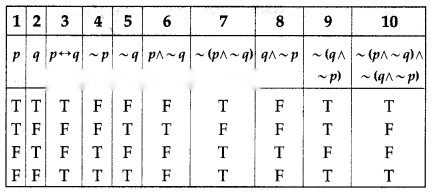
Construct the truth table for each of the following statement patterns: (i) (p ∧ ~q) ↔ (q → p)
Solution & Step-by-Step Answer:
(p ∧ ~q) ↔ (q → p)
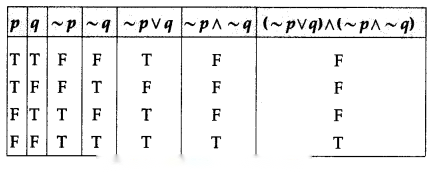
(ii) (~p ∨ q) ∧ (~p ∧ ~q)
(iii) (p ∧ r) → (p ∨ ~q)
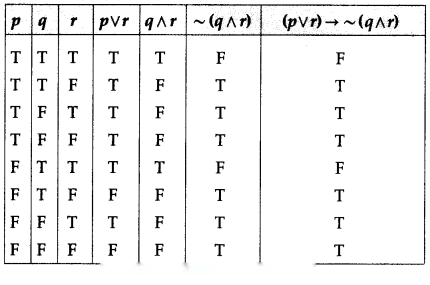
(iv) (p ∨ r) → ~(q ∧ r)
(v) (p ∨ ~q) → (r ∧ p)
Question 12
Maharashtra Board Solution
What is a tautology? What is a contradiction? Show that the negation of a tautology is a contradiction and the negation of a contradiction is a tautology.
Solution & Step-by-Step Answer:
Tautology: A statement pattern that has all the entries in the last column of its truth table as T is called a tautology. For example: In the above truth table for the statement p ∨ ~p, we observe that all the entries in the last column are T. Hence, the statement p ∨ ~p is a tautology.
Contradiction: A statement pattern that has all the entries in the last column of its truth table as F is called a contradiction.
To show that the negation of a tautology is a contradiction and vice versa:
Question 13
Maharashtra Board Solution
Determine whether the following statement patterns is a tautology or a contradiction or a contingency: (i) [(p ∧ q) ∨ (~p)] ∨ [p ∧ (~q)]
Solution & Step-by-Step Answer:
[(p ∧ q) ∨ (~p)] ∨ [p ∧ (~q)] All the entries in the last column of the above truth table are T. ∴ [(p ∧ q) ∨ (~p)] ∨ [p ∧ (~q)] is a tautology.
(ii) [(~p ∧ q) ∧ (q ∧ r)] ∨ (~q)
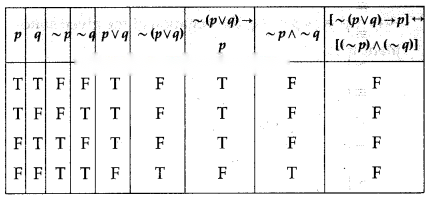
(iii) [~(p ∨ q) → p] ↔ [(~p) ∧ (~q)]
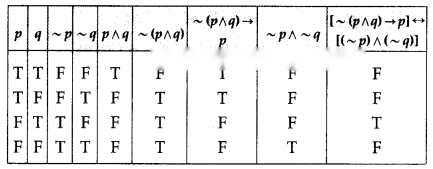
(iv) [~(p ∧ q) → p] ↔ [(~p) ∧ (~q)]
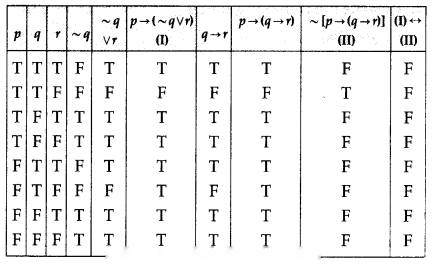
(v) [p → (~q ∨ r)] ↔ ~[p → (q → r)]
Question 14
Maharashtra Board Solution
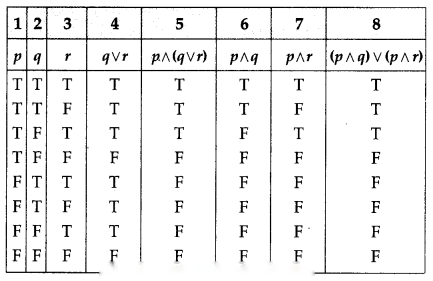
Using the truth table, prove the following logical equivalences: (i) p ∧ (q ∨ r) ≡ (p ∧ q) ∨ (p ∧ r)
Solution & Step-by-Step Answer:
p ∧ (q ∨ r) ≡ (p ∧ q) ∨ (p ∧ r) The entries in columns 5 and 8 are identical. ∴ p ∧ (q ∨ r) ≡ (p ∧ q) ∨ (p ∧ r)
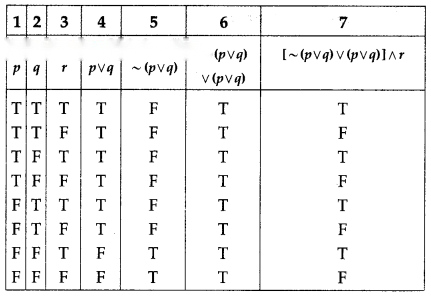
(ii) [~(p ∨ q) ∨ (p ∨ q)] ∧ r ≡ r
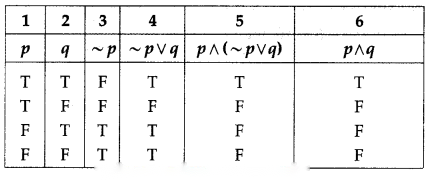
(iii) p ∧ (~p ∨ q) ≡ p ∧ q
(iv) p ↔ q ≡ ~(p ∧ ~q) ∧ ~(q ∧ ~p)
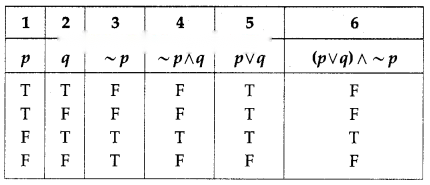
(v) ~p ∧ q ≡ (p ∨ q) ∧ ~p
Question 15
Maharashtra Board Solution
Write the converse, inverse, contrapositive of the following statements: (i) If 2 + 5 = 10, then 4 + 10 = 20.
Solution & Step-by-Step Answer:
Let p : 2 + 5 = 10. q : 4 + 10 = 20. Then the symbolic form of the given statement is p → q. Converse: q → p is the converse of p → q i.e. If 4 + 10 = 20, then 2 + 5 = 10. Inverse: ~p → ~q is the inverse of p → q i.e. If 2 + 5 ≠ 10, then 4 + 10 ≠ 20. Cotrapositive: ~q → ~p is the contrapositive of p → q, i.e. If 4 +10 ≠ 20, then 2 + 5 ≠ 10.
(ii) If a man is a bachelor, then he is happy. (iii) If I do not work hard, then I do not prosper.
Question 16
Maharashtra Board Solution
State the dual of each of the following statements by applying the principle of duality: (i) (p ∧ ~q) ∨ (~p ∧ q) ≡ (p ∨ q) ∧ ~(p ∧ q) (ii) p ∨ (q ∨ r) ≡ ~[(p ∧ q) ∨ (r ∨ s)] (iii) 2 is an even number or 9 is a perfect square.
Solution & Step-by-Step Answer:
The duals are given by: (i) (p ∨ ~q) ∧ (~p ∨ q) ≡ (p ∧ q) ∨ ~(p ∨ q) (ii) p ∧ (q ∧ r) ≡ ~[(p ∨ q) ∧ (r ∧ s)] (iii) 2 is an even number and 9 is a perfect square.
Question 17
Maharashtra Board Solution
Rewrite the following statements without using the connective ‘If … then’: (i) If a quadrilateral is a rhombus, then it is not a square. (ii) If 10 – 3 = 7, then 10 × 3 ≠ 30. (iii) If it rains, then the principal declares a holiday.
Solution & Step-by-Step Answer:
Since, p → q ≡ ~p ∨ q the given statements can be written as: (i) A quadrilateral is not a rhombus or it is not a square. (ii) 10 – 3 ≠ 7 or 10 × 3 ≠ 30. (iii) It does not rain or the principal declares a holiday.
Question 18
Maharashtra Board Solution
Write the dual of each of the following: (i) (~p ∧ q) ∨ (p ∧ ~q) ∨ (~p ∧ ~q) (ii) (p ∧ q) ∧ r ≡ p ∧ (q ∧ r) (iii) p ∨ (q ∧ r) ≡ (p ∨ q) ∧ (p ∨ r) (iv) ~(p ∨ q) ≡ ~p ∧ ~q.
Solution & Step-by-Step Answer:
The duals are given by: (i) (~p ∨ q) ∧ (p ∨ ~q) ∧ (~p ∨ ~q) (ii) (p ∨ q) ∨ r ≡ p ∨ (q ∨ r) (iii) p ∧ (q ∨ r) ≡ (p ∧ q) ∨ (p ∧ r) (iv) ~(p ∧ q) ≡ ~p ∧ ~q
Question 19
Maharashtra Board Solution
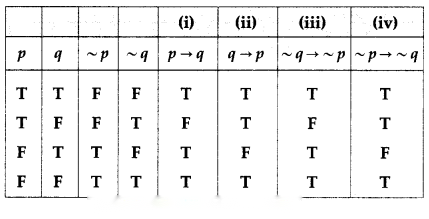
Consider the following statements: (i) If D is a dog, then D is very good. (ii) If D is very good, then D is a dog. (iii) If D is not very good, then D is not a dog. (iv) If D is not a dog, then D is not very good. Identify the pairs of statements having the same meaning. Justify.
Solution & Step-by-Step Answer:
Let p : D is a dog. and q : D is very good. Then the given statements in the symbolic form are: (i) p → q (ii) q → p (iii) ~q → ~p (iv) ~p → ~q The entries in columns (i) and (iii) are identical. Hence, these statements are equivalent. ∴ the statements (i) and (iii) have the same meaning. Similarly, the entries in columns (ii) and (iv) are identical. Hence, these statements are equivalent. ∴ the statements (ii) and (iv) have the same meaning.
Question 20
Maharashtra Board Solution
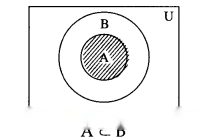
Express the truth of each of the following statements by Venn diagrams: (i) All men are mortal.
Solution & Step-by-Step Answer:
Let U : a set of all human being A : set of all men B : set of all mortals. Then the Venn diagram represents the truth of the given statement is as below:
(ii) Some persons are not politicians.
(iii) Some members of the present Indian cricket are not committed.
(iv) No child is an adult.
Question 21
Maharashtra Board Solution
If A = {2, 3, 4, 5, 6, 7, 8}, determine the truth value of each of the following statements: (i) ∃ x ∈ A, such that 3x + 2 > 9.
Solution & Step-by-Step Answer:
Clearly x = 3, 4, 5, 6, 7, 8 ∈ A satisfy 3x + 2 > 9. So, the given statement is true, hence its truth value is T.
(ii) ∀x ∈ A, x2< 18. (iii) ∃x ∈ A, such that x + 3 < 11. (iv) ∀x ∈ A, x2+ 2 ≥ 5.
Question 22
Maharashtra Board Solution
Write the negations of the following statements: (i) 7 is a prime number and the Taj Mahal is in Agra.
Solution & Step-by-Step Answer:
Let p : 7 be a prime number. q : Taj Mahal is in Agra. Then the symbolic form of the given statement is p ∧ q. Since, (p ∧ q) ≡ ~p ∨ ~q, the negation of the given statement is: ‘7 is not a prime number or Taj Mahal is not in Agra.’
(ii) 10 > 5 and 3 < 8. (iii) I will have tea or coffee. (iv) ∀n ∈ N, n + 3 > 9. (v) ∃x ∈ A, such that x + 5 < 11. |