Balbharati Maharashtra State Board12th Commerce Maths Solution Book PdfChapter 2 Matrices Ex 2.1 Questions and Answers.
Maharashtra State Board 12th Commerce Maths Solutions Chapter 2 Matrices Ex 2.1
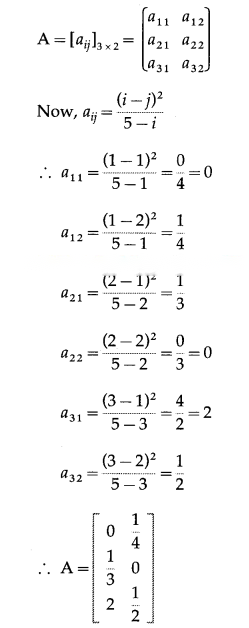
(ii) aij= i – 3j
Solution:
aij= i – 3j
∴ a11= 1 – 3(1) = 1 – 3 = -2
a12= 1 – 3(2) = 1 – 6 = -5
a21= 2 – 3(1) = 2 – 3 = -1
a22= 2 – 3(2) = 2 – 6 = -4
a31= 3 – 3(1) = 3 – 3 = 0
a32= 3 – 3(2) = 3 – 6 = -3
∴ A = ≤ft[{array}{cc}
-2 & -5 \\
-1 & -4 \\
0 & -3
{array}
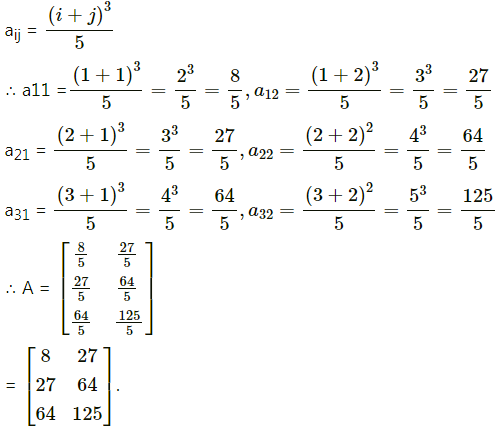
(iii) aij=
Solution:

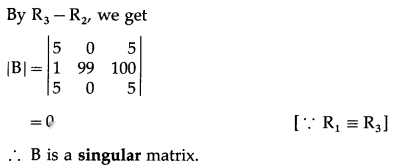
(ii) ≤ft[{array}{ccc}
5 & 0 & 5 \\
1 & 99 & 100 \\
6 & 99 & 105
{array}
Solution:

(iii) ≤ft[{array}{ccc}
3 & 5 & 7 \\
-2 & 1 & 4 \\
3 & 2 & 5
{array}
Solution:
Let C = ≤ft[{array}{ccc}
3 & 5 & 7 \\
-2 & 1 & 4 \\
3 & 2 & 5
{array}
∴ |C| = ≤ft|{array}{rrr}
3 & 5 & 7 \\
-2 & 1 & 4 \\
3 & 2 & 5
{array}
= 3(5 – 8) – 5(-10 – 12) + 7(-4 – 3)
= -9 + 110 – 49
= 52 ≠ 0
∴ C is a non-singular matrix.
(iv) ≤ft[{array}{cc}
7 & 5 \\
-4 & 7
{array}
Solution:
Let D = ≤ft[{array}{cc}
7 & 5 \\
-4 & 7
{array}
∴ |D| = ≤ft|{array}{rr}
7 & 5 \\
-4 & 7
{array}
= 49 – (-20)
= 69 ≠ 0
∴ D is a non-singular matrix.
(ii) ≤ft[{array}{ccc}
4 & 3 & 1 \\
7 & ~K & 1 \\
10 & 9 & 1
{array}
Solution:
Let B = ≤ft[{array}{ccc}
4 & 3 & 1 \\
7 & ~K & 1 \\
10 & 9 & 1
{array}
Since, B is a singular matrix, |B| = 0
∴ ≤ft|{array}{rrr}
4 & 3 & 1 \\
7 & k & 1 \\
10 & 9 & 1
{array} = 0
∴ 4(k – 9) – 3(7 – 10) + 1(63 – 10k) = 0
∴ 4k – 36 + 9 + 63 – 10k = 0
∴ -6k + 36 = 0
∴ 6k = 36
∴ k = 6.
(iii) ≤ft[{array}{ccc}
K-1 & 2 & 3 \\
3 & 1 & 2 \\
1 & -2 & 4
{array}
Solution:
Let C = ≤ft[{array}{ccc}
K-1 & 2 & 3 \\
3 & 1 & 2 \\
1 & -2 & 4
{array}
Since, C is a singular matrix, |C| = 0
∴ ≤ft|{array}{crr}
k-1 & 2 & 3 \\
3 & 1 & 2 \\
1 & -2 & 4
{array} = 0
∴ (k – 1)(4 + 4) – 2(12 – 2) + 3(-6 – 1) = 0
∴ 8k – 8 – 20 – 21 = 0
∴ 8k = 49
∴ k =