Latest Maharashtra State Board (SSC & HSC) 2026-27 Syllabus Digest & Solutions Updated!
Class 12 (HSC Board)Economics2026-27 Syllabus

Chapter 2 Utility Analysis Solutions

Complete Maharashtra State Board Balbharati & Yuvakbharati textbook solutions for Chapter 2 Utility Analysis. Step-by-step solved exercises, numerical problems, and digest answers.

13 Solved Questions4 Diagrams1884 words

Maharashtra State Board Class 12 Economics Solutions Chapter 2 Utility Analysis

1. Complete the following statements by choosing the correct alternatives.

Question 1 Maharashtra Board Solution
In the law of diminishing marginal utility, Alfred Marshall assumes that marginal utility of money ………….. (a) increases (b) remains constant (c) decreases (d) rises and then falls
Solution & Step-by-Step Answer:
(b) remains constant
Question 2 Maharashtra Board Solution
As per the law of diminishing marginal utility, measurement of utility is assumed to be …………… (a) ordinal (b) cardinal (c) both ordinal and cardinal (d) none of the above
Solution & Step-by-Step Answer:
(b) cardinal
Question 3 Maharashtra Board Solution
MU of the commodity becomes negative when TU of a commodity is …………. (a) rising (b) constant (c) falling (d) zero
Solution & Step-by-Step Answer:
(c) falling
Question 4 Maharashtra Board Solution
Point of satiety means ………………. (a) TU is rising and MU is falling (b) TU is falling and MU is negative (c) TU is maximum and MU is zero (d) MU is falling and TU is rising
Solution & Step-by-Step Answer:
(c) TU is maximum and MU is zero
Question 5 Maharashtra Board Solution
When MU is falling, TU is ……………… (a) rising (b) falling (c) not changing (d) maximum
Solution & Step-by-Step Answer:
(a) rising

2. Choose the correct option:

Question 1 Maharashtra Board Solution

Group ‘A’

Group ‘B’

1. Time utility

(a)

Transportation

2. Place utility

(b)

Blood bank

3. Service utility

(c)

Mobile phone

4. Knowledge utility

(d)

Doctor

(e)

Music

Options :
(1) 1 – d, 2 – b, 3 – a, 4 – c.
(2) 1 – b, 2 – a, 3 – d, 4 – c.
(3) 1 – a, 2 – b, 3 – e, 4 – d.
(4) 1 – b, 2 – c, 3 – d, 4 – e.

Solution & Step-by-Step Answer:

(2) 1 – b, 2 – a, 3 – d, 4 – c.

Question 2 Maharashtra Board Solution
Statments Indicating consumer equilibrium: a) MU is greater than price b) MU is equal to price c) MU is less than price d) Price is less than one Options: I) a and b II) a, b,c and d Ill) a,b and c IV) only b
Solution & Step-by-Step Answer:
IV) only b

3. Identify and explain the concept from the given illustrations.

Question 1 Maharashtra Board Solution
Salma purchased sweater for her father in winter season.
Solution & Step-by-Step Answer:
Concept: Time utility. Explanation : When utility of a commodity increases during a particular season it is called time utility. Utility of sweater increases in winter season.
Question 2 Maharashtra Board Solution
Nilesh purchased ornaments for his sister.
Solution & Step-by-Step Answer:
Concept: Possession utility. Explanation : When the ownership of a product changes from seller to buyer, it is called possession utility. In the given example, ornaments are purchased by Nilesh for his sister. Ownership of a product changed, so it is an example of possession utility.
Question 3 Maharashtra Board Solution
Kavita consumed five units of oranges one after the other.
Solution & Step-by-Step Answer:
Concept: Successive consumption. Explanation : To experience the law of DMU, there should be consumption of units of commodity, without time gap. It is called successive consumption. The given example explains that five oranges are consumed by Kavita one after another without interval of time.
Question 4 Maharashtra Board Solution
Bhushan refused to eat fifth chapati after eating four chapatis.
Solution & Step-by-Step Answer:
Concept: Disutility. Explanation : When the want is fully satisfied, a consumer realises full satisfaction i.e. point of satiety. But, beyond this point, he experiences negative utility. So, he refuses to consume any more unit of commodity. If consumption continues, it results into disutility.
Question 5 Maharashtra Board Solution
Lalita satisfied her want of writing on essay by using pen and notebook.
Solution & Step-by-Step Answer:
Concept: Utility. Explanation : Utility is want satisfying capacity of a commodity.

The given example explains that, Lalita’s want of writing an essay can be satisfied with the help of pen and note-book.

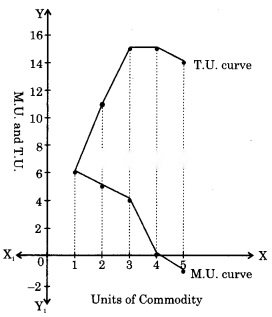
4. Observe the given table and answer the questions:

Units of Com. ‘X’

TU Units

MU Units

1

6

6

2

11

5

3

15

4

4

15

0

5

14

-1

1) Draw total utility curve and marginal utility curve.
2) a) When total utility is maximum marginal utility is …………….
b) When total utility falls, marginal utility becomes ……………
Answers:
1.

2. Zero
3. Negative

5. Answer in detail:

Question 1 Maharashtra Board Solution
State and explain the law of diminishing margmal utility with exceptions. OR State and explain the law of DMU? Explain its assumptions.
Solution & Step-by-Step Answer:
Law of Diminishing Marginal Utility : (A) Introduction: The law of diminishing M.U. explains economic behaviour of a rational consumer. The law was first proposed by Prof. Gossen and further explained in detail by Prof. Alfred Marshall in his book “Principles of J economics” published in 1890. The law of DMU is universal in nature. It ) indicates common consumer’s behaviour that Marginal Utility diminishes with reduction in the intensity of want.

(B) Statement of the Law :
According to Prof. Alfred Marshall, “Other things remaining constant, the additional benefit which a person derives from a given increase in his stock of a thing, diminishes with every increase in the stock that he already has”.
In simple words, law of DMU can be stated as follows :
“Other things being the same, MU goes on ) diminishing with every successive unit of a j commodity consumed.”

Thus, the law of DMU explains that, the more of a thing you have, the less you want to have more of it.
In short, as consumption of identical units of commodity increases, MU diminishes.

(C) Assumptions of the law of DMU :
Assumptions are those conditions which are necessary for the validity of the law. They are as follows :

Units of Commodity

Marginal Utility (M.U)

1

10

2

8

3

6

4

4

5

2

6

0

7

-2

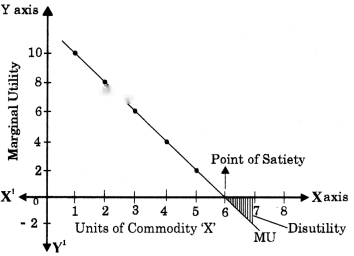
The above given schedule shows that MU goes on diminishing with an increases in units of commodity consumed.
Graphical Presentation :

In the above given diagram, X-axis indicates units of commodity and Y-axis measures marginal utility.
Various points are plotted on the graph which indicates MU derived from each unit } of commodity consumed.
When all these point are joined, we get MU curve. It slopes downward from left to right. It shows that MU diminishes as consumption of a commodity increases.
The shaded portion of the diagram shows negative utility. It is because, beyond a certain level, further consumption of a commodity results into disutility.

(E) Exceptions to the law of Diminishing M.U.
Exceptions are those cases for which the law is not applicable. They are as follows :

They are explained as under :
(1) Hobbies : The law of DMU is not applicable in case of collection of stamps, coins, rare paintings, etc. It is because, when its stock increases, M.U. may increases because it gives more and more satisfaction.
However, it violates the assumptions like homogeneity and continuity.

(2) Miser : For a miser, every additional rupee gives him more and more pleasure.
So, when the stock of money increases, MU of money tends to rise.
However, the behavior of a miser is irrational. It violates the assumption of rationality.

(3) Addictions : It is said that, the level of intoxication increases for drunkard with every additional consumption of liquor. It may increase MU for him.
This condition is similar to most of the addictions.
Here again, the assumptions like rationality and continuity are violated.

(4) Power: It is an exception to the law of DMU because, when a person acquires power, his craze for power increases MU from power. As a person gets power, he desires to have more and more of it.
But, it violates the rationality, assumption.

(5) Money : Money is used as a medium of exchange. It helps to buy goods to satisfy human want. So MU of money increases with an increase in its stock.
MU of money never becomes zero. The law holds true to money too. MU of money declines slowly as its stock increases. So MU of money is more for poor than rich people.

(6) Reading : When a person reads more and more, he gets deeper and deeper knowledge so MU of reading tends to increase. Similarly the law does not hold true in case of music, dance, etc.
However, assumptions like continuity, homogeneity, etc. are violated.
The law of DMU is universal in nature. These cases are not real exceptions as they violate some assumptions.
So, it is said that, there are no real exceptions to the law of DMU.

Intect Questions

Try this (Textbook Page 8)

Make a list of 10 commodities which satisfy your wants.
Answer:
Book, pen, mobile, foot-wear, watch, umbrella, bag, dress, bed sheet, soap.

Try this (Textbook Page 8)

Make a list of 10 commodities which ( satisfy the wants of particular individuals performing specific activities. For example, A chalk has utility for a teacher.
Answer:

Try this (Textbook Page 10) :

Following are the various types of utility and their respective examples. Arrange the information in the form of pairs:
Answer:
Types of utility : Time utility, possession utility, service utility and place utility.
Examples :

Example

Type of Utility

(a) A dentist giving dental treatment to a patient.

Service utility

(b) A mountaineer using oxygen cylinder at a high altitude.

Place utility

(c) A farmer selling rice stored in the warehouse at the end of the season

Time utility

(d) A retail trader purchasing 100 chairs from the wholesale trader.

Possession utility

Try this (Textbook Page 11)

Complete the following chart :
Answer:
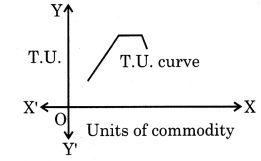
Total Utility :

(a) Total Utility is the sum total of the individual utilities derived from the consumption of all units of good.
(b) Total Utility increases at a diminishing rate.
(c) At a point of satiety, Total Utility is maximum.
(d) Total Utility declines if consumption continues.
(e) Total Utility determines value-in-use of a commodity.
(f) Total Utility is always positive.

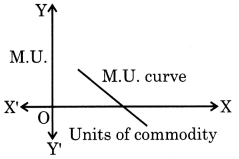
Marginal Utility :
(a) Marginal Utility is the addition made to the Total Utility from every additional unit consumed.
(b) Marginal Utility goes an diminishing.
(c) At a point of satiety, Marginal Utility = 0
(d) Marginal Utility becomes negative if consumption continues.
(e) Marginal Utility determines value-in­exchange of a commodity.
(f) Marginal Utility can be positive, zero or negative.

Try this (Textbook Page 14) :

Write an informative note on the paradox of values along with examples.
Answer:
The paradox of values –
The concept of value paradox is introduced by Adam Smith.
The term value has two meanings
(i) Value in use
(ii) Value in exchange
Some goods have greater value in use but the smaller value in exchange e.g. water.
However, some goods have smaller value in use but a greater value in exchange e.g. diamond.
So, the paradox of value is also called a water-diamond dilemma.
Greater value in use denotes high total utility whereas, greater value in exchange shows high marginal utility.
Thus, the concept paradox of value is very useful to understand the concepts of utility i.e., Total Utility & Marginal Utility.